
Test 7 of 10 · 20 questions · Free 2026
KS Permit Practice Test 7
Jump to the test ↓A fixed 20 question set from the Kansas bank with answers and plain English explanations. The real KS exam is 25 questions, 80 percent to pass; take the full length version on the main practice page.
Question 1 of 20 · 0 right so far
All 20 questions in test 7
Every question below comes from the Kansas question bank on this page. Open a question to see the correct answer and the explanation. Nothing here is hidden behind a signup.
1. Before emerging from an alley or driveway in a business or residential district, where must a driver stop?
- After crossing the sidewalk
- Immediately before driving onto the sidewalk or sidewalk area
- Only at the edge of the roadway
- Only when a pedestrian is visible
Show answer
Immediately before driving onto the sidewalk or sidewalk area. Kansas requires a driver emerging from an alley, driveway, or building in a business or residential district to stop immediately before driving onto the sidewalk or the sidewalk area extending across the entrance. After stopping, the driver must yield the right-of-way. Waiting until after the sidewalk puts the vehicle into the pedestrian space too soon. The roadway-edge choice moves the required stop farther forward, and the pedestrian condition is too narrow because the stop is required before crossing the sidewalk area. Treat the sidewalk as the first boundary to protect, then check pedestrians and traffic.
Study this in the handbook: Right of way at intersections
2. Your car breaks down on the highway. Where should you place emergency flares?
- Directly beside the driver's door
- About 20 to 30 feet behind the vehicle
- About 200 to 300 feet behind the vehicle
- About a mile behind the vehicle
Show answer
About 200 to 300 feet behind the vehicle. Flares go about 200 to 300 feet behind the disabled vehicle, which gives approaching drivers time to change lanes. Beside the door or 20 to 30 feet back gives almost no warning at highway speed. A mile is far beyond the handbook's figure and would separate the warning from the hazard. Stay off the roadway, and use a white cloth or raised hood to show the vehicle is disabled.
Study this in the handbook: Emergency braking, skids and vehicle failures
3. What does an orange and red triangle on the back of farm or construction equipment tell you?
- The vehicle is carrying hazardous materials
- The vehicle is traveling less than 25 mph
- The vehicle may exceed 45 mph
- The vehicle is stopped and will not move
Show answer
The vehicle is traveling less than 25 mph. A fluorescent or reflective orange and red triangle marks a slow moving vehicle, such as farm equipment, construction equipment, or an animal drawn vehicle, traveling less than 25 mph. It is not a hazardous materials marking. The vehicle is moving, just slowly, so plan for a large speed difference and pass only when it is safe. The 45 mph choice reverses the meaning, since the emblem warns of low speed. Treat it with caution, especially in rural areas.
Study this in the handbook: Pedestrians, bicycles, motorcycles and trucks
4. Someone has had four normal drinks. According to the Kansas handbook, how long should they wait before driving?
- One hour
- Two hours
- Until they have had coffee and a meal
- Four hours or more
Show answer
Four hours or more. The body needs about an hour to get rid of one normal drink, so four drinks call for waiting four hours or more. One or two hours covers only one or two drinks. Coffee, fresh air, cold showers, and eating do not remove alcohol, and the handbook calls time the only medically proven method. Even then, the safest choice is not to drive at all after drinking.
Study this in the handbook: How alcohol and drugs affect driving
5. A Kansas child aged 4 through 8 may use a seat belt instead of a child safety or booster seat when the child is:
- Taller than 4 feet 9 inches or weighs more than 80 pounds
- At least 4 feet tall, regardless of weight
- Older than 6 years, regardless of height or weight
- Taller than 5 feet or weighs more than 60 pounds
Show answer
Taller than 4 feet 9 inches or weighs more than 80 pounds. For children from age 4 through age 8, Kansas requires a federally approved child safety seat or booster seat unless the child is taller than 4 feet 9 inches or weighs more than 80 pounds. Either listed threshold permits the transition to a seat belt. Age alone does not create the exception, so a six-year-old still needs the required restraint if neither physical threshold is met. Check height and weight rather than relying only on the child’s birthday.
Study this in the handbook: Kansas speed limits
6. What should the curved-arrow warning prompt before entering the bend?

- Move across the centerline to make the bend wider
- Brake sharply after entering the curve to hold the lane
- Reduce speed before the curve and maintain control through it
- Accelerate because the arrow guarantees a clear roadway
Show answer
Reduce speed before the curve and maintain control through it. A curve warning gives you time to slow before the bend, when the tires are still aligned and traction demands are lower. Maintain a safe speed through the curve and stay in your lane. Sharp braking after entry can reduce traction, while crossing the centerline or accelerating on the assumption of a clear road increases danger. Read the arrow as advance notice, then use a controlled speed and steady steering to follow the roadway.
Study this in the handbook: Safe speed and stopping distance
7. When must you stop for a school bus that is stopped to pick up or release children?
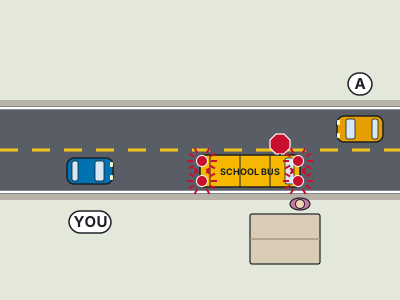
- When meeting or overtaking it, until the stop signal is retracted and red lights are off
- Only when following it on a two-lane road, and only for five seconds
- Only when children are visible in the roadway after leaving the bus
- Only when the bus is in your own lane ahead of you
Show answer
When meeting or overtaking it, until the stop signal is retracted and red lights are off. Kansas requires a driver meeting or overtaking a stopped school bus, church bus, or day care bus that is loading or unloading children to stop. Remain stopped until the stop signal is retracted and the red lights are off. The rule is not limited to five seconds, to visible children, or to traffic behind the bus, because drivers meeting it from the other direction must stop too. The one stated exception is traffic approaching in the opposing roadway of a divided highway, which is why the roadway design must be identified carefully.
Study this in the handbook: School buses and required stops
8. What does the Kansas handbook say may be the safest choice when a deer is suddenly in your path?
- Swerving into the other lane
- Hitting the animal rather than taking drastic action that could cause a worse crash
- Braking hard and turning toward the shoulder
- Speeding up to get past it
Show answer
Hitting the animal rather than taking drastic action that could cause a worse crash. Big game animals, mostly deer, are large enough to damage a vehicle, and their size may tempt a driver to take drastic action. The handbook warns that this can cause a more serious crash than colliding with the animal, so the safest alternative may be hitting the animal. Do not swerve into oncoming traffic or off the roadway, and concentrate on retaining control of the vehicle before, during, and after the collision. Use caution at dawn and dusk and where deer crossing signs are posted.
Study this in the handbook: Night driving, fog and floods
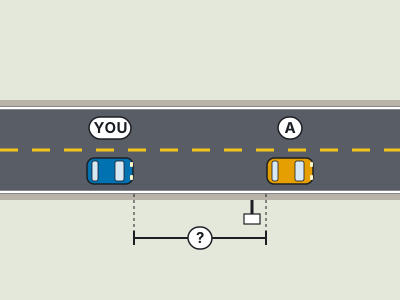
9. What must a driver be able to do by maintaining a reasonable following distance?
- Keep the same gap no matter the weather or road surface
- See only the rear bumper of the vehicle ahead
- Match the lead vehicle's speed within one car length
- Stop or turn to avoid a collision if the vehicle ahead stops suddenly
Show answer
Stop or turn to avoid a collision if the vehicle ahead stops suddenly. Following distance is a space-management tool, not merely a visual preference. Kansas guidance says the gap must leave enough time and room to stop or turn if the vehicle ahead suddenly stops. Weather, pavement, traffic, and the lead vehicle's behavior can all require more space. A one-car-length rule is too small and inflexible. Keep a clear view past the vehicle ahead, watch its brake lights, and enlarge the cushion whenever the road reduces traction or visibility.
Study this in the handbook: Turn signals, U turns and passing
10. A Kansas applicant has now failed the written test four times. What happens next?
- A fifth attempt the next working day
- A permanent ban from testing
- A required driver's education course before any retest
- A wait of at least six months from the most recent failed exam before retesting
Show answer
A wait of at least six months from the most recent failed exam before retesting. Kansas allows four chances at the written test and four at the driving test. After the fourth failure of either one, the applicant must wait a minimum of six months from the most recent failed exam. A fifth try the next day ignores that waiting period, and the ban is not permanent. The handbook sets a waiting period, not a mandatory course, as the consequence.
Study this in the handbook: License tests, renewal and losing your license
11. When parking uphill beside a curb in Kansas, how close should the vehicle be to the curb?
- No more than 24 inches
- No more than 12 inches
- At least 3 feet
- Any distance if hazard lights are on
Show answer
No more than 12 inches. The Kansas parking instructions place the vehicle parallel to and within 12 inches of the curb when parking uphill beside one. The 24-inch and three-foot choices leave too much space, while the option allowing any distance ignores the required positioning. After stopping close to the curb, move slowly forward while turning the wheel sharply away from it, then let the vehicle roll back until the tire touches the curb. That way, if the vehicle starts to roll, it rolls away from traffic. The memory cue is within 12 inches, or one foot.
Study this in the handbook: Where not to park and parking on hills
12. A 16-year-old applies for a Kansas restricted license. How much supervised driving must the applicant have completed?
- 25 hours, including 5 at night
- 40 hours, including 10 at night
- 65 hours, including 15 at night
- 50 hours, including 10 at night
Show answer
50 hours, including 10 at night. A 16-year-old applicant needs 50 hours of supervised driving with 10 of those hours at night, and a parent or guardian signs an affidavit attesting to it. Twenty five hours is the smaller figure required of 15-year-old applicants, who must add the remaining 25 hours later. Forty and 65 hours are not supervised driving figures the handbook uses. The night component is 10 hours, not 5 or 15.
Study this in the handbook: Instruction permit, farm permit and the 15 year old restricted license
13. What does Kansas basic speed law require when road, weather, or vehicle conditions change?
- Always drive exactly at the posted limit
- Never drive faster than is reasonable and prudent under the conditions
- Drive 10 mph below the limit in every rainstorm
- Match the fastest nearby vehicle
Show answer
Never drive faster than is reasonable and prudent under the conditions. Kansas basic speed law requires a driver to stay at or below a speed that is reasonable and prudent under the conditions then existing. The assessment includes the road, weather, vehicle, and the driver's physical condition. A posted limit is not a command to maintain that speed when conditions make it unsafe. The fixed 10 mph reduction is not the handbook's formula, and matching the fastest vehicle substitutes another driver's choice for a safety judgment. Before selecting a speed, scan for hazards and adjust to what the conditions actually allow.
Study this in the handbook: Safe speed and stopping distance
14. How far ahead should a driver search to reduce the chance of a panic stop?
- Only to the rear of the vehicle
- About one second ahead
- At least ten seconds ahead
- Exactly one car length ahead
Show answer
At least ten seconds ahead. The handbook recommends looking at least ten seconds ahead. That forward search reveals slowdowns, stopped traffic, and other developing problems early enough to reduce speed or change lanes smoothly. A one-second glance or a one-car-length view leaves little time to plan, while checking only behind ignores the hazard developing in front. Make the cue practical by keeping your eyes moving well beyond the vehicle immediately ahead, especially on faster roads where ten seconds covers a substantial distance.
Study this in the handbook: Safe speed and stopping distance
15. What must a driver do if a train is crossing a highway-railroad grade crossing?
- Cross quickly before the last car passes
- Drive around the gate if the crossing looks clear
- Wait until the train is well down the track or the devices show it is safe
- Stop on the tracks to watch for another train
Show answer
Wait until the train is well down the track or the devices show it is safe. A driver must wait while a train is crossing until it is well down the track or the crossing lights and gates indicate that it is safe. Driving around a gate is dangerous and unlawful, while racing the last car can leave the vehicle trapped on the tracks. Stopping on the tracks creates an immediate collision hazard. Approach with enough space to clear the crossing, obey the devices, and proceed only when the full route beyond the rails is open.
Study this in the handbook: Railroad crossing signs and safety
16. What does a One-Way sign with an arrow tell drivers?
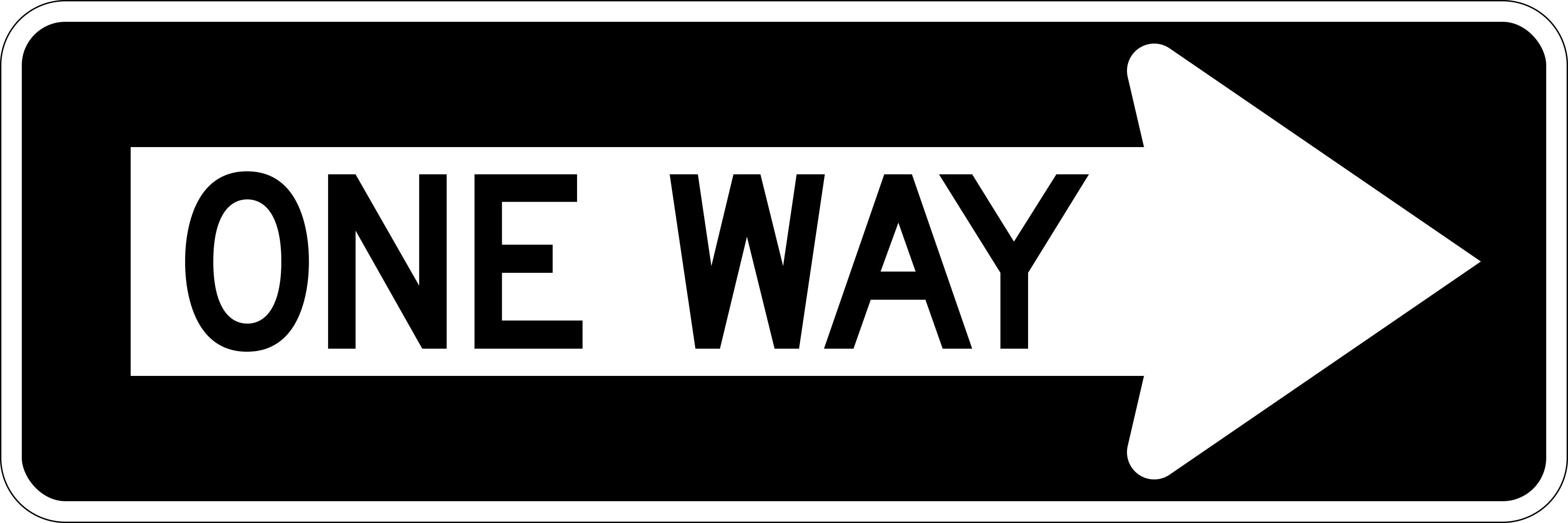
- Traffic flows only in the arrow's direction
- Vehicles may turn opposite the arrow after stopping
- The arrow marks a passing lane for all traffic
- The street changes direction at the next block
Show answer
Traffic flows only in the arrow's direction. A One-Way sign establishes the permitted direction of traffic shown by its arrow. The handbook warns drivers not to turn opposite that direction and never to drive the wrong way on a one-way street. Stopping does not create an exception, and the arrow is not a passing instruction or a promise that direction changes at the next block. Follow the displayed direction until another lawful control changes it.
Study this in the handbook: Regulatory signs
17. At what approximate speed should a driver enter a roundabout or traffic circle?
- About 15 to 20 mph
- About 35 to 40 mph
- The posted highway speed without slowing
- Walking speed in every case
Show answer
About 15 to 20 mph. Entering a roundabout requires negotiating a sharp curve, so the handbook advises slowing to about 15 to 20 mph. That range helps the driver manage the curve, observe circulating traffic, and yield as required. Thirty-five to forty mph and an unchanged highway speed are too fast for the entry geometry. Walking speed is unnecessarily broad and is not the handbook's guidance. Reduce speed before the circle, then keep scanning for vehicles, pedestrians, and bicyclists already in it.
Study this in the handbook: Driveways, yield signs and roundabouts
18. After a Kansas restricted license has been held for six months after age 16, what happens to age-related driving restrictions?
- They change only after a second road test
- They automatically double
- They continue until age 21
- They are removed
Show answer
They are removed. The handbook states that after age 16 and six months holding a restricted license, all age-related driving restrictions are removed. The alternatives invent a longer age endpoint, an increase in restrictions, or an extra testing requirement that the passage does not mention. This rule concerns age-related limits, so it should not be read as cancelling unrelated licensing duties or traffic laws. A useful timeline cue is 16 years of age plus six months on the restricted license, followed by removal of the age-based restrictions.
Study this in the handbook: Restricted license at 16 and the unrestricted license
19. The winding-arrow sign indicates what should guide your driving?

- Expect a railroad gate and stop on the tracks if needed
- Expect one straight section where speed should be increased
- Expect a series of curves and manage speed throughout them
- Expect cross traffic to yield regardless of the intersection layout
Show answer
Expect a series of curves and manage speed throughout them. A winding-road symbol means the roadway will continue changing direction, not that one isolated turn is followed by a straight sprint. Select a manageable speed before the first curve, keep the vehicle in its lane, and continue scanning through the sequence. The sign does not create railroad procedures or alter intersection priority. Smooth control matters because repeated curves can expose a driver who entered too fast and has no comfortable margin left.
20. How close to an intersection or railroad crossing is passing prohibited?
- Within 100 feet
- Within 50 feet
- Within 25 feet
- Within 200 feet
Show answer
Within 100 feet. Kansas lists passing within 100 feet of crossing an intersection or railroad grade crossing as prohibited. The 25- and 50-foot options understate the protected area, while 200 feet belongs to a different rule involving an approaching vehicle and returning to the driving lane with double solid yellow lines. Look ahead for the crossing or intersection before moving left, and wait until the restricted distance has passed and the view is clear.
Study this in the handbook: Turn signals, U turns and passing
QualitySpace is expanding to Kansas
We are a California-based independent insurance brokerage working on licensing in more states. We cannot help with Kansas insurance yet. Leave your email and we will let you know when we can.
Every question is written from the official Kansas Driving Handbook. Need paper? Printable KS practice test with answer key.
Last verified 2026-10-05. How we check every question · Study all 211 as flashcards
Frequently asked questions
How many questions are on this Kansas practice test?
This fixed set has 20 questions. It is test 7 of 10 from the 211 question Kansas bank. The real KS exam asks 25 questions and you need 20 correct.
What is the passing score for the real Kansas test?
You must score an 80% to pass the knowledge test That figure comes from the official Kansas source cited on the DMV facts page.
How does this fixed test relate to the full Kansas bank?
Each numbered test is a fixed set of questions in a fixed order, so you can retake the same test later and compare. Every test mixes road signs and the other topics in about the same proportion as the full bank. Tests 1 to 10 together cover 200 of the 211 questions in the Kansas bank, each once. The full practice page mixes the whole bank at random.
Last verified 2026-10-05. See the Kansas DMV facts page for sourced state details.