
Test 8 of 10 · 20 questions · Free 2026
KS Permit Practice Test 8
Jump to the test ↓A fixed 20 question set from the Kansas bank with answers and plain English explanations. The real KS exam is 25 questions, 80 percent to pass; take the full length version on the main practice page.
Question 1 of 20 · 0 right so far

All 20 questions in test 8
Every question below comes from the Kansas question bank on this page. Open a question to see the correct answer and the explanation. Nothing here is hidden behind a signup.
1. What does the pedestrian crossing warning sign tell a driver to expect?
- People may be crossing the roadway ahead
- Pedestrians are forbidden from entering the road
- A sidewalk repair crew controls the next lane
- Only bicycles may cross at the marked location
Show answer
People may be crossing the roadway ahead. The walking person identifies a pedestrian crossing warning, so drivers should expect people near or crossing the roadway ahead. Kansas lists pedestrian crossings among warning signs that may use fluorescent yellow, distinguishing them from regulatory signs that impose a prohibition. The sign does not forbid pedestrians, reserve the crossing for bicycles, or announce a work crew. Ease off the accelerator, scan both sides of the road, and prepare to yield as the crossing comes into view. Advance attention gives you time to stop smoothly if someone enters the path.
Study this in the handbook: Traffic lights and arrows
2. What precaution is most appropriate after seeing the pictured skidding-car warning?

- Reduce speed and be prepared for a slippery roadway
- Increase speed so the tires spend less time on the pavement
- Brake hard while turning to test the available traction
- Follow the vehicle ahead more closely for guidance
Show answer
Reduce speed and be prepared for a slippery roadway. The skidding-car symbol warns that the roadway may lose traction, especially when wet. Reduce speed early, leave extra stopping space, and make steering and braking inputs smooth. Accelerating, hard braking in a turn, or tailgating can make a slide harder to control. The sign is an advance warning rather than proof that the pavement is already impassable. Use the cue to lower risk before the surface or weather forces an abrupt response.
Study this in the handbook: Safe speed and stopping distance
3. What should a driver do when entering a Kansas work zone?
- Use the shoulder to avoid cones and barriers
- Maintain speed unless a worker steps into the lane
- Follow the vehicle ahead closely to pass the zone sooner
- Reduce speed and be prepared to stop suddenly
Show answer
Reduce speed and be prepared to stop suddenly. Work zones can contain workers, changing lanes, temporary controls, and suddenly reduced space. The handbook tells drivers to reduce speed and be prepared for a sudden stop, while also warning against tailgating. Maintaining speed gives less time to react, close following removes a useful safety margin, and using the shoulder can enter an area reserved for workers or equipment. Treat orange signs and barriers as an immediate change in conditions: slow before the first cone and keep extra room ahead.
Study this in the handbook: Kansas speed limits
4. An emergency vehicle is stopped on the shoulder with its emergency lights on. Within what distance of it is passing prohibited?
- Within 25 feet of it
- Within 100 feet of it
- Within 50 feet of it
- Within 500 feet of it
Show answer
Within 100 feet of it. Kansas lists passing within 100 feet of an emergency vehicle stopped at the side of the roadway with its emergency lights on as a no passing situation. Twenty five and 50 feet understate it. Five hundred feet is the distance to stay behind a moving emergency vehicle after it passes you, a different rule. On a road with two or more lanes in each direction, you also move out of the lane next to the stopped vehicle when you can.
Study this in the handbook: Turn signals, U turns and passing
5. Driving without an adult, a 15-year-old with a Kansas restricted license heads to school. Which school trip is allowed?
- Any school activity, including evening games and practices
- Directly between home and school to attend classes on days school is in session
- Any trip to a school building before 9 p.m.
- School trips only when a sibling rides along
Show answer
Directly between home and school to attend classes on days school is in session. At 15, the restricted license covers a direct trip between home and school for attendance on days school is in session, and the handbook adds that school activities are not included. That rules out games and practices, which only become allowed trips at the 16-year-old stage. The 9 p.m. figure belongs to the 16-year-old time window, not the 15-year-old rules. Having a sibling in the car does not change the purpose limit.
Study this in the handbook: Restricted license at 16 and the unrestricted license
6. What vision standard must a Kansas license applicant meet?
- 20/20 in both eyes
- 20/40 in both eyes without lenses
- 20/70 in the better eye
- At least 20/40 in at least one eye, with or without corrective lenses
Show answer
At least 20/40 in at least one eye, with or without corrective lenses. Kansas requires at least 20/40 vision in at least one eye, and glasses or contacts may be used to meet it. Both 20/20 and a two eye requirement set a stricter standard than the handbook does, and barring lenses contradicts it. The 20/70 figure is weaker than the 20/40 minimum. A driver who needs lenses to pass gets a corrective lens restriction and must wear them any time they drive.
Study this in the handbook: Fatigue, distractions and driver responsibility
7. What does a solid white line between lanes of traffic generally require?
- Stop before reaching the line at every intersection
- Cross whenever the driver wants to pass a slower vehicle
- Use the lane only for emergency vehicles
- Stay within the lane unless a special situation requires a lane change
Show answer
Stay within the lane unless a special situation requires a lane change. A solid white lane line generally means the driver must remain in the lane unless a special situation requires changing it. It is different from a dashed white line, which permits crossing when a safe gap is available. The passing choice treats the marking as unrestricted, while the emergency-only choice invents a use that the pavement marking does not establish. The intersection choice confuses a lane boundary with a stop line. Look for the line pattern before moving laterally, and check whether traffic, a turn, or an unusual hazard creates the special condition described by the handbook.
Study this in the handbook: Work zone, guide and incident signs
8. How many traffic-law and sign questions must an applicant answer on the Kansas knowledge test?
- 15
- 35
- 25
- 50
Show answer
25. The Kansas knowledge test requires 25 questions. The handbook says those questions cover traffic laws and identification of signs by shape, color, or symbol, and its testing section describes them as multiple choice questions important to the safe operation of a motor vehicle. Neither 15 nor 35 is the handbook figure, and 50 is the supervised driving hour requirement for some young drivers. A useful study cue is to connect 25 with the written knowledge test, then keep 50 associated with practice driving rather than test questions. The exam may be taken at a license office or online.
Study this in the handbook: Restricted license at 16 and the unrestricted license
9. What type of suspension follows a failure to maintain continuous liability insurance in Kansas?
- A warning with no license action
- A suspension lasting exactly 30 days
- A mandatory indefinite suspension
- A suspension only after three moving violations
Show answer
A mandatory indefinite suspension. The handbook lists failure to maintain continuous liability insurance as a mandatory indefinite suspension. Indefinite means the listed consequence has no fixed end date in the statement, so a 30-day period is too specific and unsupported. A warning alone ignores the licensing action, while the moving-violation condition belongs to a separate suspension ground. Keep insurance compliance separate from ordinary traffic penalties: the manual treats an insurance lapse as its own direct trigger. Drivers should preserve continuous coverage and respond promptly to any proof-of-insurance issue.
Study this in the handbook: License tests, renewal and losing your license
10. For a first alcohol violation conviction, which additional device does the Kansas handbook say a driver will be required to use?
- An ignition interlock device
- A passenger-side brake pedal
- A vehicle tracking beacon
- A permanently installed breathalyzer at home
Show answer
An ignition interlock device. The handbook says a driver convicted of an alcohol violation for the first time will be required to drive with an ignition interlock device. That device is connected to vehicle operation, unlike a passenger brake pedal or a home breathalyzer, neither of which the passage names. A tracking beacon is also a different technology and is not the stated consequence. The same paragraph mentions fines, court costs, and either jail or community service, so this device requirement belongs to a broader first-conviction penalty package. Study the device name exactly: ignition interlock.
Study this in the handbook: How alcohol and drugs affect driving
11. When a green arrow permits a turn, what must the driver still watch for?
- A requirement to wait for a second green signal
- No one, because the arrow removes every yielding duty
- Only vehicles approaching from behind
- Pedestrians crossing in front of or beside the vehicle
Show answer
Pedestrians crossing in front of or beside the vehicle. A green arrow authorizes movement in the arrow's direction when the intersection is clear, but it does not make the path automatically empty. The handbook specifically tells turning drivers to watch for pedestrians crossing in front or from the side. Other roadway users may also be present, including someone turning right on red. Keep the turn controlled, check both sides of the crosswalk, and be prepared to yield or stop if a person has entered your path.
Study this in the handbook: Traffic lights and arrows
12. Where does the Kansas handbook say to find the recommended tire pressure?
- In the owner's manual or on the driver's side door jamb
- On the tire sidewall only
- At the gas station pump
- On the registration
Show answer
In the owner's manual or on the driver's side door jamb. Before entering the vehicle, tires should be checked for proper inflation, tread depth and condition. To check pressure, use the recommended psi located in the vehicle owner's manual or on the driver's side door jamb, and measure it with a tire pressure gauge. If the reading is above the listed number let air out, and if below add air, or have a tire professional help you. The handbook names only those two sources for the recommended number, so the tire itself, the pump, and the registration are not where you look.
13. When following a motorcycle, what minimum interval should a driver allow in normal conditions?
- One second because motorcycles stop quickly
- Three to four seconds or more
- One car length at every speed
- No gap if the motorcycle is using its headlight
Show answer
Three to four seconds or more. Motorcycles can stop quickly, and the handbook warns that following too closely endangers your life and that of the motorcyclist. The handbook recommends a three to four second following distance, with additional room in wet conditions. That space provides time to recognize a stop, brake without an abrupt maneuver, and account for a motorcycle's smaller profile. A single car length changes meaning with speed and is not a reliable measure. Look through the motorcycle's path, keep your attention forward, and avoid crowding the rider.
Study this in the handbook: Pedestrians, bicycles, motorcycles and trucks
14. What can white arrows on the roadway indicate?
- The legal weight limit for each lane
- The distance to the nearest emergency vehicle
- Which way traffic is flowing and which turns may be made from lanes
- That every lane change is required before the next intersection
Show answer
Which way traffic is flowing and which turns may be made from lanes. White arrows painted on the roadway can show the direction of traffic flow and indicate which turns may be made from particular lanes. They guide lane selection before an intersection, but they do not measure emergency response distance or establish a vehicle's weight limit. The choice “That every lane change is required before the next intersection” turns guidance into a mandatory lane change, which the marking does not say. Read the arrow together with lane lines, signs, and signal indications. Position the vehicle in the lane that matches the permitted movement, then follow the intersection control and check for other road users.
Study this in the handbook: Work zone, guide and incident signs
15. What does the Kansas handbook say about a flooded road ahead?
- Cross only if the water looks calm
- Drive through slowly in low gear
- Follow a larger vehicle across
- Do not drive through flooded areas
Show answer
Do not drive through flooded areas. Flash floods can come rapidly and unexpectedly, within minutes or hours of heavy rain, on roads, bridges and low areas. The handbook says do not drive through flooded areas, and if you see a flooded roadway ahead, turn around and find another route. Even water that appears shallow can hide dips, and floodwaters can wash away the road surface underneath. Six inches of water reaches the bottom of most passenger cars, and 2 feet of rushing water can carry away most vehicles. If there is no other route, go to higher ground and wait.
Study this in the handbook: Night driving, fog and floods
16. When is the reduced speed on a School Speed Limit When Flashing sign required?
- Only while the sign is flashing
- At all times near the school
- Only after a crossing guard enters the road
- Only during evening hours
Show answer
Only while the sign is flashing. The school-zone reduction applies only when the School Speed Limit When Flashing sign is actually flashing. When the lights are off, the driver follows the roadway’s ordinary posted speed limit unless another control applies. The sign does not wait for a crossing guard, and its operation is not tied to evening hours. A practical check is to look at the beacon before choosing speed, then scan for children and other activity around the school area.
Study this in the handbook: Kansas speed limits
17. At an uncontrolled intersection, which vehicle must yield when another vehicle is approaching from the right?
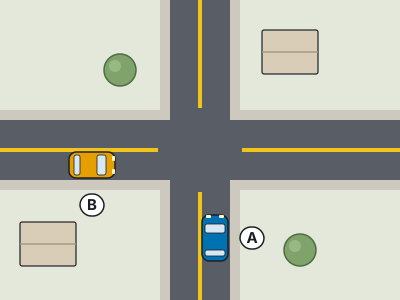
- The vehicle traveling faster
- The vehicle on the left
- The vehicle that signals first
- Neither vehicle, because no sign controls the intersection
Show answer
The vehicle on the left. At an uncontrolled intersection, Kansas requires the driver on the left to yield to the vehicle on the right. The absence of a stop sign or signal does not remove the duty to decide who waits. A turn signal or higher speed does not establish priority. Slow before entering, check for traffic already in the intersection, and be prepared to stop if the other vehicle has the right-of-way. The practical cue is simple: when both vehicles arrive together, the driver to the left gives way.
Study this in the handbook: Right of way at intersections
18. When can driving below an unposted minimum speed become unlawful in Kansas?
- Only when the driver is in the left lane
- Whenever the vehicle travels below 25 mph
- When the slow driving impedes or blocks normal traffic, unless needed for safe operation
- Never, because only speeding is regulated
Show answer
When the slow driving impedes or blocks normal traffic, unless needed for safe operation. Kansas makes it unlawful to drive so slowly that the vehicle impedes or blocks the normal movement of traffic, even when no minimum speed sign is posted. There is an exception when the slower pace is necessary for safe operation under the basic speed law. The 25 mph number is invented, and the rule is not limited to a left lane. The never choice ignores the handbook's explicit minimum-speed provision. Use a concrete check: if traffic is stacking behind you, consider whether a hazard requires the slower speed and whether you can safely allow traffic to pass.
Study this in the handbook: Safe speed and stopping distance
19. When approaching an intersection, which search is recommended before entering?
- Look only at the traffic signal above the lane
- Look to the front, left, and right for vehicles and pedestrians
- Watch the vehicle ahead and ignore cross traffic
- Check the rearview mirror but not the roadway sides
Show answer
Look to the front, left, and right for vehicles and pedestrians. Intersections combine crossing and merging traffic, so the handbook calls for a three-direction search before entry. Looking ahead identifies the path, while checking left and right can reveal vehicles or pedestrians that a signal or the vehicle ahead does not show. A green light is not a guarantee that the path is clear. Scan all three areas and confirm that you can proceed without entering a developing conflict.
Study this in the handbook: Safe speed and stopping distance
20. Kansas prohibits parking within what distance of a fire hydrant?
- Within 5 feet
- Within 10 feet
- Within 15 feet
- Within 25 feet
Show answer
Within 15 feet. Kansas prohibits parking within 15 feet of a fire hydrant. The five-foot and ten-foot choices leave too little clearance, while 25 feet is farther than the handbook's stated boundary and is not the tested figure. The reason for the restriction is practical: a parked vehicle can obstruct firefighters who need to connect equipment and reach the hydrant quickly. As you approach a hydrant, count at least 15 feet of space before leaving the vehicle. Do not treat the rule as a courtesy-only suggestion, because the handbook places it among locations where parking is not allowed.
Study this in the handbook: Where not to park and parking on hills
QualitySpace is expanding to Kansas
We are a California-based independent insurance brokerage working on licensing in more states. We cannot help with Kansas insurance yet. Leave your email and we will let you know when we can.
Every question is written from the official Kansas Driving Handbook. Need paper? Printable KS practice test with answer key.
Last verified 2026-10-05. How we check every question · Study all 211 as flashcards
Frequently asked questions
How many questions are on this Kansas practice test?
This fixed set has 20 questions. It is test 8 of 10 from the 211 question Kansas bank. The real KS exam asks 25 questions and you need 20 correct.
What is the passing score for the real Kansas test?
You must score an 80% to pass the knowledge test That figure comes from the official Kansas source cited on the DMV facts page.
How does this fixed test relate to the full Kansas bank?
Each numbered test is a fixed set of questions in a fixed order, so you can retake the same test later and compare. Every test mixes road signs and the other topics in about the same proportion as the full bank. Tests 1 to 10 together cover 200 of the 211 questions in the Kansas bank, each once. The full practice page mixes the whole bank at random.
Last verified 2026-10-05. See the Kansas DMV facts page for sourced state details.