Every question below comes from the Maine question bank on this page. Open a question to see the correct answer and the explanation. Nothing here is hidden behind a signup.
1. What kinds of information do Maine traffic signs provide?
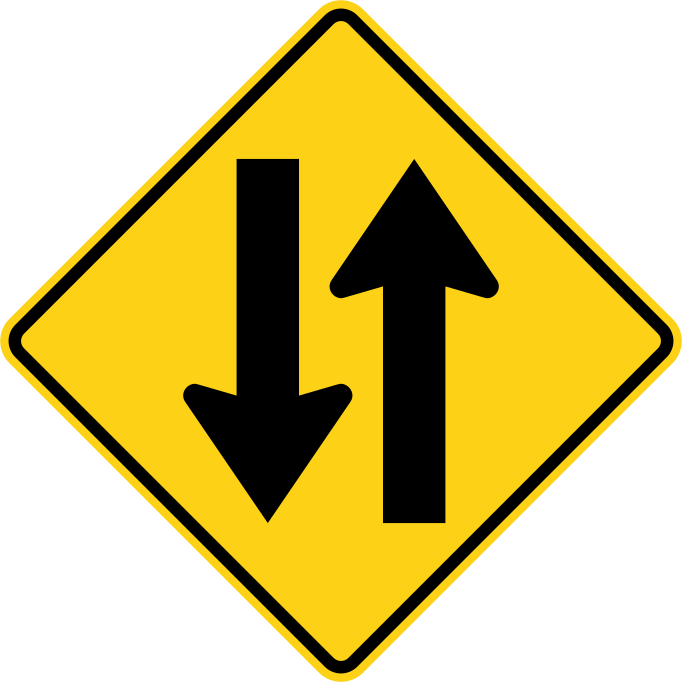
- Only fuel prices and service hours
- Rules, hazards, and road locations
- Only weather forecasts
- Only vehicle registration instructions
Show answer
Rules, hazards, and road locations. Maine says traffic signs tell drivers about rules, hazards, and road locations. Full explanation in Test 1
2. What maximum speed applies when passing a Maine school during recess or during school opening and closing hours?
- 20 miles per hour
- 15 miles per hour
- 25 miles per hour
- 10 miles per hour
Show answer
15 miles per hour. The maximum near a school is 15 miles per hour during recess or while children are going to or from school during the school's opening or cl Full explanation in Test 2
3. Besides rules and hazards, what information can traffic signs provide?
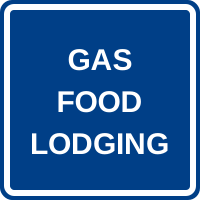
- Highway directions and road services
- The mechanical condition of every nearby vehicle
- The driver's license status of approaching motorists
- A guarantee that all lanes are free of traffic
Show answer
Highway directions and road services. Traffic signs do more than regulate movement or warn about hazards. Full explanation in Test 3
4. At what demerit point level does the Maine Secretary of State issue a warning to a driver?
- 3 points
- 6 points
- 8 points
- 12 points
Show answer
6 points. Under the Maine point system, a driver who reaches 6 points receives a warning from the Secretary of State. Full explanation in Test 4
5. About how many bicycles are there in Maine, according to the handbook?
- Nearly 900,000
- About 10,000
- About 50,000
- About 5 million
Show answer
Nearly 900,000. There are nearly 900,000 bicycles in Maine and most bicycling is done on the roadways, so drivers should expect bicyclists on every kind of Full explanation in Test 5
6. If a driver is later found innocent of OUI, what happens to the administrative suspension issued by the Secretary of State?
- It changes to a warning only
- It is automatically erased
- It remains in effect
- It applies only after a second OUI
Show answer
It remains in effect. The Maine manual says the administrative suspension issued by the Secretary of State remains in effect even if the driver is later found inn Full explanation in Test 6
7. Red lights are flashing at a Maine railroad crossing. How far from the crossing must you stop?
- At least 5 feet
- At least 10 feet
- At least 15 feet
- At least 50 feet
Show answer
At least 15 feet. When railroad crossing lights are flashing, stop at least 15 feet from the crossing and wait until they go out or the way is clear in both d Full explanation in Test 7
8. What must a Maine applicant under 18 complete to obtain a learner's permit?
- A two year driving record
- A commercial driver course
- A motorcycle endorsement exam
- An approved driver education course
Show answer
An approved driver education course. Applicants younger than 18 must complete an approved driver education course before obtaining a Maine learner's permit. Full explanation in Test 8
9. In Maine, who can ask the Secretary of State to suspend a minor's license or instruction permit by filing a notarized written request?
- The minor's driver education instructor
- The minor's auto insurance company
- Only a juvenile court judge
- A person who signed the minor's license or permit application
Show answer
A person who signed the minor's license or permit application. Whoever signed a minor's application for a license or instruction permit, usually a parent, guardian, or spouse who is at least 18, may late Full explanation in Test 9
10. Under Maine's under-21 alcohol rule, may a driver drive after consuming any amount of alcohol?
- Yes, if the driver stays below 0.08 BAC
- No, driving after any amount is prohibited
- Yes, if the alcohol was consumed with food
- Yes, if the trip is less than five miles
Show answer
No, driving after any amount is prohibited. The manual says a person under 21 may not drive after consuming any amount of alcohol. The 0. Full explanation in Test 10
11. When changing lanes is unsafe near a stopped emergency vehicle, what must the driver do?
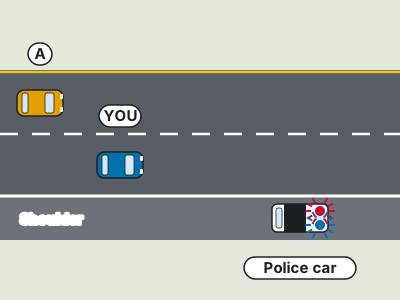
- Slow down and use caution while passing
- Maintain normal speed to avoid delay
- Stop in the travel lane beside the vehicle
- Pass on the shoulder without reducing speed
Show answer
Slow down and use caution while passing. The move-over rule does not make an unsafe lane change acceptable. Full explanation in Test 1
12. At what alcohol level does Maine identify operation of a motor vehicle as a criminal OUI offense?
- 0.05 grams per 100 milliliters of blood only
- 0.08 grams per 100 milliliters of blood or 210 liters of breath
- 0.10 grams per 100 milliliters of blood or 150 liters of breath
- 0.15 grams per 100 milliliters of blood only
Show answer
0.08 grams per 100 milliliters of blood or 210 liters of breath. Maine identifies 0.08 grams per 100 milliliters of blood or 210 liters of breath as the alcohol level for the criminal OUI offense described Full explanation in Test 2
13. What do Maine warning signs indicate?

- The end of all traffic controls
- A guaranteed clear roadway
- A required parking maneuver
- Danger ahead
Show answer
Danger ahead. Maine describes warning signs as signs that warn of danger ahead. Full explanation in Test 3
14. How should you respond when this skidding-car sign warns of a slippery road?

- Maintain the posted limit because the sign is advisory only
- Accelerate sharply to cross the slick area quickly
- Brake hard while turning to test the pavement
- Slow down and avoid hard braking or abrupt steering
Show answer
Slow down and avoid hard braking or abrupt steering. A slippery-road warning means the pavement may not provide enough tire grip for normal speed and abrupt control inputs. Full explanation in Test 4
15. What is unlawful when following a fire truck responding to a fire alarm?
- Following within 500 feet of it
- Remaining more than 500 feet behind it
- Pulling to the right and stopping for it
- Clearing an intersection before pulling over
Show answer
Following within 500 feet of it. Maine makes it unlawful to follow within 500 feet of a fire truck that is responding to a fire alarm. Full explanation in Test 5
16. How are speeding fines handled in a Maine work zone?
- They are doubled
- They are reduced by half
- They are waived if workers are absent
- They are unchanged from the ordinary fine
Show answer
They are doubled. A work zone carries an enhanced financial consequence for speeding: Maine doubles the fine. Full explanation in Test 6
17. In a Maine school zone, how does the handbook define school opening and closing hours for the 15 mph limit?
- One hour before the school day starts to one hour after it ends
- Only while a crossing guard is present
- The whole school day, from 7 a.m. to 4 p.m.
- Half an hour before the school day starts to half an hour after it ends
Show answer
Half an hour before the school day starts to half an hour after it ends. A five sided school sign means you must slow to 15 mph during recess, when children are going to or leaving school, and during opening or cl Full explanation in Test 7
18. What should a Maine driver do when a moose is standing in or near the roadway?
- Get out and chase the moose away
- Drive around the moose on the shoulder
- Slow down, stay in the vehicle, and give the moose room and time to leave
- Honk repeatedly and pass at normal speed
Show answer
Slow down, stay in the vehicle, and give the moose room and time to leave. The manual calls for extreme caution, slower speed, remaining in the vehicle, and allowing the moose room and time to wander away. Full explanation in Test 8
19. How many hours of supervised practice driving must a Maine applicant under 21 complete before taking the road test?
- At least 40 hours
- At least 50 hours
- At least 70 hours
- At least 100 hours
Show answer
At least 70 hours. Before a Maine applicant under 21 can apply for a road test, the applicant must complete a minimum of 70 hours of driving with a licensed dr Full explanation in Test 9
20. What is the best way to reduce the chance of hydroplaning on a wet road?
- Increase speed to cross the water before sliding
- Use worn tires so water escapes more quickly
- Keep the tires in good condition and reduce speed
- Make frequent sharp steering changes to test traction
Show answer
Keep the tires in good condition and reduce speed. The manual identifies two practical defenses against hydroplaning: maintain tires in good condition and keep speed down on wet pavement. Full explanation in Test 10
21. What color and markings do Maine warning signs usually have?
- Green with red lettering
- Blue with white lettering
- Yellow with black lettering or symbols
- White with black lettering only
Show answer
Yellow with black lettering or symbols. Maine describes warning signs as usually yellow with black lettering or symbols. Full explanation in Test 1
22. When you see this warning sign, what response does Maine advise?

- Move into the oncoming lane
- Accelerate to clear the area
- Stop in the travel lane immediately
- Reduce your speed
Show answer
Reduce your speed. Maine tells drivers to reduce speed when they see warning signs because the signs identify danger ahead. Full explanation in Test 2
23. What shape and color identify most Maine warning signs?
- Blue circle
- Yellow diamond
- Green rectangle
- White octagon
Show answer
Yellow diamond. Most Maine warning signs are yellow and shaped like a diamond. Full explanation in Test 3
24. What additional suspension period applies after an OUI conviction when the vehicle carried a passenger under 21?
- 90 additional days
- 30 additional days
- 60 additional days
- 275 additional days
Show answer
275 additional days. Maine adds 275 days to the OUI or refusal suspension when a passenger under the age of 21 was in the vehicle. Full explanation in Test 4
25. How far behind a fire truck responding to a fire alarm is a Maine driver prohibited from following?
- Within 300 feet
- Within 100 feet
- Within 500 feet
- Within 1,000 feet
Show answer
Within 500 feet. Maine prohibits following within 500 feet of a fire truck that is responding to a fire alarm. Full explanation in Test 5
26. When may a Maine driver legally travel below the posted speed without violating the slow driving rule?
- When the reduced speed is necessary for safety
- Whenever the driver wants to conserve fuel
- Only when following a motorcycle
- Whenever the driver is at least 10 miles below the limit
Show answer
When the reduced speed is necessary for safety. Maine permits reduced speed when it is necessary for safety, even though unnecessary slow driving may interfere with normal traffic movement Full explanation in Test 6
27. When must drivers in Maine report a crash to the police or local sheriff?
- Only when property damage is over $5,000
- When property damage is $500 or more
- When anyone is injured or property damage is $2,000 or more
- Only when a vehicle has to be towed
Show answer
When anyone is injured or property damage is $2,000 or more. Maine requires drivers to report a crash to the police or local sheriff when anyone is injured or property damage reaches $2,000 or more. Full explanation in Test 7
28. Unless posted otherwise, what is the maximum speed outside any business, residential, or built-up area in Maine?
- 25 mph
- 45 mph
- 55 mph
- 65 mph
Show answer
45 mph. Maine's default maximum is 45 miles per hour outside business, residential, or built-up areas, unless a different limit is posted. Full explanation in Test 8
29. How should a driver approach an intersection where buildings or trees block the view of the cross street?
- Maintain speed because the obstruction protects the vehicle
- Edge forward slowly until the cross street can be seen
- Drive into the cross street before looking to save time
- Use the horn as a substitute for checking both directions
Show answer
Edge forward slowly until the cross street can be seen. A blocked view requires a controlled approach. Full explanation in Test 9
30. How many crashes each year does NHTSA attribute to sleepiness at the wheel, according to the Maine handbook?
- About 1,000
- About 10,000
- About 5 million
- As many as 240,000
Show answer
As many as 240,000. The National Highway Traffic Safety Administration estimates that each year as many as 240,000 accidents are related to sleepiness at the wh Full explanation in Test 10
