
Test 3 of 10 · 20 questions · Free 2026
ME Permit Practice Test 3
Jump to the test ↓A fixed 20 question set from the Maine bank with answers and plain English explanations. The real ME exam is 30 questions, 80 percent to pass; take the full length version on the main practice page.
Question 1 of 20 · 0 right so far
All 20 questions in test 3
Every question below comes from the Maine question bank on this page. Open a question to see the correct answer and the explanation. Nothing here is hidden behind a signup.
1. Besides rules and hazards, what information can traffic signs provide?
- Highway directions and road services
- The mechanical condition of every nearby vehicle
- The driver's license status of approaching motorists
- A guarantee that all lanes are free of traffic
Show answer
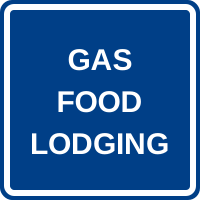
Highway directions and road services. Traffic signs do more than regulate movement or warn about hazards. They can provide highway directions and show where road services are located, such as facilities a driver may need during a trip. They cannot report another vehicle's mechanical condition, reveal a driver's license status, or promise that a lane is clear. The pictured blue sign is a guide sign, a category Maine describes as green, brown, or blue and able to help drivers find service stations, restaurants, and hotels. Read signs for rules, hazards, directions, and services before acting.
Study this in the handbook: Traffic signals, arrows and lane lights
2. What do Maine warning signs indicate?

- The end of all traffic controls
- A guaranteed clear roadway
- A required parking maneuver
- Danger ahead
Show answer
Danger ahead. Maine describes warning signs as signs that warn of danger ahead. They give advance notice of a roadway condition so the driver can observe, slow, or prepare for a change. The other choices incorrectly promise a clear road, impose a parking maneuver, or end traffic controls. A warning sign is an early cue, not permission to ignore the roadway or a replacement for a regulatory instruction. Look beyond the sign and identify the condition it announces before deciding how to proceed.
Study this in the handbook: Speed limits and school zones
3. What shape and color identify most Maine warning signs?
- Blue circle
- Yellow diamond
- Green rectangle
- White octagon
Show answer
Yellow diamond. Most Maine warning signs are yellow and shaped like a diamond. That combination tells the driver to expect a hazard or roadway change and to prepare before reaching it. A blue circle, green rectangle, or white octagon identifies a different sign category or function. Use both visual features together rather than relying on color alone. When the yellow diamond appears, scan past the sign, compare the symbol with the road ahead, and adjust speed if the approaching condition requires more time to react.
Study this in the handbook: Warning, railroad and work zone signs
4. At an intersection, one driver goes straight and the opposing driver signals a turn. Who has the right-of-way?
- The driver who signals first
- The driver turning left
- The driver going straight
- The larger vehicle
Show answer
The driver going straight. When two vehicles approach an intersection from opposite directions at the same time and one driver signals a turn, Maine gives the right-of-way to the vehicle going straight. Signaling communicates an intention, but it does not give a turning vehicle priority over opposing traffic. Vehicle size also has no role in this rule. Before moving, each driver should still check the whole situation because the manual warns against insisting on priority. The useful visual cue is the conflict between a straight path and a turn: the straight-moving vehicle proceeds first, and the turning driver yields.
Study this in the handbook: Right of way at intersections and highways
5. At what BAC does the Maine manual say vision is impacted for all drivers?
- 0.05 BAC
- 0.02 BAC
- 0.08 BAC
- 0.15 BAC
Show answer
0.02 BAC. The manual identifies 0.02 BAC as a level at which vision is impacted for all drivers. The 0.08 figure is associated elsewhere with a criminal OUI threshold, not the point at which visual effects begin. A lower reading can still change focus, distance judgment, or recognition of movement before a driver reaches that legal threshold. Use the number as an early warning rather than a permission level: after consuming alcohol, do not drive. The useful memory cue is that impairment of a key driving sense starts well below the commonly remembered 0.08 figure.
Study this in the handbook: How alcohol affects driving
6. When may a driver on the opposite side of a divided highway continue past a school bus with red lights flashing?
- Only when the bus driver waves every vehicle through
- Whenever the driver is late
- Only after passing the bus on the shoulder
- When a solid divider separates that roadway from the bus
Show answer
When a solid divider separates that roadway from the bus. Maine allows traffic on the opposite side of a multi-lane divided highway to continue when a solid divider separates that roadway from the school bus. The divider is the condition that creates the exception. A driver cannot use lateness, the shoulder, or a missing wave as justification. Vehicles traveling on the bus’s side still stop when the red lights flash or the stop arm is extended, then proceed slowly only after those warnings end and children are watched for.
Study this in the handbook: Intersections, lane changes, expressways and school buses
7. When may a driver pass across a broken center line on the driver’s side?
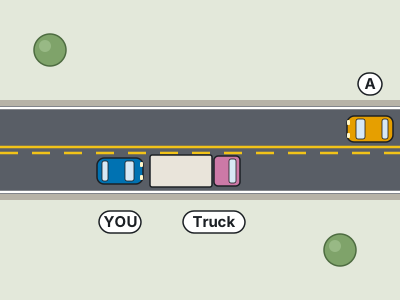
- Only when no oncoming cars are in the passing lanes
- Whenever the vehicle ahead is moving slowly
- Only after sounding the horn twice
- Even when a no-passing sign is posted
Show answer
Only when no oncoming cars are in the passing lanes. A broken center line on your side permits a pass only when the passing movement is safe and no oncoming cars occupy the passing lanes. The marking alone does not guarantee a clear path. A slow vehicle ahead is not enough reason to cross, and a horn cannot make an unsafe gap safe. A no-passing sign or another traffic control device still governs the maneuver. Look far ahead, judge the available distance, and return only after the pass can be completed legally.
Study this in the handbook: Passing and no passing zones
8. What do warning signs tell a Maine driver to expect?

- A parking fee required ahead
- A road closed to motor vehicles
- A railroad train entering the roadway
- Danger ahead
Show answer
Danger ahead. Warning signs alert drivers to danger ahead. Their purpose is to give a driver time to reduce speed and react if a hazard appears. A pedestrian image can point to activity near the roadway, but the category itself does not close the road, announce that a train is entering the roadway, or impose a parking fee. Read the symbol for the specific hazard, then scan the road and surroundings, adjust speed, and prepare to stop or yield when people or other traffic are present.
Study this in the handbook: Traffic signals, arrows and lane lights
9. What does Maine's inspection require of the rear view mirror?
- It may be missing if side mirrors work
- It must be tinted
- It must not be cracked, broken, clouded or have sharp edges
- It must be at least 12 inches wide
Show answer
It must not be cracked, broken, clouded or have sharp edges. Maine's inspection list requires the rear view mirror to be free of cracks, breaks, clouding and sharp edges, and the windshield and windows must not be cracked, broken, clouded or blocked. The exhaust and fuel systems must have no holes or leaks, the speedometer and odometer must work and be untampered, and the fuel inlet and catalytic converter must not be changed in any way.
Study this in the handbook: Title, registration, insurance and inspection
10. A Maine driver under 21 is adjudicated a second time for using a false ID to get liquor. What license suspension is required?
- 30 days
- 90 days
- One year
- None, only a fine
Show answer
90 days. For using false credentials to obtain liquor or enter a drinking establishment, a court may suspend the license for 30 days on a first offense, must suspend it for 90 days on a second offense, and must suspend it for one year on any later offense. Thirty days is the first offense figure, and it is discretionary. One year applies to the third and later offenses. A fine alone is not an option for a second offense, and the offense also carries six demerit points.
11. How close to a fire hydrant may you not park under the rules listed in the Maine handbook?
- Within 10 feet
- Within 5 feet
- Within 15 feet
- Within 20 feet
Show answer
Within 10 feet. The handbook lists parking within 10 feet of a fire hydrant as not allowed. Five feet is closer than the stated limit. Fifteen feet is the figure for a crosswalk and for a fire station driveway entrance, not for a hydrant. Twenty feet does not appear in the handbook's parking list and is not the hydrant distance it gives. The same parking list also bans parking in a loading zone.
12. A Maine learner's permit holder is supervised by a licensed driver. Which supervisor meets the manual's requirement?
- Any licensed driver seated in the back seat
- A driver age 18 who has held a license for 1 year
- A driver at least 20 who has held a valid license for 2 years
- A driver at least 21 who has held a permit for 6 months
Show answer
A driver at least 20 who has held a valid license for 2 years. The supervising operator must be at least 20 years old and must have held a valid license for 2 years. The manual adds that this accompanying operator must be licensed to drive the class of vehicle being operated. Simply holding some license is not enough, because age and license history both have to be met. Age 18 and one year of licensing falls short on both measures, and time on a learner's permit does not substitute for the required valid license history. Check age, years licensed, and license class together.
Study this in the handbook: Getting a learner's permit and a license
13. How should an infant under age 2 ride in a vehicle under Maine's child safety guidance?
- In the front seat facing forward
- In the back seat facing the rear
- In the back seat without a restraint for short trips
- On an adult passenger's lap in the front seat
Show answer
In the back seat facing the rear. Maine's child safety guidance says infants under age 2 should always ride in the back seat facing the rear. A forward facing position is identified for children age 2 and older, and neither an unrestrained short trip nor an adult's lap provides the required protection. The front seat is especially unsafe when a passenger air bag is active. The cue is age and direction together: under two means rear facing in the back seat, with the child restraint used according to its instructions.
Study this in the handbook: Seat position, seat belts and child safety
14. When is driving below the posted speed limit unlawful under Maine's traffic rule?
- Whenever another vehicle is following at a safe distance
- Whenever a driver travels 5 miles per hour below the sign
- Only when the driver is in a school zone
- When the slow speed interferes with normal and reasonable traffic movement without a safety need
Show answer
When the slow speed interferes with normal and reasonable traffic movement without a safety need. Maine prohibits driving so slowly that normal and reasonable traffic movement is interfered with, unless the reduced speed is necessary for safety. The rule does not create a fixed five mile threshold, and it is not limited to school zones. A vehicle behind you is not automatically evidence of a violation if traffic is still moving normally. The practical cue is to distinguish unnecessary obstruction from a justified slower speed caused by weather, hazards, visibility, or another safety condition.
Study this in the handbook: Speed limits and school zones
15. What does a solid white line separating lanes generally tell a driver?
- The roadway has no marked lanes after the line
- The lanes carry opposing traffic and passing is required
- A lane change is required before the next intersection
- The lanes have different uses and changing lanes is discouraged
Show answer
The lanes have different uses and changing lanes is discouraged. Solid white lines separate lanes moving in the same direction when those lanes have different uses. They also discourage a lane change across the line. That is different from a broken white line, which indicates multiple same-direction lanes and allows a safe lane change. The marking does not divide opposing traffic or command a driver to move immediately. Read arrows, signs, and surrounding lane arrangements together before changing position, especially near turn-only lanes.
Study this in the handbook: Lane markings, lane use and special lanes
16. What criminal consequence does Maine identify for failing to yield to an active emergency vehicle?
- A Class E crime
- A warning with no possible charge
- A mandatory parking citation
- A license renewal delay only
Show answer
A Class E crime. Failing to yield to an emergency vehicle with an active siren and flashing light is a Class E crime under the Maine manual. The rule also requires moving right, clearing an intersection, and stopping until the vehicle passes. This consequence is different from the separate distance rule for following a responding fire truck. Treat the siren and flashing light as an immediate command to clear the path, not as a suggestion to continue through the junction. Stop only after positioning the vehicle where responders can pass safely.
Study this in the handbook: Right of way at intersections and highways
17. What tire tread does Maine's inspection require for cars and for 10,000 pound commercial vehicles?
- 1/32 inch for both
- 6/32 inch for both
- 2/32 inch for cars and 4/32 inch for commercial vehicles of 10,000 pounds
- Any tread without cuts
Show answer
2/32 inch for cars and 4/32 inch for commercial vehicles of 10,000 pounds. Tires must have 2/32 of an inch of tread and be free of cuts, tears or other dangerous conditions, and for commercial vehicles of 10,000 pounds gross vehicle weight 4/32 of an inch is required. The inspection also checks that mirrors, windshields and windows are not cracked or clouded, the exhaust and fuel systems have no leaks, and the odometer has not been tampered with.
Study this in the handbook: Title, registration, insurance and inspection
18. What does Maine say about highways with minimum posted speed limits?
- Minimum speeds apply only in parking lots
- All highways require a minimum of 10 mph
- Some highways may have minimum posted speed limits
- Maine prohibits all minimum speed limits
Show answer
Some highways may have minimum posted speed limits. Maine notes that some highways may have minimum posted speed limits. A posted minimum tells drivers not to travel below that speed unless another safety rule or condition requires a slower pace. The choices claiming every highway has a 10 mph minimum, limiting minimums to parking lots, or banning them all contradict the manual. Look for the word some, because the rule is not universal. The practical cue is a separate minimum-speed sign, which differs from the maximum speed limit shown on ordinary speed signs.
Study this in the handbook: Speed limits and school zones
19. After a Maine vehicle breaks down, how far behind it should emergency flares be placed?
- Twenty to thirty feet
- Two hundred to three hundred feet
- Fifty to one hundred feet
- Five hundred to six hundred feet
Show answer
Two hundred to three hundred feet. For a breakdown, Maine advises placing emergency flares 200 to 300 feet behind the vehicle. That distance gives approaching drivers time to change lanes or reduce speed. A short twenty or fifty foot placement may leave too little warning, while the larger figure is not the stated guidance. First get the vehicle away from traffic when possible, activate the flashers, and warn other roadway users.
Study this in the handbook: Collisions, crash reports and first aid
20. When a first OUI conviction includes an aggravating circumstance, how long is the listed minimum license loss?
- At least 150 days
- At least 30 days
- At least 90 days
- At least one year
Show answer
At least 150 days. For a first OUI conviction with an aggravating circumstance, Maine lists a license loss of at least 150 days. The 30 day and 90 day choices are shorter than the stated minimum, while one year belongs to a different rule and is not the figure in this first conviction penalty list. Read the question for the aggravated category, which can involve a high alcohol level, excessive speed, refusal, attempted eluding, or an underage passenger. The memory cue is 150 days after the 48 hour jail provision.
Study this in the handbook: OUI law, implied consent and penalties
QualitySpace is expanding to Maine
We are a California-based independent insurance brokerage working on licensing in more states. We cannot help with Maine insurance yet. Leave your email and we will let you know when we can.
Every question is written from the official Maine Driver's License Manual. Need paper? Printable ME practice test with answer key.
Last verified 2026-10-05. How we check every question · Study all 218 as flashcards
Frequently asked questions
How many questions are on this Maine practice test?
This fixed set has 20 questions. It is test 3 of 10 from the 218 question Maine bank. The real ME exam asks 30 questions and you need 24 correct.
What is the passing score for the real Maine test?
You must answer a minimum of 24 correctly to pass the test (24 of 30) That figure comes from the official Maine source cited on the DMV facts page.
How does this fixed test relate to the full Maine bank?
Each numbered test is a fixed set of questions in a fixed order, so you can retake the same test later and compare. Every test mixes road signs and the other topics in about the same proportion as the full bank. Tests 1 to 10 together cover 200 of the 218 questions in the Maine bank, each once. The full practice page mixes the whole bank at random.
Last verified 2026-10-05. See the Maine DMV facts page for sourced state details.