
Test 5 of 10 · 20 questions · Free 2026
ME Permit Practice Test 5
Jump to the test ↓A fixed 20 question set from the Maine bank with answers and plain English explanations. The real ME exam is 30 questions, 80 percent to pass; take the full length version on the main practice page.
Question 1 of 20 · 0 right so far
All 20 questions in test 5
Every question below comes from the Maine question bank on this page. Open a question to see the correct answer and the explanation. Nothing here is hidden behind a signup.
1. About how many bicycles are there in Maine, according to the handbook?
- Nearly 900,000
- About 10,000
- About 50,000
- About 5 million
Show answer
Nearly 900,000. There are nearly 900,000 bicycles in Maine and most bicycling is done on the roadways, so drivers should expect bicyclists on every kind of road. Despite all laws, you must exercise care to avoid colliding with pedestrians or bicyclists. Maine law requires at least three feet of space between the right side of your vehicle and the bicycle as you pass, and the handbook tells motorists to drive defensively around riders.
Study this in the handbook: Pedestrians, bicycles, motorcycles and large vehicles
2. What is unlawful when following a fire truck responding to a fire alarm?
- Following within 500 feet of it
- Remaining more than 500 feet behind it
- Pulling to the right and stopping for it
- Clearing an intersection before pulling over
Show answer
Following within 500 feet of it. Maine makes it unlawful to follow within 500 feet of a fire truck that is responding to a fire alarm. Staying farther back is not the prohibited conduct. Pulling right, stopping, and clearing an intersection are actions the manual requires when yielding to emergency vehicles, not violations. The numeric cue is 500 feet: once the truck has passed, do not close the gap and trail it closely. Continue only with ample separation and normal caution, and remember that the same section tells drivers to make room for ambulances, fire trucks, and police cars.
Study this in the handbook: Emergency vehicles, move over and traffic stops
3. How far behind a fire truck responding to a fire alarm is a Maine driver prohibited from following?
- Within 300 feet
- Within 100 feet
- Within 500 feet
- Within 1,000 feet
Show answer
Within 500 feet. Maine prohibits following within 500 feet of a fire truck that is responding to a fire alarm. The rule applies to any fire truck on its way to a fire alarm, and it sits beside the duty to pull over and stop for emergency vehicles that are using lights and sirens. The 100, 300, and 1,000 foot figures do not match the distance stated in the handbook. When you hear or see a responding fire truck, keep well back instead of treating its route as a convenient lead.
Study this in the handbook: Emergency vehicles, move over and traffic stops
4. After stopping at a steady red traffic light, when may a driver make a right turn?
- Whenever the driver slows enough to check for traffic
- After stopping, unless the turn is posted as prohibited, while yielding to traffic and pedestrians
- Only after another vehicle waves the driver through
- Before stopping if the right lane appears empty
Show answer
After stopping, unless the turn is posted as prohibited, while yielding to traffic and pedestrians. Maine permits a right turn on red only after the driver has stopped, and the turn is not allowed when a sign prohibits it. The turning driver must yield to pedestrians and all vehicle traffic. Merely slowing is insufficient because the manual specifically requires a stop before entering the intersection. A wave from another driver does not replace the legal duties, and an empty-looking lane does not justify turning before stopping. The sequence is simple: stop behind the line or crosswalk, check every conflict, obey any posted restriction, yield, then turn when the movement is safe.
Study this in the handbook: Traffic signals, arrows and lane lights
5. After a first OUI conviction, how long is the reinstated Maine license conditional?
- One year
- Six months
- Three years
- Ten years
Show answer
One year. When a license is reinstated after a first OUI conviction, it is conditional for one year, meaning the driver may not operate with any amount of alcohol in the system. Six months and three years are not the stated periods. Ten years is the conditional period after a second or later conviction, not after the first. Operating with any amount of alcohol while the license is conditional brings a one year suspension without a preliminary hearing.
Study this in the handbook: OUI law, implied consent and penalties
6. What license consequence does the Maine manual describe for a person under 21 found operating with any amount of alcohol?
- Loss of the driver's license for at least one year
- A 30 day suspension only
- No action unless the level reaches 0.08
- A required warning with no license loss
Show answer
Loss of the driver's license for at least one year. For a driver under 21, the manual says operating with any amount of alcohol results in losing the driver's license for at least one year. The rule is stricter than the adult 0.08 criminal threshold, so waiting for that adult number would be unsafe and legally wrong. A 30 day period and a warning do not match the stated consequence. The useful cue is zero amount for a minor: any measurable alcohol can activate the one year minimum license loss.
Study this in the handbook: Under 21, conditional licenses and open containers
7. Which movement is forbidden by this crossed left-turn arrow?
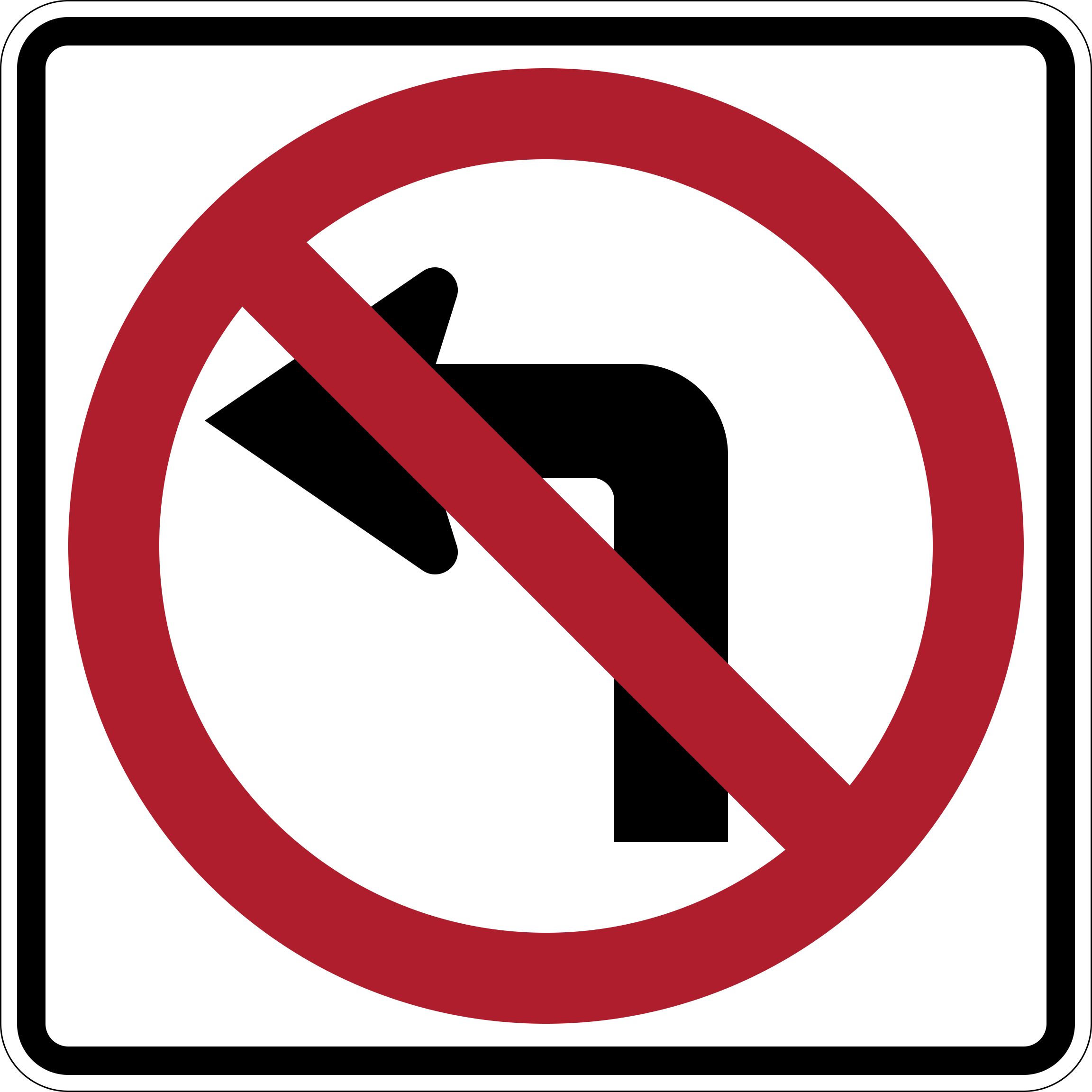
- Turning right after yielding to pedestrians
- Turning left at the posted location
- Going straight through a green signal
- Moving into the lane designated for through traffic
Show answer
Turning left at the posted location. The crossed left arrow identifies a no-left-turn restriction. At that location, the driver must continue straight or choose another permitted movement instead of turning left. The sign does not automatically prohibit right turns, straight travel, or a lane change that follows the lane markings. The restriction applies where the sign is displayed, so the driver should plan before reaching the junction and follow any other traffic control present. The arrow direction plus the red slash gives the needed answer.
Study this in the handbook: Warning, railroad and work zone signs
8. At this STOP sign, where should you stop before proceeding?

- At least 15 feet from the sign in every situation
- After entering the intersection so approaching traffic can see you
- Before the stop line or crosswalk, then wait until it is safe
- Only when another vehicle or pedestrian is visible
Show answer
Before the stop line or crosswalk, then wait until it is safe. A Maine stop sign requires the vehicle to stop behind the stop line or crosswalk when one is present. If neither exists, stop at the nearest point to the intersection that still lets you see approaching traffic. The vehicle must stop before any part enters the intersection, then the driver waits until proceeding is safe and yields to vehicles or pedestrians when necessary. Stopping only for visible traffic misses the legal duty to stop. The practical cue is line first, intersection second, then a safe gap.
Study this in the handbook: Warning, railroad and work zone signs
9. Under current Maine law, which child must ride in a belt positioning seat or other child restraint system?
- A child weighing 80 pounds or more who is 12 years old
- Any child under 18 who is taller than 57 inches
- A child under 8 who weighs less than 80 pounds and is less than 57 inches tall
- Any passenger age 18 or older riding in the rear seat
Show answer
A child under 8 who weighs less than 80 pounds and is less than 57 inches tall. Maine requires a child who is younger than 8, weighs less than 80 pounds and is shorter than 57 inches to be secured in a belt positioning seat or other child restraint system, following the seat and vehicle instructions. All three conditions must match. The handbook still describes a 55 to 80 pound range, but the statute text, marked as amended in 2019, uses these three conditions, and younger and lighter children fall under separate harness and rear facing rules. A violation is a traffic infraction, and the court may not suspend the fine.
10. What suspension period does the Maine handbook list for a conviction of operating after suspension?
- 30 days
- 60 days
- 90 days
- One year
Show answer
60 days. A person convicted of operating after suspension may have the license suspended for 60 days. Thirty days is the period for offenses such as passing a stopped school bus or loaning a license. Ninety days is the upper limit for eluding an officer, passing a roadblock, or street racing. One year is not the listed period for this conviction. The handbook lists this period separately from the 30 day and 90 day groups.
11. What alcohol level do over half of fatally injured drivers have, according to the Maine handbook?
- .06 grams per 100 milliliters of blood or 210 liters of breath
- Zero
- .02
- .20 or higher
Show answer
.06 grams per 100 milliliters of blood or 210 liters of breath. Over 50 percent of all fatally injured drivers have an alcohol level of .06 grams per 100 milliliters of blood or 210 liters of breath, below the .08 level the handbook ties to the criminal OUI offense, which shows impairment starts well before that line. Alcohol and drugs contribute to about 40 percent of fatal crashes. The handbook warns that you begin losing your driving skills with the first drink, so do not drive after drinking.
Study this in the handbook: How alcohol affects driving
12. What do construction warning signs use to identify a work zone?
- White symbols on a blue background
- Black symbols or lettering on an orange background
- Green lettering on a white background
- Red symbols on a yellow background
Show answer
Black symbols or lettering on an orange background. Construction warning signs use black symbols or lettering on an orange background. They alert drivers to road construction or maintenance and help guide traffic safely through or around the work site. Blue and green sign colors are associated with other kinds of information, while a yellow background is commonly used for general warnings. When an orange sign appears, expect changed lanes, workers, equipment, or a detour and reduce speed early rather than waiting for the roadway to narrow.
13. What maximum speed applies when passing a school during recess in Maine, unless a different limit is posted?
- 35 miles per hour
- 25 miles per hour
- 15 miles per hour
- 45 miles per hour
Show answer
15 miles per hour. Maine sets a 15 mile per hour maximum when a driver passes a school during recess, or when children are traveling to or from school during opening or closing hours. The 25 mile per hour figure belongs to business, residential, and built-up areas, so it is the most plausible but incorrect substitute here. A posted limit still controls when one is lower or otherwise specific. The practical cue is the school setting and the timing: slow to 15 mph during recess or the listed arrival and departure periods, and use extreme care when the exact period is uncertain.
Study this in the handbook: Speed limits and school zones
14. What does a steady green arrow pointing upward permit?
- Drive in any direction without checking
- Turn left after yielding
- Stop until the arrow turns red
- Proceed straight ahead
Show answer
Proceed straight ahead. A steady green arrow pointing upward permits movement straight ahead. The arrow applies to the direction it displays, so it does not authorize a left turn or every possible movement at the intersection. Drivers must still watch for pedestrians and obey any other signal or officer directing traffic. A red arrow requires the indicated turning traffic to stop, but that is a different signal state. Follow the lane under the arrow and continue with ordinary intersection caution.
Study this in the handbook: Traffic signals, arrows and lane lights
15. At what point total will a Maine driver's license be suspended under the demerit point system?
- 6 points or more
- 10 points or more
- 18 points or more
- 12 points or more
Show answer
12 points or more. A Maine license is suspended when the point total reaches 12 points or more. Six points brings a warning, not a suspension. Ten points is not a threshold in the handbook, and 18 points is higher than the suspension level. A driver who is suspended is entitled to a hearing, and the decision may be appealed to Superior Court. Points are erased from the record once they become one year old.
Study this in the handbook: Young driver restrictions, points and suspensions
16. Which electronic device rule applies to a Maine driver under 18 with a newly issued license?
- The driver may text if traffic is stopped at a light
- The driver may use a handheld phone for navigation only
- The driver may not use a mobile telephone or handheld electronic device while driving
- The driver may use a phone whenever a licensed adult is present
Show answer
The driver may not use a mobile telephone or handheld electronic device while driving. Maine's under 18 restriction prohibits using a mobile telephone or handheld electronic device while operating a motor vehicle. The rule is not limited to texting, navigation, or moving traffic. A red light does not create a general exception, and an adult passenger does not authorize handheld use. Treat the device restriction as an operating rule that applies throughout the drive. The manual places it alongside the nighttime and passenger limits for drivers under 18, so those restrictions should be remembered as a group.
Study this in the handbook: Young driver restrictions, points and suspensions
17. On a gravel rural road, which adjustment does the manual recommend?
- Drive on the shoulder to gain traction
- Keep highway speed and shorten the gap
- Brake sharply at every curve
- Slow down and increase following distance
Show answer
Slow down and increase following distance. Gravel and dirt provide less traction than a paved surface, so the manual calls for slower travel and more space behind the vehicle ahead. The larger gap gives the driver additional time to brake gently if the surface causes a skid. Maintaining highway speed or following closely reduces that margin, while sudden braking can make a loss of traction worse. Keep the vehicle centered in its lane, make smooth inputs, and treat loose pavement as a reason to reduce speed before a problem develops.
Study this in the handbook: Night, rural, winter and wet weather driving
18. Who has the right-of-way when a driver is entering an interstate from an entrance ramp?
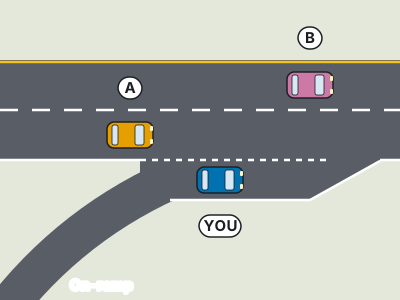
- The vehicle that activates its signal first
- The vehicle on the entrance ramp
- The vehicle traveling fastest
- Drivers already on the interstate
Show answer
Drivers already on the interstate. Traffic already traveling on the interstate has the right-of-way over a vehicle coming from the entrance ramp. The merging driver must select a safe gap and enter without forcing established traffic to yield. Speed and signaling help communication, but neither changes the priority rule. The manual places this alongside other yielding situations, including entering from a private road. A good test cue is to identify which vehicle is already on the through roadway: that vehicle keeps priority, while the ramp driver adjusts speed and position to merge safely.
Study this in the handbook: Right of way at intersections and highways
19. What does a bicycle-crossing warning tell a driver to do?
- Stop at every bicycle sign regardless of traffic
- Pay extra attention for bicycles ahead
- Speed up before bicycles reach the road
- Use the bicycle lane as a passing lane
Show answer
Pay extra attention for bicycles ahead. A bicycle or bicycle crossing ahead calls for extra attention. The warning tells the driver to expect people on bicycles near the roadway or crossing area, where their position and speed may differ from motor traffic. It is not a command to stop in every location, but it does require scanning, a safe speed, and enough room to react. Look beyond the sign for riders, check the lane edge, and be prepared to yield or adjust course when the roadway user has priority.
Study this in the handbook: Speed limits and school zones
20. What must a Maine driver do when a pedestrian with a guide dog or white cane is crossing?
- Proceed first if the traffic light is green
- Sound the horn and continue if the pedestrian pauses
- Pass behind the pedestrian without slowing
- Come to a complete stop and yield
Show answer
Come to a complete stop and yield. A pedestrian using a guide dog or carrying a white cane is visually impaired, and Maine requires the driver to come to a complete stop. A horn does not replace yielding, and passing close behind someone who may not see the vehicle creates serious danger. A green light also does not cancel the driver's duty to yield. Stop with enough room, remain alert, and wait until the crossing is clear.
Study this in the handbook: Pedestrians, school children and blind pedestrians
QualitySpace is expanding to Maine
We are a California-based independent insurance brokerage working on licensing in more states. We cannot help with Maine insurance yet. Leave your email and we will let you know when we can.
Every question is written from the official Maine Driver's License Manual. Need paper? Printable ME practice test with answer key.
Last verified 2026-10-05. How we check every question · Study all 218 as flashcards
Frequently asked questions
How many questions are on this Maine practice test?
This fixed set has 20 questions. It is test 5 of 10 from the 218 question Maine bank. The real ME exam asks 30 questions and you need 24 correct.
What is the passing score for the real Maine test?
You must answer a minimum of 24 correctly to pass the test (24 of 30) That figure comes from the official Maine source cited on the DMV facts page.
How does this fixed test relate to the full Maine bank?
Each numbered test is a fixed set of questions in a fixed order, so you can retake the same test later and compare. Every test mixes road signs and the other topics in about the same proportion as the full bank. Tests 1 to 10 together cover 200 of the 218 questions in the Maine bank, each once. The full practice page mixes the whole bank at random.
Last verified 2026-10-05. See the Maine DMV facts page for sourced state details.