Every question below comes from the Virginia question bank on this page. Open a question to see the correct answer and the explanation. Nothing here is hidden behind a signup.
1. A stopped school bus displays flashing red lights and an extended stop sign. When may you resume driving?
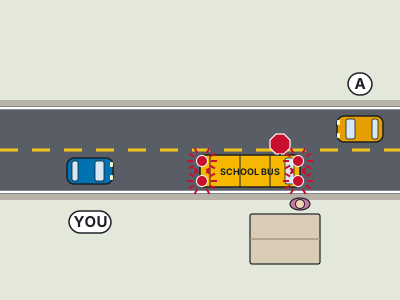
- After all persons are clear and the bus moves again
- After waiting ten seconds, even if the bus remains stopped
- As soon as the nearest child reaches the sidewalk
- When traffic behind you begins passing
Show answer
After all persons are clear and the bus moves again. Drivers approaching from any direction on a highway, private road, or school driveway must stop for the specified school bus. Full explanation in Test 1
2. What roadway arrangement does a Divided Highway Begins sign announce?

- A two-way road with no median ahead
- A highway split into two separate one-way roadways
- A mandatory U-turn at the next opening
- A lane reserved for bicycles only
Show answer
A highway split into two separate one-way roadways. Divided Highway Begins announces that a median or divider will separate the highway into two roadways, each carrying one-way traffic. Full explanation in Test 2
3. What vision does Virginia require for an unrestricted driver's license?
- 20/40 or better in one or both eyes, with 110 degrees or better horizontal vision
- 20/20 in both eyes
- 20/70 with 70 degrees of horizontal vision
- Any vision with glasses
Show answer
20/40 or better in one or both eyes, with 110 degrees or better horizontal vision. Virginia's unrestricted license standard is 20/40 or better vision in one or both eyes and 110 degrees or better horizontal vision in one or Full explanation in Test 3
4. What does the color orange indicate in a highway work zone?
- The road is reserved for bicycles
- Slow down and stay alert
- A higher speed is permitted through the zone
- The work area has ended
Show answer
Slow down and stay alert. Orange marks a work zone and signals drivers to slow down and remain alert. Full explanation in Test 4
5. What does yellow used with black convey on a traffic sign?
- A regulatory instruction such as a speed limit
- Directions to a motorist service
- A warning about a curve, stop ahead, or slippery pavement
- A historical or cultural destination
Show answer
A warning about a curve, stop ahead, or slippery pavement. Yellow used with black marks a warning sign. Full explanation in Test 5
6. After the first impoundment, how much longer can a Virginia court impound the car of a driver convicted of driving on an alcohol-related suspension?
- An additional 10 days
- An additional 30 days
- An additional two years
- An additional 90 days
Show answer
An additional 90 days. The first 30 days of impoundment are immediate, and the court can add another 90 days if the driver is convicted. Full explanation in Test 6
7. What action is prohibited by a No U-Turn sign?
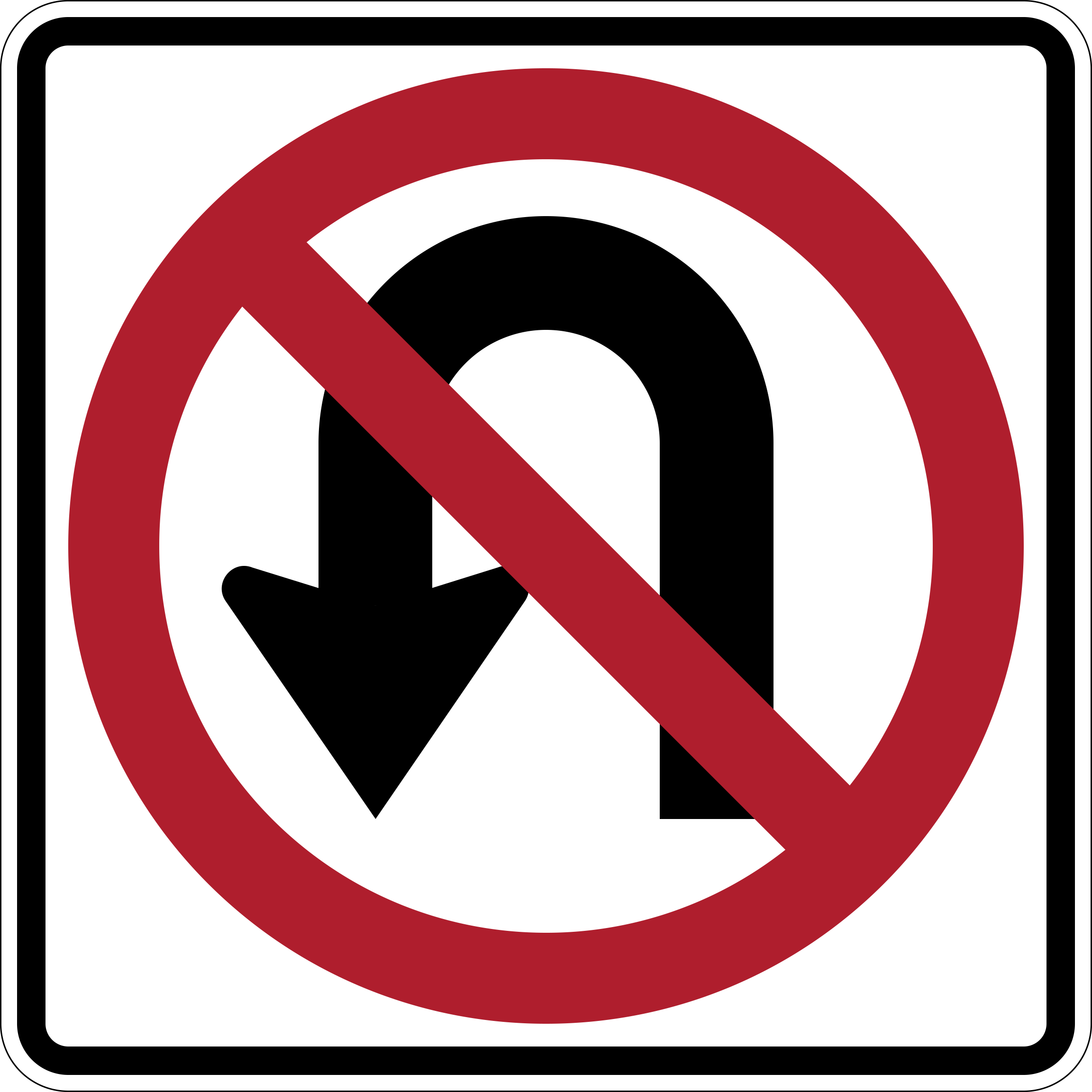
- Making a U-turn at that location
- Turning right after a full stop
- Changing lanes before the intersection
- Turning around through a legal opening
Show answer
Making a U-turn at that location. Virginia's manual says a No U-Turn sign means U-turns are illegal, so do not make a U-turn when you see this sign. Full explanation in Test 7
8. How far from an intersection must a Virginia driver park?
- At least 10 feet
- At least 15 feet
- At least 50 feet
- At least 20 feet
Show answer
At least 20 feet. Virginia's parking list says you may not park within 20 feet of an intersection. Full explanation in Test 8
9. A Virginia driver under 18 is convicted of a second demerit point violation. What does DMV do?
- Sends a warning letter only
- Suspends the driving privilege for 90 days
- Revokes the license until age 21
- Requires only a second online course
Show answer
Suspends the driving privilege for 90 days. For violations committed under 18, the first demerit point conviction sends the driver to a driver improvement clinic, and the second brings Full explanation in Test 9
10. Regardless of the posted limit, what speed can expose a Virginia driver to a reckless-driving charge?
- Over 85 MPH
- Over 65 MPH
- Exactly 80 MPH
- Exactly 75 MPH
Show answer
Over 85 MPH. Virginia identifies driving over 85 MPH as an independent reckless-driving basis, regardless of the posted limit. Full explanation in Test 10
11. In Virginia, how close to a railroad crossing may you park?
- No closer than 15 feet
- No closer than 25 feet
- No closer than 100 feet
- No closer than 50 feet
Show answer
No closer than 50 feet. The list of places where you may not park includes anywhere within 50 feet of a railroad crossing. Full explanation in Test 1
12. Who under age 21 may supervise a Virginia learner's permit holder?
- Any licensed friend age 18 or older
- Any licensed driver age 16 or older
- A licensed legal guardian or sibling age 18, 19 or 20
- No one under 21 may ever supervise
Show answer
A licensed legal guardian or sibling age 18, 19 or 20. A permit holder normally drives with a licensed driver at least 21 years old in the front passenger seat. Full explanation in Test 2
13. At least how far above the posted speed limit may support a Virginia reckless-driving charge based on speed?
- 10 MPH
- 15 MPH
- 20 MPH
- 5 MPH
Show answer
20 MPH. Virginia identifies 20 miles per hour above the posted limit as one speed based threshold for a possible reckless-driving charge. Full explanation in Test 3
14. Why should you create a space cushion around your vehicle?
- It gives you distance to react and avoid a crash
- It prevents every other driver from passing you
- It lets you drive faster than the posted limit safely
- It removes the need to check mirrors and blind spots
Show answer
It gives you distance to react and avoid a crash. Open space around the vehicle gives a driver room to respond when traffic changes suddenly. Full explanation in Test 4
15. When a green arrow points left, what movement does it permit if the way is clear?
- Turn right across the intersection
- Proceed straight only, not left
- Travel in the direction of the arrow
- Treat the signal as a stop sign
Show answer
Travel in the direction of the arrow. A green arrow permits movement in the arrow's direction when the way is clear, so a left-pointing arrow authorizes the left movement. Full explanation in Test 5
16. An applicant fails the Virginia road skills test at DMV. How long must the person wait to take it again?
- One day
- Two days
- 15 days
- 30 days
Show answer
Two days. After failing the road skills test, the applicant must wait two days before trying again. Full explanation in Test 6
17. Which location is included in Virginia's definition of a vehicle's passenger area for open-container enforcement?
- Only the exterior roof rack
- Only the trunk of the vehicle
- An unlocked glove compartment within the driver's reach
- A separate building next to the vehicle
Show answer
An unlocked glove compartment within the driver's reach. Virginia defines the passenger area broadly for this rule. Full explanation in Test 7
18. A Virginia driver whose license is suspended for an alcohol-related offense is caught driving. What happens to the vehicle right away?
- It is impounded for 30 days
- It is impounded for 3 days
- It is towed only if it is blocking traffic
- It is impounded for one year
Show answer
It is impounded for 30 days. The vehicle is impounded immediately for 30 days when someone drives after a suspension for an alcohol-related offense. Full explanation in Test 8
19. A 20-year-old Virginia driver is convicted of driving after illegally drinking, with a BAC of .09. Which penalties can apply?
- Only the underage .02 penalties
- No penalty, because the driver is not yet 21
- Only a written warning to the parents
- The same penalties as an adult
Show answer
The same penalties as an adult. An underage driver whose BAC was .08 percent or higher may face the same penalties as an adult DUI offender. Full explanation in Test 9
20. How many traffic-sign questions must an applicant answer correctly before moving to part two of Virginia’s knowledge exam?
- At least eight
- All ten
- At least five
- All thirty
Show answer
All ten. Part one contains ten traffic-sign questions, and the applicant must answer all ten correctly before taking part two. Full explanation in Test 10
21. When must you drive below a posted speed limit?
- Only when a police officer is following you
- When road construction or bad weather makes the posted speed unsafe
- Never, because the posted limit is always safe
- Only when another driver is traveling below the limit
Show answer
When road construction or bad weather makes the posted speed unsafe. A posted limit assumes ideal conditions, not every roadway situation. Full explanation in Test 1
22. When may a Virginia driver hold a cell phone while the vehicle is in use?
- Whenever the call is under one minute
- While using it for navigation and typing an address
- In a driver emergency or when the vehicle is lawfully parked or stopped
- At any red light
Show answer
In a driver emergency or when the vehicle is lawfully parked or stopped. Virginia law prohibits holding a cell phone or other wireless device while driving, except in a driver emergency or when the vehicle is lawf Full explanation in Test 2
23. What is prohibited when a funeral procession is traveling through Virginia?
- Yielding to the procession at an intersection
- Waiting until the procession has passed
- Allowing the lead vehicle to obey traffic signals
- Cutting through, joining, or interfering with the procession
Show answer
Cutting through, joining, or interfering with the procession. Virginia requires drivers to yield to funeral processions and separately prohibits cutting through them, joining them, or interfering with t Full explanation in Test 3
24. What must you do when traffic signals are out of service and displaying no lights?
- Stop and wait until a steady green appears
- Continue normally because no light means no rule
- Stop and proceed as though the intersection were an all-way stop
- Yield only to traffic approaching from the left
Show answer
Stop and proceed as though the intersection were an all-way stop. When a signal is dark because of a power outage or another problem, Virginia treats the intersection as an all-way stop. Full explanation in Test 4
25. What does braking distance describe?
- The time needed to notice a hazard
- The distance the car travels after the brakes are applied
- The distance traveled before the driver reacts
- The width of the lane during a stop
Show answer
The distance the car travels after the brakes are applied. Braking distance begins after the driver applies the brakes and continues until the vehicle stops. Full explanation in Test 5
26. How many demerit points can Virginia DMV assign to a single conviction?
- One, two or three
- Five, ten or fifteen
- Three, four or six
- Two, eight or twelve
Show answer
Three, four or six. Virginia assigns three, four or six demerit points per conviction, and tracks them over rolling 12 month and 24 month periods. Full explanation in Test 6
27. How does Virginia deliver a newly issued driver's license according to the manual?
- Only as a digital credential in a DMV app
- By mail, rather than issuing it at a customer service center
- Through the applicant's insurance company
- At the testing site immediately after the road test
Show answer
By mail, rather than issuing it at a customer service center. Virginia mails the new driver's license and, for security, does not issue licenses in customer service centers. Full explanation in Test 7
28. What does red used with white convey on a Virginia traffic sign?
- Motorist services only
- A destination or route distance
- Stop, yield, do not, and no
- A historical or cultural interest
Show answer
Stop, yield, do not, and no. Red used with white conveys stop, yield, do not, and no on Virginia traffic signs. Full explanation in Test 8
29. A Virginia officer asks you to sign a traffic citation. What does the manual say about signing?
- Signing counts as pleading guilty
- You may refuse to sign with no consequence
- Only a lawyer may sign for you
- Signing is not an admission of guilt, and refusing may lead to arrest
Show answer
Signing is not an admission of guilt, and refusing may lead to arrest. The manual tells drivers to sign the citation because signing is not an admission of guilt. Full explanation in Test 9
30. Where must Virginia drivers yield to pedestrians or bicyclists under this crosswalk rule?
- Only after the person reaches the driver’s lane
- Only at a signalized crosswalk
- At a clearly marked crosswalk or an unmarked intersection
- Only when a crossing guard is present
Show answer
At a clearly marked crosswalk or an unmarked intersection. The Virginia rule covers a person crossing within a clearly marked crosswalk and a person crossing at an intersection even when the pavement Full explanation in Test 10
31. You have a green light, but a pedestrian is still in the intersection. What must you do before turning?
- Turn first because the green light gives absolute priority
- Allow the pedestrian to cross before turning
- Drive around the pedestrian in the adjacent lane
- Sound the horn until the pedestrian stops
Show answer
Allow the pedestrian to cross before turning. A green signal permits movement only when the driver can proceed safely. Full explanation in Test 1
32. What should you do at a flashing red arrow?
- Slow down and turn without stopping
- Proceed straight because the arrow does not control your lane
- Wait for a green arrow even after the road is clear
- Stop completely, yield, and proceed in the arrow's direction when clear
Show answer
Stop completely, yield, and proceed in the arrow's direction when clear. A flashing red arrow combines a required stop with a controlled turn. Full explanation in Test 2
33. What response is appropriate at a Pedestrian Crossing warning sign?

- Maintain speed because pedestrians must wait
- Honk so people leave the crosswalk
- Slow down and be prepared to stop
- Move onto the shoulder to pass walkers
Show answer
Slow down and be prepared to stop. A pedestrian crossing warning means people may be entering a crosswalk or crossing the vehicle’s path. Full explanation in Test 3
34. What does a flashing yellow light require a driver to do?
- Stop and remain stopped until the light changes
- Turn only in the direction of a nearby arrow
- Speed up before the light turns red
- Slow down and proceed with caution
Show answer
Slow down and proceed with caution. A flashing yellow light requires reduced speed and cautious progress. Full explanation in Test 4
35. After moving to a new address within Virginia, how soon must you notify DMV?
- Within 10 days
- Within 60 days
- Only at your next renewal
- Within 30 days
Show answer
Within 30 days. Virginia requires drivers to notify DMV within 30 days of a move. Full explanation in Test 5
36. What does a Signal Ahead warning sign indicate?
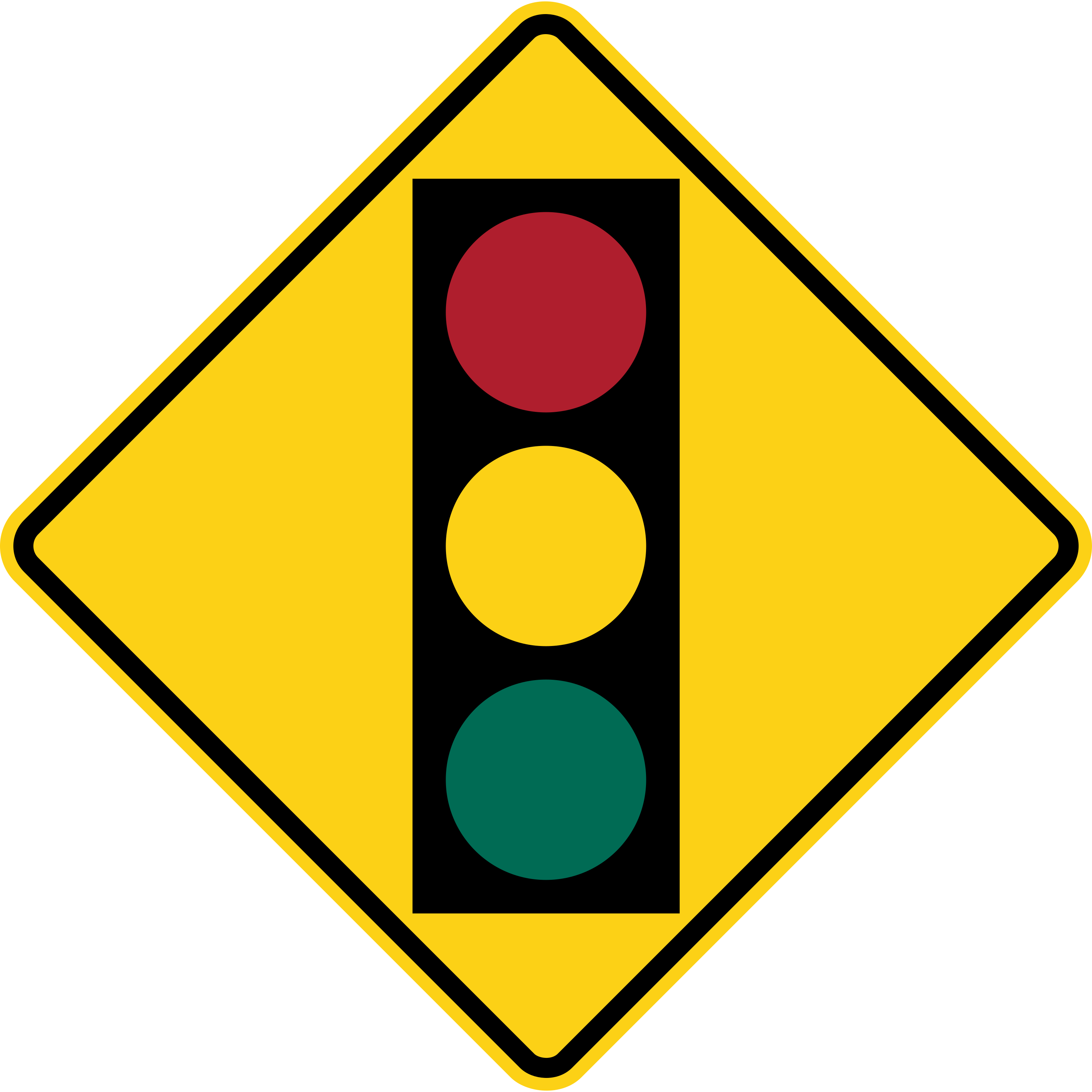
- A signal is behind you and can be ignored
- The next signal is permanently out of service
- Only emergency vehicles may enter the intersection
- Traffic signals are ahead, so slow and be ready to stop
Show answer
Traffic signals are ahead, so slow and be ready to stop. Signal Ahead is advance notice that traffic lights are coming. Full explanation in Test 6
37. What must a Virginia driver do when meeting a military convoy?
- Pass it on the left as soon as possible
- Yield to it, and never cut through or join it
- Stop and wait for it to pass in either direction
- Follow closely behind the last vehicle
Show answer
Yield to it, and never cut through or join it. You must yield to all military convoys, and never cut through or join a military convoy. Full explanation in Test 7
38. How often must a Virginia vehicle pass a safety inspection?
- Every two years, only when the vehicle is sold
- Once when the vehicle is first registered in Virginia
- Monthly, before every long trip
- Annually, with a valid inspection sticker displayed
Show answer
Annually, with a valid inspection sticker displayed. Virginia requires an annual vehicle safety inspection and a valid inspection sticker displayed on the vehicle. Full explanation in Test 8
39. What roadway condition is shown by a Winding Road warning sign?

- A series of turns or curves ahead
- A straight road with a single lane closure
- A railroad crossing with several tracks
- A hill where stopping is prohibited
Show answer
A series of turns or curves ahead. The winding-road symbol forecasts a series of turns or curves rather than one isolated bend. Full explanation in Test 9
40. What vision standard allows a Virginia license restricted to daylight driving only?
- 20/40 with 110 degrees
- 20/70 or better in one or both eyes, with 70 degrees or better horizontal vision
- 20/100 with 50 degrees
- No minimum for daylight driving
Show answer
20/70 or better in one or both eyes, with 70 degrees or better horizontal vision. A license restricted to daylight hours only requires 20/70 or better vision in one or both eyes and 70 degrees or better horizontal vision. Full explanation in Test 10
