
Key points
In a center lane marked with solid and broken yellow lines, drivers from either direction may turn left but may not travel more than 150 feet in it.
Source: Handbook p. 12
“drivers traveling in either direction may use the lane for making left turns. However, they may not travel further than 150 feet in this lane.”
Virginia Driver's Manual, Handbook p. 12Double solid white lines separate same direction lanes, often an HOV lane, and you may not cross them.
Source: Handbook p. 12
“Double solid white lines separate lanes of traffic going in the same direction. Most often they are used to designate special use lane from conventional lanes, as when used to separate a High Occupancy Vehicle lanes from the other lanes of an expressway. You may not cross these lines.”
Virginia Driver's Manual, Handbook p. 12Do not drive in a bicycle lane except when necessary to turn.
Source: Handbook p. 12
“Drivers should not drive in the bicycle lane except when necessary to turn left or right.”
Virginia Driver's Manual, Handbook p. 12At a red light, stop behind a bicycle box, not inside it.
Source: Handbook p. 13
“Drivers must stop for a red traffic signal behind all bicycle boxes, not inside the box.”
Virginia Driver's Manual, Handbook p. 13A painted curb means special parking rules apply; check with the locality for its meaning.
Source: Handbook p. 13
“A painted curb means that you must follow special rules to park there. Check with the locality for specific meanings.”
Virginia Driver's Manual, Handbook p. 13When parking next to a curb, you may not park more than 1 foot from it.
Source: Handbook p. 22
“If you park next to a curb, pull close to it. You may not park more than one foot from the curb.”
Virginia Driver's Manual, Handbook p. 22On a two way street, park on the right side; on a one way road, you may park on either side.
Source: Handbook p. 22
“On a two-way street, park on the right side of the road. On a one-way road, park on either side.”
Virginia Driver's Manual, Handbook p. 22Do not park within 15 feet of a fire hydrant or within 20 feet of an intersection.
Source: Handbook p. 22
“within 15 feet of a fire hydrant within 20 feet of an intersection”
Virginia Driver's Manual, Handbook p. 22Do not park within 50 feet of a railroad crossing.
Source: Handbook p. 22
“within 50 feet of a railroad crossing”
Virginia Driver's Manual, Handbook p. 22On a hill with a curb, turn your front wheels so the car cannot roll into the street.
Source: Handbook p. 22
“With a curb: Turn the front wheels of your vehicle to prevent it from rolling into the street.”
Virginia Driver's Manual, Handbook p. 22
Numbers to know
| Number | What it means | Manual |
|---|---|---|
| 150 feet | most you may travel in a two way center left turn lane | Handbook p. 12 |
| 1 foot | farthest you may park from the curb | Handbook p. 22 |
| 15 feet | no parking distance from a fire hydrant | Handbook p. 22 |
| 20 feet | no parking distance from an intersection | Handbook p. 22 |
| 15 feet | no parking distance from the entrance to a fire, ambulance or rescue squad station | Handbook p. 22 |
| 500 feet | no parking distance from fire equipment stopped at an alarm | Handbook p. 16 |
| 50 feet | no parking distance from a railroad crossing | Handbook p. 22 |
Recognize these signs
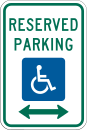
Disabled parking
3 questions from the Virginia practice test
1. When parking next to a curb on a public road, how close must your vehicle be?
- No more than three feet from the curb
- At least five feet from the curb
- No more than one foot from the curb
- Any distance if the hazard lights are on
Show answer
No more than one foot from the curb. When parking next to a curb, Virginia requires the vehicle to be pulled close and no more than one foot away. Three feet leaves unnecessary space for moving traffic and does not meet the stated limit. Parking five feet away is even farther from the curb, and hazard lights do not make an excessive distance lawful. After pulling over, check that the vehicle is not blocking a lane, driveway, or required access area. The easy measurement cue is approximately one foot, not the width of a parking lane.
2. When parking on a public road in Virginia, how should you position your vehicle?
- With the driver-side wheels on the centerline
- More than one foot from the curb
- As far from traffic as possible
- Facing against traffic on every road
Show answer
As far from traffic as possible. When parking on a public road, Virginia directs drivers to move as far from traffic as possible. If using a shoulder, pull as far onto it as possible; if next to a curb, pull close to it, because you may not park more than one foot from the curb. The centerline choice creates a hazard. On a two-way street, park on the right side of the road, so facing against traffic is not the rule; on a one-way road, you may park on either side. Look for a legal space that leaves moving traffic a clear path.
3. How far may a Virginia driver travel in a two-way center left turn lane?
- As far as needed to reach the turn
- Up to one half mile
- No more than 150 feet
- No more than 500 feet
Show answer
No more than 150 feet. A center lane bordered by a solid yellow line and a broken yellow line on each side may be used by drivers traveling in either direction for making left turns, but they may not travel further than 150 feet in this lane. It is a turning lane, not a passing or merging lane. Enter it just before the turn and watch for opposing drivers using the same lane.
Practice this topic
Lock it in with signals and markings questions from the free Virginia practice test. Every answer comes with a plain English explanation.
Source: the Virginia Driver's Manual, Section 2: Signals, Signs and Pavement Markings. This lesson is a plain English summary, not the law itself; where it differs, the manual and the statute govern. Last checked 2026-09-27.