Every question below comes from the Wyoming question bank on this page. Open a question to see the correct answer and the explanation. Nothing here is hidden behind a signup.
1. What information does a rectangular Wyoming traffic sign generally provide?
- A reminder that a vehicle cannot exceed 25 miles per hour
- A warning that animals are near the roadway
- The number of tracks at a railroad crossing
- Regulatory information about lawful speeds and directions
Show answer
Regulatory information about lawful speeds and directions. Rectangular signs communicate regulatory information, including lawful speeds and directions that govern how traffic should proceed. Full explanation in Test 1
2. Under Wyoming's Implied Consent law, when are drivers deemed to have consented to chemical tests for alcohol?
- Only when a commercial vehicle is involved
- Only after a judge signs a warrant
- Only after a crash causes an injury
- Whenever they drive on a public street or highway
Show answer
Whenever they drive on a public street or highway. Wyoming treats driving on a public street or highway as consent to the chemical testing process when an officer is investigating possible im Full explanation in Test 2
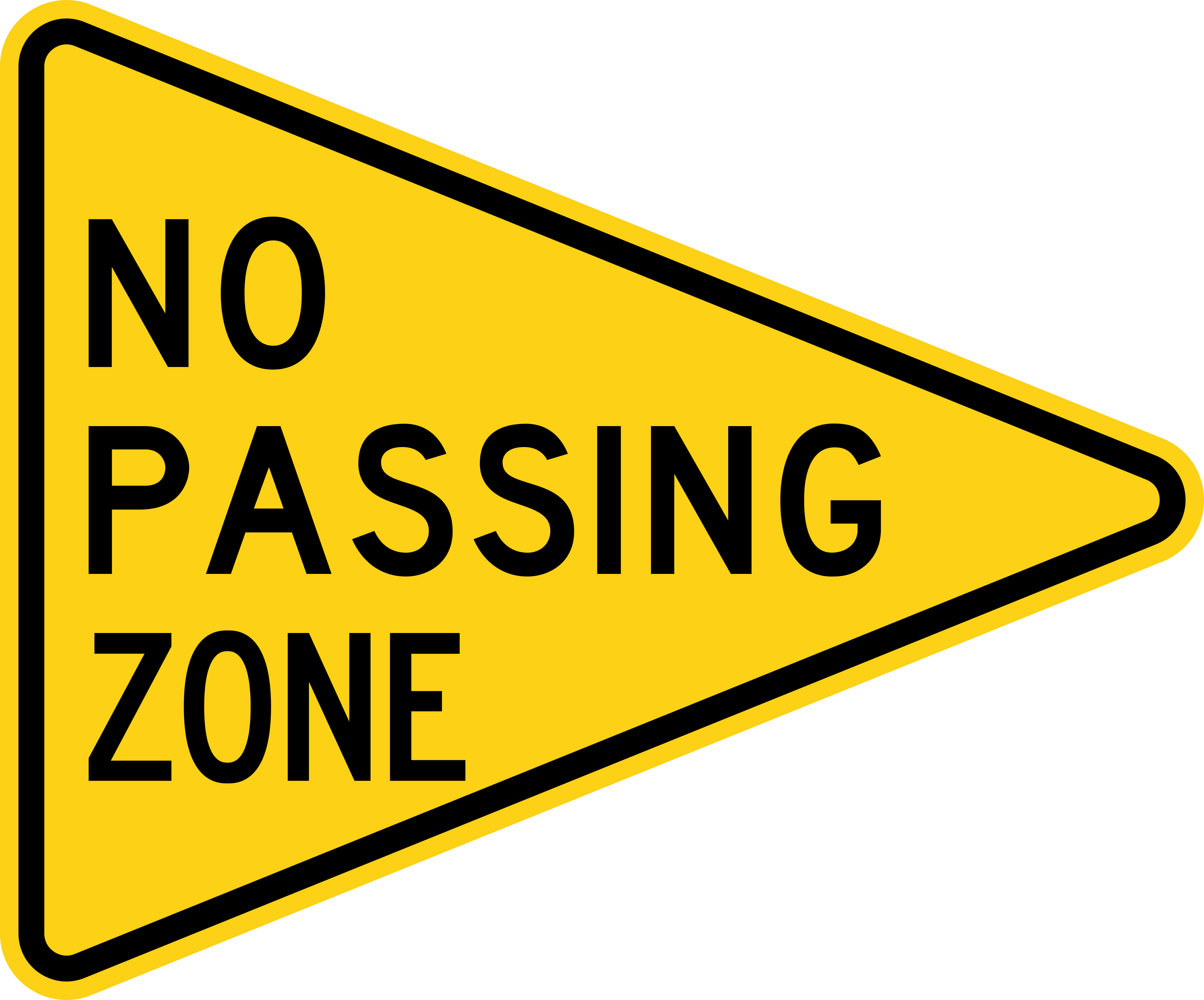
3. Where are pennant-shaped signs placed in Wyoming?
- Before a railroad crossing
- At the end of a school zone
- At the beginning of a no-passing zone
- At a required stop
Show answer
At the beginning of a no-passing zone. Pennant-shaped signs are located at the beginning of a no-passing zone. Full explanation in Test 3
4. What does the round railroad advance warning sign tell a driver to prepare for?

- A roundabout that requires entering counterclockwise
- A highway-rail intersection ahead, where the driver should slow, look, and listen
- A bicycle route with priority over motor vehicles
- A no-passing zone that ends immediately at the sign
Show answer
A highway-rail intersection ahead, where the driver should slow, look, and listen. The round railroad warning sign marks an approaching highway-rail intersection. Full explanation in Test 4
5. How long does it take to fully absorb the alcohol in a single drink, according to the Wyoming manual?
- About 5 hours
- About 2 minutes
- 30 to 40 minutes
- It is absorbed instantly
Show answer
30 to 40 minutes. The effects of alcohol increase with the passage of time because it takes 30 to 40 minutes to totally absorb the alcohol in a single drink. Full explanation in Test 5
6. Which vehicles does the Wyoming manual say are more likely to tip over in a skid?
- Four-wheel-drive vehicles with high centers of gravity
- Small front-wheel-drive cars
- Vehicles with anti-lock brakes
- Low sports cars with wide tires
Show answer
Four-wheel-drive vehicles with high centers of gravity. The manual warns that four-wheel-drive vehicles with high centers of gravity are more likely to tip over in a skid. Full explanation in Test 6
7. At an intersection with no signs or signals, you plan to turn left while an oncoming vehicle proceeds straight and another vehicle approaches from your right; to which vehicles must you yield?
- Yield to both vehicles
- Yield only to the vehicle on the right
- Yield only to the straight-moving vehicle
- Claim priority by turning first
Show answer
Yield to both vehicles. A left turn at an uncontrolled intersection creates two separate conflicts in the manual example. Full explanation in Test 7
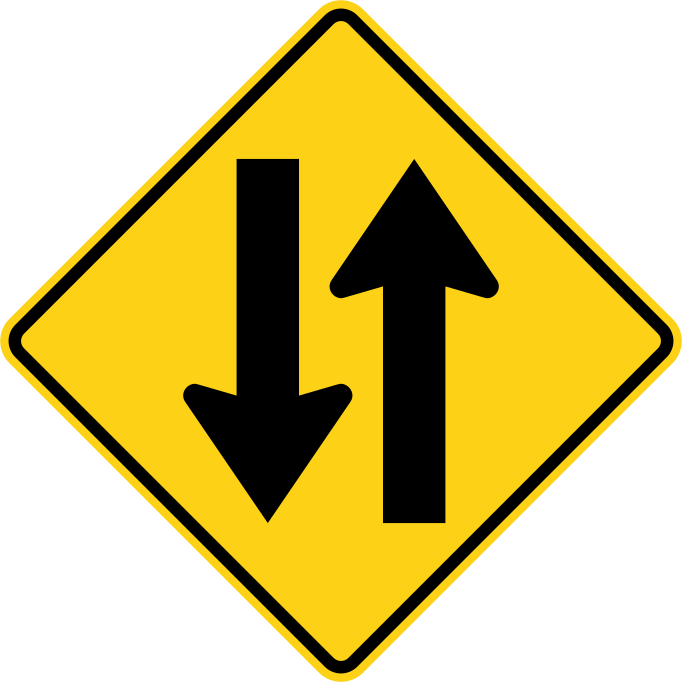
8. On the two-way roadway indicated by this sign, where should the driver travel?
- In any lane as on a multilane one-way roadway
- On the left side, because opposing vehicles must yield
- Across the center line whenever the lane ahead is open
- On the right side, leaving the left half for approaching traffic
Show answer
On the right side, leaving the left half for approaching traffic. On a two-lane road with one lane in each direction, Wyoming requires the driver to use the right side and yield the left half to oncoming tr Full explanation in Test 8
9. How can a Wyoming applicant get full driving privileges before age 17?
- At 16 and a half, after an approved driver education course and six months with an intermediate license
- At 15 with a restricted license
- At 16 with a parent's note
- Only at 17, no exceptions
Show answer
At 16 and a half, after an approved driver education course and six months with an intermediate license. For full driving privileges an applicant must be at least 17, or be 16 and a half and have completed an approved driver education course and Full explanation in Test 9
10. What does Wyoming impose for a third DWUI within 10 years?
- A 90-day suspension
- A one-year suspension
- A six-month suspension
- A three-year revocation
Show answer
A three-year revocation. A third or subsequent DWUI within 10 years results in a three-year revocation, not a suspension. Full explanation in Test 10
11. What does Wyoming law require of a driver at a railroad crossbuck?
- Always stop for five seconds even with clear tracks
- Yield the right of way to trains
- Speed up because trains must yield to vehicles
- Ignore the crossing unless a gate is present
Show answer
Yield the right of way to trains. Wyoming says railroad crossbuck signs are yield signs and that you are legally required to yield the right of way to trains. Full explanation in Test 1
12. What is the proper response to a steady amber traffic light when stopping is safe?
- Accelerate to beat the red light
- Stop before entering the intersection
- Proceed at the same speed whenever the light has just changed
- Treat it as permission to turn without yielding
Show answer
Stop before entering the intersection. An amber, or yellow, light means the driver should stop before entering the intersection when a safe stop is possible. Full explanation in Test 2
13. When does a Wyoming restricted (extreme inconvenience) license expire?
- On the holder's 16th birthday
- 30 days after the holder's 16th birthday
- One year after it is issued
- 30 days after the holder's 17th birthday
Show answer
30 days after the holder's 16th birthday. A restricted license expires 30 days after the holder's 16th birthday. Full explanation in Test 3
14. Without a licensed adult driver, how many unrelated passengers under 18 may an intermediate license holder carry?
- None
- Two
- One
- Three
Show answer
One. An intermediate license holder may transport no more than one passenger under 18 who is not an immediate family member unless accompanied by Full explanation in Test 4
15. What type of message does a yellow diamond shaped sign normally communicate?
- Guide information about destinations and distances
- Regulatory information about lawful speeds and directions
- A warning about a possible danger ahead
- A route marker identifying a numbered highway
Show answer
A warning about a possible danger ahead. Yellow diamond signs are warning signs, so they prepare drivers for a condition that may require attention or a speed adjustment. Full explanation in Test 5
16. When this school sign is posted near the roadway, what should a driver do?

- Keep the normal speed because the sign only identifies a school building
- Slow down and create more space when children may be near traffic
- Use the shoulder to pass any vehicle slowing for students
- Stop in the travel lane until a school employee waves traffic through
Show answer
Slow down and create more space when children may be near traffic. A school sign calls for more than simply identifying a nearby building. Full explanation in Test 6
17. A Wyoming driver is convicted in court of driving without liability insurance. How long does the suspension last?
- For 30 days
- Until an SR-22 insurance form is filed with the department
- For 90 days
- For one year
Show answer
Until an SR-22 insurance form is filed with the department. The Compulsory Insurance Suspension lasts until an SR-22 insurance form has been filed with the department. Full explanation in Test 7
18. For the instruction-permit route to a Wyoming intermediate license, how much behind-the-wheel driving must a parent or legal guardian certify?
- 30 hours, including 5 at night
- 40 hours, including 8 at night
- 60 hours, including 15 at night
- 50 hours, including 10 at night
Show answer
50 hours, including 10 at night. For the instruction-permit route, Wyoming requires 50 hours of behind-the-wheel driving, including 10 hours at night, certified by a parent Full explanation in Test 8
19. How long is the Wyoming license suspension for a first reckless driving conviction within five years?
- For 90 days
- For 30 days
- For one year
- For three years
Show answer
For 90 days. Reckless driving means driving with willful or wanton disregard for the safety of persons or property. Full explanation in Test 9
20. According to the Wyoming manual, when should a passing driver move back into the right lane?
- As soon as the front bumper is even with the other vehicle
- After counting two seconds past the other vehicle
- When the other driver flashes the headlights
- When the front of the passed vehicle is visible in the rear view mirror
Show answer
When the front of the passed vehicle is visible in the rear view mirror. Wyoming's how to pass steps are: decide if it is necessary to pass, start at least two seconds behind the vehicle ahead, make sure you have Full explanation in Test 10
21. When should a driver avoid changing lanes in relation to an intersection?
- Only when traveling on a two lane road
- Only after fully entering the intersection
- Before or while in the intersection
- Never, if the driver signals first
Show answer
Before or while in the intersection. Lane changes near intersections create extra conflicts with turning vehicles, crossing traffic, and drivers making their own moves. Full explanation in Test 1
22. After a traffic crash, how long must you stay at or near the scene?
- After calling police, even before officers question anyone
- After exchanging complete information, even if police have not arrived
- Until police have arrived and questioned everyone involved
- Only until traffic behind you begins honking
Show answer
Until police have arrived and questioned everyone involved. Wyoming says that if you are involved in a crash you must stop your vehicle at or near the crash scene and stay there until the police have Full explanation in Test 2
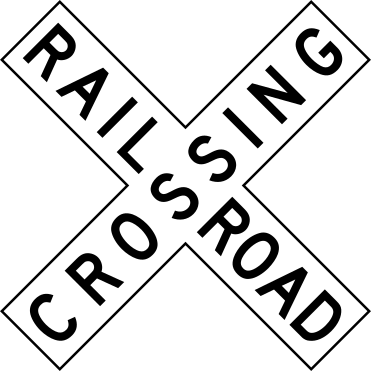
23. At the railroad crossing, how must a driver treat the crossbuck shown?
- As permission to pass another vehicle on the crossing
- As a stop sign that requires stopping even when every track is clear
- As a warning to accelerate before a train arrives
- As a yield sign, slowing, looking, listening, and stopping if a train approaches
Show answer
As a yield sign, slowing, looking, listening, and stopping if a train approaches. Wyoming identifies railroad crossbucks as yield signs. Full explanation in Test 3
24. What speed limit does the manual list for residential areas unless otherwise posted?
- 20 mph
- 25 mph
- 30 mph
- 35 mph
Show answer
30 mph. The manual's default speed table lists residential areas at 30 mph unless a different limit is posted. Full explanation in Test 4
25. On a divided roadway, which vehicles must stop when a school bus stops with flashing red lights?
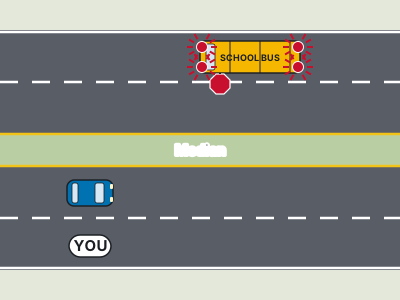
- Only vehicles on the same side of the separation as the bus
- Vehicles in every lane on both sides of the roadway
- Only vehicles directly behind the bus
- Only vehicles next to the bus after its stop arm is fully extended
Show answer
Only vehicles on the same side of the separation as the bus. On a divided roadway, the stop requirement applies to vehicles traveling on the same side of the separation as the stopped school bus. Full explanation in Test 5
26. When should the driver reduce speed for the curve shown ahead?

- Before entering the curve, while the vehicle is still straight and stable
- After reaching the middle of the curve, with firm braking applied
- Only after entering the curve and feeling the vehicle drift
- After crossing the center line to improve the turning radius
Show answer
Before entering the curve, while the vehicle is still straight and stable. Wyoming's manual tells drivers to adjust speed before entering a curve, because going too fast can break the grip that tires have on the roa Full explanation in Test 6
27. How should speed change as a road becomes wet, covered with packed snow, and then icy?
- Reduce speed by exactly 5 mph for every condition
- Keep the dry-road speed until the tires begin to slide
- Reduce speed progressively, ending at a crawl on ice
- Use the posted limit because surface conditions do not alter it
Show answer
Reduce speed progressively, ending at a crawl on ice. The Wyoming guidance becomes more cautious as traction worsens. Full explanation in Test 7
28. After changing an address, how soon must a Wyoming licensee notify the department in writing?
- Within 10 days
- Within 5 days
- Within 30 days
- At the next license renewal only
Show answer
Within 10 days. The manual requires written notice within 10 days after a licensee changes an address. Full explanation in Test 8
29. A red signal that flashes calls for which action before entering?
- Continue through after reducing speed
- Come to a complete stop before entering the intersection
- Remain stopped until the flashing red changes to green
- Treat it as a warning that never controls entry
Show answer
Come to a complete stop before entering the intersection. A flashing red signal requires a complete stop before entering the intersection. Full explanation in Test 9
30. At a four-way stop, who should normally go first?
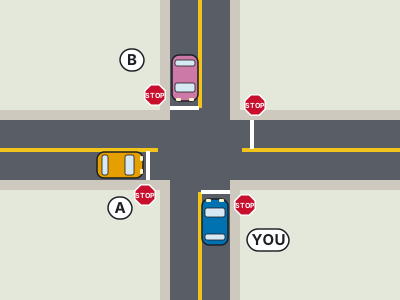
- The driver on the left
- The driver in the largest vehicle
- The driver who stopped first
- The driver who is turning left
Show answer
The driver who stopped first. At a four-way stop, the driver who stops first should normally be permitted to proceed first. Full explanation in Test 10
31. What should a driver do if an emergency stop is needed on the road?
- Park on a curve if the shoulder is wider there
- Keep only the right wheels off the pavement and leave the left wheels in the lane
- Move all four wheels off the pavement if possible and turn on emergency flashers
- Stop on a hill without using warning lights
Show answer
Move all four wheels off the pavement if possible and turn on emergency flashers. The safest emergency stop removes the vehicle from the active path of traffic. Full explanation in Test 1
32. Where should you place your vehicle during an emergency stop when possible?
- On a hill or curve where the vehicle is easiest to reach
- With only the right wheels on the shoulder and the left wheels on the pavement
- Partly in the travel lane so other drivers can see you
- With all four wheels off the pavement
Show answer
With all four wheels off the pavement. An emergency stop should remove the disabled vehicle from moving traffic as much as conditions allow. Full explanation in Test 2
33. What does a round traffic sign warn a Wyoming driver about?
- The beginning of a no-passing zone
- A school zone or school crossing
- A railroad crossing ahead
- A requirement to yield to cross traffic
Show answer
A railroad crossing ahead. Wyoming reserves the round shape for a railroad crossing warning. Full explanation in Test 3
34. Which offense causes a license revocation in Wyoming?
- A first speeding ticket
- Failing to report an address change
- A first reckless driving conviction
- Leaving the scene of an injury accident
Show answer
Leaving the scene of an injury accident. Wyoming lists the offenses that cause a revocation: a third or later DWUI, a third or later reckless driving offense, leaving the scene of a Full explanation in Test 4
35. Besides the SR-22 and reinstatement fee, what must a Wyoming driver do to be relicensed after a third DWUI?
- Nothing more once the revocation ends
- Pay a $1,000 bond only
- Undergo an alcohol or drug evaluation, complete treatment, and pass a driving re-examination
- Take only a vision test
Show answer
Undergo an alcohol or drug evaluation, complete treatment, and pass a driving re-examination. Reinstatement after a third or later DWUI requires completing all suspension and revocation actions or getting an ignition interlock license Full explanation in Test 5
36. During a breakdown, where should you place the vehicle if you need to stop?
- With only the right-side wheels on the shoulder
- With all four wheels on the shoulder
- Partly in the travel lane so the vehicle remains visible
- On the shoulder only after stopping first in the lane
Show answer
With all four wheels on the shoulder. For a breakdown, Wyoming directs a driver to stop with all four wheels on the shoulder. Full explanation in Test 6
37. Why does the manual say it cannot serve as an actual expression of Wyoming law?
- Its guidance becomes legally binding only after an applicant passes the test
- It uses simple terms instead of the language of Wyoming Motor Vehicle Law
- Only its printed speed limits reproduce legally authoritative text
- It explains licensing procedures but excludes the basic intent of traffic laws
Show answer
It uses simple terms instead of the language of Wyoming Motor Vehicle Law. The introduction explains that the manual uses simple language rather than the language of Wyoming Motor Vehicle Law, so it cannot be treate Full explanation in Test 7
38. A Wyoming intermediate license holder is driving friends. Whose seat belt use is the teen responsible for?
- All occupants of the vehicle
- Only passengers under 18
- Only the teen driver's own
- Only the front seat passenger
Show answer
All occupants of the vehicle. Holders of intermediate licenses must ensure that all occupants of the vehicle are wearing seat belts, alongside the passenger limit and the Full explanation in Test 8
39. A 19-year-old Wyoming driver gets a second Youthful Driver alcohol suspension within two years. How long is it?
- 30 days of suspension
- 90 days of suspension
- One year of suspension
- Six months of suspension
Show answer
Six months of suspension. Under the Youthful Driver Suspension, a first offense brings a 90-day suspension and a second or later offense within two years a six-month Full explanation in Test 9
40. If you are already in a roundabout when an emergency vehicle approaches, what should you do?
- Circle an extra lap so the emergency vehicle can choose a route
- Stop immediately inside the circle
- Continue to your exit, leave the roundabout, then pull right
- Remain at the entry until every approach is empty
Show answer
Continue to your exit, leave the roundabout, then pull right. When you are already in a roundabout and an emergency vehicle approaches, Wyoming tells you to continue to your exit, leave the roundabout, Full explanation in Test 10
