Every question below comes from the Mississippi question bank on this page. Open a question to see the correct answer and the explanation. Nothing here is hidden behind a signup.
1. Your car stalls on Mississippi railroad tracks with a train coming. How does the manual say to run?
- Straight down the tracks away from the train
- Toward the rear of the car
- Stay inside and honk
- At a 45 degree angle away from the tracks toward the train, then dial 911
Show answer
At a 45 degree angle away from the tracks toward the train, then dial 911. If your vehicle is on the tracks and the crossing lights begin to flash, the manual says you may have only 20 seconds before the train reach Full explanation in Test 1
Study this in the handbook: Railroad Crossings
2. At a two-way stop, two vehicles arrive together after cross traffic has cleared. Who has priority?
- The vehicle intending to travel straight across
- The vehicle intending to turn across the traffic lane
- The vehicle closest to the stop sign, regardless of direction
- Neither vehicle until a police officer arrives
Show answer
The vehicle intending to travel straight across. When two vehicles arrive at a two-way stop together, the one intending to travel straight across has the right-of-way. Full explanation in Test 2
Study this in the handbook: Right of Way at Intersections
3. How close to a crosswalk at an intersection may a vehicle park in Mississippi?
- No closer than 20 feet
- No closer than 5 feet
- Right up to the crosswalk line
- No closer than 75 feet
Show answer
No closer than 20 feet. Parking is not allowed within 20 feet of a crosswalk at an intersection in Mississippi, and parking on the crosswalk itself is also banned. Full explanation in Test 3
Study this in the handbook: Parking Rules
4. Your car breaks down. How can you let others know you need help?
- Stand in the travel lane and wave your arms
- Flashers on, hood up, and a white cloth tied on
- Turn off all lights to save the battery
- Walk along the interstate to find a ride
Show answer
Flashers on, hood up, and a white cloth tied on. If your vehicle breaks down, signal that you need help by turning on your emergency flashers, raising the hood, and tying a white cloth to y Full explanation in Test 4
Study this in the handbook: Following Distance and Stopping
5. According to the Mississippi manual, if your reactions slow down only a half-second at 55 mph, how much farther will your vehicle travel before stopping?
- An extra 5 feet
- No extra distance
- An extra 200 feet
- An extra 44 feet
Show answer
An extra 44 feet. Mississippi's manual warns that alcohol slows reflexes and reaction time, and that even two beers can markedly decrease them. Full explanation in Test 5
Study this in the handbook: DUI and Implied Consent
6. On a four-lane highway, what should a driver do when an emergency vehicle is parked on the roadside with lights or a siren activated?
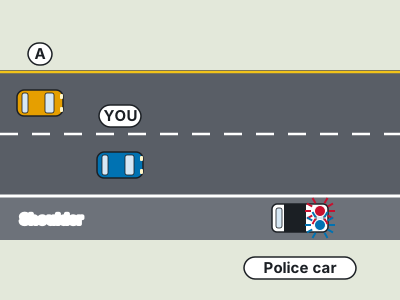
- Move onto the shoulder beside the emergency vehicle
- Merge into the lane away from the emergency vehicle if safe
- Pass without changing position or reducing attention
- Stop in the lane next to the emergency vehicle
Show answer
Merge into the lane away from the emergency vehicle if safe. On a four-lane highway, the driver should merge into the lane away from the parked emergency vehicle when that movement is safe. Full explanation in Test 6
Study this in the handbook: Emergency Vehicles
7. How much better fuel economy does the Mississippi manual say most cars get at 50 mph than at 70 mph?
- About 28 percent more miles per gallon
- About 2 percent more
- No difference
- About 50 percent less
Show answer
About 28 percent more miles per gallon. Most automobiles get about 28 percent more miles per gallon on the highway at 50 mph than at 70 mph, and about 21 percent more at 55 mph tha Full explanation in Test 7
8. How may a Mississippi learner's permit be used?
- For unsupervised driving after midnight
- Only with a licensed driver
- Only on interstate highways
- For vehicle registration without driving
Show answer
Only with a licensed driver. A learner's permit may be used only when a licensed driver is present. Full explanation in Test 8
Study this in the handbook: Learner's Permits and the Regular License
9. When a broken yellow line is closest to your lane beside a solid yellow line, what may you do?
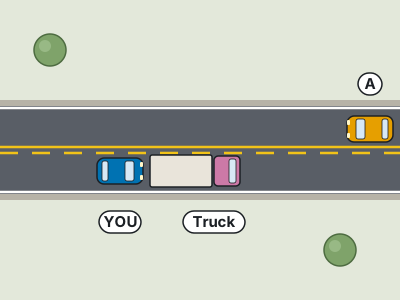
- Pass if you sound the horn and speed up quickly
- Pass at any time because the solid line applies only to trucks
- Pass with caution when the oncoming lane is clear and it is safe
- Cross the lines to turn around, but not to pass another car
Show answer
Pass with caution when the oncoming lane is clear and it is safe. With a broken yellow line closest to the driver's lane, crossing to pass is permitted only with caution and only when the oncoming lane is c Full explanation in Test 9
Study this in the handbook: Pavement Markings and Lanes
10. At a flashing red light, what must happen before the driver proceeds?
- Stop completely, then proceed cautiously while following intersection yielding rules
- Slow only if another vehicle is approaching
- Continue without stopping when the cross street is empty
- Turn left immediately before the signal changes
Show answer
Stop completely, then proceed cautiously while following intersection yielding rules. A flashing red signal requires a complete stop, followed by cautious movement under the ordinary right-of-way rules for an intersection. Full explanation in Test 10
Study this in the handbook: Traffic Signals and Arrows
11. Where do you begin a turn-around in a confined space?
- From the center line, wheels straight, rolling forward quickly
- From the left curb, wheels right, backing into the street first
- From a stopped position across both lanes at once
- From the extreme right side, signaling, wheels sharply left while inching forward
Show answer
From the extreme right side, signaling, wheels sharply left while inching forward. A confined turn-around starts at the extreme right side with a signal, wheels cut sharply left, creeping forward to use available width. Full explanation in Test 11
12. When following a large vehicle at night, what should you do with headlights?
- Dim your headlights so glare does not blind its driver
- Raise high beams so the truck driver sees you clearly
- Flash beams repeatedly to mark your position behind
- Turn lights off briefly so mirrors stop reflecting glare
Show answer
Dim your headlights so glare does not blind its driver. Behind a large vehicle at night, dim headlights keep glare out of its oversized mirrors and preserve that driver forward vision. Full explanation in Test 12
Study this in the handbook: Bicycles and Large Vehicles
13. Besides sunset to sunrise, when does the Mississippi manual say to use headlights?
- Only in rain
- Only on interstates
- Whenever parking lights would do
- Any time you cannot see clearly ahead for 500 feet
Show answer
Any time you cannot see clearly ahead for 500 feet. Headlights should be used between sunset and sunrise and any other time you cannot see clearly ahead for 500 feet. Full explanation in Test 13
Study this in the handbook: Night Driving, Rain and Skids
14. How should speed change as you approach and clear an intersection?
- Speed up on approach to beat cross traffic through
- Slow on approach, stop if required, then gradually speed up after clearing
- Hold full speed and brake only inside the intersection
- Stop in the middle, then accelerate hard to clear it
Show answer
Slow on approach, stop if required, then gradually speed up after clearing. Approach intersections slower, stop when required, and build speed gradually only after clearing the conflict area completely. Full explanation in Test 14
Study this in the handbook: Right of Way at Intersections
15. Why must stereo headphones never be worn while driving?
- Headphones and loud audio can block whistles and sirens
- Headphones are allowed if only one ear is covered
- Loud audio is harmless if the windows are closed
- Sirens are visible, so hearing them is not required
Show answer
Headphones and loud audio can block whistles and sirens. The manual warns that headphones and loud audio can prevent a driver from hearing warning signals such as whistles and sirens. Full explanation in Test 15
Study this in the handbook: Night Driving, Rain and Skids
16. You park facing downhill on a hill with no curb. How should the wheels be turned?
- Toward the uphill side
- Sharply to the left
- Straight ahead
- Sharply to the right
Show answer
Sharply to the right. In a downhill position, the manual calls for the front wheels sharply to the right whether or not a curb is present. Full explanation in Test 16
Study this in the handbook: Parking Rules
17. When may a cyclist move left, farther into the traffic lane?
- When the right side of the lane is unsafe.
- When the cyclist wants to avoid being passed.
- When a vehicle is following closely behind the cyclist.
- Whenever the cyclist reaches a marked intersection.
Show answer
When the right side of the lane is unsafe.. Mississippi expects a cyclist to ride as far right as safely possible. Full explanation in Test 17
Study this in the handbook: Bicycles and Large Vehicles
18. When does a Temporary Learner's Permit stop being valid in Mississippi?
- When the student leaves the driver education course
- After two full years from the issue date
- When the student turns fifteen years old
- Only when a parent cancels it in writing
Show answer
When the student leaves the driver education course. A Temporary Learner's Permit stays valid only while the student is enrolled in an approved driver education course. Full explanation in Test 18
Study this in the handbook: Learner's Permits and the Regular License
19. Farm machinery exceeding size limits may travel how far from its origin?
- Any distance, provided travel stays off interstate highways
- Within fifty miles of the point of origin, in daylight hours
- Within ten miles, and only between midnight and dawn
- Statewide on interstates during daylight hours only
Show answer
Within fifty miles of the point of origin, in daylight hours. Oversize farm machinery is exempt from size, weight, and height limits only in daylight, on state highways, within fifty miles of origin. Full explanation in Test 19
20. How should the driver seat be adjusted before driving?
- As far back as possible while still touching pedals barely
- Low and reclined for a relaxed posture on long trips
- So you can reach the wheel and pedals easily and comfortably
- Close enough that elbows bend sharply against the torso
Show answer
So you can reach the wheel and pedals easily and comfortably. Seat position should let you reach wheel and pedals easily from a comfortable posture, supporting full brake pressure and steering range. Full explanation in Test 20
Study this in the handbook: Seat Belts, Child Seats and Distractions
21. How long must a driver hold a Regular Learner's Permit before upgrading to a Regular Driver's License, unless the driver turns seventeen first?
- Six months
- One year
- Two years
- Three months
Show answer
One year. The permit stage lasts one year before a driver can upgrade to a Regular Driver's License. Full explanation in Test 21
Study this in the handbook: Learner's Permits and the Regular License
22. What is the first rule for every right-of-way situation?
- Insist on your right whenever the law assigns it
- Always use common sense in right-of-way situations
- Let the largest vehicle decide every conflict point
- Memorize the order and ignore unusual circumstances
Show answer
Always use common sense in right-of-way situations. Common sense heads the right-of-way rules, because no priority assignment is worth forcing when another driver behaves unpredictably. Full explanation in Test 22
Study this in the handbook: Right of Way at Intersections
23. What control action does the Mississippi manual prohibit while a driver is turning?
- Press down on the brake or clutch while turning
- Signal before changing lanes or turning
- Stay in the proper lane through the turn
- Look around in all directions before the turn
Show answer
Press down on the brake or clutch while turning. While the car is turning, the manual says not to push down on the brake or clutch. Full explanation in Test 23
24. A school bus has stopped with its red lights flashing. What must happen before you may proceed?
- The last child in the group reaches the curb
- Children clear, the bus moves, and its lights and sign stop
- The driver in the lane ahead begins moving
- The bus driver waves you past from the window
Show answer
Children clear, the bus moves, and its lights and sign stop. The stop does not end when the children reach the curb or when the bus driver waves. Full explanation in Test 24
Study this in the handbook: School Buses and Pedestrians
25. What does the Mississippi manual say about walking along or across an interstate?
- Walk on the left edge facing traffic
- Walk on the right shoulder with a flashlight
- Never walk along or across the interstate
- Walk only after the emergency flashers are on
Show answer
Never walk along or across the interstate. The advice to walk on the left facing traffic applies to ordinary highways, not to interstates. Full explanation in Test 25
Study this in the handbook: Following Distance and Stopping
26. A yellow flashing arrow appears for your turn. What must you do?
- Turn immediately because the arrow gives a protected movement
- Turn in the arrow's direction only from the proper lane and yield to oncoming traffic
- Stop and wait until a solid green arrow appears
- Accelerate and claim priority over approaching vehicles
Show answer
Turn in the arrow's direction only from the proper lane and yield to oncoming traffic. A yellow flashing arrow permits a turn in the arrow's direction from the proper lane, but it does not create a protected movement. Full explanation in Test 1
Study this in the handbook: Traffic Signals and Arrows
27. What does a ONE WAY arrow sign tell drivers?

- They must use the center lane for passing
- They may turn either way at the next signal
- They may travel only in the direction of the arrow
- They may reverse direction when traffic is light
Show answer
They may travel only in the direction of the arrow. The one-way display restricts travel to the direction shown by its arrow. Full explanation in Test 2
Study this in the handbook: Regulatory and Warning Signs
28. What minimum speed does Mississippi list for passenger cars on interstates and four-lane state and U.S. highways?
- 30 mph
- 45 mph
- 55 mph
- 40 mph
Show answer
40 mph. The passenger automobile table lists a 40 mph minimum for interstates (maximum 70) and for four-lane state and U.S. highways (maximum 65). Full explanation in Test 3
Study this in the handbook: Mississippi Speed Limits
29. How close to the nearest rail of a railroad crossing may a Mississippi driver park?
- No closer than 50 feet
- No closer than 5 feet
- No closer than 100 feet
- No closer than 15 feet
Show answer
No closer than 15 feet. Mississippi prohibits parking within 15 feet of the nearest rail of any railroad crossing. Full explanation in Test 4
Study this in the handbook: Parking Rules
30. After moving to Mississippi, how soon must a resident obtain a Mississippi license plate?
- Within 60 days
- Within 10 days
- Within 30 days
- By the next annual vehicle inspection
Show answer
Within 30 days. A person who moves to Mississippi must obtain a Mississippi license plate within 30 days. Full explanation in Test 5
Study this in the handbook: Required Equipment, Tags and Tint
31. When should a Mississippi driver reduce speed because of visibility or weather?
- When traffic is light and the roadway is straight
- Only when the road is dry and visibility is clear
- Only after reaching the posted maximum speed
- When the weather or visibility is poor
Show answer
When the weather or visibility is poor. Mississippi instructs drivers to slow down when weather or visibility is poor. Full explanation in Test 6
Study this in the handbook: Mississippi Speed Limits
32. A school bus carrying a child, a vehicle for hire carrying passengers, or a vehicle hauling explosives approaches a railroad crossing. How far from the outer rail must it stop?
- Within 5 to 10 feet
- At least 100 feet away
- Within 50 to 100 feet
- Within 10 to 50 feet
Show answer
Within 10 to 50 feet. A school bus carrying even one child, a passenger vehicle for hire, or a vehicle carrying explosives or flammable liquids must stop within 5 Full explanation in Test 7
Study this in the handbook: Railroad Crossings
33. What should a driver expect at a pedestrian crossing warning sign?

- Pedestrians may be crossing and have the right-of-way at intersections
- Pedestrians are prohibited from entering any marked crosswalk
- Only school buses may stop near the crossing
- The sidewalk is closed and vehicles may use it
Show answer
Pedestrians may be crossing and have the right-of-way at intersections. The pedestrian crossing warning means people may be crossing, and the manual reminds drivers that pedestrians have the right-of-way at inter Full explanation in Test 8
Study this in the handbook: Regulatory and Warning Signs
34. How can you tell whether a large truck driver can see your car?
- If you flash your lights, the driver can see you
- If you can see the truck's taillights, the driver can see you
- Truck drivers can always see cars directly behind them
- If you cannot see the truck's side mirrors, the driver cannot see you
Show answer
If you cannot see the truck's side mirrors, the driver cannot see you. A blind spot exists immediately behind large tractor-trailer rigs. Full explanation in Test 9
Study this in the handbook: Following Distance and Stopping
35. What jail term does Mississippi list for a second DUI offense within five years?
- Up to 48 hours
- Not less than 1 year nor more than 5 years
- No jail, only a fine
- Not less than 5 days nor more than 6 months
Show answer
Not less than 5 days nor more than 6 months. A second DUI within five years is still a misdemeanor, but the jail range rises to not less than 5 days and not more than 6 months, with a $ Full explanation in Test 10
Study this in the handbook: DUI and Implied Consent
36. What does a KEEP RIGHT sign direct a driver to do?

- Turn right at the next intersection regardless of lane markings
- Use the right lane only when preparing to pass
- Avoid driving on the right side of a divided road
- Keep the vehicle to the right of the obstruction or divider
Show answer
Keep the vehicle to the right of the obstruction or divider. The Mississippi manual labels this regulatory sign KEEP RIGHT, and its arrow curves to the right of the island or obstruction pictured on th Full explanation in Test 11
Study this in the handbook: Regulatory and Warning Signs
37. What warning does the manual give about pedestrians and other drivers at intersections?
- A driver may proceed whenever a signal is lit
- A pedestrian must yield whenever a vehicle is nearby
- A driver can ignore pedestrians outside marked crosswalks
- Do not assume that pedestrians or other drivers understand your intentions
Show answer
Do not assume that pedestrians or other drivers understand your intentions. The manual warns drivers not to assume that pedestrians or other drivers understand their intentions. Full explanation in Test 12
Study this in the handbook: Right of Way at Intersections
38. Before backing toward the curb in step two, what must you confirm?
- That your backing will not interfere with oncoming traffic
- That oncoming traffic will stop and wave you into place
- That the car behind has left its space for you to use
- That your front tires already align with the rear car bumper
Show answer
That your backing will not interfere with oncoming traffic. Step two backing begins only after confirming your path will not interfere with oncoming traffic approaching in the adjacent lane. Full explanation in Test 13
Study this in the handbook: Parking Rules
39. When may a driver overtake and pass another vehicle on the right?
- When the vehicle ahead is making or about to make a left turn
- When the right shoulder is wide and paved smoothly
- When the vehicle ahead is turning right at a corner
- Whenever the left lane feels crowded during heavy traffic flow
Show answer
When the vehicle ahead is making or about to make a left turn. Passing on the right is allowed when the car ahead is making or about to make a left turn, opening the right side lawfully. Full explanation in Test 14
Study this in the handbook: Signals, Lanes and Passing
40. What should a driver never do while driving across railroad tracks?
- Look both directions before entering the crossing area
- Check for a second train after the first one passes
- Stop before the tracks when signals begin flashing
- Shift gears while crossing the tracks with the vehicle
Show answer
Shift gears while crossing the tracks with the vehicle. Crossing tracks is no place to shift gears; a missed shift can stall the vehicle directly in the train path. Full explanation in Test 15
Study this in the handbook: Railroad Crossings
