
Test 10 of 10 · 20 questions · Free 2026
WY Permit Practice Test 10
Jump to the test ↓A fixed 20 question set from the Wyoming bank with answers and plain English explanations.
Question 1 of 20 · 0 right so far
All 20 questions in test 10
Every question below comes from the Wyoming question bank on this page. Open a question to see the correct answer and the explanation. Nothing here is hidden behind a signup.
1. What does Wyoming impose for a third DWUI within 10 years?
- A 90-day suspension
- A one-year suspension
- A six-month suspension
- A three-year revocation
Show answer
A three-year revocation. A third or subsequent DWUI within 10 years results in a three-year revocation, not a suspension. A revocation cancels the license, and the driver must go through a driver investigation to be relicensed. When alcohol is involved, an ignition interlock restricted license is required for two years plus the remainder of the revocation period. The 90-day and one-year choices are the first and second offense suspensions.
Study this in the handbook: DWUI, Administrative Per Se and youthful driver suspensions
2. According to the Wyoming manual, when should a passing driver move back into the right lane?
- As soon as the front bumper is even with the other vehicle
- After counting two seconds past the other vehicle
- When the other driver flashes the headlights
- When the front of the passed vehicle is visible in the rear view mirror
Show answer
When the front of the passed vehicle is visible in the rear view mirror. Wyoming's how to pass steps are: decide if it is necessary to pass, start at least two seconds behind the vehicle ahead, make sure you have time and space to pass safely, signal and check all around your vehicle, increase speed and pull into the passing lane, then move back into the right lane when you see the front of the vehicle in your rear view mirror. The two second figure belongs to the starting position, not the return, and the manual does not wait for a signal from the other driver.
Study this in the handbook: Speed limits and adjusting to conditions
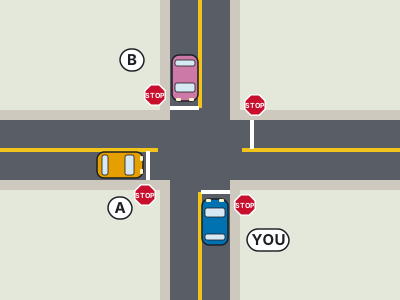
3. At a four-way stop, who should normally go first?
- The driver on the left
- The driver in the largest vehicle
- The driver who stopped first
- The driver who is turning left
Show answer
The driver who stopped first. At a four-way stop, the driver who stops first should normally be permitted to proceed first. If arrival is uncertain, the manual gives a secondary cue: yield to the driver on your right. Vehicle size and turning direction do not automatically establish priority, and a driver should never insist on going first if doing so risks a crash. Approach under control, make eye contact when needed, and let the sequence remain predictable. The key is first stop, then right-side courtesy if doubt remains.
Study this in the handbook: Right of way rules
4. If you are already in a roundabout when an emergency vehicle approaches, what should you do?
- Circle an extra lap so the emergency vehicle can choose a route
- Stop immediately inside the circle
- Continue to your exit, leave the roundabout, then pull right
- Remain at the entry until every approach is empty
Show answer
Continue to your exit, leave the roundabout, then pull right. When you are already in a roundabout and an emergency vehicle approaches, Wyoming tells you to continue to your exit, leave the roundabout, and then pull right so it can pass. Stopping inside the circle can block circulating traffic and the responder. Taking an extra lap delays the clear path, while the entry choice applies to a driver who has not yet entered. The cue is your location: inside the roundabout means exit first, then yield from the right side.
Study this in the handbook: Right of way rules
5. What is the usual purpose of a diamond-shaped road sign in Wyoming?
- To warn of a road hazard
- To identify a legal speed limit
- To show a destination distance
- To mark a hospital service
Show answer
To warn of a road hazard. The manual uses the diamond shape as a warning that a road hazard or other change may be ahead. Shape remains useful when fog, rain, snow, darkness, or fading light makes lettering difficult to read. A rectangular sign is the one associated with regulatory information such as lawful speeds and directions. Destination and hospital information belong to different sign purposes. When a diamond appears, reduce distractions, scan for the developing hazard, and prepare to adjust speed or position.
6. Which sign shape is reserved for stop signs?
- Downward-pointing triangle
- Round circle
- Octagon, with eight sides
- Five-sided pentagon
Show answer
Octagon, with eight sides. Wyoming reserves the eight-sided octagon for stop signs. Its unusual outline lets drivers identify the required action even when glare, snow, or darkness obscures the lettering. A round sign warns of a railroad crossing, a downward triangle requires yielding, and a pentagon warns of a school zone or marks a school crossing. Therefore shape recognition should happen before the vehicle reaches the sign. Once the octagon is identified, make a complete stop at the crosswalk or stop line and then assess the intersection.
Study this in the handbook: Road sign shapes and colors
7. On a dark road, why should a driver avoid traveling faster than 55 mph when headlights illuminate only about 250 feet?
- The posted limit cancels the need to match speed to visibility
- The driver must switch to parking lights above that speed
- High beams always reveal every object in time to brake
- The vehicle may not be able to stop within the distance the driver can see
Show answer
The vehicle may not be able to stop within the distance the driver can see. The issue is stopping distance, not a rule about parking lights or a claim that high beams reveal everything. The manual explains that lights let a driver see clearly for about 250 feet, and speeds above 55 mph on a dark road may prevent stopping within that visible area. Reduce speed enough to keep the stopping distance inside the illuminated roadway. This gives time to respond to an object that appears at the edge of the beam.
Study this in the handbook: Speed limits and adjusting to conditions
8. What is the highest posted interstate speed limit listed in the Wyoming manual?
- 65 mph
- 70 mph
- 80 mph
- 75 mph
Show answer
80 mph. The speed table lists two interstate figures, 80 mph and 75 mph. Since the question asks for the highest posted interstate value in that list, 80 mph is the unique answer. The 75 mph choice is tempting because it is also an interstate number, but it is not the top value printed in the table. A driver still follows the posted sign for the exact segment and reduces speed when weather, traffic, or visibility makes the maximum unsafe.
Study this in the handbook: Speed limits and adjusting to conditions
9. If a driver was uninsured during a crash and cannot provide a release, what cash deposit does the manual describe?
- The property damage plus $25,000 per injury
- The property damage plus $10,000 per injury
- The property damage plus $5,000 per injury
- A flat $50,000 regardless of damage
Show answer
The property damage plus $25,000 per injury. For an uninsured crash, the manual lists a cash deposit for the total property damage plus $25,000 per injury as one possible reinstatement path. The deposit is not a flat amount, and the lower per-injury figures are not the stated condition. Other paths include notarized releases or a later affidavit, but those alternatives do not change the amount in this cash-deposit option. Think of the formula as two pieces: all property damage, then $25,000 for each injury.
Study this in the handbook: Suspensions, revocations and reinstatement
10. What happens when a Wyoming driver's BAC is 0.08 percent or more after the required test?
- The license is suspended for 30 days
- The license and driving privileges are suspended for 90 days
- Only the vehicle registration is suspended
- There is no license consequence unless property is damaged
Show answer
The license and driving privileges are suspended for 90 days. The manual says a BAC of 0.08 percent or more brings a 90-day suspension of the driver license and driving privileges, along with possible criminal penalties. Thirty days is not the period given in this passage. Vehicle registration and property damage are unrelated to the stated alcohol-testing consequence. Remember that the administrative suspension described here follows the test result, while a criminal case can also expose the driver to separate penalties.
Study this in the handbook: DWUI, Administrative Per Se and youthful driver suspensions
11. How does the Wyoming manual say to use conventional brakes to avoid locked wheels and a skid?
- Pump them about once every second
- Hold them down as hard as possible until the vehicle stops
- Tap them rapidly several times per second
- Release them completely and use the parking brake instead
Show answer
Pump them about once every second. Locked wheels and skids typically result when a driver jams on conventional brakes. The manual's rule of thumb is to pump those brakes about once every second, which lets the wheels keep rolling between applications so the tires can still steer. Holding the pedal down hard locks the wheels, rapid tapping does not give the wheels time to turn, and the parking brake is an emergency backup rather than a stopping method. This advice is for conventional brakes only; anti-lock brakes work differently.
Study this in the handbook: Night, weather and winter driving
12. Who may receive a Wyoming restricted license for extreme inconvenience?
- Any applicant under 16
- Applicants age 14 to 15 who held an instruction permit and live five or more miles from school or work
- Applicants age 16 to 17
- Anyone without public transportation
Show answer
Applicants age 14 to 15 who held an instruction permit and live five or more miles from school or work. A restricted license may be issued to applicants age 14 to 15 when an extreme inconvenience exists in their household. The applicant must have held an instruction permit and must live five or more miles from school or employment. The license limits driving hours and distance, is suspended for a moving violation, and expires 30 days after the holder's 16th birthday.
Study this in the handbook: Tests, renewals and restricted licenses
13. What must a driver do when a traffic signal is flashing red?
- Stop completely, then proceed only after yielding as required
- Treat it as a green light if no vehicle is visible
- Slow without stopping and continue through the intersection
- Stop only when a pedestrian is waiting to cross
Show answer
Stop completely, then proceed only after yielding as required. A flashing red signal is a stop instruction. The driver must come to a complete stop, assess the intersection, and proceed only when the movement is safe and lawful. Treating the indication as green or merely slowing removes the required pause and can conflict with traffic that already has priority. Waiting for a pedestrian is too narrow because the signal governs vehicle movement as well. Stop at the line or before the crossing area, look in every direction, and yield before entering.
Study this in the handbook: Traffic signals and arrows
14. How long must a Wyoming applicant wait to retake a failed test, and what if 13 or more questions were missed?
- One week in all cases
- 30 days
- No wait, retest the same day
- 24 hours, or three days after missing 13 or more questions
Show answer
24 hours, or three days after missing 13 or more questions. Applicants who fail are required to wait 24 hours before testing again, and applicants who miss 13 or more questions must wait three days to be retested. The skills test may be waived for those who present a certification card from an approved driver education class. The number of missed questions decides which wait applies, so an applicant who misses 12 waits one day while one who misses 13 waits three. Neither a one week nor a 30 day wait appears in this retest rule.
Study this in the handbook: Tests, renewals and restricted licenses
15. Under Wyoming's safety belt law, who must wear a belt, and who is responsible for making sure they do?
- All occupants including the driver; the driver is responsible
- Only front seat occupants; each person is responsible
- Only children; parents are responsible
- Only the driver; passengers are exempt
Show answer
All occupants including the driver; the driver is responsible. Under Wyoming law a safety belt must be worn by all occupants of the vehicle, including the driver, and it is the driver's responsibility to see that the law is obeyed. Children must be in appropriate child restraint systems. The law is not limited to the front seat, to children, or to the driver. The manual adds that the lap belt goes snugly across the hip bones and the shoulder strap should never be worn alone.
Study this in the handbook: Seat belts and child restraints
16. How often may Wyoming issue a probationary driver's license to the same person?
- Every year
- Only once in a five year period
- Without limit
- Twice per suspension
Show answer
Only once in a five year period. You can only be issued one probationary driver's license in a five year period. The probationary license lets a suspended driver keep driving for limited purposes, and a request for it or a contested case hearing must be in writing with the required fee, postmarked within 20 days of the notice date. An SR-22 must be on file for the probationary license.
Study this in the handbook: Suspensions, revocations and reinstatement
17. What is the best defense against hazardous wind conditions for trucks, recreational vehicles, campers, and vehicles towing trailers?
- Following a large truck as closely as possible
- Using cruise control to hold a constant speed
- Accelerating through exposed areas
- Driving at slower speeds
Show answer
Driving at slower speeds. The manual says wind is a problem for all drivers and is especially hazardous for trucks, recreational vehicles, campers, and drivers towing trailers, and it names driving at slower speeds as the best defense. Accelerating through exposed areas or holding a set cruise control speed is the opposite of slowing down, and following a large truck closely adds a hazard of its own. The manual also says to watch for open spaces after driving in a protected area and to be ready to make steering corrections when the wind changes.
Study this in the handbook: Night, weather and winter driving
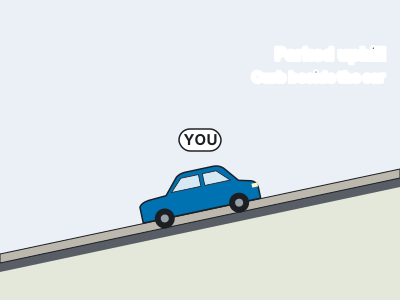
18. How should the front wheels be positioned when parking uphill beside a curb?
- Leave them straight
- Turn them toward the curb
- Turn them away from the curb
- Either wheel direction is acceptable if the parking brake is set
Show answer
Turn them away from the curb. When parking uphill beside a curb, Wyoming tells the driver to set the parking brake and turn the wheels away from the curb. The parking brake is required, but it does not make wheel direction optional. Turning toward the curb belongs to other hill-parking situations described in the same paragraph. Before leaving the vehicle, match the wheel angle to the hill and curb, turn off the engine, take the keys, and lock the car.
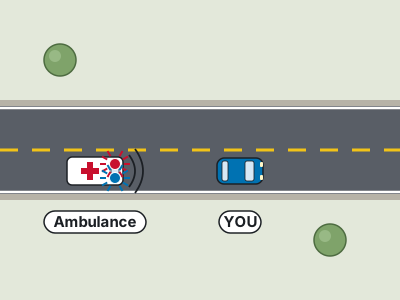
19. An emergency vehicle approaches from behind with its siren sounding. What should you do first?
- Race through the next intersection to stay ahead of it
- Pull as close as possible to the right edge and stop
- Stop immediately in the center of the intersection
- Maintain speed and let the emergency driver choose a path
Show answer
Pull as close as possible to the right edge and stop. When a fire truck, police car, or ambulance approaches from behind, the manual directs the driver to move as close as possible to the right curb or roadway edge and stop. Do not stop in an intersection, and remain stopped until the emergency vehicle has passed. Racing ahead can obstruct the response, while stopping in the center creates a blockage. Keeping a foot on the brake helps communicate that the vehicle is stationary. Afterward, check for additional emergency vehicles before moving.
Study this in the handbook: Emergency vehicles and the Move Over law
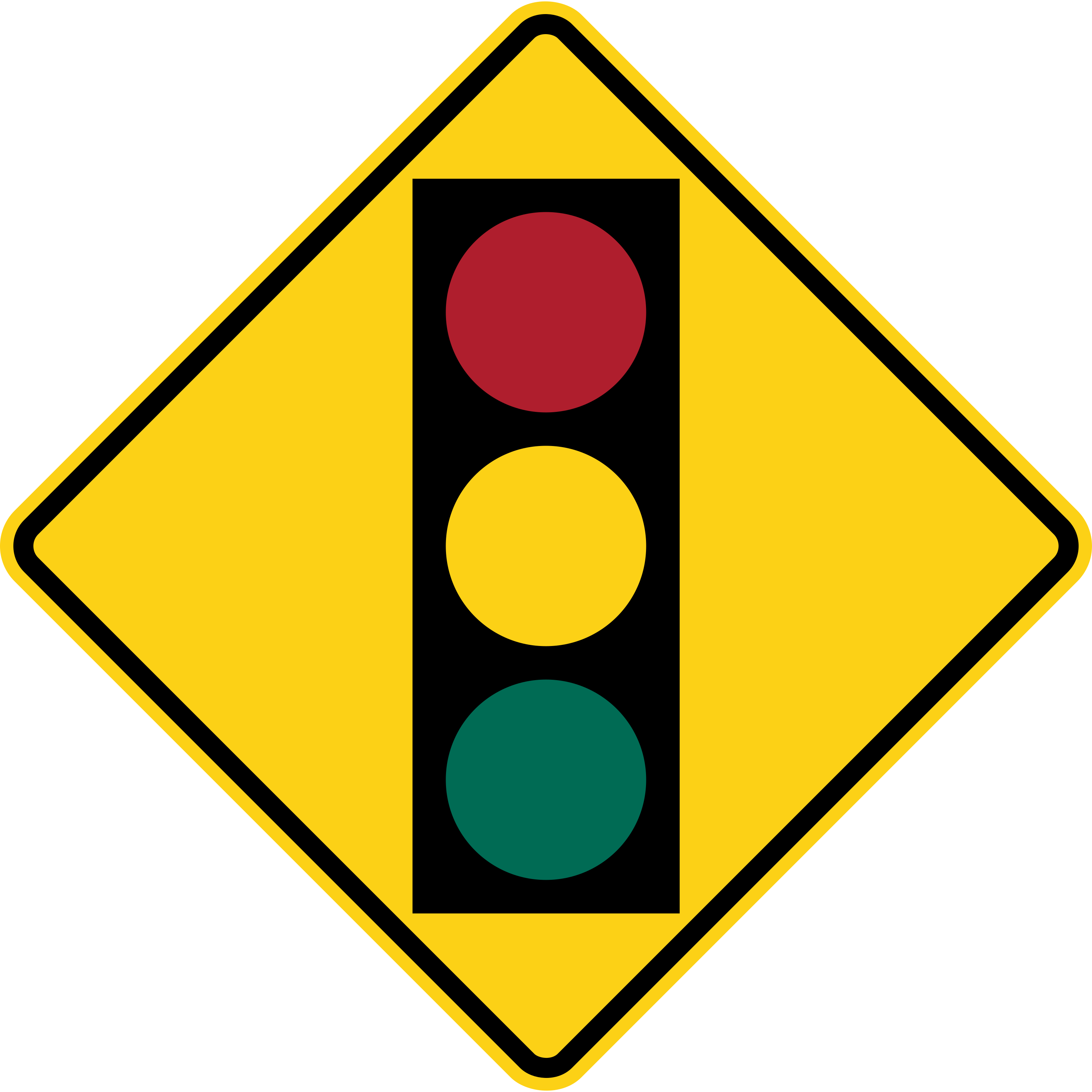
20. After seeing this advance warning, how should a defensive driver prepare?
- Accelerate so the signal cannot change before the vehicle arrives
- Scan ahead for the upcoming signal and be ready to adjust or stop
- Treat the warning sign itself as a stop sign at that point
- Ignore the warning until the signal is directly overhead
Show answer
Scan ahead for the upcoming signal and be ready to adjust or stop. Wyoming's manual says warning signs alert you to conditions ahead and warn about road hazards or other situations that require your special attention. Its IPDE method has defensive drivers scan ahead to identify anything that could cause them to slow down, speed up or turn. For a signal ahead, that means looking for the signal early and being ready to adjust, since the manual says that at an amber light you must stop before the intersection if possible. Accelerating, treating the sign as a stop, or ignoring it all defeat that advance warning.
Study this in the handbook: Road sign shapes and colors
QualitySpace is expanding to Wyoming
We are a California-based independent insurance brokerage working on licensing in more states. We cannot help with Wyoming insurance yet. Leave your email and we will let you know when we can.
Every question is written from the official Wyoming Rules of the Road Driver License Manual. Need paper? Printable WY practice test with answer key.
Last verified 2026-10-05. How we check every question · Study all 200 as flashcards
Frequently asked questions
How many questions are on this Wyoming practice test?
This fixed set has 20 questions. It is test 10 of 10 from the 200 question Wyoming bank.
How does this fixed test relate to the full Wyoming bank?
Each numbered test is a fixed set of questions in a fixed order, so you can retake the same test later and compare. Every test mixes road signs and the other topics in about the same proportion as the full bank. Tests 1 to 10 together cover every question in the Wyoming bank once. The full practice page mixes the whole bank at random.
Last verified 2026-10-05. See the Wyoming DMV facts page for sourced state details.