
Test 9 of 10 · 20 questions · Free 2026
WY Permit Practice Test 9
Jump to the test ↓A fixed 20 question set from the Wyoming bank with answers and plain English explanations.
Question 1 of 20 · 0 right so far
All 20 questions in test 9
Every question below comes from the Wyoming question bank on this page. Open a question to see the correct answer and the explanation. Nothing here is hidden behind a signup.
1. How can a Wyoming applicant get full driving privileges before age 17?
- At 16 and a half, after an approved driver education course and six months with an intermediate license
- At 15 with a restricted license
- At 16 with a parent's note
- Only at 17, no exceptions
Show answer
At 16 and a half, after an approved driver education course and six months with an intermediate license. For full driving privileges an applicant must be at least 17, or be 16 and a half and have completed an approved driver education course and held an intermediate license for six months. At 16 an applicant may obtain limited privileges through an intermediate license, and an instruction permit comes earlier. Under 18, a legal parent or guardian must sign a minor's release.
Study this in the handbook: Instruction permits and intermediate licenses
2. How long is the Wyoming license suspension for a first reckless driving conviction within five years?
- For 90 days
- For 30 days
- For one year
- For three years
Show answer
For 90 days. Reckless driving means driving with willful or wanton disregard for the safety of persons or property. A first offense within the previous five years brings a 90-day suspension, a second within five years six months, and a third or later within five years a one-year revocation. Reinstatement requires an SR-22 and the reinstatement fee. Thirty days, one year, and three years do not match a first reckless driving conviction.
Study this in the handbook: DWUI, Administrative Per Se and youthful driver suspensions
3. A red signal that flashes calls for which action before entering?
- Continue through after reducing speed
- Come to a complete stop before entering the intersection
- Remain stopped until the flashing red changes to green
- Treat it as a warning that never controls entry
Show answer
Come to a complete stop before entering the intersection. A flashing red signal requires a complete stop before entering the intersection. After stopping, the driver may proceed only when the way is safe and any required yielding is complete. The choice to continue after merely slowing treats the signal like a flashing amber light, which has a different meaning. A green light is not required before proceeding, and the signal is not advisory. The useful memory aid is simple: flashing red has the same meaning as a stop sign, so stop first and then check for traffic and pedestrians.
Study this in the handbook: Traffic signals and arrows
4. A 19-year-old Wyoming driver gets a second Youthful Driver alcohol suspension within two years. How long is it?
- 30 days of suspension
- 90 days of suspension
- One year of suspension
- Six months of suspension
Show answer
Six months of suspension. Under the Youthful Driver Suspension, a first offense brings a 90-day suspension and a second or later offense within two years a six-month suspension. Ninety days is only the first offense penalty. Thirty days is the under 21 penalty for driving while suspended, and one year is the suspension for transporting liquor to a minor. If the second offense conviction includes alcohol, a one year ignition interlock license is also required.
Study this in the handbook: DWUI, Administrative Per Se and youthful driver suspensions
5. What is the safest use of the warning shown before a stop-controlled intersection?

- Pass traffic immediately because the stop sign is still distant
- Begin planning and slowing early so a complete stop is possible
- Maintain speed and brake only after entering the intersection
- Treat the warning sign itself as permission to roll through the stop
Show answer
Begin planning and slowing early so a complete stop is possible. Wyoming's manual says warning signs alert you to conditions ahead and warn about situations that require your special attention, and that the octagon is reserved for stop signs, where you must come to a complete stop. A stop ahead warning therefore gives you time to slow down early so a complete stop is possible at the sign. Braking only after entering the intersection, passing because the stop is still distant, or rolling through the stop all ignore the warning and the stop it announces.
Study this in the handbook: Road sign shapes and colors
6. What does the Wyoming manual say about pumping anti-lock brakes?
- Pump them only when the road is icy
- Pump them once every second like conventional brakes
- Do not pump them; the anti-lock system pulses the brakes automatically
- Pump them twice, then hold the pedal down
Show answer
Do not pump them; the anti-lock system pulses the brakes automatically. The manual draws a clear line between the two brake types. Conventional brakes can be pumped about once every second to avoid locked wheels, but anti-lock brakes should not be pumped because the system achieves that effect automatically. The ABS note warns that pumping, or removing steady pressure from the pedal, will disengage or turn off the system. With ABS, press down hard on the brake pedal, hold it, and steer out of danger. How brakes can best be used depends on which type the vehicle has, so know your vehicle before an emergency stop.
Study this in the handbook: Night, weather and winter driving
7. How does the Wyoming manual describe a BAC of 0.02 percent?
- Legally drunk
- Fatal
- Low, with most people not significantly affected, though crash risk still rises from that level
- Impossible after one drink
Show answer
Low, with most people not significantly affected, though crash risk still rises from that level. A BAC of 0.02 percent is considered low and most persons are not significantly affected at this level, while 0.08 percent is considered high and people at that level are impaired mentally and physically whether or not they show it. Even drivers who can cover up their drunkenness increase their chances of a crash once they drive at 0.02 percent or higher.
Study this in the handbook: How alcohol affects you, and implied consent
8. At this sign, what action is required before entering the intersection?
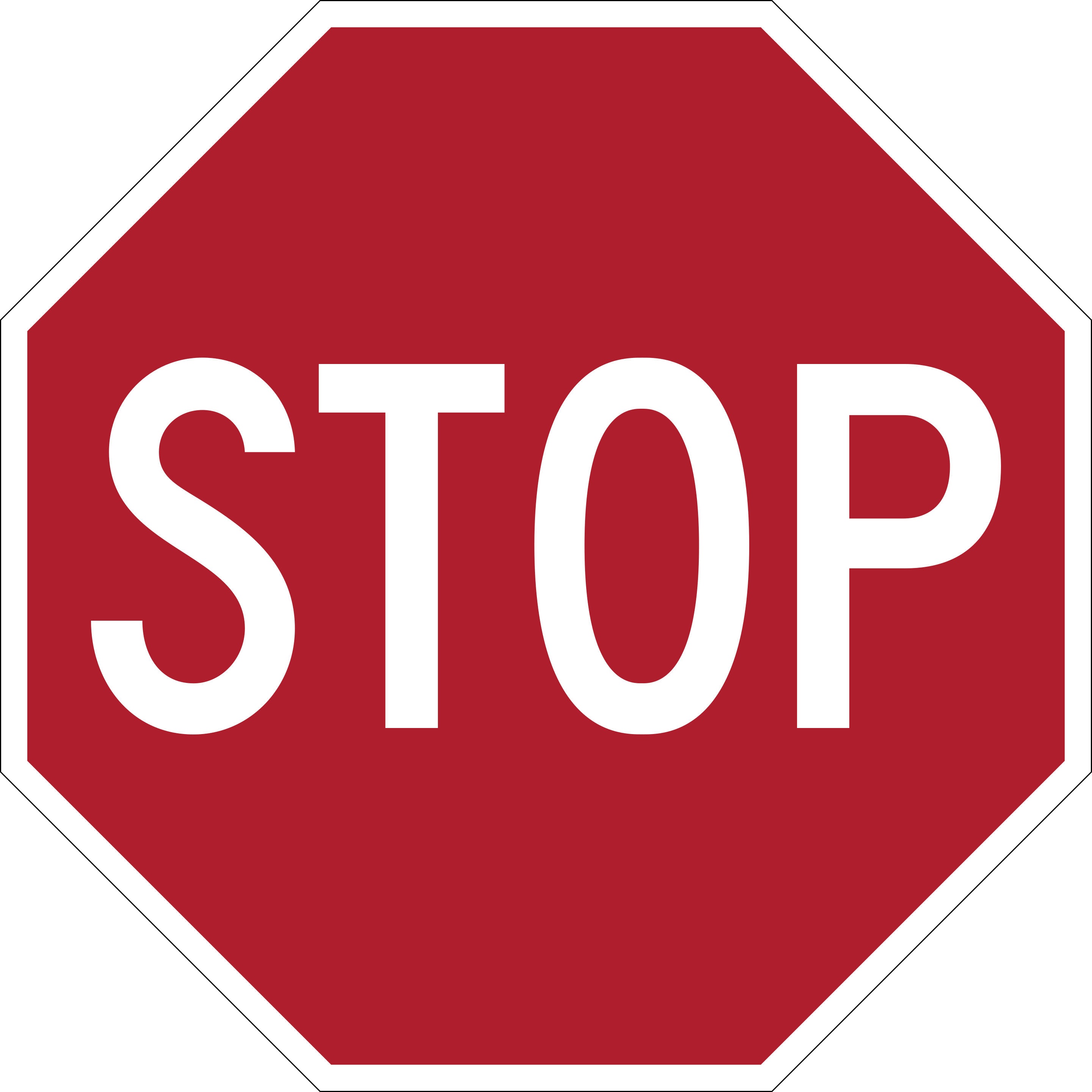
- Slow briefly and continue if no pedestrian is visible
- Make a complete stop before the crosswalk, then proceed when safe
- Stop only when another vehicle has already entered
- Yield without stopping unless the signal beside it is red
Show answer
Make a complete stop before the crosswalk, then proceed when safe. The octagonal stop sign requires a complete stop before the crosswalk. After stopping, the driver must yield and check the intersection before proceeding. A brief slowdown is not the required action, and waiting for another vehicle or a pedestrian to appear reverses the rule. The signal color is irrelevant to the sign's stop command. Use the crosswalk or stop line as the target point, keep the vehicle behind it, and scan in both directions before moving.
Study this in the handbook: School buses and required stops
9. According to the Wyoming manual's description of the school zone sign, what is the absolute speed limit in a school zone?
- 20 mph
- 15 mph
- 25 mph
- 30 mph
Show answer
20 mph. The pentagon sign section says the sign warns of a school zone ahead or marks a school crossing, and it states that the absolute speed limit in a school zone is 20 mph. The same 20 mph figure appears for school zones in the manual's legal speed limit table. Thirty mph is the figure the table gives for residential and business areas, and neither 15 mph nor 25 mph appears as the school zone limit. Slow to 20 mph whenever you enter a marked school zone.
Study this in the handbook: Speed limits and adjusting to conditions
10. Why does Wyoming's manual emphasize special caution around wildlife on rural highways?
- Migration seasons are the only time animal crashes happen
- Wildlife danger rises only after animals are already standing in the lane
- Large animals usually move predictably along the shoulder
- Collisions with deer and other big-game animals can seriously harm people and vehicles
Show answer
Collisions with deer and other big-game animals can seriously harm people and vehicles. Wyoming emphasizes wildlife because deer and other big-game animals create real rural highway danger, including serious injury and major vehicle damage. Migration seasons increase concern, but they are not the only possible time for an animal crash. Assuming animals move predictably along the shoulder is also risky because they can enter the lane suddenly. Reduce speed near wildlife signs, use extra caution at dawn and dusk, and scan the shoulder as far ahead as headlights or daylight allow.
Study this in the handbook: Motorcycles, pedestrians, bicycles and animals
11. When a YIELD sign is in your lane, what must you do?
- Yield to traffic close enough to create a danger
- Stop every time, even when no traffic is nearby
- Enter first because the sign grants priority
- Assume cross traffic will slow for you
Show answer
Yield to traffic close enough to create a danger. A yield sign calls for an assessment of cross traffic and a willingness to give way when another vehicle is close enough to be dangerous. It does not automatically demand a full stop every time, although stopping may be necessary to yield safely. Entering first reverses the sign's meaning, and assuming cross traffic will slow for you invites a collision. Approach slowly, look for a safe gap, and merge only after the required traffic has been given priority.
Study this in the handbook: Road sign shapes and colors
12. What must an insurance company do if an SR-22 on file is cancelled?
- Notify only the policyholder
- Notify the department
- Notify the department only at the next license renewal
- Wait for the driver to report the cancellation
Show answer
Notify the department. An SR-22 is filed with the department, so a cancellation has to be reported there by the insurance company. Notifying only the policyholder would leave the state record inaccurate, and waiting for renewal delays the report beyond the cancellation event. The driver is not the only source for this notice. A practical cue is the filing location: because the certificate is on file with the department, the insurer reports a cancellation to that same agency.
Study this in the handbook: Suspensions, revocations and reinstatement
13. How many attempts may an applicant make on Wyoming's written test during one day?
- One attempt
- As many as desired
- Three attempts
- Two attempts
Show answer
Two attempts. The automated testing section allows applicants to take the written test twice in one day. That means the daily total is two attempts, not two additional retakes after an initial test. One attempt is too restrictive, and unlimited testing is not authorized by the passage. The practical cue is to count the complete day's opportunities. An applicant who needs another opportunity beyond that daily allowance must return on a later day under the testing process.
Study this in the handbook: Tests, renewals and restricted licenses
14. When is passing on the right permitted under the manual's examples?
- Whenever the vehicle ahead is traveling below the speed limit
- Whenever the right shoulder is paved
- When the vehicle ahead is turning left and passing can be done safely
- Only by driving off the pavement
Show answer
When the vehicle ahead is turning left and passing can be done safely. Passing on the right may be done when the vehicle being overtaken is making a left turn, provided the maneuver is safe. It may also be possible where two or more lanes of heavy traffic move in the same direction. A paved shoulder does not create a general passing lane, and a slower vehicle alone is not enough. The manual expressly says it is not legal to leave the pavement to pass on the right. Check space, sight distance, and nearby traffic before moving.
Study this in the handbook: Pavement markings, signaling and passing
15. How is alcohol eliminated from the body, according to the Wyoming manual?
- Mostly through sweat during exercise
- Faster after coffee
- About 90 percent by the liver, at a constant rate of about one drink per hour
- Faster after a cold shower
Show answer
About 90 percent by the liver, at a constant rate of about one drink per hour. Time is the only significant factor in reducing BAC. Approximately 90 percent of the alcohol in your body is eliminated by the liver, at a constant rate that is about the same for everyone, about one drink per hour. It cannot be eliminated any faster; the manual calls showering, drinking coffee or exercising in an effort to sober up useless. Plan on time, not tricks.
Study this in the handbook: How alcohol affects you, and implied consent
16. A Wyoming teen with an instruction permit is practicing. Who must ride along, and where?
- A person 18 or older with a valid license for that vehicle type, in the front passenger seat
- Any licensed driver 16 or older, in any seat
- A parent only, in the back seat
- A licensed driver 25 or older, in the back seat
Show answer
A person 18 or older with a valid license for that vehicle type, in the front passenger seat. An instruction permit holder must be accompanied by a person 18 or older who has a valid driver license for the type of vehicle being driven, and that person must occupy the front passenger seat for instruction while the vehicle is driven. A 16-year-old companion is too young. The rule does not limit supervision to a parent, and the back seat does not meet the front seat requirement. Wyoming does not set a 25 year minimum for this role.
Study this in the handbook: Instruction permits and intermediate licenses
17. When entering a Wyoming roundabout, what must you do before merging?
- Drive clockwise to reach the next exit
- Stop in the circle and wait for every approach to clear
- Enter immediately because circulating traffic must yield
- Yield to pedestrians and traffic already in the roundabout
Show answer
Yield to pedestrians and traffic already in the roundabout. Approaching traffic must slow and yield to pedestrians and vehicles already in the roundabout before looking left and merging through a safe gap. Stopping in the circle interrupts the continuous flow, and circulating traffic does not have to yield to a vehicle entering. Roundabouts travel counterclockwise, so the clockwise option sends the vehicle against the intended movement. Once inside, keep moving, signal for the exit, and yield again to pedestrians leaving the crosswalk. The cue is yield before merge.
Study this in the handbook: Right of way rules
18. What vision standard must a Wyoming driver meet?
- 20/20 in each eye
- 20/100 with 90 degrees
- 20/40 acuity with both eyes, with or without glasses, and a combined horizontal field of at least 120 degrees
- Any vision if wearing glasses
Show answer
20/40 acuity with both eyes, with or without glasses, and a combined horizontal field of at least 120 degrees. A person must have 20/40 acuity with both eyes, with or without glasses, and a combined horizontal field of vision of at least 120 degrees to meet Wyoming's vision standard. Those who fail must obtain a statement from an eye specialist, and lenses used to pass become required while driving. Acuity worse than 20/40 but at least 20/100 triggers a required driving skills test.
Study this in the handbook: Tests, renewals and restricted licenses
19. Under Wyoming's Move Over Law, which additional stopped vehicle category is named besides emergency vehicles?
- Any privately owned passenger car with its hood raised
- An authorized municipal, public utility, or highway construction vehicle
- Only a school bus loading children on a two-lane road
- A delivery van stopped at a restaurant
Show answer
An authorized municipal, public utility, or highway construction vehicle. The law covers authorized municipal, public utility, highway construction, and highway maintenance vehicles when their lights or other emergency signals are activated and the vehicle is stopped or moving below 20 mph on or near the roadway. The private car and restaurant van choices are not named categories. A school bus is not the only additional class. On a multilane highway, move into the lane farthest from the stopped vehicle when safe; on a qualifying two-lane road, slow as required.
Study this in the handbook: Emergency vehicles and the Move Over law
20. Which description best matches the manual's warning about driving when strong emotions take control?
- A driver may continue if the road is empty
- Strong emotions improve reaction speed by increasing alertness
- Only anger affects driving; grief and fear do not matter
- A driver should not drive when grief, rage, or terror prevents clear thinking
Show answer
A driver should not drive when grief, rage, or terror prevents clear thinking. The manual says deep emotions can overwhelm clear thought, object identification, and sound decisions. When someone is grief stricken, enraged, or terrified and no longer in control, that person should not drive. The alertness claim mistakes agitation for reliable attention, and limiting the warning to anger ignores the other named states. An empty road does not remove the need to steer, judge, and respond. Recognize the emotional condition before starting the trip, and postpone driving until control returns.
QualitySpace is expanding to Wyoming
We are a California-based independent insurance brokerage working on licensing in more states. We cannot help with Wyoming insurance yet. Leave your email and we will let you know when we can.
Every question is written from the official Wyoming Rules of the Road Driver License Manual. Need paper? Printable WY practice test with answer key.
Last verified 2026-10-05. How we check every question · Study all 200 as flashcards
Frequently asked questions
How many questions are on this Wyoming practice test?
This fixed set has 20 questions. It is test 9 of 10 from the 200 question Wyoming bank.
How does this fixed test relate to the full Wyoming bank?
Each numbered test is a fixed set of questions in a fixed order, so you can retake the same test later and compare. Every test mixes road signs and the other topics in about the same proportion as the full bank. Tests 1 to 10 together cover every question in the Wyoming bank once. The full practice page mixes the whole bank at random.
Last verified 2026-10-05. See the Wyoming DMV facts page for sourced state details.