Every question below comes from the North Carolina question bank on this page. Open a question to see the correct answer and the explanation. Nothing here is hidden behind a signup.
1. What does the North Carolina handbook say to do before a curve while traveling downhill?
- Shift to neutral
- Shift to a lower gear and begin braking earlier
- Speed up to carry momentum
- Brake hard in the middle of the curve
Show answer
Shift to a lower gear and begin braking earlier. When you meet a curve while traveling downhill, consider the pull of gravity, shift to a lower gear before moving downhill, and begin to bra Full explanation in Test 1
2. What maximum speed does the North Carolina handbook list for a school bus?
- 55 mph
- 35 mph
- 45 mph
- 70 mph
Show answer
45 mph. The maximum speed limit listed for a school bus is 45 mph. Full explanation in Test 2
3. A North Carolina driver turning right on red fails to yield to a pedestrian starting to cross in front of stopped traffic. What penalty applies?
- A warning only, with no penalty
- A penalty of not less than $100 and not more than $500
- A flat $25 infraction
- A penalty of $1,000 to $2,000
Show answer
A penalty of not less than $100 and not more than $500. North Carolina allows a right turn on red after stopping unless a sign prohibits it, but the turning driver must yield to other traffic and Full explanation in Test 3
4. What testing accommodation is available on request for a North Carolina applicant who has difficulty reading?
- A waiver of the traffic law examination
- An audio version of the knowledge test
- A road test that replaces the knowledge test
- Automatic passage without answering questions
Show answer
An audio version of the knowledge test. Applicants who have difficulty reading may request an audio test for the knowledge examination. Full explanation in Test 4
5. How early may a North Carolina driver renew a license, and how often is online renewal allowed?
- Up to one year early, online every time
- Up to six months before expiration, online every other renewal
- Only in the last 30 days, in person only
- Any time, online every time
Show answer
Up to six months before expiration, online every other renewal. North Carolina drivers may renew a license up to six months before its expiration date. Full explanation in Test 5
6. Unless a different limit is posted, what speed limit applies in North Carolina cities and towns?
- 25 mph in cities and towns
- 35 mph in cities and towns
- 45 mph in cities and towns
- 55 mph in cities and towns
Show answer
35 mph in cities and towns. The handbook table gives 35 mph as the default maximum in cities and towns unless another limit is posted. Full explanation in Test 6
7. A 16-year-old North Carolina driver is driving. Whom may the teen call on a cell phone in an emergency?
- Emergency responders, a hospital or clinic, law enforcement, or a parent, legal guardian, or spouse
- Anyone, if the call is hands free
- Only friends in the car
- No one, even in an emergency
Show answer
Emergency responders, a hospital or clinic, law enforcement, or a parent, legal guardian, or spouse. North Carolina bars drivers under 18 from using a cell phone or related technology while driving, with an exception for emergency calls to a Full explanation in Test 7
8. When driving through changing areas such as open country, residential communities and school zones, what should a driver do?
- Watch for changing conditions and adjust speed accordingly
- Accelerate whenever entering a residential community
- Use the interstate speed in every school zone
- Keep the posted speed regardless of conditions
Show answer
Watch for changing conditions and adjust speed accordingly. The handbook warns that driving conditions change as a trip moves through open country, residential communities and school zones. Full explanation in Test 8
9. For a driver age 21 or older, which BAC level is the North Carolina per se DWI threshold?
- A BAC of 0.08 percent or more
- A BAC of 0.05 percent or more
- A BAC of 0.10 percent or more
- A BAC of 0.15 percent or more
Show answer
A BAC of 0.08 percent or more. North Carolina treats a BAC of 0.08 percent or more as one way to prove impaired driving for the ordinary driver. The 0. Full explanation in Test 9
10. What does the North Carolina handbook call the safest way to pass a bicyclist?
- Change lanes
- Sound the horn and pass closely
- Pass on the right
- Squeeze by in the same lane
Show answer
Change lanes. The safest way to pass a bicyclist is to change lanes, and to pass lawfully a driver must follow the vehicle passing laws in the General Sta Full explanation in Test 10
11. What must every vehicle in a North Carolina funeral procession display?
- Nothing special
- High beams only
- A flag on the antenna
- Headlights on, and hazard warning signals if equipped
Show answer
Headlights on, and hazard warning signals if equipped. Every vehicle in a North Carolina funeral procession must have its headlights on, and the hazard warning signals must also be on if the vehi Full explanation in Test 1
12. When leaving a parallel parking space, what should a North Carolina driver do before pulling into traffic?
- Move out immediately because parked vehicles have priority
- Use the right turn signal and leave without checking behind
- Sound the horn while backing into the nearest travel lane
- Check for approaching traffic and give a left turn signal
Show answer
Check for approaching traffic and give a left turn signal. A driver leaving a parallel space should first check for approaching traffic and signal left before pulling out. Full explanation in Test 2
13. After a North Carolina crash with no injuries, at what amount of apparent property damage must the driver immediately report it to law enforcement?
- $100 or more
- $5,000 or more
- Only when a vehicle must be towed
- $1,000 or more
Show answer
$1,000 or more. North Carolina requires an immediate report to the nearest law enforcement officer or agency when anyone is killed or injured, or when the t Full explanation in Test 3
14. What license suspension does North Carolina list for prearranged racing with another vehicle on the highway?
- A 30-day suspension
- 90 days
- 1 year
- 3 years
Show answer
3 years. North Carolina lists a 3 year suspension for prearranged racing on the highway, and the same 3 years for watching, betting on, or lending a Full explanation in Test 4
15. In which direction do vehicles travel around a traffic circle or roundabout?
- To the right around the circle in a counterclockwise direction
- Straight across the center whenever traffic is light
- In either direction according to the driver’s preferred lane
- To the left around the circle in a clockwise direction
Show answer
To the right around the circle in a counterclockwise direction. Vehicles in a traffic circle travel to the right around the circle in a counterclockwise direction until reaching the road where they intend Full explanation in Test 5
16. Which headlights does the North Carolina handbook say to use when driving at night in a city?
- High-beam headlights
- Parking lights only
- Low-beam headlights
- No headlights where streetlights are on
Show answer
Low-beam headlights. The North Carolina handbook separates city and open road lighting. When you drive at night in a city, use low beam headlights. Full explanation in Test 6
17. How long is the first suspension under North Carolina's point system?
- 30 days only
- 60 days
- 6 months
- 12 months
Show answer
60 days. A North Carolina point system suspension can be 60 days for the first, 6 months for the second, and 12 months for the third. Full explanation in Test 7
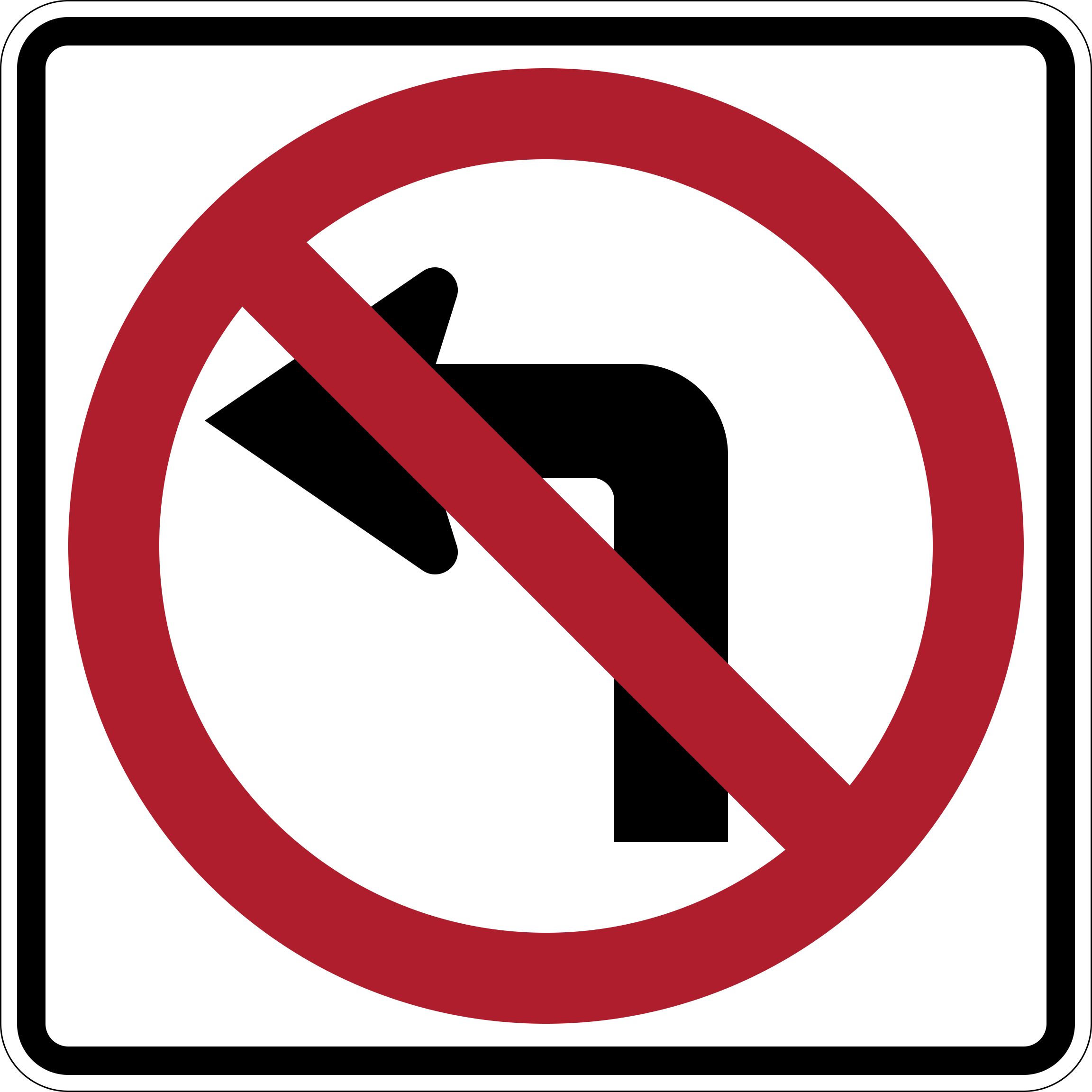
18. The pictured prohibition sign is an example of a sign used to show what?
- A route direction
- A driver service
- A road hazard
- A traffic regulation
Show answer
A traffic regulation. The pictured prohibition communicates a rule governing what drivers may do at that location. Full explanation in Test 8
19. Before a North Carolina driver under 18 may take the learner permit or license test, what driver education instruction is required?
- Ten classroom hours and two road hours
- At least 30 classroom hours and six behind-the-wheel hours
- Six classroom hours and 30 road hours
- Twenty classroom hours with no driving instruction
Show answer
At least 30 classroom hours and six behind-the-wheel hours. The handbook requires a certificate for an approved driver education course with at least 30 hours of classroom instruction and six hours be Full explanation in Test 9
20. In North Carolina, how far to the left must a passing driver pass the vehicle being overtaken?
- At least two feet
- At least six inches
- At least one foot
- At least ten feet
Show answer
At least two feet. The passing rule requires the driver to pass at least two feet to the left of the vehicle being passed. Full explanation in Test 10
21. On a highway with only one lane in your direction, how should you pass a stopped emergency vehicle with warning lights activated?
- Slow down and use a reduced, safe speed until completely past it
- Stop directly beside it
- Speed up to minimize the time nearby
- Change into the oncoming lane without checking
Show answer
Slow down and use a reduced, safe speed until completely past it. When only one lane travels in your direction, there is no adjacent same-direction lane for a standard move-over. Full explanation in Test 1
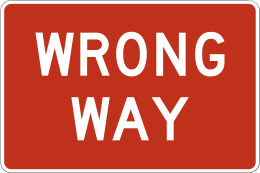
22. Rectangular and square-shaped signs that are normally black and white or red and white are used for what purpose?
- Warning that a railroad crossing is immediately ahead
- Showing speed limits and other traffic regulations
- Identifying hospitals and roadside telephone locations
- Marking the beginning of every passing zone
Show answer
Showing speed limits and other traffic regulations. North Carolina uses rectangular and square-shaped signs for speed limits and other regulations. Full explanation in Test 2
23. On a North Carolina highway with two lanes in your direction, a police car is stopped within 12 feet of the roadway with warning lights on. What must you do?
- Stop in your lane until the officer waves you on
- Move into a lane that is not the lane nearest the stopped vehicle and stay there until clear
- Stay in the nearest lane and sound the horn
- Speed up to clear the area quickly
Show answer
Move into a lane that is not the lane nearest the stopped vehicle and stay there until clear. North Carolina's move over law applies when an authorized emergency vehicle or public service vehicle is parked or standing within 12 feet o Full explanation in Test 3
24. A North Carolina driver is charged twice with reckless driving within 12 months. What suspension applies?
- 1 year
- Thirty days
- 60 days
- Permanent
Show answer
1 year. North Carolina's suspension table lists one year for two charges of reckless driving committed within 12 months. Full explanation in Test 4
25. Where do crashes caused by drowsy driving most often happen, according to the North Carolina handbook?
- In parking lots
- In city traffic during rush hour
- On high-speed rural highways when the driver is alone
- At school crossings
Show answer
On high-speed rural highways when the driver is alone. The National Sleep Foundation reports that crashes caused by drowsy driving are often serious and occur most often on high speed rural highw Full explanation in Test 5
26. When a ramp meter shows a circular green display, what may a North Carolina driver do?
- Proceed down the ramp and merge onto the freeway
- Drive onto the freeway without merging
- Back up and use the shoulder
- Stop at the ramp entrance until the display turns red
Show answer
Proceed down the ramp and merge onto the freeway. A circular green ramp-meter display permits a vehicle facing it to proceed down the entrance ramp and merge onto the freeway. Full explanation in Test 6
27. With properly working high-beam headlights at night, how far away should a North Carolina driver be able to see a person?
- 75 feet
- 200 feet
- 50 feet
- 1,000 feet
Show answer
200 feet. The North Carolina handbook gives a simple check for headlights. Full explanation in Test 7
28. What does the circular yellow RR sign warn you about?

- A school zone beginning immediately
- A railroad crossing ahead
- A required route around a work zone
- A hospital entrance ahead
Show answer
A railroad crossing ahead. The circular yellow sign with RR and a black cross gives advance warning of a railroad crossing ahead. Full explanation in Test 8
29. On a North Carolina road with a 55 mph speed limit, what is the minimum signaling distance before a turn?
- At least the last 50 feet
- At least the last 100 feet
- At least one mile
- At least the last 200 feet
Show answer
At least the last 200 feet. North Carolina asks for more warning on faster roads. Full explanation in Test 9
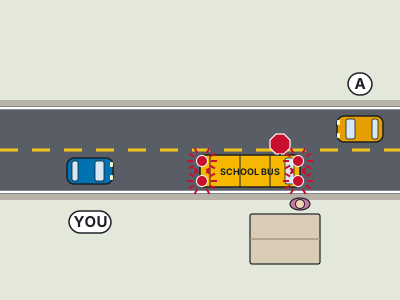
30. When a school bus is displaying its stop signal or flashing red lights, what must an approaching driver do?
- Pass after checking that no child is visible
- Stop only when following directly behind the bus
- Continue if the driver can see the bus driver
- Stop and not attempt to pass until the stop signal is withdrawn
Show answer
Stop and not attempt to pass until the stop signal is withdrawn. When a school bus displays its mechanical stop signal or flashing red lights, an approaching driver must stop and may not attempt to pass. Full explanation in Test 10
31. On a street with curbs, how close to the curb line of an intersecting street may a North Carolina driver park?
- No closer than 25 feet
- No closer than 10 feet
- No closer than 15 feet
- Right up to the crosswalk paint
Show answer
No closer than 25 feet. North Carolina keeps parked cars back from intersections so that drivers and pedestrians can see one another. Full explanation in Test 1
32. Without supervision or any immediate-family or household passengers aboard, how many outside passengers under 21 may a North Carolina Level Two driver carry?
- No more than one
- Two unrelated passengers under 21 on every trip
- No passengers under 21 under any circumstance
- Three passengers if each wears a seat belt
Show answer
No more than one. The limit is one passenger under 21 from outside the driver’s immediate family and household. Full explanation in Test 2
33. How far ahead on the roadway does the North Carolina handbook say good drivers try to look?
- 1 to 2 seconds ahead
- Only to the bumper of the car in front
- 10 to 15 seconds ahead, about one city block
- About one mile ahead
Show answer
10 to 15 seconds ahead, about one city block. Scanning is a core defensive driving skill in the North Carolina handbook. Full explanation in Test 3
34. A North Carolina provisional licensee is convicted of a fourth moving violation within 12 months. What suspension can follow?
- Six months
- One month
- 90 days
- Two years
Show answer
Six months. For a provisional licensee under 18, North Carolina's escalating suspensions are 30 days for a second moving violation within 12 months, 90 Full explanation in Test 4
35. If a vehicle stalls on or near railroad tracks, what should the occupants do first?
- Remain inside and try to restart the engine
- Stand behind the vehicle to warn traffic
- Wait for the crossing gate to rise before leaving
- Get out immediately
Show answer
Get out immediately. A stalled vehicle near tracks creates an immediate risk because a train may require more than a mile to stop. Full explanation in Test 5
36. What can happen to fines for a violation committed while driving a commercial motor vehicle in North Carolina?
- They are halved
- They may be doubled
- They are waived for a first offense
- They are the same as for a car
Show answer
They may be doubled. Any person who commits an offense for which points may be assessed while operating a commercial motor vehicle may be assessed double the amo Full explanation in Test 6
37. After a North Carolina DWI conviction with a BAC of 0.15 or more, what vehicle equipment may be required?
- A second passenger side air bag
- A commercial vehicle speed governor
- A replacement catalytic converter
- An ignition interlock device
Show answer
An ignition interlock device. A DWI conviction with a BAC of 0.15 or more requires an ignition interlock device to be installed on the vehicle under the handbook’s listed Full explanation in Test 7
38. How many hours must a North Carolina teen log on the Driving Log before a Level Two license, and how many at night?
- At least 40 hours, with 6 at night
- At least 50 hours, with 10 at night
- At least 60 hours, with at least 10 at night
- At least 30 hours, all in daylight
Show answer
At least 60 hours, with at least 10 at night. A Level One permit holder receives a Driving Log that must detail a minimum of 60 hours of operation, and at least 10 of those hours must oc Full explanation in Test 8
39. A North Carolina license holder moves to a new home within the state. By when must the holder update the physical address with the DMV?
- Within 10 days of moving
- Only at the next license renewal
- Within 60 days of moving
- Never, because the address only matters for out of state moves
Show answer
Within 60 days of moving. Chapter 7 of the North Carolina handbook covers a move inside the state. Full explanation in Test 9
40. How many driver license points may trigger assignment to a driver improvement clinic in North Carolina?
- Seven points
- Eight points
- Five points
- Twelve points
Show answer
Seven points. Accumulating seven driver license points may lead to assignment to a driver improvement clinic. Full explanation in Test 10
