
Test 3 of 10 · 20 questions · Free 2026
NC Permit Practice Test 3
Jump to the test ↓A fixed 20 question set from the North Carolina bank with answers and plain English explanations.
Question 1 of 20 · 0 right so far
All 20 questions in test 3
Every question below comes from the North Carolina question bank on this page. Open a question to see the correct answer and the explanation. Nothing here is hidden behind a signup.
1. A North Carolina driver turning right on red fails to yield to a pedestrian starting to cross in front of stopped traffic. What penalty applies?
- A warning only, with no penalty
- A penalty of not less than $100 and not more than $500
- A flat $25 infraction
- A penalty of $1,000 to $2,000
Show answer
A penalty of not less than $100 and not more than $500. North Carolina allows a right turn on red after stopping unless a sign prohibits it, but the turning driver must yield to other traffic and pedestrians using the intersection, including pedestrians close by who are starting to cross in front of the traffic stopped at the red light. The handbook states that failure to yield to a pedestrian in this situation will result in a penalty of not more than $500 and not less than $100. A warning or a small flat fee understates the consequence, and a four figure penalty is not the stated range.
Study this in the handbook: Traffic signals and pavement markings
2. After a North Carolina crash with no injuries, at what amount of apparent property damage must the driver immediately report it to law enforcement?
- $100 or more
- $5,000 or more
- Only when a vehicle must be towed
- $1,000 or more
Show answer
$1,000 or more. North Carolina requires an immediate report to the nearest law enforcement officer or agency when anyone is killed or injured, or when the total damage to vehicles and other property appears to amount to $1,000 or more. Even a crash without injuries can reach that figure quickly. Failure to make the report may lead to prosecution and a license suspension. One hundred dollars and five thousand dollars are not the stated threshold, and whether a car must be towed does not decide it. The handbook also advises reporting any crash to your insurance company.
Study this in the handbook: Blowouts, breakdowns and crashes
3. On a North Carolina highway with two lanes in your direction, a police car is stopped within 12 feet of the roadway with warning lights on. What must you do?
- Stop in your lane until the officer waves you on
- Move into a lane that is not the lane nearest the stopped vehicle and stay there until clear
- Stay in the nearest lane and sound the horn
- Speed up to clear the area quickly
Show answer
Move into a lane that is not the lane nearest the stopped vehicle and stay there until clear. North Carolina's move over law applies when an authorized emergency vehicle or public service vehicle is parked or standing within 12 feet of the roadway with its emergency or warning lights on. On a highway with at least two lanes of traffic going your way, you must move into a lane that is not the lane nearest the stopped vehicle and continue in that lane until safely clear. Only when there is a single lane in your direction does the rule switch to slowing to a reduced, safe speed. Stopping in the lane, staying close, or speeding up does not comply.
4. How far ahead on the roadway does the North Carolina handbook say good drivers try to look?
- 1 to 2 seconds ahead
- Only to the bumper of the car in front
- 10 to 15 seconds ahead, about one city block
- About one mile ahead
Show answer
10 to 15 seconds ahead, about one city block. Scanning is a core defensive driving skill in the North Carolina handbook. Good drivers try to see 10 to 15 seconds ahead on the roadway, which the handbook compares to about one city block. Looking that far ahead helps a driver avoid last minute moves such as sudden stops or quick lane changes. A one or two second look only covers the space right in front of the car, staring at the bumper ahead hides developing hazards, and a mile is beyond the stated range. Keep the eyes moving well down the road.
5. When a driver under 18 must use a cell phone while the vehicle is moving, whom may the driver call about an emergency?
- A friend who is waiting for a ride
- An emergency response operator
- A business for a nonurgent appointment
- A classmate about a homework assignment
Show answer
An emergency response operator. North Carolina prohibits drivers under 18 from using a cell phone or related technology while operating a moving vehicle on a public street, highway or public vehicular area. The listed emergency exception allows a call to an emergency response operator, and it also names a hospital, physician's office or health clinic, an ambulance service, a fire department and a law enforcement agency. A parent, legal guardian or spouse may be called as well. A friend, a classmate asking about homework and a nonurgent business call fall outside those exceptions. If an urgent situation develops, control the vehicle first and then make only a permitted call.
Study this in the handbook: License tests, teen phone ban and full provisional license
6. What does North Carolina law prohibit a driver from doing with a cell phone while operating on a public street or highway?
- Having it secured in the vehicle
- Using it to call 911 during an emergency
- Using it for email or text messages
- Letting a passenger place an emergency call
Show answer
Using it for email or text messages. The handbook makes it unlawful to use a cell phone for email or text messages while operating a vehicle on a public street, highway, or public vehicular area. It does not prohibit securing the phone in the vehicle, and it identifies emergency communication such as a call to an emergency response operator as an exception in the age specific rule. The ban is aimed at the driver who is operating the vehicle, not at a passenger. The exam cue is the combination of phone use, email or text messages, and vehicle operation on a public roadway.
7. What lane practice is required while traveling inside a multi-lane roundabout in North Carolina?
- Do not change lanes while in the roundabout
- Use the shoulder to pass slower traffic
- Change lanes at every exit
- Drive across the center island before exiting
Show answer
Do not change lanes while in the roundabout. Drivers should choose the appropriate lane before entering a multi-lane roundabout and then remain in that lane while circulating. The handbook expressly says not to change lanes inside the roundabout. Changing at every exit increases conflict points, the shoulder is not a passing lane, and the center island is not a travel path. Plan the exit early by reading signs and pavement markings before you enter.
Study this in the handbook: Right of way at intersections and roundabouts
8. Which graduated licensing restrictions no longer apply after a driver reaches a Level Three Full Provisional License?
- The earlier time, supervision, and passenger limitations
- The prohibition on driving while impaired
- The requirement to hold a valid license while driving
- The requirement to obey traffic signals and signs
Show answer
The earlier time, supervision, and passenger limitations. A Level Three Full Provisional License removes the Level One and Level Two limits on driving time, supervision, and passengers. It does not create permission to ignore traffic controls, drive impaired, or operate without a valid license. Those duties remain general rules of safe and lawful driving. The important distinction is between graduated restrictions and core traffic laws. Once the license reaches Level Three, review whether a restriction belongs only to the earlier levels before assuming it continues.
Study this in the handbook: License tests, teen phone ban and full provisional license
9. When rain requires you to use windshield wipers in North Carolina, which lighting rule also applies?
- Use hazard flashers whenever the windshield wipers are operating
- Use parking lights only until the roadway becomes completely dry
- Use high beams whenever rain continues for more than ten minutes
- Use headlights whenever the windshield wipers are operating
Show answer
Use headlights whenever the windshield wipers are operating. North Carolina ties the lighting requirement directly to wiper use during inclement weather. If the wipers are operating because of rain, headlights must be on as well. Hazard flashers are not the required companion, and high beams can create glare rather than improve safety. Parking lights alone do not satisfy the rule. A useful roadside cue is simple: wipers moving for weather means headlights on, even when it is daytime and you can still see the lane ahead.
Study this in the handbook: Turn signals, headlights and bad weather
10. How should a North Carolina driver handle a pedestrian in a crosswalk at an unsignalized intersection?
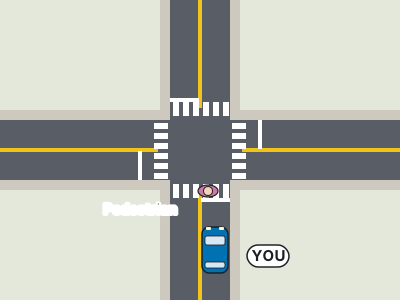
- Yield because the pedestrian has the right of way
- Yield only when the pedestrian is running
- Use the horn and continue through the crosswalk
- Proceed first if the vehicle arrived first
Show answer
Yield because the pedestrian has the right of way. At an intersection without signals, a pedestrian in a marked crosswalk or an unmarked crosswalk formed by sidewalk lines has priority. Slow and yield so the person can cross safely. Vehicle arrival order does not cancel that protection. A horn may warn someone in limited circumstances, but it does not give permission to drive through the pedestrian's path. The visual cue is the person occupying the crossing area, whether painted lines are present or not.
Study this in the handbook: Pedestrians, school buses and emergency vehicles
11. How long must North Carolina vehicle owners maintain liability insurance while a license plate is valid?
- Only during the month of registration renewal
- For 30 days after buying the vehicle
- Continuously
- Only when the vehicle is driven outside the state
Show answer
Continuously. The owner of every registered vehicle must maintain continuous liability insurance as long as the vehicle has a valid license plate. Coverage cannot be paused between trips or held only for renewal month. A lapse can expose the owner to a fine or penalty and may lead to plate revocation unless continuous coverage is shown. Keep the policy active for the full period that the plate remains valid, including days when the car is parked.
Study this in the handbook: Bicycles, mopeds, trucks and insurance
12. Who may sit in the front seat while a North Carolina Level One permit holder is driving?
- Only the driver and the supervising driver
- Any passenger with a seat belt
- Two passengers if one is family
- Anyone over 21
Show answer
Only the driver and the supervising driver. North Carolina allows no one except the driver and the supervising driver in the front seat during Level One. All other passengers must be restrained by a seat belt or child safety seat. A belted passenger, a family member, or an adult over 21 still cannot take the front seat. The supervising driver must be a parent, grandparent, guardian, or approved responsible person who has held a license for at least five years.
Study this in the handbook: Graduated licensing: learner permit to full license
13. What do yellow lines separate on a North Carolina roadway?
- Parking spaces from traffic lanes
- Travel lanes moving in the same direction
- Only bicycle lanes from sidewalks
- Travel lanes moving in opposite directions
Show answer
Travel lanes moving in opposite directions. Yellow pavement lines divide traffic moving in opposite directions. White lines separate lanes traveling the same way. This distinction helps a driver interpret whether a neighboring lane carries opposing vehicles and whether a crossing movement could create a head-on risk. Do not infer permission to cross solely from the color. The line pattern and local rule still matter, especially where solid or broken markings control passing.
Study this in the handbook: Traffic signals and pavement markings
14. What does a blue and white North Carolina highway sign commonly indicate?
- A route marker for an interstate
- The beginning of a no-passing zone
- A railroad crossing warning
- A nearby hospital, Highway Patrol station, or telephone
Show answer
A nearby hospital, Highway Patrol station, or telephone. Blue and white signs identify certain nearby services, including a hospital, Highway Patrol station, or telephone. Their service function differs from the yellow railroad warning sign and the pennant that marks no passing. Interstate highways use a red, white, and blue shield as a route marker, which is a separate sign type. When a blue service sign appears, use it to locate help or facilities and continue reading the roadway rather than treating it as a hazard warning.
15. A North Carolina driver is convicted twice within one year of speeding over 55 mph and more than 15 mph above the limit. How long is the license taken?
- 10 days
- A 30-day minimum
- 60 days
- 3 years
Show answer
60 days. One conviction of driving more than 15 mph over the limit at a speed above 55 mph brings a revocation of at least 30 days in North Carolina. A second such charge within one year, or speeding plus reckless driving on the same occasion, raises it to 60 days. Ten days is not a handbook period, and 30 days is only the first offense. Three years is the period for prearranged racing.
Study this in the handbook: Keeping your license: points, suspensions and renewal
16. If a vehicle begins to hydroplane, what should the driver do?
- Brake hard and jerk the steering wheel toward the shoulder
- Take the foot off the gas, keep the steering wheel straight, and let momentum decrease
- Accelerate until the tires cut through the water
- Use cruise control to hold a steady path
Show answer
Take the foot off the gas, keep the steering wheel straight, and let momentum decrease. Hydroplaning reduces tire contact with the road, so sudden steering or braking can turn a slide into an uncontrollable skid. The handbook advises taking the foot off the gas, resisting the brakes, keeping the steering wheel straight, and letting speed decrease until the tires grip again. Acceleration and cruise control work against that recovery. Keep the vehicle pointed steadily, make no abrupt input, and regain traction before making a normal steering correction.
Study this in the handbook: Turn signals, headlights and bad weather
17. Before making a right turn, where should a driver position the vehicle?
- Close to the right edge of the road
- Beside the center line so another vehicle can pass on the right
- In the left edge of the roadway regardless of lane markings
- Anywhere in the lane because position does not affect turning safety
Show answer
Close to the right edge of the road. For a right turn, the handbook advises staying close to the right edge so another vehicle cannot move between the turning vehicle and the curb. The center line position invites an unsafe pass on the right, while the left edge is unrelated to a normal right turn. Reduce speed before turning, signal, and check carefully for motorcycles and bicycles, which can be difficult to see. Position and observation work together to keep the turn contained.
18. A North Carolina driver is convicted of DWI while already revoked for an earlier DWI. What can the court order?
- A 30 day extension only
- A new driver education course
- The vehicle seized and sold
- A warning
Show answer
The vehicle seized and sold. North Carolina allows the court to order the vehicle seized and sold when a person is convicted of DWI while the license is already revoked for an earlier DWI conviction. A short extension, a driver education course, or a warning are not the stated consequence. Racing cases carry a similar risk: a vehicle used in prearranged racing can be seized and, after conviction, sold at auction.
Study this in the handbook: Driving while impaired and alcohol limits
19. What does the pennant-shaped yellow warning sign emphasize?
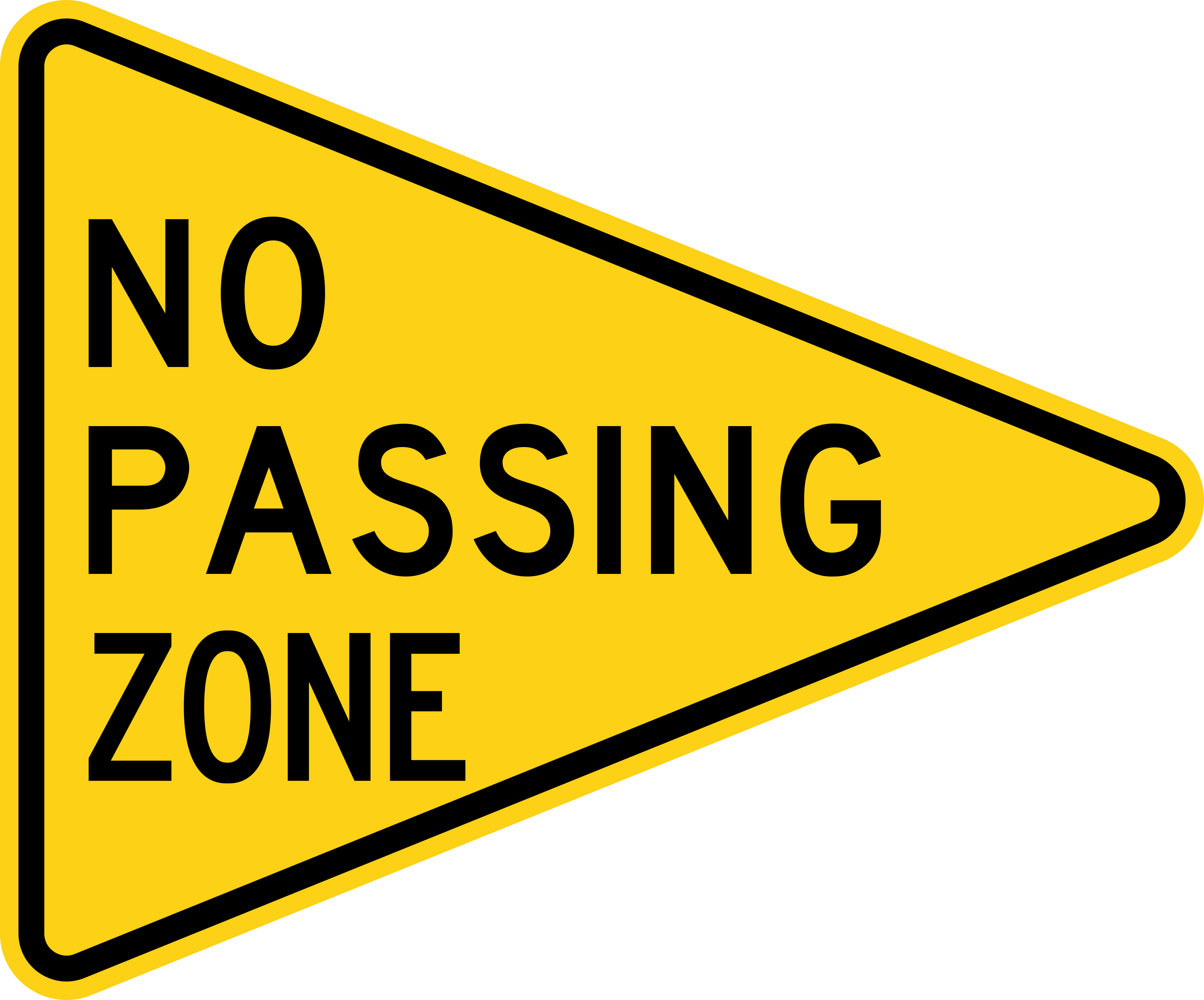
- The circular railroad crossing sign
- The rectangular regulatory DO NOT PASS sign
- The blue and white hospital sign
- The five-sided school crossing sign
Show answer
The rectangular regulatory DO NOT PASS sign. The pennant-shaped yellow warning sign emphasizes the rectangular regulatory DO NOT PASS sign. It reinforces the beginning of a no-passing zone rather than replacing the rule-setting sign. The circular sign with RR warns of a railroad crossing, and the five-sided sign warns of a school zone or school crossing. Blue and white signs identify services or facilities. When a pennant appears on the left side of the road, look for the solid yellow line and treat the area ahead as the start of a no-passing restriction.
Study this in the handbook: Sign shapes and colors
20. Where is the railroad crossbuck sign located?
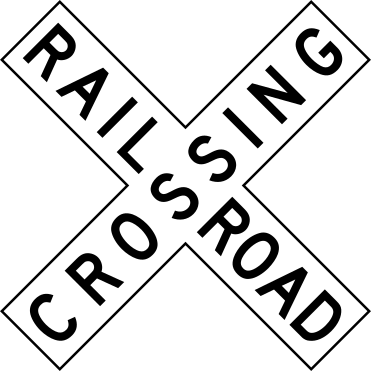
- Far before the tracks as an advance warning
- Only beside a school crossing
- At the entrance to a highway work zone
- At the railroad crossing itself
Show answer
At the railroad crossing itself. The crossbuck is installed at the railroad crossing itself. The handbook distinguishes it from the circular yellow RR sign, which gives advance warning before the tracks. If a smaller panel appears below the crossbuck, it tells you that multiple tracks are present. A school crossing and a work zone use different warning signs. As you reach the crossbuck, stay alert for a train and obey any flagger, signal, or gate that requires you to stop.
Study this in the handbook: Sign shapes and colors
QualitySpace is expanding to North Carolina
We are a California-based independent insurance brokerage working on licensing in more states. We cannot help with North Carolina insurance yet. Leave your email and we will let you know when we can.
Every question is written from the official North Carolina Driver Handbook. Need paper? Printable NC practice test with answer key.
Last verified 2026-10-05. How we check every question · Study all 207 as flashcards
Frequently asked questions
How many questions are on this North Carolina practice test?
This fixed set has 20 questions. It is test 3 of 10 from the 207 question North Carolina bank.
How does this fixed test relate to the full North Carolina bank?
Each numbered test is a fixed set of questions in a fixed order, so you can retake the same test later and compare. Every test mixes road signs and the other topics in about the same proportion as the full bank. Tests 1 to 10 together cover 200 of the 207 questions in the North Carolina bank, each once. The full practice page mixes the whole bank at random.
Last verified 2026-10-05. See the North Carolina DMV facts page for sourced state details.
Return to the full North Carolina practice test · Study road signs