
Test 4 of 10 · 20 questions · Free 2026
NC Permit Practice Test 4
Jump to the test ↓A fixed 20 question set from the North Carolina bank with answers and plain English explanations.
Question 1 of 20 · 0 right so far
All 20 questions in test 4
Every question below comes from the North Carolina question bank on this page. Open a question to see the correct answer and the explanation. Nothing here is hidden behind a signup.
1. What testing accommodation is available on request for a North Carolina applicant who has difficulty reading?
- A waiver of the traffic law examination
- An audio version of the knowledge test
- A road test that replaces the knowledge test
- Automatic passage without answering questions
Show answer
An audio version of the knowledge test. Applicants who have difficulty reading may request an audio test for the knowledge examination. That accommodation changes how the questions are presented, not whether the applicant must demonstrate knowledge. A reading difficulty does not waive traffic law questions, produce automatic passage, or turn the road test into a substitute for the knowledge test. If reading is a barrier, request the audio format when arranging the examination and still prepare for the same traffic law and safe driving material.
Study this in the handbook: License tests, teen phone ban and full provisional license
2. What license suspension does North Carolina list for prearranged racing with another vehicle on the highway?
- A 30-day suspension
- 90 days
- 1 year
- 3 years
Show answer
3 years. North Carolina lists a 3 year suspension for prearranged racing on the highway, and the same 3 years for watching, betting on, or lending a car for prearranged racing. When an officer finds a vehicle being used or loaned for prearranged racing, the officer seizes it, and after conviction the court may order it sold at auction. Thirty days, 90 days, and one year are periods the handbook gives for other offenses.
3. A North Carolina driver is charged twice with reckless driving within 12 months. What suspension applies?
- 1 year
- Thirty days
- 60 days
- Permanent
Show answer
1 year. North Carolina's suspension table lists one year for two charges of reckless driving committed within 12 months. Thirty and 60 days apply to speeding related revocations, and permanent revocation is reserved for offenses like manslaughter while impaired or repeat DWI. Reckless driving also carries 4 points on its own. One year also applies to manslaughter, death by vehicle, and failure to stop and give aid.
4. A North Carolina provisional licensee is convicted of a fourth moving violation within 12 months. What suspension can follow?
- Six months
- One month
- 90 days
- Two years
Show answer
Six months. For a provisional licensee under 18, North Carolina's escalating suspensions are 30 days for a second moving violation within 12 months, 90 days for a third, and six months for a fourth. Thirty and 90 days are the earlier steps. Two years is not listed. DMV reviews a provisional licensee's record more closely and may contact the driver about certain convictions or crashes.
Study this in the handbook: Keeping your license: points, suspensions and renewal
5. A North Carolina driver going faster than 55 mph is convicted of exceeding the limit by more than 15 mph. For how long is the driving privilege revoked at minimum?
- At least 10 days
- At least 6 months
- There is no revocation for a first offense
- At least 30 days
Show answer
At least 30 days. North Carolina ties license revocation directly to high speed. If you are driving faster than 55 mph and are convicted of going more than 15 mph over the limit, your driving privilege is revoked for at least 30 days. Ten days is not the stated minimum, and six months is not the period for this offense. Treating a first offense as revocation free is the costly mistake, because the rule applies the first time it happens. A second such conviction within one year, or speeding plus reckless driving on the same occasion, brings 60 days.
Study this in the handbook: Keeping your license: points, suspensions and renewal
6. How close may you park to an emergency vehicle stopped to investigate an accident or give assistance?
- Not within 25 feet
- Not within 10 feet
- There is no distance rule
- Not within 100 feet
Show answer
Not within 100 feet. A driver may not park within 100 feet of an emergency vehicle that has stopped to investigate an accident or provide assistance. The distance protects responders and leaves room for other emergency equipment to approach or work. The 25-foot and 10-foot alternatives are smaller distances and therefore do not meet this rule. Parking farther away is the safe choice when a response scene is visible. Do not use the stopped vehicle as a landmark for a quick roadside stop: continue beyond the 100-foot buffer and keep the access area open for the emergency operation.
Study this in the handbook: Pedestrians, school buses and emergency vehicles
7. How should the lap belt be positioned according to the North Carolina handbook?
- High across the stomach
- Under the abdomen and low across the hips
- Loose enough to fit a fist underneath
- Across the thighs only
Show answer
Under the abdomen and low across the hips. The lap belt should be worn under the abdomen and low across the hips, and the shoulder portion should come over the collarbone. A belt worn high across the stomach can cause internal injuries in a crash, and a loose belt lets the body slide. Air bags supplement belts rather than replace them, and everyone in a moving vehicle must be buckled up on every trip.
Study this in the handbook: Seat belts, child restraints and window tint
8. On a North Carolina street posted at 35 mph, how far before a turn or stop should a driver begin signaling at minimum?
- At least the last 20 feet
- At least the last 500 feet
- At least the last 100 feet
- Only as the wheels start to turn
Show answer
At least the last 100 feet. The North Carolina handbook sets a minimum distance for turn and stop signals. A driver should signal at least the last 100 feet before turning or stopping. The longer 200 foot distance applies only when the speed limit is 45 mph or more, so on a 35 mph street the 100 foot minimum controls. Twenty feet or waiting until the wheels start to turn leaves following drivers no time to react, and five hundred feet is not a stated rule. The handbook adds that the faster you are driving, the farther ahead you should signal.
Study this in the handbook: Turn signals, headlights and bad weather
9. When a railroad crossing gate is lowered or a flagger signals an approaching train, how far from the nearest rail must a driver stop?
- At least 100 feet away in every case
- Exactly 5 feet from the rail
- Within 50 feet but not less than 15 feet
- After crossing the nearest track
Show answer
Within 50 feet but not less than 15 feet. North Carolina's railroad rule requires stopping within 50 feet, but not less than 15 feet, from the nearest rail when a gate is lowered or a flagger gives the train signal. Stopping five feet away is too close, 100 feet is not the stated universal distance, and crossing before stopping defeats the protection. Leave a clear buffer, remain stopped, and wait until the signal or flagger indicates that proceeding is safe.
Study this in the handbook: Railroad crossings and funeral processions
10. A North Carolina driver refuses a chemical test after a DWI charge. When may a judge issue a limited driving privilege?
- Immediately, on the day of the arrest
- In certain instances, after six months of the refusal revocation have passed
- After 30 days
- Never
Show answer
In certain instances, after six months of the refusal revocation have passed. Refusing a required chemical test in North Carolina brings an immediate revocation of at least 30 days and an additional revocation of at least 12 months by DMV. In certain instances, after six months of that willful refusal revocation, a judge may issue a limited driving privilege. It is not available on the day of arrest or after only 30 days. Never is too strong, because the handbook does allow it in some cases.
Study this in the handbook: Driving while impaired and alcohol limits
11. How long must a North Carolina Level One Limited Learner Permit be held before applying for a Limited Provisional License?
- At least six months
- At least three months
- At least nine months
- At least twelve months
Show answer
At least nine months. The Level One permit must be held for nine months before the driver may apply for a Limited Provisional License. Six months is a different milestone: after six months from issuance, the permit holder may drive at any time with a supervising driver. Three months is too short, and twelve months is not the stated upgrade period. Keep the milestones separate by linking nine months to applying for the next license level and six months to expanded supervised driving hours.
Study this in the handbook: Graduated licensing: learner permit to full license
12. When approaching a stop sign, where must you stop if there is no stop line or marked crosswalk?
- Six feet past the intersection
- At the nearest driveway
- Only after another vehicle stops
- Before entering the intersection where you can see the intersecting street
Show answer
Before entering the intersection where you can see the intersecting street. If a stop line or marked crosswalk is absent, the driver must stop before entering the intersection at a point where the intersecting street can be viewed. Stopping after entering the intersection can put the vehicle in the path of cross traffic and does not meet the handbook's placement rule. A driveway is unrelated, and another vehicle does not have to stop before your duty begins. Approach under control, locate the line or crosswalk if one exists, and otherwise stop before the intersection with enough visibility to check for traffic before proceeding.
Study this in the handbook: Sign shapes and colors
13. A school bus stops on a two-lane roadway to receive passengers. Which traffic must stop?
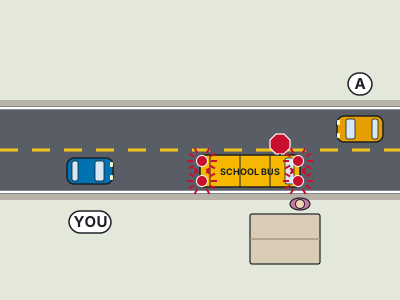
- Only traffic behind the bus
- Traffic from both directions
- Only traffic approaching the bus
- No traffic if children are not visible
Show answer
Traffic from both directions. On a two-lane roadway, all traffic from both directions must stop when the school bus stops for passengers. The same all-direction rule also applies to a four-lane roadway without a median and to a two-lane roadway with a center turning lane. Only traffic following the bus stops on a divided highway of four or more lanes with a median separation, which is a different roadway design. Visibility of children does not remove the duty. Watch for the bus's mechanical stop signal or flashing red lights, stop, and wait until the signal is withdrawn, the lights turn off, and the bus starts moving.
Study this in the handbook: Pedestrians, school buses and emergency vehicles
14. What does the North Carolina handbook say about points for the offenses in its no-points list?
- Five driver license points are assessed for each conviction
- Points are assessed only if the offense occurs at night
- The court automatically doubles every driver license point
- No driver license points are assessed for those convictions
Show answer
No driver license points are assessed for those convictions. The handbook states that no driver license points are assessed for convictions included in the named no-points list. This concerns the license point system, not whether a person can still receive a citation, fine, or another consequence. The alternatives invent a five-point rule, a nighttime condition, or an automatic doubling provision. Read the list heading before comparing it with the separate tables that assign points to moving violations. The cue is the phrase no points, which identifies the treatment of each offense listed immediately afterward.
Study this in the handbook: Keeping your license: points, suspensions and renewal
15. Why does the North Carolina handbook warn that passing on the right is risky?
- The passing vehicle must always cross a double-solid yellow line
- The vehicle being passed may turn right or pull toward the right side
- The passing vehicle cannot use a signal on a multilane highway
- The vehicle being passed must stop before the maneuver begins
Show answer
The vehicle being passed may turn right or pull toward the right side. Passing on the right places the passing vehicle on the blind side of the vehicle being passed. That vehicle may unexpectedly make a right turn or pull toward the right side of the road, creating a collision risk. The other choices invent requirements about yellow lines, stopping, or signal use that are not the handbook’s warning. Before moving right, check the roadway, the other vehicle’s position, and the space ahead. The cue is to remember the hidden side of the vehicle and the possibility of a sudden rightward movement.
Study this in the handbook: Passing, backing and parking
16. Which vehicles have the right of way when their flashing lights and sirens are operating?
- Any vehicle displaying four-way flashers
- Police cars, ambulances, fire engines, and rescue vehicles
- Only a school bus with red lights
- A private vehicle traveling faster than traffic
Show answer
Police cars, ambulances, fire engines, and rescue vehicles. Police cars, ambulances, fire engines, and rescue vehicles with flashing lights and sirens have the right of way under the North Carolina handbook. A private vehicle’s hazard flashers do not create emergency priority, and the school-bus rule is separate. Speed alone also gives no driver authority to demand the roadway. When one of these authorized vehicles approaches, yield promptly, move to the right-hand curb or edge, and stop completely. Scan in both directions because the response vehicle may approach from ahead or behind, then stay stopped until it passes or an officer directs you onward.
Study this in the handbook: Railroad crossings and funeral processions
17. What is the purpose of a two-way left-turn lane in North Carolina?
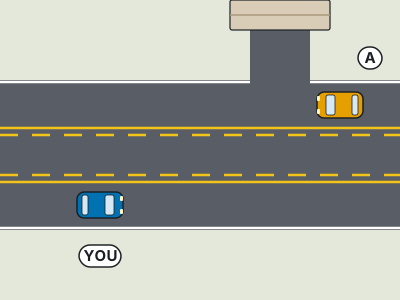
- It is reserved for left-turn movements in both directions
- It is a general travel lane during heavy traffic
- It is a passing lane for either direction
- It is reserved for parking before a turn
Show answer
It is reserved for left-turn movements in both directions. A center lane marked for two-way left turns is reserved exclusively for those turning movements. Drivers from either direction may use it to prepare for a left turn, but it is not a shortcut for passing or merging into traffic. Treating the lane as a through lane creates conflicts with opposing drivers who also need the space. Look for the yellow boundary markings and the left-turn arrows before entering.
Study this in the handbook: Traffic signals and pavement markings
18. Behind a tractor-trailer, how far back does the truck's rear no-zone extend, according to the North Carolina handbook?
- About 10 feet
- Up to 20 feet
- Up to 200 feet
- There is no rear blind spot because trucks have large mirrors
Show answer
Up to 200 feet. Many drivers assume truckers see the road better because they sit high, but the North Carolina handbook warns that trucks have serious blind spots called no-zones. A car can disappear from view up to 20 feet in front of the cab, along either side, particularly beside the cab, and up to 200 feet in the rear. Ten feet understates the rear zone, and twenty feet is the front figure. Large mirrors do not erase these blind spots. Lingering in a no-zone takes away the trucker's ability to make an evasive move.
Study this in the handbook: Bicycles, mopeds, trucks and insurance
19. What does a five-sided yellow warning sign identify?

- A school zone or school crossing
- A no-passing zone on a rural road
- A guide route through a city
- A railroad crossing at the tracks
Show answer
A school zone or school crossing. The five-sided, or pentagon, warning sign identifies a school zone or school crossing. Drivers should watch especially carefully for children there, and some school zones reduce the speed limit during specified school hours. The railroad warning uses a circular shape, while no-passing and guide signs have different purposes. Do not treat the pentagon as a general route marker. Its distinctive five-sided outline is the cue to expect children and to moderate speed near the school area.
20. Why is a STOP AHEAD sign placed before a stop sign?

- The driver’s view of the stop sign may be blocked
- The road has no legal stopping point
- The next intersection permits passing only
- A railroad gate is always nearby
Show answer
The driver’s view of the stop sign may be blocked. The STOP AHEAD warning is placed far enough before a stop sign to alert drivers when a curve or another object blocks the view of that stop sign. It is advance notice, not a replacement for the required full stop at the actual stop location. The sign does not remove a stopping point, create a passing rule, or indicate a railroad gate. Once the stop sign becomes relevant, locate the proper stopping position and stop before proceeding when the way is clear.
Study this in the handbook: Sign shapes and colors
QualitySpace is expanding to North Carolina
We are a California-based independent insurance brokerage working on licensing in more states. We cannot help with North Carolina insurance yet. Leave your email and we will let you know when we can.
Every question is written from the official North Carolina Driver Handbook. Need paper? Printable NC practice test with answer key.
Last verified 2026-10-05. How we check every question · Study all 207 as flashcards
Frequently asked questions
How many questions are on this North Carolina practice test?
This fixed set has 20 questions. It is test 4 of 10 from the 207 question North Carolina bank.
How does this fixed test relate to the full North Carolina bank?
Each numbered test is a fixed set of questions in a fixed order, so you can retake the same test later and compare. Every test mixes road signs and the other topics in about the same proportion as the full bank. Tests 1 to 10 together cover 200 of the 207 questions in the North Carolina bank, each once. The full practice page mixes the whole bank at random.
Last verified 2026-10-05. See the North Carolina DMV facts page for sourced state details.
Return to the full North Carolina practice test · Study road signs