
Test 22 of 25 · 20 questions · Free 2026
NC Permit Practice Test 22
Jump to the test ↓A fixed 20 question set from the North Carolina bank with answers and plain English explanations.
Question 1 of 20 · 0 right so far
All 20 questions in test 22
Every question below comes from the North Carolina question bank on this page. Open a question to see the correct answer and the explanation. Nothing here is hidden behind a signup.
1. When entering a North Carolina interstate from an on-ramp, how should you use the acceleration lane?
- Stop at its end and wait for a large gap
- Use it to match the speed of traffic, then merge
- Merge right away at the start of the lane
- Drive slowly so traffic can see you coming
Show answer
Use it to match the speed of traffic, then merge. The handbook's interstate rules say to use the acceleration lane until your vehicle's speed matches the speed of the other traffic, and then merge safely. Stopping at the end of the lane or entering slowly forces a merge far below the flow, and the handbook warns that crashes are more likely when a vehicle moves significantly slower than traffic. Merging at the very start of the lane wastes the room it gives you to build speed.
2. A driver who has had a few drinks keeps misjudging the gap to the car ahead. Which effect of alcohol explains this?
- It makes the vehicle ahead brake harder than usual
- It weakens your judgment of speed and distance
- It improves focus on one task but not on two
- It affects only drivers who are also very tired
Show answer
It weakens your judgment of speed and distance. Among the effects of alcohol, the handbook lists a reduced ability to judge how fast you are moving or how far you are from other cars, people, or objects. That is why a drinking driver may misread a gap. The other car's brakes are not the issue. Alcohol also makes it harder to do more than one thing at once, so it does not improve focus on anything. These effects can appear even in people who seem completely unaffected by what they drank.
3. A driver tests at 0.06 but is weaving across lanes and slurring words. Can North Carolina still prove driving while impaired?
- No, a reading below 0.08 means the driver must be released
- Only if the driver refuses the breath test
- Only if drugs are found in the vehicle
- Yes, by showing the driver was appreciably impaired
Show answer
Yes, by showing the driver was appreciably impaired. A BAC of 0.08 percent or more is one way to prove driving while impaired, but it is not the only way. North Carolina can also prove the offense by showing the driver's physical or mental fitness was appreciably impaired by alcohol, drugs, or both. A driver at 0.06 who is weaving and slurring can still be charged. The handbook also notes that many people are affected at levels well below 0.08.
Study this in the handbook: Driving while impaired and alcohol limits
4. As you get closer behind a motor home or camper, what happens to your view of the road ahead?
- It blocks less, because you are closer
- Nothing changes, since you can see over it
- It improves because its lights guide you
- It blocks more of your field of vision
Show answer
It blocks more of your field of vision. Most recreational vehicles, such as motor homes, campers, and travel trailers, are longer, higher, and wider than passenger cars. The handbook warns that visibility is a major problem: the closer you get to a recreational vehicle, the more it blocks your field of vision. RV drivers also have much larger blind spots than car drivers, so they can lose sight of you. Hanging back gives you a better view and more room.
Study this in the handbook: Bicycles, mopeds, trucks and insurance
5. To slow down on an icy road in a car without anti-lock brakes, how should you use the brake pedal?
- Press it to the floor and hold it
- Avoid the brakes and shift to park
- Pump the brakes gently
- Tap it once and coast to a stop
Show answer
Pump the brakes gently. On wet roads, ice, and packed snow, the handbook says to reduce speed gradually to avoid skidding. With anti-lock brakes, use firm, steady pressure and do not pump. Without anti-lock brakes, you should pump the brakes gently to slow the vehicle. Holding the pedal to the floor or shifting into park while moving is not the method the handbook gives for a car without ABS.
Study this in the handbook: Blowouts, breakdowns and crashes
6. At a signal showing both a green arrow and a circular red light, which light controls drivers who are turning?
- The arrow controls turning traffic
- The circular red controls everyone
- Whichever light changed most recently
- Turning drivers must wait for both to be green
Show answer
The arrow controls turning traffic. Some North Carolina signals combine protected turn arrows with unprotected circular lights based on traffic demand. When both an arrow and a circular light are displayed, turning traffic follows the arrow and through traffic follows the circular light. So a green arrow lets turning drivers go even while the circular light is red for through traffic. If no arrow is displayed, both through and turning traffic are controlled by the circular signals.
Study this in the handbook: Traffic signals and pavement markings
7. You have a green arrow to make a U-turn, and the opposing traffic has a green arrow to turn right. Who should yield?
- You, the U-turning driver
- The driver turning right
- Whoever reaches the lane first
- Neither, since both arrows are green
Show answer
You, the U-turning driver. A green arrow gives you a protected movement, letting you cautiously enter the intersection in the direction of the arrow. The handbook adds one special case: when a U-turn and an opposing right turn both have green arrows at the same time, the U-turning traffic should yield to the right-turning traffic. Both drivers may be heading into the same lane, so a green arrow alone does not settle it. Arriving first does not change the rule.
Study this in the handbook: Traffic signals and pavement markings
8. A train traveling 55 mph is approaching a crossing. Why can't the engineer simply stop for a car stuck on the tracks?
- Trains are not allowed to brake near crossings
- The train needs more than a mile to stop
- The engineer must keep the schedule
- Trains can stop within about 100 feet
Show answer
The train needs more than a mile to stop. A train traveling at 55 mph takes more than a mile to come to a stop, and it may weigh several thousand tons. The handbook says that by the time the engineer sees a car on the tracks, it is too late to stop the train. That is why the occupants of a stalled vehicle must get out immediately and move away. Trains cannot stop quickly, but your vehicle can.
Study this in the handbook: Railroad crossings and funeral processions
9. You slow down after passing this sign, then reach the roundabout as a car is already circling toward you. What do you do?

- Enter first, since you are on the right
- Honk and enter right beside it
- Let it pass, then enter the circle
- Speed up to merge ahead of it
Show answer
Let it pass, then enter the circle. The yellow roundabout ahead sign tells you to slow down as you approach. Once you reach the roundabout, the handbook says vehicles already in the circle have the right of way, and drivers entering must yield to vehicles and bicyclists already circulating. Being on the right does not give you priority here, and you should not squeeze in beside or ahead of a circulating car. Wait for a gap, then enter and travel counterclockwise.
10. A 17-year-old North Carolina driver wants to call a friend while driving to say they are running late. Is that allowed?
- Yes, if the call is hands-free
- No, drivers under 18 may not
- Yes, if the call lasts under a minute
- Yes, if they keep both eyes on the road
Show answer
No, drivers under 18 may not. North Carolina does not permit drivers under 18 to use a cell phone or related technology while operating a motor vehicle on a public street or highway, and hands-free technology is included. The exception is an emergency, such as calling 911. A quick call to a friend is not an emergency. The teen can pull over to a safe place and make the call from there.
Study this in the handbook: Graduated licensing: learner permit to full license
11. You are turning left on a green light. A pedestrian is crossing the street you are entering and also has a green signal. Who goes first?
- You, because you are already in the intersection
- You, since a left turn has priority over walkers
- Whoever is closest to the crosswalk
- The pedestrian, even though you are turning
Show answer
The pedestrian, even though you are turning. The handbook says that when crossing with a green signal, pedestrians have the right of way over all vehicles, including those turning across their paths. Being in the intersection first or turning on a green light does not change that. Wait until the pedestrian has cleared your path before you complete the turn. The handbook also says a turning driver on a circular green must yield to oncoming traffic and pedestrians, so the green light does not let you turn ahead of people on foot.
Study this in the handbook: Pedestrians, school buses and emergency vehicles
12. You leave town on a two-lane state road with no speed limit sign in sight. What is the maximum speed?
- 35 mph
- 45 mph
- 55 mph
- 65 mph
Show answer
55 mph. Outside cities and towns, North Carolina's maximum speed limit is 55 mph unless a sign posts something different. Inside cities and towns the default is 35 mph, and interstates have a maximum of 70. A posted limit is the most you may drive, and the handbook says you must often drive slower to be safe, for example on secondary roads with steep hills, sharp curves, and short sight distances.
Study this in the handbook: Speed limits and stopping distance
13. A driver behind you on a two-lane road taps the horn and pulls out to pass. What does North Carolina law expect of you?
- Move toward the right edge and do not speed up
- Speed up so the driver cannot cut back in
- Brake hard so the driver gets by faster
- Move toward the center line to block the pass
Show answer
Move toward the right edge and do not speed up. When another driver sounds the horn to pass, the handbook says it places you under a legal obligation to help that driver pass. Move to the right edge of the road and never increase your speed. If you speed up and fail to give way, you can be charged with a misdemeanor if a crash causes injury or property damage. Hard braking or drifting toward the center line works against the passing driver.
Study this in the handbook: Passing, backing and parking
14. The traffic signal at an intersection is out, but a police officer in the middle is directing traffic and waves you through. What should you do?
- Stop anyway, as at a four-way stop
- Follow the officer's direction and proceed
- Wait until the signal starts working
- Turn around and find another route
Show answer
Follow the officer's direction and proceed. When a signal fails, drivers normally treat the intersection as if it had a stop sign on all approaches. The handbook says that rule does not apply when a law enforcement officer or another authorized person is directing traffic, or when another traffic control device is working. An officer's hand signals take the place of the normal signals and signs, so follow the officer's direction and proceed when waved through.
Study this in the handbook: Traffic signals and pavement markings
15. In a North Carolina multi-lane roundabout, which lane do you typically use to make a left turn?
- The left lane, chosen before entering
- The right lane, then cross over inside
- Whichever lane is moving faster
- The shoulder along the outer edge
Show answer
The left lane, chosen before entering. In a multi-lane roundabout, the handbook says to watch signs and pavement markings and pick your lane before entering. You typically use the right lane to exit right, and you stay in the left lane to go straight, turn left, or make a U-turn. Changing lanes while in the roundabout is not allowed, so a plan to cross over later does not work. The shoulder of a roundabout is not a travel lane for anyone.
Study this in the handbook: Right of way at intersections and roundabouts
16. You are driving slower than the posted speed limit on a multi-lane North Carolina highway. Which lane should you use?
- The left lane, so faster cars can pass on the right
- Any lane, as long as you stay above the minimum
- The far right lane, unless passing or turning left
- The center lane, to stay away from merging traffic
Show answer
The far right lane, unless passing or turning left. The handbook says that when you are moving slower than the posted speed limit on a multi-lane highway, you should drive in the extreme right lane. The exceptions are passing, turning left, or avoiding an obstruction. Staying left forces faster traffic to pass on the right, which the handbook describes as risky because it puts a car on the blind side. Meeting the posted minimum speed does not make another lane the right choice for slower traffic.
Study this in the handbook: Railroad crossings and funeral processions
17. On which North Carolina roads should drivers expect to see bicyclists?
- On roads with marked bike lanes, and nowhere else
- On roads posted below 35 mph, not faster roads
- In cities and towns, not rural roads
- On all roads unless bicycles are prohibited
Show answer
On all roads unless bicycles are prohibited. The handbook says bicyclists can be expected on all roads except where they are expressly prohibited. Bicycles are narrow and usually ride at the right of the lane, so they can be hidden by other vehicles and hard to detect. Bike lanes are one place cyclists may ride, but not the only one, and rural and higher-speed roads are included. Scan for cyclists everywhere, especially when turning.
Study this in the handbook: Bicycles, mopeds, trucks and insurance
18. After driving through deep water, your brakes feel weak. How does the North Carolina handbook say to dry them?
- Drive a short distance pressing the brake lightly
- Pump the brakes as hard as you can several times
- Park for an hour and let them air dry
- Drive fast so wind dries the brake linings
Show answer
Drive a short distance pressing the brake lightly. Wet brakes can be dried by driving a short distance while applying light pressure to the brake pedal. The handbook explains that the heat created by the friction of the brakes evaporates the water from the brake linings. Hard pumping, waiting an hour, or driving fast are not the method it describes. Test the brakes gently as you go, and give yourself extra room until they respond normally again.
19. You need to stop on the shoulder of a rural North Carolina highway. A hill crest is about 100 feet ahead. Is this a legal place to park?
- Yes, the shoulder is always legal for parking
- Yes, as long as your flashers are turned on
- No, it must be seen from 200 feet both ways
- Yes, as long as you stay inside the car
Show answer
No, it must be seen from 200 feet both ways. Parking on the paved or main travel part of a highway is not allowed, and the handbook says parking on the shoulder is also against the law unless approaching drivers in both directions can see the parked vehicle from at least 200 feet. A hill crest only 100 feet away hides you from traffic coming over it. Flashers or staying in the car do not fix that. If a breakdown forces you to stop, move as far off the road as you can.
Study this in the handbook: Passing, backing and parking
20. Near an interstate interchange, you see this sign facing you at the start of a ramp. Why does the North Carolina handbook tell you to watch for it?
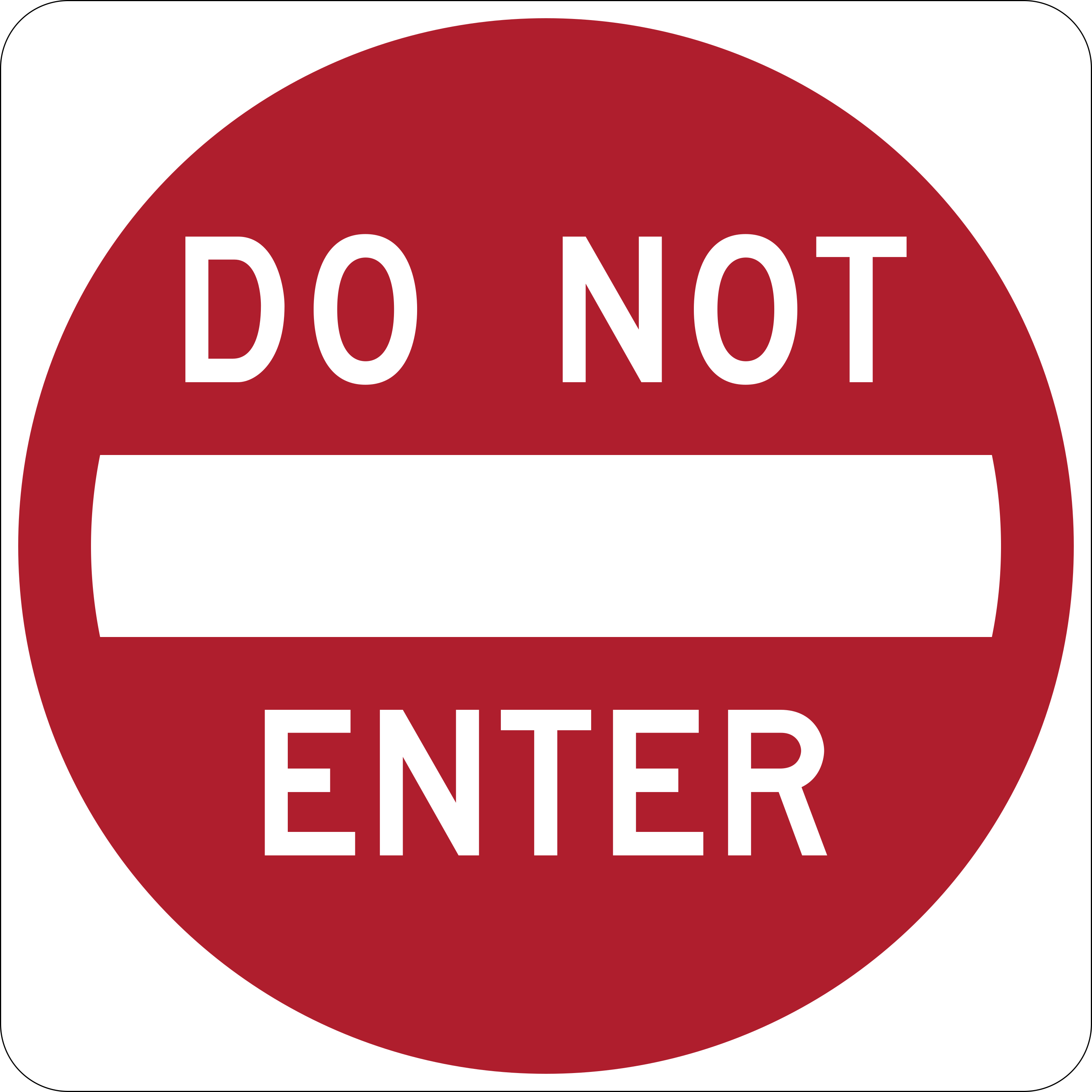
- It marks the ramp as a route for trucks only
- It warns that the ramp is closed for repairs
- It shows where drivers must stop to pay a toll
- So you do not enter the interstate going the wrong way
Show answer
So you do not enter the interstate going the wrong way. The handbook describes a dangerous error: entering an interstate headed in the wrong direction. If that happens, pull over to the right shoulder, stop, and turn around when the way is clear. The handbook says to avoid the error by watching for DO NOT ENTER signs. If one is facing you at the start of a ramp, do not turn in, because traffic on that ramp is coming toward you.
Every question is written from the official North Carolina Driver Handbook. Need paper? Printable NC practice test with answer key.
Last verified 2026-10-05. How we check every question · Study all 500 as flashcards
Frequently asked questions
How many questions are on this North Carolina practice test?
This fixed set has 20 questions. It is test 22 of 25 from the 500 question North Carolina bank.
How does this fixed test relate to the full North Carolina bank?
Each numbered test is a fixed set of questions in a fixed order, so you can retake the same test later and compare. Every test mixes road signs and the other topics in about the same proportion as the full bank. Tests 1 to 25 together cover every question in the North Carolina bank once. The full practice page mixes the whole bank at random.
Last verified 2026-10-05. See the North Carolina DMV facts page for sourced state details.
Return to the full North Carolina practice test · Study road signs