
Test 19 of 25 · 20 questions · Free 2026
NC Permit Practice Test 19
Jump to the test ↓A fixed 20 question set from the North Carolina bank with answers and plain English explanations.
Question 1 of 20 · 0 right so far
All 20 questions in test 19
Every question below comes from the North Carolina question bank on this page. Open a question to see the correct answer and the explanation. Nothing here is hidden behind a signup.
1. You are driving beside a tractor-trailer and cannot see the driver's face in the truck's side mirror. What does that tell you?
- The driver is looking straight ahead
- You are too far away to matter
- The truck driver probably cannot see you
- The truck is about to change lanes
Show answer
The truck driver probably cannot see you. A general rule for sharing the road with a tractor-trailer is that if you cannot see the truck driver in their side-view mirror, they cannot see you. Motorists lingering in a truck's no-zones make it hard for the trucker to take evasive action. If you cannot see the driver's face in the mirror, either pass steadily or drop back until you can. Do not stay alongside the cab.
Study this in the handbook: Bicycles, mopeds, trucks and insurance
2. Traffic is backed up just past a railroad crossing marked with this sign. What should you do?
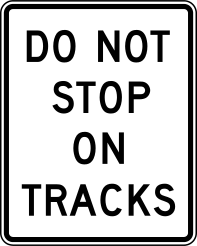
- Wait before the tracks until you can clear them
- Pull onto the tracks and wait for traffic to move
- Stop on the tracks only if no train is in sight
- Go around the line using the shoulder
Show answer
Wait before the tracks until you can clear them. This sign reminds drivers not to stop on the railroad track for any reason. If traffic is backed up beyond the crossing, wait before the tracks until there is room for your whole vehicle on the far side. The handbook warns that crossing gates will not trap you, but stopping traffic might. No train in sight is not a reason to stop on the tracks, since trains can approach at any time from either direction.
3. Another vehicle is following you too closely on a multi-lane road. What does the North Carolina handbook advise?
- Tap your brakes to warn the driver to back off
- Speed up to open more space behind you
- Slow down sharply so the driver has to pass
- Move to another lane and signal the driver to pass
Show answer
Move to another lane and signal the driver to pass. Keeping a margin of safety means leaving room ahead, behind, and to the sides. If another vehicle follows you too closely, the handbook says to move to another lane and signal for the driver to pass you. Driving at a steady speed and signaling early when you slow or stop also helps keep others from following too closely. Brake taps, sudden slowing, or speeding up are not on the handbook's list of responses.
Study this in the handbook: Turn signals, headlights and bad weather
4. How does the North Carolina handbook tell you to leave an interstate?
- Signal early, then slow down in the exit lane
- Slow down in the travel lane, then turn onto the ramp
- Brake hard just before the exit so you do not miss it
- Move to the shoulder and coast to the ramp
Show answer
Signal early, then slow down in the exit lane. To exit an interstate, the handbook says to signal well in advance and, without slowing down, enter the deceleration lane. Then slow to the posted exit speed limit. Braking in the travel lane makes you a hazard for the traffic behind you, and rear-end crashes are one of the most frequent interstate crash types. The shoulder is not an exit lane. If you realize you have missed your exit, go on to the next one instead.
5. On a one-way street with three or more lanes, how does the North Carolina handbook suggest using the lanes?
- Left lane for through travel, right lane for parking
- Any lane for any movement, since traffic flows one way
- Center lanes for through travel, outside lanes for turns
- Outside lanes for through travel, center lanes for turns
Show answer
Center lanes for through travel, outside lanes for turns. The handbook's city driving rules say that on a one-way street, the center lane or lanes are for through travel and the outside lanes are for turning. That keeps drivers who are slowing to turn left or right out of the way of through traffic. Weaving in and out of traffic is also on the handbook's list of things to avoid, so plan lane changes ahead and signal in advance before moving over.
6. How much does the North Carolina handbook recommend reducing your speed on packed snow?
- By about 5 to 10 mph
- By more than half
- By about one quarter
- Not at all with snow tires
Show answer
By more than half. The handbook recommends reducing speed by more than half on packed snow and slowing to a crawl on ice. Chains can help with traction, but even chains and snow tires can slide on ice and packed snow. In these conditions you cannot start, stop, or maneuver quickly, so a small cut of a few miles per hour is not enough. Watch for other drivers who do not have their vehicles under control.
Study this in the handbook: Turn signals, headlights and bad weather
7. How must you pass a motorcycle on a North Carolina road?
- Share its lane, since a motorcycle is narrow
- Pass within its lane if you stay two feet away
- Honk and pass using the paved shoulder
- Change lanes and pass as you would a car
Show answer
Change lanes and pass as you would a car. The handbook says motorcycles are entitled to the full width of their lane. To pass one, you must change lanes and pass the same way you would pass a larger motor vehicle. Squeezing by within the motorcycle's lane is not allowed, even with two feet of space, because the rider is entitled to the whole lane. You must also leave enough room that your vehicle's windstream cannot cause the rider to lose control.
Study this in the handbook: Bicycles, mopeds, trucks and insurance
8. Workers have gone home for the day, but you are still between the orange sign that began the work zone and the sign that ends it. Is this still a work zone?
- No, it ends when the workers leave
- Yes, until you pass the sign marking its end
- Only where cones are still on the road
- No, work zones apply only in daylight
Show answer
Yes, until you pass the sign marking its end. The handbook defines a highway work zone as the area between the first sign that shows the beginning of the work zone and the last sign that shows its end. The definition depends on the signs, not on whether workers are present. So the posted work zone speed limit and the need to stay alert apply until you pass the last sign. Lane shifts and narrow lanes may still be there after workers leave.
9. You are in a left-turn lane. The signal for straight traffic is green, but your lane shows a steady red arrow. What should you do?
- Turn after yielding, since the main light is green
- Turn if no oncoming cars are in sight
- Stop and wait; the red arrow controls your turn
- Go straight through the intersection instead
Show answer
Stop and wait; the red arrow controls your turn. A red arrow means turning traffic must stop. When arrow and circular signals are both displayed, turning traffic is controlled by the arrow and through traffic by the circular signal. So a green light for straight traffic does not let you turn while your arrow is red. Wait for a green arrow or, where used, a flashing yellow arrow that permits the turn after yielding.
Study this in the handbook: Traffic signals and pavement markings
10. You want to pass a slow car on a two-lane road, but you cannot tell whether there is enough room before an oncoming car arrives. What should you do?
- Pass quickly and cut back in if needed
- Pass on the right shoulder instead
- Flash your lights so the oncoming car slows
- Wait until you can see enough room ahead
Show answer
Wait until you can see enough room ahead. The handbook says you cannot pass safely unless you can see far enough ahead to be sure you can get back to your original lane before meeting oncoming traffic. If you cannot tell, stay behind the slow car. Cutting back in at the last second may force the car you passed to slow down, which means you did not pass safely. Passing on the right shoulder is not a legal option.
Study this in the handbook: Passing, backing and parking
11. You see this sign on the left side of a two-lane road as you near a hill. What does it tell you about passing?

- Passing is allowed for the next mile
- A no-passing zone begins here, so do not start a pass
- You may pass if the car ahead is slow
- The road widens to two lanes in your direction
Show answer
A no-passing zone begins here, so do not start a pass. The pennant-shaped yellow warning sign sits on the left side of the road and points to the beginning of a no-passing zone, where a solid yellow line is in your lane. It emphasizes, rather than replaces, the rectangular DO NOT PASS sign. When you see it, do not start a pass. Hills and curves where you cannot see at least 500 feet ahead are among the places where passing is always unsafe.
Study this in the handbook: Sign shapes and colors
12. For a North Carolina auto policy issued or renewed on or after July 1, 2025, what is the minimum bodily-injury liability coverage for one person?
- $25,000
- $60,000
- $750,000
- $50,000
Show answer
$50,000. For policies issued or renewed on or after July 1, 2025, North Carolina requires at least $50,000 for bodily injury to one person, $100,000 for bodily injury per accident, and $50,000 for property damage. The per-person bodily-injury amount is therefore $50,000. The former 30/60/25 limits are no longer the current minimum. Keep the per-person, per-accident, and property-damage categories separate when checking the policy, because the limits apply to different kinds of loss.
13. A school bus stops for passengers on a North Carolina road with four lanes and a center turning lane. Which traffic must stop?
- Only traffic following the bus
- Traffic from both directions
- Only vehicles in the center turning lane
- No one, as the turn lane splits traffic
Show answer
Only traffic following the bus. On a roadway of four lanes or more with a center turning lane, North Carolina requires only the traffic following a stopped school bus to stop. Oncoming drivers may continue, but the handbook says to always be careful around school buses and bus stops. Compare this with a two-lane road that has a center turning lane, where all traffic from both directions must stop. The number of travel lanes is what changes the rule.
Study this in the handbook: Pedestrians, school buses and emergency vehicles
14. You have a bad cold and a headache but still need to drive. What does the North Carolina handbook warn about?
- Short illnesses do not affect driving ability
- Only long-term illness changes how people drive
- You may be less alert and slower to respond
- Cold medicine always improves your focus
Show answer
You may be less alert and slower to respond. The handbook points out that most health problems are short term, like colds, headaches, or the flu, and that any time you are not feeling well your driving is likely to be different. You may be less alert and less responsive than normal. Serious, long-term conditions may come to DMV's attention, but this warning is about everyday illness. Medications can add to the problem, so the handbook says to find out how any medicine affects you before driving.
Study this in the handbook: Speed limits and stopping distance
15. A North Carolina car has an active passenger-side air bag and a second row of seats. Where must a child under age 5 who weighs less than 40 pounds ride?
- In the rear seat, unless the child seat is made for air bags
- In the front seat, in a booster seat instead
- In any seat, as long as a lap belt is used
- In the front seat with the seat slid all the way back
Show answer
In the rear seat, unless the child seat is made for air bags. When a vehicle has an active passenger-side front air bag and also has a rear seat, North Carolina requires a child under age 5 who weighs less than 40 pounds to be secured in the rear seat. The exception is a child restraint system designed for use with a front air bag. Sliding the front seat back does not satisfy the law, and a lap belt alone is not the answer. An air bag can come out at up to 200 miles per hour.
Study this in the handbook: Seat belts, child restraints and window tint
16. An oncoming driver at night does not dim their high beams. What does the North Carolina handbook suggest?
- Blink your high beams once, then keep yours on low
- Turn your high beams on and leave them on
- Flash your lights repeatedly until they dim
- Turn off your headlights until they pass
Show answer
Blink your high beams once, then keep yours on low. If an approaching driver does not dim their headlights, the handbook says you can remind them by blinking your high beams once. If the driver still does not dim, keep your own lights on low beam. Answering with your own high beams only adds glare for the other driver. To cope with the glare, look slightly to the right and use the edge of the road as a guide. Turning off your headlights at night is not an option.
Study this in the handbook: Turn signals, headlights and bad weather
17. A front tire blows out at highway speed. What should you do with the steering wheel?
- Turn sharply toward the shoulder right away
- Grip it tightly and keep the car straight
- Let go briefly so the car can settle
- Steer back and forth to test control
Show answer
Grip it tightly and keep the car straight. A blowout announces itself with a loud noise and the vehicle starting to swerve. The handbook says to hold the steering wheel tightly and try to keep the vehicle straight on your side of the road. Then reduce speed by lifting your foot from the accelerator, and do not brake until the engine has slowed the car enough for you to keep control. Only then find a safe place to move completely off the road.
Study this in the handbook: Blowouts, breakdowns and crashes
18. An ambulance with its siren on reaches a railroad crossing just as a train approaches. Who has the right of way?
- The ambulance, because of its siren
- The train, over all highway traffic
- Whoever reaches the crossing first
- The ambulance, if the gates are up
Show answer
The train, over all highway traffic. Trains have the right of way over all highway traffic, and the handbook specifically includes police, fire, and ambulance emergency vehicles. A train cannot turn and may need more than a mile to stop, so even an ambulance with its siren on must wait. Gates being up does not change who goes first when a train is approaching. Stop and wait until the crossing is clear.
Study this in the handbook: Railroad crossings and funeral processions
19. A center lane on a multi-lane road is marked as a two-way left-turn lane. Which use is not allowed?
- Turning left into a driveway
- Waiting there to turn left
- Using it to pass a slow car
- Turning left from either direction
Show answer
Using it to pass a slow car. On some multi-lane highways, a special center lane is reserved for left turns by traffic from both directions. The handbook says this two-way left-turn lane must not be used for passing another vehicle or for merging into traffic. Its purpose is turning, so entering it to wait for a left turn into a driveway or side street, from either direction, is exactly how it is meant to be used.
Study this in the handbook: Traffic signals and pavement markings
20. A driver in a commercial motor vehicle has a test result of 0.05 percent. According to the handbook, can driving while impaired be proven from that number?
- No, the number must reach 0.08 to prove it
- Yes, because 0.04 or more is enough in a commercial vehicle
- Yes, but only if the driver also caused a crash
- No, because the lower number applies only under age 21
Show answer
Yes, because 0.04 or more is enough in a commercial vehicle. The handbook says driving while impaired can be proven in one of two ways: by showing a driver's physical or mental fitness is appreciably impaired, or by proving a blood alcohol concentration of 0.08 percent or more, or 0.04 or more if driving a commercial motor vehicle. A reading of 0.05 is above the lower commercial figure, so it can prove the offense. No crash is needed, and the lower figure depends on the vehicle, not the driver's age.
Study this in the handbook: Driving while impaired and alcohol limits
Every question is written from the official North Carolina Driver Handbook. Need paper? Printable NC practice test with answer key.
Last verified 2026-10-05. How we check every question · Study all 500 as flashcards
Frequently asked questions
How many questions are on this North Carolina practice test?
This fixed set has 20 questions. It is test 19 of 25 from the 500 question North Carolina bank.
How does this fixed test relate to the full North Carolina bank?
Each numbered test is a fixed set of questions in a fixed order, so you can retake the same test later and compare. Every test mixes road signs and the other topics in about the same proportion as the full bank. Tests 1 to 25 together cover every question in the North Carolina bank once. The full practice page mixes the whole bank at random.
Last verified 2026-10-05. See the North Carolina DMV facts page for sourced state details.
Return to the full North Carolina practice test · Study road signs