
Key points
When required to stop at a crossing, stop within 50 feet but not less than 15 feet from the nearest rail.
Source: Handbook p. 60
“the driver of the vehicle shall stop within 50 feet, but not less than 15 feet from the nearest rail of the railroad”
North Carolina Driver Handbook, Handbook p. 60The train always has the right of way.
Source: Handbook p. 60
“The train always has the right of way. If there is a stop sign, you must come to a full stop before safely crossing.”
North Carolina Driver Handbook, Handbook p. 60Trains have the right of way over all highway traffic, including police, fire and ambulances.
Source: Handbook p. 60
“Trains have the right-of-way over all highway traffic including police, fire and ambulance emergency vehicles.”
North Carolina Driver Handbook, Handbook p. 60A train at 55 mph can take more than a mile to stop.
Source: Handbook p. 62
“A train, which may weigh several thousand tons traveling at 55 mph may take more than a mile to stop.”
North Carolina Driver Handbook, Handbook p. 62Never stop on train tracks for any reason.
Source: Handbook p. 61
“Never stop on train tracks for any reason”
North Carolina Driver Handbook, Handbook p. 61If lights start flashing while you are crossing, do not stop or back up. Keep moving.
Source: Handbook p. 61
“If you happen to be crossing the tracks and the warning lights begin flashing or gates start to come down, do not stop, do not backup, KEEP MOVING.”
North Carolina Driver Handbook, Handbook p. 61Every vehicle in a funeral procession must have its headlights on, and hazard lights if equipped.
Source: Handbook p. 52
“Every vehicle in a funeral procession must have its headlights on, and the hazard warning signals must also be on, if so equipped.”
North Carolina Driver Handbook, Handbook p. 52Police cars, ambulances, fire engines and rescue vehicles with lights and sirens always have the right of way.
Source: Handbook p. 48
“Police cars, ambulances, fire engines and rescue vehicles with flashing lights and sirens always have the right of way.”
North Carolina Driver Handbook, Handbook p. 48
Numbers to know
| Number | What it means | Manual |
|---|---|---|
| 15 to 50 feet | where to stop from the nearest rail | Handbook p. 60 |
| 55 mph | train speed in the stopping example | Handbook p. 62 |
Recognize these signs
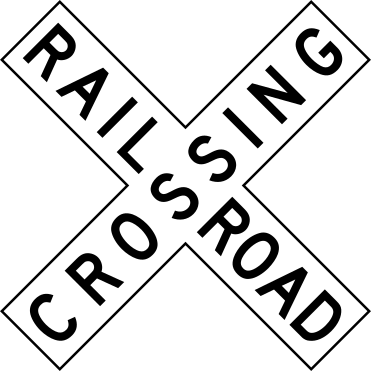
Railroad crossbuck 
Railroad crossing ahead 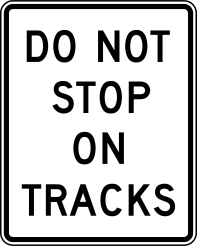
Do not stop on tracks
3 questions from the North Carolina practice test
1. At a North Carolina railroad crossing, which road user has the right of way?
- The train over all highway traffic
- The first automobile to reach the rails
- A vehicle facing a green signal on a nearby road
- A police vehicle approaching with warning lights
Show answer
The train over all highway traffic. Trains have priority at railroad crossings, including over police, fire, and ambulance vehicles. The first automobile to reach the rails cannot claim precedence, and a green signal on a nearby road does not control the train crossing. Rail equipment needs a great distance to stop and cannot swerve around a vehicle. When approaching tracks, reduce speed, look both ways, listen, and be prepared to stop before the crossing rather than trying to beat the train.
2. What must every vehicle in a North Carolina funeral procession display?
- Nothing special
- High beams only
- A flag on the antenna
- Headlights on, and hazard warning signals if equipped
Show answer
Headlights on, and hazard warning signals if equipped. Every vehicle in a North Carolina funeral procession must have its headlights on, and the hazard warning signals must also be on if the vehicle has them. The operator of the lead vehicle must comply with all traffic control signals, but once the lead vehicle has crossed an intersection lawfully or under an officer's direction, the following vehicles may proceed through without stopping. Other drivers must not cut through the line.
3. Which vehicles have the right of way when their flashing lights and sirens are operating?
- Any vehicle displaying four-way flashers
- Police cars, ambulances, fire engines, and rescue vehicles
- Only a school bus with red lights
- A private vehicle traveling faster than traffic
Show answer
Police cars, ambulances, fire engines, and rescue vehicles. Police cars, ambulances, fire engines, and rescue vehicles with flashing lights and sirens have the right of way under the North Carolina handbook. A private vehicle’s hazard flashers do not create emergency priority, and the school-bus rule is separate. Speed alone also gives no driver authority to demand the roadway. When one of these authorized vehicles approaches, yield promptly, move to the right-hand curb or edge, and stop completely. Scan in both directions because the response vehicle may approach from ahead or behind, then stay stopped until it passes or an officer directs you onward.
Practice this topic
Lock it in with right of way questions from the free North Carolina practice test. Every answer comes with a plain English explanation.
Source: the North Carolina Driver Handbook, Chapter 4: Your Driving. This lesson is a plain English summary, not the law itself; where it differs, the manual and the statute govern. Last checked 2026-09-27.