Every question below comes from the Washington question bank on this page. Open a question to see the correct answer and the explanation. Nothing here is hidden behind a signup.
1. You are approaching a steady red arrow traffic light in Washington. What must you do first?
- Slow down and turn without stopping
- Come to a complete stop
- Go ahead once pedestrians have cleared the crosswalk
- Proceed if the lane beside you is empty
Show answer
Come to a complete stop. The Washington guide lists the first step for a red arrow in one word: stop. Full explanation in Test 1
2. How long do alcohol and drug related offenses stay on a Washington driving record?
- Three years
- Five years
- For life
- Until age 21
Show answer
For life. Washington keeps alcohol and drug related offenses on the driving record for life. Full explanation in Test 2
3. How are bicycle lanes typically marked in Washington?
- Painted blue with double yellow lines
- Marked with orange cones only
- Painted green with solid white lines and a bicycle symbol
- Painted red with a dashed yellow line
Show answer
Painted green with solid white lines and a bicycle symbol. The Washington guide tells drivers to watch for bicycle lanes, which are typically painted green, use solid white lines and are marked with Full explanation in Test 3
4. When are Washington intermediate driver license restrictions automatically lifted?
- After the first six months
- When the driver turns 18
- After one month of safe driving
- When the driver receives a new permit
Show answer
When the driver turns 18. Washington says intermediate license restrictions are automatically lifted when the driver turns 18. Full explanation in Test 4
5. A motorcyclist is riding far to one side of a wide lane. May you move into that lane beside the motorcycle?
- Yes, if the motorcyclist is near the edge
- Yes, during heavy traffic only
- Yes, if you signal first
- No, motorcyclists are entitled to the full lane width
Show answer
No, motorcyclists are entitled to the full lane width. Motorcyclists change position within their lane to see, be seen and avoid objects, and they are entitled to the same lane width as any other Full explanation in Test 5
6. How close to a railroad crossing may you park in Washington?
- No closer than 15 feet
- No closer than 20 feet
- No closer than 50 feet
- No closer than 100 feet
Show answer
No closer than 50 feet. Washington bans parking on railroad tracks and within 50 feet of a railroad crossing. Full explanation in Test 6
7. What does the guide say drivers are responsible for knowing about Washington signs?
- Only signs pictured in the guide
- Only signs on interstate highways
- All signs, including city and county signs
- Only signs with a speed number
Show answer
All signs, including city and county signs. The guide lists some Washington State signs but makes clear that the list is not complete. Full explanation in Test 7
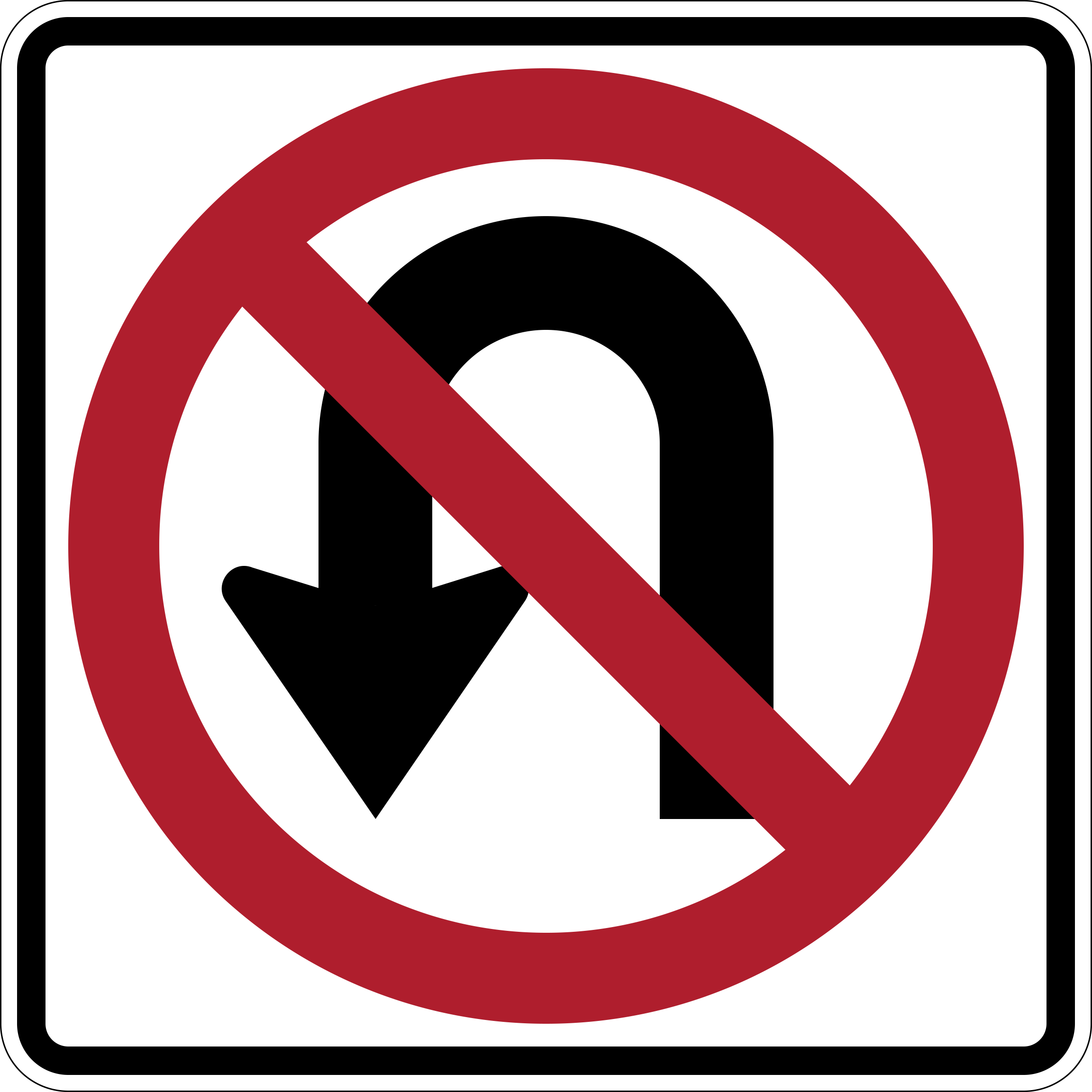
8. A red circle and slash over a U-turn symbol indicates what?
- U-turns are required
- Left turns are the only prohibited movement
- U-turns are not allowed
- The lane is reserved for passing
Show answer
U-turns are not allowed. Washington uses a red circle with a red slash over a symbol to prohibit the pictured action. Full explanation in Test 8
9. What additional signs can a Washington roundabout have?
- Only signs assigning parking spaces
- Only signs setting freeway ramp speeds
- Only signs marking county boundaries
- Yield, pedestrian warning, and directional arrow signs
Show answer
Yield, pedestrian warning, and directional arrow signs. Washington notes that roundabouts can have yield signs, pedestrian warning signs, and directional arrow signs. Full explanation in Test 9
10. How early may a Washington driver renew a license before it expires?
- Up to 30 days before
- Up to 90 days before
- Only after it expires
- Up to one year before
Show answer
Up to one year before. Washington drivers can renew up to one year before the license expires, online through License Express or at a licensing office. Full explanation in Test 10
11. In Washington, how far from a traffic signal, stop sign, or yield sign may you not park?
- Within 5 feet
- Within 15 feet
- Within 30 feet
- Within 75 feet
Show answer
Within 30 feet. Washington's do not park list includes parking within 30 feet of a traffic signal, stop sign, or yield sign. Full explanation in Test 1
12. A Washington license has been expired for 8 years. What must the driver do?
- Pay only the regular renewal fee
- Retake the skills and knowledge tests
- Take only a vision screening
- Wait one year before renewing
Show answer
Retake the skills and knowledge tests. If a license is 8 or more years expired, the driver must retake the skills and knowledge tests. Full explanation in Test 2
13. You want to pass a bicyclist on a road with two lanes in your direction. How far should you move over?
- Just enough to clear the handlebars
- One full lane
- Half a lane
- No move is needed if you slow down
Show answer
One full lane. Washington tells drivers not to pass a bicyclist until it is safe for both of you. Full explanation in Test 3
14. A solid white line separates your lane from another lane. What does the marking generally mean?
- Stay in your lane unless a special situation requires a change
- Cross whenever you want to pass
- Traffic is traveling in opposite directions
- The lane is reserved for school buses
Show answer
Stay in your lane unless a special situation requires a change. A solid white line means the driver should stay in the current lane unless a special situation requires changing lanes. Full explanation in Test 4
15. When does the Washington guide recommend placing one hand at the 12 o'clock position on the wheel?
- When driving straight on the freeway
- Whenever making a sharp left turn
- Only when backing the vehicle
- When recovering from a skid
Show answer
Only when backing the vehicle. Washington describes one hand steering for backing up and for reaching vehicle controls such as wipers or lights. Full explanation in Test 5
16. When driving at night, how should you adjust your following distance?
- Reduce it because headlights improve visibility
- Keep exactly one vehicle length in every condition
- Increase it
- Follow more closely so you can use the vehicle ahead as a guide
Show answer
Increase it. Night driving limits what you can see and how quickly you can identify a hazard, so the guide advises increasing following distance. Full explanation in Test 6
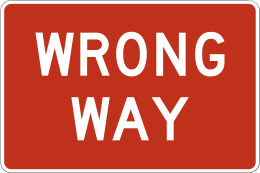
17. What should you do immediately after seeing a Wrong Way sign facing you?
- Continue until the next exit
- Move to the left lane and speed up
- Stop and turn around immediately
- Stop only if another car appears
Show answer
Stop and turn around immediately. A Wrong Way sign warns that the vehicle is traveling against the intended direction and that a head on collision is possible. Full explanation in Test 7
18. What lane does a Washington Keep Right sign tell you to use when you are not passing?
- The far left lane
- The shoulder
- The right lane
- Any lane closed by a merge sign
Show answer
The right lane. The Keep Right sign reminds drivers to stay in the right lane unless they are passing another vehicle. Full explanation in Test 8
19. A Washington intermediate license holder gets a second traffic violation. What happens?
- The license is suspended for 6 months or until age 18, whichever comes first
- The current restrictions simply continue until 18
- The license is suspended until age 21
- Nothing happens until a third violation
Show answer
The license is suspended for 6 months or until age 18, whichever comes first. The intermediate license penalty ladder has three steps. A first violation keeps the current restrictions in place until 18. Full explanation in Test 9
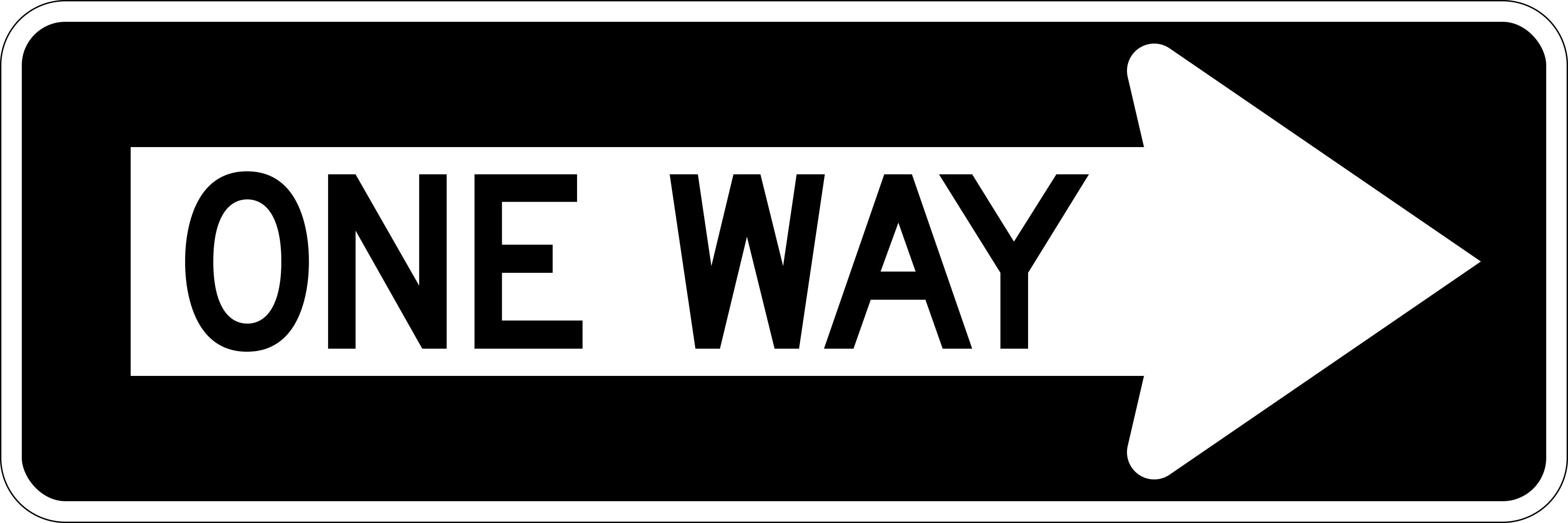
20. What does a One Way sign identify?
- Only buses may use the road
- Passing is required in the arrow's direction
- The road has two opposing travel lanes
- Traffic flows only in the direction of the arrow
Show answer
Traffic flows only in the direction of the arrow. A One Way sign identifies the permitted flow of traffic, which is only the direction shown by its arrow. Full explanation in Test 10
21. What does Washington require when transporting an animal outside the passenger area, such as in a truck bed?
- Nothing, as long as the tailgate is up
- A speed under 35 mph
- A leash tied to the bumper
- A protective harness or enclosure so the animal cannot jump or fall out
Show answer
A protective harness or enclosure so the animal cannot jump or fall out. It is illegal for anyone to transport an animal outside a vehicle, such as in the bed of a truck, without a protective harness or enclosure Full explanation in Test 1
22. For a Washington driver age 21 or older, what active THC concentration is described as a DUI threshold?
- Any amount measured in a vehicle's fuel system
- More than 1 nanogram per milliliter of blood
- Exactly 0 nanograms per milliliter of blood
- More than 5 nanograms per milliliter of blood
Show answer
More than 5 nanograms per milliliter of blood. For drivers 21 and older, the guide identifies more than 5 nanograms of active THC per milliliter of blood as a DUI threshold. Full explanation in Test 2
23. The Washington Driver Guide says it is a crime to leave a child below what age unattended in a parked vehicle?
- Under 5
- Under 8
- Under 18
- Under 12
Show answer
Under 12. The answer is 12. Per the Washington Driver Guide, leaving any child younger than that alone in a parked car is a crime. Full explanation in Test 3
24. Which earpiece use does Washington allow while driving?
- Full headphones at low volume
- Noise cancelling earbuds in both ears
- A hands free device in one ear that complies with the state code
- None at all, even hands free
Show answer
A hands free device in one ear that complies with the state code. You cannot drive while wearing earbuds, earphones, headphones or headsets that broadcast sound or cancel noise, but you can use a hands free Full explanation in Test 4
25. What does a dashed yellow line at the center of a two-way, two-lane road indicate?
- Traffic travels in the same direction on both sides
- The lane is reserved for left turns
- Passing is forbidden in both directions
- You may use the oncoming lane to pass when safe
Show answer
You may use the oncoming lane to pass when safe. A dashed yellow centerline separates opposing traffic while permitting a driver to enter the oncoming lane for a pass when the view, traffic Full explanation in Test 5
26. What do Washington regulatory signs with a red circle and slash indicate?
- A pictured action is not allowed
- The roadway is reserved for passing
- The pictured action is required
- Only trucks may perform the action
Show answer
A pictured action is not allowed. A red circle with a slash marks a prohibited action shown by the symbol. Full explanation in Test 6
27. What features of a traffic sign give clues to the type of information it provides?
- Only the driver's vehicle color
- The age of the pavement
- The posted fuel price
- Its shape, color, symbols, and words
Show answer
Its shape, color, symbols, and words. Traffic signs communicate rules, hazards, directions, and services. Full explanation in Test 7
28. Until what age must a Washington child ride in a rear-facing car seat?
- Up to age 2
- Up to age 1
- Up to age 4
- Up to age 8
Show answer
Up to age 2. Children up to age 2 must ride rear facing. Full explanation in Test 8
29. A Washington intermediate driver needs to drive at 2 a.m. Besides a parent or guardian, who may ride along to make the trip legal?
- A licensed driver at least age 18
- A licensed driver at least age 21
- A licensed driver at least age 25
- Any passenger age 20 or older
Show answer
A licensed driver at least age 25. The only adults who lift the 1 a.m. to 5 a.m. restriction are a parent, a guardian, or a licensed driver at least 25 years old. Full explanation in Test 9
30. How does the Washington guide say to report road rage in progress?
- File a report at a licensing office
- Post it on social media
- Call 911 immediately
- Follow the driver to get the plate
Show answer
Call 911 immediately. Report in progress road rage incidents immediately by calling 911. Full explanation in Test 10
31. What THC level makes a Washington driver under 21 subject to DUI consequences?
- More than 5 nanograms
- More than 2 nanograms
- Anything more than 0 nanograms of active THC
- Only a level that visibly impairs driving
Show answer
Anything more than 0 nanograms of active THC. Drivers under 21 face the same potential consequences as adults for anything more than 0 nanograms of active THC per milliliter of blood. Full explanation in Test 1
32. How should the head restraint be set to protect you from whiplash?
- Even with your ears
- Level with the base of your neck
- As low as it will go
- Removed for better rear visibility
Show answer
Even with your ears. Whiplash is a neck injury from the head being thrown during a crash. Full explanation in Test 2
33. Can a person be considered in physical control of a vehicle for DUI purposes when the vehicle is parked?
- Yes, if the person can take control of its engine or operation
- Yes, but only when the keys are outside the vehicle
- No, unless the vehicle is moving on a public highway
- No, a parked vehicle can never be involved in DUI
Show answer
Yes, if the person can take control of its engine or operation. Washington's DUI rule reaches physical control, not just motion on a roadway. Full explanation in Test 3
34. A Washington teen took a traffic safety course in another state. What minimum must that course meet?
- 10 hours of classroom and 2 hours behind the wheel
- 30 hours of classroom and 6 hours of behind-the-wheel instruction
- 24 hours of classroom and 6 hours behind the wheel
- 40 hours of classroom and 10 hours behind the wheel
Show answer
30 hours of classroom and 6 hours of behind-the-wheel instruction. Washington accepts an out-of-state traffic safety course only if it meets the state minimum of 30 hours of classroom and 6 hours of behind-t Full explanation in Test 4
35. After pulling right for an emergency vehicle, how should you reenter traffic?
- Wait until it passes, then reenter in the order you were traveling
- Back into the lane before signaling
- Reenter immediately behind the emergency vehicle
- Use the left lane first regardless of traffic
Show answer
Wait until it passes, then reenter in the order you were traveling. After yielding to an emergency vehicle, wait until it has passed before signaling and reentering traffic. Full explanation in Test 5
36. When must a Washington driver yield to a transit bus?
- Never, buses yield to cars
- Only at bus stops with a red curb
- Only when the bus is stopped
- When a bus traveling in the same direction has signaled and is pulling back onto the roadway
Show answer
When a bus traveling in the same direction has signaled and is pulling back onto the roadway. Yield to any transit vehicle traveling in the same direction as you that has signaled and is pulling back onto the roadway. Full explanation in Test 6
37. When driving behind a bicyclist in Washington, how much space should a driver leave?
- Less than 1 foot to discourage wobbling
- Exactly 10 feet in every situation
- At least 3 feet
- No space if the bicycle is near the curb
Show answer
At least 3 feet. Washington tells drivers to leave at least 3 feet of space when driving behind a bicyclist. Full explanation in Test 7
38. What is the maximum speed allowed in a Washington emergency zone?
- Posted speed limit plus 10 mph
- 35 mph in every emergency zone
- 50 mph
- No maximum if the driver changes lanes
Show answer
50 mph. A driver in a Washington emergency zone must never drive faster than 50 mph. Full explanation in Test 8
39. You just started a new prescription medicine. What does the Washington guide say about driving?
- It is fine to drive because the medicine is legal
- Drive only during daylight for the first week
- Drive normally unless the label mentions alcohol
- Do not drive until you know how it affects your judgment, coordination, and reaction time
Show answer
Do not drive until you know how it affects your judgment, coordination, and reaction time. The Washington guide says a drug being legal does not make it safe for driving. Full explanation in Test 9
40. What is required when approaching a railroad crossing with flashing red lights?
- Cross quickly before the train reaches the crossing
- Stop and stay outside the gates, because a train is approaching
- Stop only if a gate is lowered
- Drive around the warning lights if the track looks clear
Show answer
Stop and stay outside the gates, because a train is approaching. Flashing red lights at a railroad crossing mean a train is approaching, so the driver must stop and stay outside of the gates. Full explanation in Test 10
