
Test 14 of 25 · 20 questions · Free 2026
WA Permit Practice Test 14
Jump to the test ↓A fixed 20 question set from the Washington bank with answers and plain English explanations. The real WA exam is 40 questions, 80 percent to pass; take the full length version on the main practice page.
Question 1 of 20 · 0 right so far
All 20 questions in test 14
Every question below comes from the Washington question bank on this page. Open a question to see the correct answer and the explanation. Nothing here is hidden behind a signup.
1. A steady yellow X glows over a Washington reversible lane. What does it ask?
- Speed up to exit the lane system early
- Treat the lane as open for one more mile
- Stop in the lane until it turns green
- Move out of the lane as soon as it is safe
Show answer
Move out of the lane as soon as it is safe. A steady yellow X means a reversible lane is changing direction. Move out as soon as it is safe. A green arrow permits lane use, and a red X prohibits it. These lanes are usually marked by double-dashed white lines. Check overhead signs before entering. A steady yellow X means the lane is changing direction, and you should move out of the lane as soon as it’s safe.
Study this in the handbook: Pedestrians, school buses and transit buses
2. You are taken into custody in Washington while an animal is in your vehicle. What happens to the animal?
- The animal stays alone in the vehicle until you return
- An officer can take charge of the animal, and you pay a fee to collect it from police custody
- The animal is released at the roadside for safety
- A passenger must drive the animal home at once
Show answer
An officer can take charge of the animal, and you pay a fee to collect it from police custody. If you’re taken into custody for any reason, an officer can take charge of any animal(s) in the vehicle. If your animal is in police custody, you’ll need to pay a fee before you can collect the animal. An officer can take charge of animals in the vehicle when you are taken into custody. The guide says an officer can take charge of the animal; it does not direct roadside release.
3. Cars are lined up in a Washington ferry holding lane. What does the guide say about passing that line?
- Passing the line is allowed when your sailing leaves soon
- Passing the line is allowed for small cars that fit past
- Cutting the ferry line is a traffic offense that can lead to a fine
- Cutting the line is allowed outside residential areas
Show answer
Cutting the ferry line is a traffic offense that can lead to a fine. Pull up behind vehicles already in the ferry line. Cutting the line is a traffic offense that can lead to a fine. Do not block residential driveways or intersections in a residential ferry holding lane. Bicyclists receive priority loading on most ferries and may proceed past vehicles waiting in the holding lane. Pull up behind other vehicles already in line. Ferry line-cutting is a traffic offense that can lead to a fine.
Study this in the handbook: Speed, following space and zipper merging
4. When may a car legally sit in a Washington electric vehicle charging station space?
- Whenever the lot is full and the stop lasts under ten minutes
- When the driver waits inside the car for a passenger
- Only while the vehicle is connected to the charging equipment
- When the space is used overnight and vacated by morning
Show answer
Only while the vehicle is connected to the charging equipment. It is illegal to park a vehicle in an electric vehicle charging station if the vehicle is not connected to the charging equipment. It’s illegal to park a vehicle in any electric vehicle charging station if the vehicle is not connected to the charging equipment. A full lot and a brief stop do not allow parking without a charging connection. Remaining inside does not satisfy the manual's requirement that a vehicle parked in a charging station be connected to the equipment.
5. How should large objects be secured in a Washington vehicle or trailer load?
- Tied directly to the vehicle or trailer itself
- Wedged between smaller loose items for friction
- Covered with a loose tarp without straps
- Placed on top so wind presses them down
Show answer
Tied directly to the vehicle or trailer itself. Tie large objects directly to your vehicle or trailer. Tie everything down with rope, netting, or straps, and pack only items you can safely and securely carry. Loose neighbors cannot anchor a large object; it must tie to the vehicle or trailer. Tie everything down with rope, netting, or straps, and tie large objects directly to the vehicle or trailer. The manual requires tying large objects directly to the vehicle or trailer, not relying on wind.
6. Why does the Washington guide tell teen drivers to put safety-focused decisions ahead of speed and social pressures?
- Teen licenses carry lower speed limits than adult licenses
- The part of the brain for judgment and decision making is still developing in teens
- Teens may legally drive only with adult passengers
- Teen insurance rules require slower driving
Show answer
The part of the brain for judgment and decision making is still developing in teens. Judgment develops over time, and the guide is candid that the brain region handling judgment and decision making is still developing during the teen years. That makes teens more prone to taking risks or miscalculating situations, especially with friends watching or a clock pressing. No separate teen speed limit, adult passenger rule, or insurance speed rule explains the advice; licensing stages and restrictions do that work elsewhere. Knowing the development gap is real gives a young driver a reason to slow down, think twice, and let social pressure lose.
7. A solid green light faces you in Washington. What still applies?
- Wait for the intersection to clear and yield to pedestrians
- Cross traffic owes you an open path at once
- Pedestrians must wait until your lane empties
- Emergency vehicles must merge behind you
Show answer
Wait for the intersection to clear and yield to pedestrians. A solid green means go ahead, but only after the intersection clears. You must still yield to emergency vehicles as required by law and yield to pedestrians, who may be finishing a crossing as your light turns. Green does not sweep the box clean by itself or push emergency vehicles behind you in line. A quick scan before rolling turns the permission into a safe entry, much like the stop then look routine at a flashing red that works as a stop sign.
Study this in the handbook: Traffic signals and rules of the road
8. How can you keep your vehicle out of another driver's blind zone?
- Hold a steady speed directly beside a large vehicle
- Speed up or slow down so the driver can clearly see you
- Follow closely behind its rear bumper
- Ride beside the vehicle where its mirrors point away
Show answer
Speed up or slow down so the driver can clearly see you. Avoid other vehicles’ blind zones. You can speed up or slow down so the other driver can clearly see you. Buses, motorhomes, and commercial vehicles have larger blind zones, sometimes called no zones. If you cannot see their mirrors, the driver cannot see you. Avoid driving alongside large vehicles for too long. You also need to be aware of other vehicles’ blind zones.
Study this in the handbook: Headlights, brake lights, tires and signals
9. How soon must new Washington residents complete their vehicle registration?
- Within 5 days
- Within 10 days
- Within 15 days
- Within 30 days
Show answer
Within 30 days. New residents get 30 days to complete vehicle registration, and vehicles purchased in another state should be registered in Washington immediately. Before registering, a person generally needs a driver license unless exempt by law, using the Vehicle Registration Driver License Exemption form when that applies. The shorter deadlines belong elsewhere: five days for a seller report of sale, 15 days for a buyer to transfer a title without penalty, and 10 days for an address update. When you move here, put registration on the first month calendar.
Study this in the handbook: License exams, renewal and losing your license
10. What do Washington service signs show?
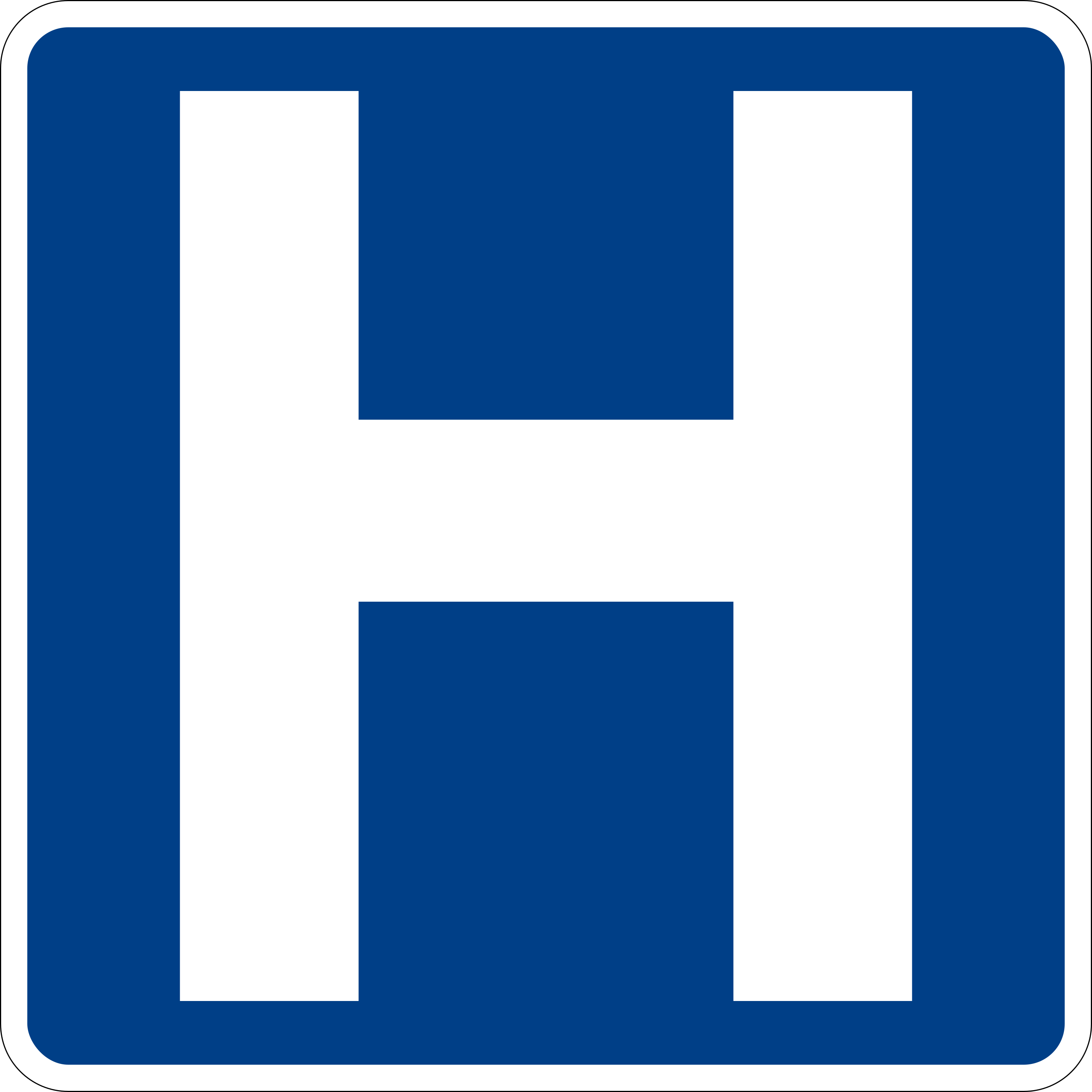
- The location of every no-passing zone
- The location of services such as hospitals, charging stations, and rest areas
- The names of all county roads
- The maximum speed for a work zone
Show answer
The location of services such as hospitals, charging stations, and rest areas. Service signs direct drivers toward useful facilities. Washington gives hospitals, electric vehicle charging stations, and rest areas as examples. These signs do not establish passing restrictions, set work-zone speeds, or list every county road. When a service sign appears, use its information to plan a safe stop or route choice while continuing to obey the separate signs and markings that control vehicle movement.
Study this in the handbook: Traffic signs
11. What does slowing down while approaching a hazard buy a Washington driver?
- A legal excuse to stop watching mirrors
- More space and time to make safe decisions
- A chance to finish a phone conversation
- Protection from every possible collision
Show answer
More space and time to make safe decisions. Drive slower when approaching hazards to give yourself more space and time to make safe decisions. Safe driving can reduce crash potential, but risk is always present. The guide calls for constant visual searching and checking traffic behind you, including when slowing down. Phones stay away while hazards demand attention. Slowing reduces risk; it cannot erase risk entirely. The marked choice, More space and time to make safe decisions, is the one that matches the guide on this point.
12. You park on a Washington hill where no curb exists. Which way should the wheels point?
- Toward the center line so the car stays visible
- Straight ahead to keep steering parts unloaded
- Opposite the last turn you made into the space
- Toward the edge of the road so a roll moves away from traffic
Show answer
Toward the edge of the road so a roll moves away from traffic. Turn your steering wheel and tires toward the edge of the road. This way, if your vehicle starts to roll, it will roll away from traffic. Turn the wheels toward the edge of the road so a roll moves away from traffic. The no-curb instruction is to turn the wheels toward the edge of the road. Aiming toward the edge of the road so a roll moves away from traffic is the guide instruction for that situation.
Study this in the handbook: Parking rules and hills
13. Which counting exercise does Washington suggest for calming down while sitting in a parked car?
- Count to 20, or count backward from 100 by threes, focusing only on the numbers
- Count passing cars until traffic clears
- Count breaths only while rolling slowly forward
- Count to 100 as fast as possible twice
Show answer
Count to 20, or count backward from 100 by threes, focusing only on the numbers. While sitting in a parked car, count slowly from 1 to 20 or backward from 100 by threes, such as 100, 97, 94, and 91. Concentrate only on the numbers to quiet other thoughts. The guide also suggests breathing in through the nose and exhaling as if cooling hot soup. Count slowly from 1 to 20, or backwards from 100 by three (100, 97, 94, 91, 88…).
Study this in the handbook: Distracted driving, emotions and road rage
14. How are Washington speeding tickets from camera locations delivered?
- Sent only after a court hearing date
- Handed to the driver at the next fuel station
- Mailed to the vehicle owner
- Left under the windshield wiper
Show answer
Mailed to the vehicle owner. All locations with traffic cameras are clearly marked. Speeding tickets from these locations are mailed to the vehicle owner. The guide lists steady-red-light violations, railroad-crossing-signal violations, and school-zone speeding as camera triggers. The guide says speeding tickets from camera locations are mailed to the vehicle owner. The delivery method stated in the guide is mail to the vehicle owner. Wiper notes are not the delivery method described.
Study this in the handbook: Traffic signs
15. At what height does Washington place the seat belt stage for a child who outgrows booster support?
- Over 4 feet 9 inches, with a properly fitting belt for every occupant tall enough
- At 4 feet even, whenever the shoulder belt feels close
- At 5 feet, matching adult licensing height ideas
- Height never matters once age 8 arrives
Show answer
Over 4 feet 9 inches, with a properly fitting belt for every occupant tall enough. The guide lists the seat belt stage as over 4 feet 9 inches and requires a properly fitting belt. Children ages 4 and older must use a car or booster seat until the vehicle lap and shoulder belts fit properly, typically between ages 8 and 12. The lap belt should fit snugly across the hips below the stomach, and the shoulder belt should fit across the shoulder and chest rather than the neck or face.
Study this in the handbook: Seat belts, child seats, steering and braking
16. Your car keeps accelerating on its own in Washington. What gear move helps you regain control?
- Shift into a lower gear and ride the brakes
- Shift into reverse to cancel forward speed
- Shift quickly to neutral, pull off safely, then turn off the engine
- Hold the gear and steer to a long uphill climb
Show answer
Shift quickly to neutral, pull off safely, then turn off the engine. Keep your eyes on the road, quickly shift to neutral, pull off the road when safe, and turn off the engine. Pull off the road when safe to do so. The guide says to shift quickly to neutral, then pull off safely and turn off the engine. The guide says to shift quickly to neutral, not reverse. The guide says to shift quickly to neutral and pull off when safe, not search for a hill.
Study this in the handbook: Breakdowns, collisions and power lines
17. Where is driving on ocean beaches allowed in Washington, and what speed limit applies?
- On any beach at 15 mph
- Statewide at 35 mph
- Only in Grays Harbor and Pacific Counties, at 25 mph
- Nowhere
Show answer
Only in Grays Harbor and Pacific Counties, at 25 mph. Driving is allowed on ocean beaches only in Grays Harbor and Pacific Counties. The beach is considered a state highway, so all driving laws apply, the speed limit is 25 mph, and pedestrians and bicyclists have the right of way at all times. Enter only through marked beach approaches and drive only on hard packed sand, watching for signs that prohibit beach driving in some areas and circumstances.
Study this in the handbook: Speed, following space and zipper merging
18. A Washington school bus shows yellow lights. What do they mean?
- Stop where you are immediately
- Caution, so slow down
- Children have finished crossing safely
- Pass quickly before red lights appear
Show answer
Caution, so slow down. School bus lights work like traffic signals: red means stop, and yellow means caution or slow down. Yellow is a warning to prepare, not permission to rush past before red appears, and it certainly does not signal an immediate stop in traffic or an all clear from children. Loading and unloading put unpredictable children near the roadway, so patience and the speed limit matter around every bus. Red lights with an extended stop sign will tell you when a full stop is required.
Study this in the handbook: Pedestrians, school buses and transit buses
19. Why is following a Washington snowplow too closely risky?
- Plows always reverse without warning lights
- Plow blades hide the plow brake lights fully
- Following closely keeps your tires in cleared ruts
- Snow forced off the road can create blizzard-like conditions
Show answer
Snow forced off the road can create blizzard-like conditions. Use caution near snow removal equipment. Snowplows can force snow up and off the road, causing blizzard-like conditions that reduce visibility for drivers following too closely. Reversing without lights is not the stated plow hazard. Hidden brake lights are not the condition described. Following too closely can reduce visibility because of snow thrown up by the plow. Snow forced off the road can create blizzard-like conditions, which is exactly the hazard the guide names here.
Study this in the handbook: Large vehicles, motorcycles, bicycles and farm vehicles
20. What does the Washington guide say to do if the vehicle keeps going faster because the accelerator is stuck?
- Pump the accelerator until it releases
- Turn off the engine while remaining in the travel lane
- Shift quickly to neutral and pull off the road when safe
- Shift into reverse to stop the vehicle immediately
Show answer
Shift quickly to neutral and pull off the road when safe. For a vehicle that keeps going faster and faster, the Washington guide gives these steps in order: keep your eyes on the road, quickly shift to neutral, pull off the road when safe to do so, and then turn off the engine. Turning off the engine while still in the travel lane reverses that order, and pumping the accelerator or shifting into reverse appears nowhere in the guide's steps for this emergency.
Study this in the handbook: Breakdowns, collisions and power lines
QualitySpace is expanding to Washington
We are a California-based independent insurance brokerage working on licensing in more states. We cannot help with Washington insurance yet. Leave your email and we will let you know when we can.
Every question is written from the official Washington State Driver Guide. Need paper? Printable WA practice test with answer key.
Last verified 2026-10-05. How we check every question · Study all 500 as flashcards
Frequently asked questions
How many questions are on this Washington practice test?
This fixed set has 20 questions. It is test 14 of 25 from the 500 question Washington bank. The real WA exam asks 40 questions and you need 32 correct.
What is the passing score for the real Washington test?
32 out of 40 correct answers (80%) That figure comes from the official Washington source cited on the DMV facts page.
How does this fixed test relate to the full Washington bank?
Each numbered test is a fixed set of questions in a fixed order, so you can retake the same test later and compare. Every test mixes road signs and the other topics in about the same proportion as the full bank. Tests 1 to 25 together cover every question in the Washington bank once. The full practice page mixes the whole bank at random.
Last verified 2026-10-05. See the Washington DMV facts page for sourced state details.
Return to the full Washington practice test · Study road signs