
Test 9 of 25 · 20 questions · Free 2026
WA Permit Practice Test 9
Jump to the test ↓A fixed 20 question set from the Washington bank with answers and plain English explanations. The real WA exam is 40 questions, 80 percent to pass; take the full length version on the main practice page.
Question 1 of 20 · 0 right so far
All 20 questions in test 9
Every question below comes from the Washington question bank on this page. Open a question to see the correct answer and the explanation. Nothing here is hidden behind a signup.
1. What additional signs can a Washington roundabout have?
- Only signs assigning parking spaces
- Only signs setting freeway ramp speeds
- Only signs marking county boundaries
- Yield, pedestrian warning, and directional arrow signs
Show answer
Yield, pedestrian warning, and directional arrow signs. Washington notes that roundabouts can have yield signs, pedestrian warning signs, and directional arrow signs. These controls help drivers determine who must wait, where people may cross, and which way traffic moves around the circle. The other choices invent restrictions about parking, freeway ramp speeds, or county boundaries that are not the listed roundabout controls. As you approach, slow down, read each sign, watch for pedestrians, and follow the lane arrows. Yield when required and enter only after checking the traffic already circulating in the roundabout.
Study this in the handbook: Traffic signs
2. A Washington intermediate license holder gets a second traffic violation. What happens?
- The license is suspended for 6 months or until age 18, whichever comes first
- The current restrictions simply continue until 18
- The license is suspended until age 21
- Nothing happens until a third violation
Show answer
The license is suspended for 6 months or until age 18, whichever comes first. The intermediate license penalty ladder has three steps. A first violation keeps the current restrictions in place until 18. A second violation suspends the license for 6 months or until 18, whichever comes first. A third suspends it until 18. So restrictions continuing is the first step, not the second, and nothing waits for a third violation. Suspension until 21 is not part of the ladder.
Study this in the handbook: Instruction permits and the intermediate license
3. A Washington intermediate driver needs to drive at 2 a.m. Besides a parent or guardian, who may ride along to make the trip legal?
- A licensed driver at least age 18
- A licensed driver at least age 21
- A licensed driver at least age 25
- Any passenger age 20 or older
Show answer
A licensed driver at least age 25. The only adults who lift the 1 a.m. to 5 a.m. restriction are a parent, a guardian, or a licensed driver at least 25 years old. Eighteen and twenty-one are tempting guesses, but Washington sets 25 for this exception. A passenger of 20 who is unlicensed or younger than 25 does not qualify. Agricultural trips and drivers with a year of safe driving are separate exceptions.
Study this in the handbook: Instruction permits and the intermediate license
4. You just started a new prescription medicine. What does the Washington guide say about driving?
- It is fine to drive because the medicine is legal
- Drive only during daylight for the first week
- Drive normally unless the label mentions alcohol
- Do not drive until you know how it affects your judgment, coordination, and reaction time
Show answer
Do not drive until you know how it affects your judgment, coordination, and reaction time. The Washington guide says a drug being legal does not make it safe for driving. Do not drive if you just started a prescription for the first time, started a new medicine, or moved to a higher dose of a current one. Wait until you know its effect on your judgment, coordination and reaction time, read the warning labels, and ask your doctor or pharmacist. A label warning against operating heavy machinery includes driving a vehicle.
Study this in the handbook: Alcohol, cannabis, medicine and fatigue
5. What should you do if your vehicle has trouble on the road and can be moved safely?
- Leave it in the travel lane with no warning lights
- Get it off the road and away from traffic
- Stop just beyond a hill so other drivers cannot see it
- Stand in the lane and direct traffic around it
Show answer
Get it off the road and away from traffic. When possible, move a disabled vehicle away from active traffic. The guide also advises stopping where other drivers have a clear view, turning on emergency flashers and headlights, and placing flares behind the vehicle when available. A hidden position beyond a hill gives approaching drivers less time to react. Standing in a travel lane exposes you to a collision. Once stopped, keep yourself in a safe location and make the vehicle visible without becoming part of the traffic hazard.
Study this in the handbook: Breakdowns, collisions and power lines
6. What does a green arrow give a driver?
- Permission to ignore pedestrians
- A command to stop before the arrow changes
- The right-of-way to travel in the arrow's direction
- Priority over an emergency vehicle
Show answer
The right-of-way to travel in the arrow's direction. A green arrow gives the driver the right-of-way to travel in the direction shown. It does not cancel the need to watch the intersection or yield to an emergency vehicle, and it is not a stop instruction. The guide says there should be no oncoming vehicles, crossing traffic, or pedestrians while the arrow is green, but active scanning remains important. Follow the arrow, check that the movement area is clear, and be prepared to respond to anyone already in the intersection or to an emergency signal.
Study this in the handbook: Traffic signals and rules of the road
7. Why should a driver not rely on daytime running lights as a complete substitute for regular headlights?
- They work only when the vehicle is parked
- They make the front of the vehicle invisible
- They are not as bright and do not activate the taillights
- They automatically activate high beams in every condition
Show answer
They are not as bright and do not activate the taillights. Daytime running lights help illuminate the front of some vehicles, but the guide warns they are not as bright as headlights and do not activate the taillights. That means a driver relying on them may be less visible from behind, especially in changing weather or light. The other choices describe behavior the guide does not state. A useful check is whether the rear lights are on, not merely whether some front lights appear. Turn on regular headlights when darkness or rain, snow, fog, or smoke makes visibility more demanding.
Study this in the handbook: Headlights, brake lights, tires and signals
8. Which exam must be passed before a Washington applicant may take the Driving Skills Exam?
- The vision screening only
- The vehicle inspection exam
- The road test in another state
- The Driving Knowledge Exam
Show answer
The Driving Knowledge Exam. Washington puts the Driving Knowledge Exam first in the sequence. It checks understanding of the state's rules of the road, and the skills exam follows after that knowledge requirement is met. The vision screening is another licensing step but does not replace the prerequisite. A vehicle inspection is not identified as the gate before the skills exam. Think of the process as knowledge first, then demonstrating the rules behind the wheel.
Study this in the handbook: License exams, renewal and losing your license
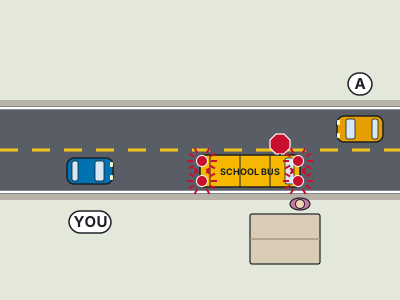
9. When must vehicles stop for a school bus on a two-lane road?
- Only vehicles behind the bus stop
- Opposing vehicles stop only if the bus is moving
- Only vehicles traveling faster than 25 mph stop
- All vehicles must stop when the red lights flash and the stop sign extends
Show answer
All vehicles must stop when the red lights flash and the stop sign extends. On a two-lane road, all vehicles must stop when the school bus red lights flash and its stop sign extends. The rule protects children who may cross from either side, so opposing traffic is not excused merely because it is in front of the bus. Speed and whether the bus is rolling do not replace the signal condition. Wait until the red lights stop, the sign retracts, and the metal arm returns to the front bumper before resuming. Continue watching because children can still be nearby after the signals end.
Study this in the handbook: Pedestrians, school buses and transit buses
10. How far before a turn should a Washington driver normally begin signaling?
- At least 100 feet before turning left or right across oncoming traffic
- At least 25 feet before the turn begins
- Only after the front wheels enter the intersection
- Exactly 500 feet before every turn
Show answer
At least 100 feet before turning left or right across oncoming traffic. The guide gives a minimum of 100 feet for signaling before turning left or right across oncoming traffic. Signaling early communicates the planned movement and gives other road users time to respond. Twenty-five feet is shorter than the stated distance, while waiting until the wheels enter the intersection communicates too late. Five hundred feet is not the guide’s ordinary figure for this maneuver. Use the 100-foot mark as a planning point, then check for a safe gap and vulnerable road users.
Study this in the handbook: Intersections, turns and roundabouts
11. What must a Washington driver do to get a license back after a suspension or revocation ends?
- Take the driving knowledge and skills exams again and pay a reissue fee
- Pay the fee only
- Wait 30 more days
- Nothing, it is restored automatically
Show answer
Take the driving knowledge and skills exams again and pay a reissue fee. When you are eligible to get your driver license back, you must take the driving knowledge and skills exams even if you have already taken them, and pay a reissue fee in addition to the usual testing and licensing fees. Applicants under 18 also need a parent or guardian's consent. The guide lists the same retest and reissue fee step among the possible consequences of a DUI conviction.
Study this in the handbook: License exams, renewal and losing your license
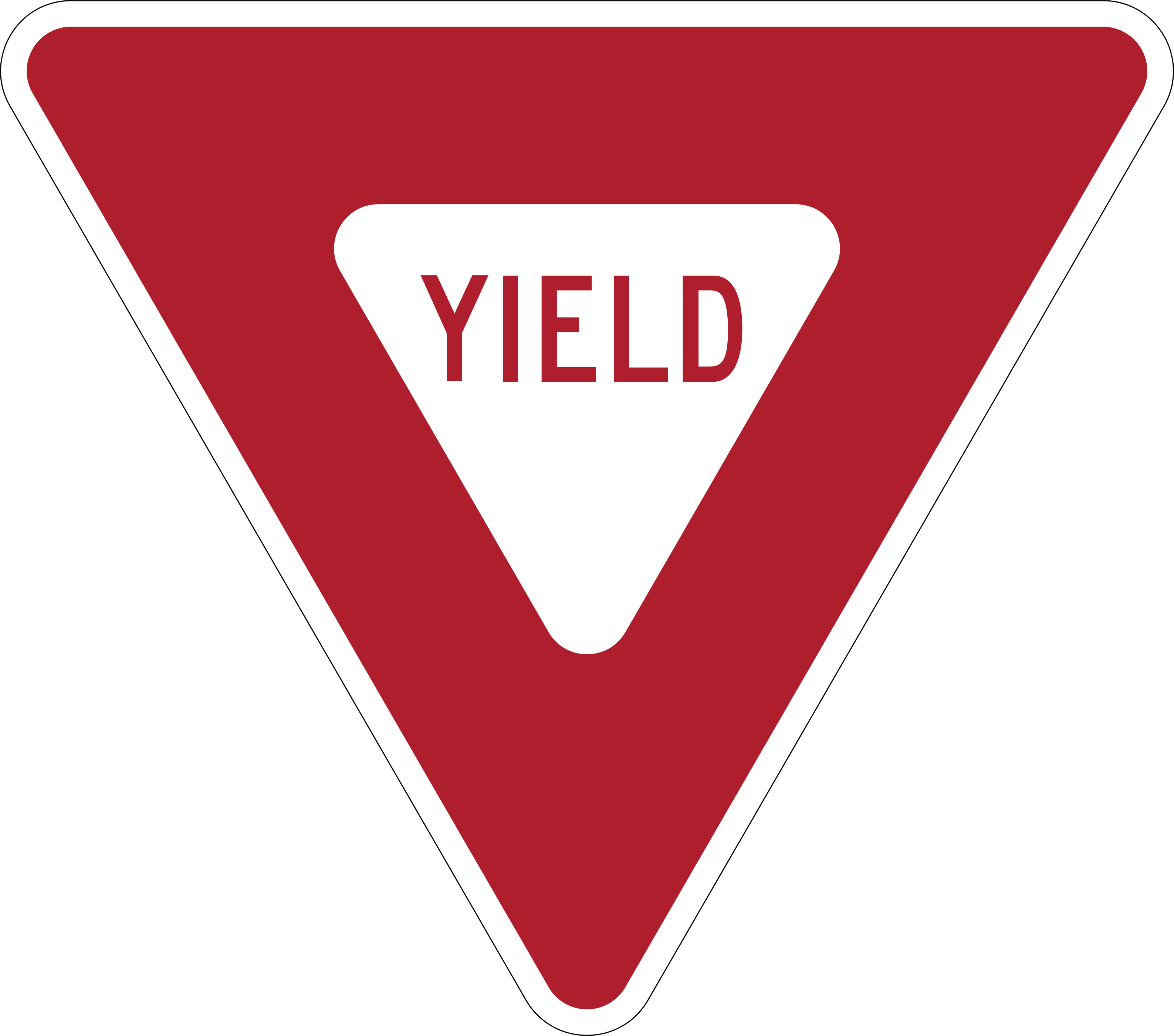
12. At a yield sign, what action is required before entering the roadway?
- Stop for exactly three seconds every time
- Slow down and allow right of way traffic to cross first
- Proceed first if you are in the larger vehicle
- Accelerate to enter before cross traffic
Show answer
Slow down and allow right of way traffic to cross first. A yield sign calls for a meaningful reduction in speed and deference to traffic that already has the right of way. You must let that traffic cross first, and you should be ready to stop if the situation requires it. The sign does not impose a fixed three second wait when no traffic is present. Size, urgency, or acceleration never creates priority. Approach slowly, look for vehicles and pedestrians, and enter only when the crossing path is clear.
Study this in the handbook: Traffic signs
13. Which statement matches the Washington guide's warning about driving after consuming cannabis?
- Cannabis is lawful for driving once the driver is 21
- Driving after consuming any cannabis is illegal for all ages
- Driving is legal if the driver waits ten minutes
- Only cannabis edibles make driving illegal
Show answer
Driving after consuming any cannabis is illegal for all ages. The guide separates legal recreational possession from driving behavior. It says driving after consuming any cannabis is illegal for all ages, so being 21 does not create a driving exception. The choices about edibles or a ten minute wait introduce limits that the guide never gives. The useful cue is any cannabis, all ages. Cannabis can reduce attention, coordination, reaction time, and distance judgment, so a driver should arrange another way home rather than trying to estimate when the effects have faded.
Study this in the handbook: Alcohol, cannabis, medicine and fatigue
14. What restraint does the Washington guide require for a child who is 3 years old?
- A car seat with a rear or forward facing harness
- A regular lap and shoulder belt
- A booster seat without a harness
- No restraint if the child sits in the back seat
Show answer
A car seat with a rear or forward facing harness. Washington sets restraint stages by age and size. Children up to age 2 ride rear facing, and children ages 2 to 4 must ride in a car seat with a rear or forward facing harness. A booster seat comes later, from about age 4 until the adult belt fits properly, and a regular seat belt alone is for children over 4 feet 9 inches. Every person in a moving vehicle must be belted or secured in an approved child restraint.
Study this in the handbook: Seat belts, child seats, steering and braking
15. Where does the Washington guide say to find the proper inflation pressure for your tires?
- Molded on the tire sidewall as the number to fill to
- On the Tire and Loading Information label on the driver's side door edge, or in the owner's manual
- On your vehicle registration card
- On a sticker inside the fuel door only
Show answer
On the Tire and Loading Information label on the driver's side door edge, or in the owner's manual. Low tire pressure can affect how your car handles. The Washington guide says the proper inflation pressure is printed on the Tire and Loading Information label on the driver's side door edge, and it is also listed in your owner's manual. The guide does not send you to the tire sidewall, the registration card or the fuel door for this number. Check pressure regularly, since low pressure develops slowly. Keeping tires at the right pressure also improves gas mileage.
Study this in the handbook: Headlights, brake lights, tires and signals
16. How far before a fire station driveway is parking prohibited on the opposite side of the street?
- 15 feet
- 75 feet
- 30 feet
- 50 feet
Show answer
75 feet. Washington parking rules prohibit parking within 75 feet of a fire station driveway on the opposite side of the street. The other distances are used for different restrictions, including fire hydrants, traffic control signs, or railroad crossings. Keeping this larger clear area helps emergency vehicles enter and leave without obstruction. The cue is a fire station driveway: measure the approach and opposite side carefully before leaving a parked vehicle there.
Study this in the handbook: Parking rules and hills
17. At night, what speed does the Washington guide say to keep?
- A speed that lets you stop within the glow of your headlights, usually about 400 feet
- The posted limit regardless of visibility
- 10 mph under the limit
- A speed that lets you stop within 100 feet
Show answer
A speed that lets you stop within the glow of your headlights, usually about 400 feet. It is harder to see at night, so drive at a speed that will allow you to stop within the glow of your headlights, usually about 400 feet. Use high beams when there are no oncoming vehicles, switch to low beams for approaching traffic and when following, and avoid looking directly into oncoming headlights. Keep your eyes moving across the road ahead.
Study this in the handbook: Night driving, slippery roads, skids and hydroplaning
18. What should you do if you are involved in a crash in which someone is injured or killed?
- Wait to report it unless the damage exceeds a stated dollar amount
- Leave immediately after exchanging a phone number
- Move the vehicle far away before reporting anything
- Do not drive away, call 911, and notify law enforcement
Show answer
Do not drive away, call 911, and notify law enforcement. After a collision involving injury or death, Washington guidance says not to drive away. Call 911 and notify law enforcement. Leaving, delaying the report, or moving far away before handling the emergency can prevent medical care and investigation. The cue is injury or a fatality: protect the scene as safely as possible, summon help, and remain available to provide information rather than treating the crash as a minor property-only event.
Study this in the handbook: Breakdowns, collisions and power lines
19. When turning at an intersection, which lane should you enter?
- The farthest lane from your starting direction
- Any lane that has the shortest queue
- The shoulder if the turn is difficult
- The lane closest to the direction you are coming from
Show answer
The lane closest to the direction you are coming from. Washington law requires a driver turning left or right to turn into the lane closest to the direction from which the driver came. Entering the far lane can cross other traffic paths and make the turn unpredictable. Queue length does not change the lane rule, and the shoulder is not a substitute travel lane. The cue is near side to near side: hold the original lane through the turn, then change lanes after completing it if necessary.
Study this in the handbook: Intersections, turns and roundabouts
20. Where does the Washington guide say to place your hands for hand-to-hand steering?
- At 12 and 6
- One hand at 12 o'clock
- At 9 and 3 or 10 and 2, keeping them there through the turn
- Both hands at the bottom of the wheel
Show answer
At 9 and 3 or 10 and 2, keeping them there through the turn. Imagine the steering wheel as a clock. For hand to hand steering, also called pull and push, your hands should be at 9 and 3 or 10 and 2, and they stay in that position as you turn. Because the hands never cross over the wheel, there is less risk of an arm being struck by a deploying airbag, and the grip on the top half of the wheel gives the best control.
Study this in the handbook: Seat belts, child seats, steering and braking
QualitySpace is expanding to Washington
We are a California-based independent insurance brokerage working on licensing in more states. We cannot help with Washington insurance yet. Leave your email and we will let you know when we can.
Every question is written from the official Washington State Driver Guide. Need paper? Printable WA practice test with answer key.
Last verified 2026-10-05. How we check every question · Study all 500 as flashcards
Frequently asked questions
How many questions are on this Washington practice test?
This fixed set has 20 questions. It is test 9 of 25 from the 500 question Washington bank. The real WA exam asks 40 questions and you need 32 correct.
What is the passing score for the real Washington test?
32 out of 40 correct answers (80%) That figure comes from the official Washington source cited on the DMV facts page.
How does this fixed test relate to the full Washington bank?
Each numbered test is a fixed set of questions in a fixed order, so you can retake the same test later and compare. Every test mixes road signs and the other topics in about the same proportion as the full bank. Tests 1 to 25 together cover every question in the Washington bank once. The full practice page mixes the whole bank at random.
Last verified 2026-10-05. See the Washington DMV facts page for sourced state details.
Return to the full Washington practice test · Study road signs