
Test 17 of 25 · 20 questions · Free 2026
WA Permit Practice Test 17
Jump to the test ↓A fixed 20 question set from the Washington bank with answers and plain English explanations. The real WA exam is 40 questions, 80 percent to pass; take the full length version on the main practice page.
Question 1 of 20 · 0 right so far

All 20 questions in test 17
Every question below comes from the Washington question bank on this page. Open a question to see the correct answer and the explanation. Nothing here is hidden behind a signup.
1. The pictured Washington sign tells drivers that the road ahead does what?
- Ends at a ferry terminal
- Becomes one way to the left
- Winds through a series of curves
- Narrows to a single lane
Show answer
Winds through a series of curves. This sign warns of a winding road. Its image is a yellow diamond sign with a winding arrow. Yellow in the guide list warns of general and unexpected road conditions. The road does not end at a ferry terminal, become one way to the left, or narrow to a single lane at this sign. Traffic signs tell you about traffic rules, hazards, roadway directions, and the location of roadway services.
2. What happens after a third traffic violation or at-fault collision by a Washington intermediate license holder?
- The license is suspended for 30 days
- The license is suspended until the driver turns 18
- The driver receives a warning letter only
- The license is suspended for 6 months
Show answer
The license is suspended until the driver turns 18. A third violation suspends the intermediate license until the driver turns 18. Six months, or until 18 if sooner, is the second step, and the first violation only extends the restrictions to age 18. A warning letter and a 30 day suspension are not on the ladder. The penalties apply to traffic violations and at-fault collisions alike, so a crash the teen causes counts the same as a ticket. The suspension ends on the 18th birthday.
Study this in the handbook: Instruction permits and the intermediate license
3. What does switching attention mean for a Washington driver?
- Resting both eyes during straight highway stretches
- Holding focus on one task for a long trip
- Quickly switching focus from one thing to another
- Doing several tasks at the same time
Show answer
Quickly switching focus from one thing to another. Switching attention means quickly moving focus from one thing to another, a skill drivers use while balancing the vehicle, rules, hazards, signs, and people around them. Sustained attention covers holding focus over a long period, and divided attention covers performing several tasks at once, which the guide warns against by urging drivers to resist multitasking. Focused attention concentrates the whole brain on one task. Silencing electronics, limiting passengers, and staying rested all support whichever kind of attention the moment demands.
Study this in the handbook: Distracted driving, emotions and road rage
4. At a T-intersection, who normally has the right-of-way?
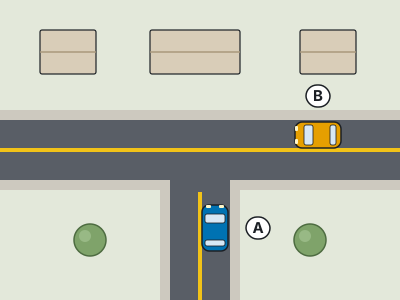
- Traffic leaving the road that ends
- Traffic on the through road
- The vehicle that sounds its horn first
- The vehicle that is closest to the center line
Show answer
Traffic on the through road. A T-intersection is formed when one road ends at a through road. The guide notes that passing traffic on the through road has the right-of-way, sometimes reinforced by a yield or stop sign for the ending road. The ending road does not gain priority by arriving first. A horn is a warning device, not a right-of-way grant, and lane position near the center line does not settle the order. Drivers leaving the short road should approach cautiously and yield as required.
Study this in the handbook: Intersections, turns and roundabouts
5. A Washington dealership sells a vehicle. What does the guide say about filing the report of sale?
- The dealer must file it within five days
- No report of sale is ever needed after a dealer sale
- The dealer might file it for you, but is not required to, so filing it yourself is in your best interest
- Only the purchaser may file it, at a driver licensing office
Show answer
The dealer might file it for you, but is not required to, so filing it yourself is in your best interest. If a vehicle is sold by a dealer, the dealership might file a report of sale on your behalf, but is not required to. The guide says it is in your best interest to file the report yourself. For individual-to-individual transactions, file a Vehicle Report of Sale within five days of selling, trading, gifting, or disposing of the vehicle, at a vehicle licensing office or through dol.wa.gov.
6. How may a Washington median be built, and what driving rule follows?
- Open spaces, cement dividers, or striped yellow markings; driving within or across is illegal
- Painted areas where passing is allowed at night
- Gore areas reserved for slow merging
- Only grass spaces where parking is allowed
Show answer
Open spaces, cement dividers, or striped yellow markings; driving within or across is illegal. Medians divide two or more roadways. They may be open spaces, cement dividers, or 18-inch solid yellow pavement markings with stripes. It is illegal to drive within, over, or across medians. They can be open spaces, cement dividers, or 18-inch solid yellow pavement markings with stripes. It’s illegal to drive within, over, or across medians. Painted medians never become night passing lanes.
Study this in the handbook: Road markings, lanes and school zones
7. Which road flaws can force a Washington motorcyclist to change speed or lane position?
- Painted arrows and fresh lane striping
- Wide shoulders and long exit ramps
- Gravel, pavement seams, potholes, and manhole covers
- Signal timing at the next intersection
Show answer
Gravel, pavement seams, potholes, and manhole covers. Gravel, debris, pavement seams, small animals, potholes, and manhole covers can force a motorcyclist to change speed or lane position. Anticipate changes the rider might need to make. Motorcyclists are entitled to the same lane width as other vehicles. Bumpy road surfaces and irregularities that don’t affect other drivers, such as gravel, debris, pavement seams, small animals, potholes, and even manhole covers, can force a motorcyclist to change speed or lane position.
Study this in the handbook: Large vehicles, motorcycles, bicycles and farm vehicles
8. A vehicle is purchased in another state and brought to Washington. When should it be registered here?
- Within ninety days of arrival
- Immediately
- At the next yearly tab renewal
- Only after its first Washington oil change
Show answer
Immediately. Vehicles purchased in another state should be registered in Washington immediately. The guide separately gives new residents 30 days to complete vehicle registration. New residents have 30 days to complete their vehicle registration. Out of state purchases carry an immediate duty, not ninety days. The guide says to register an out-of-state purchase immediately rather than wait for tab renewal. The guide specifies immediate registration, not an oil-change milestone.
Study this in the handbook: License exams, renewal and losing your license
9. Which container trick does Washington open container law treat as a traffic infraction inside a vehicle on the road?
- Carrying sealed bottles home in the trunk
- Placing groceries over a sealed purchase bag
- Hiding alcohol or cannabis in unlabeled or mislabeled containers
- Keeping an empty rinsed bottle for recycling
Show answer
Hiding alcohol or cannabis in unlabeled or mislabeled containers. The guide lists hiding alcohol or cannabis in unlabeled or mislabeled containers as an open-container traffic infraction in a vehicle on the road. Open alcohol and cannabis products may be transported only in a trunk or truck bed, not in storage compartments accessible to the driver. Hides alcohol or cannabis in unlabeled or mislabeled containers. The listed infraction is hiding alcohol or cannabis in unlabeled or mislabeled containers; this option describes sealed bottles in the trunk.
Study this in the handbook: License exams, renewal and losing your license
10. What must the liability insurance proof show for a vehicle brought to a Washington Driving Skills Exam?
- The examiner name printed on the policy
- The policy holder name or the vehicle description
- A full year of prepaid premiums
- The driving school owner signature
Show answer
The policy holder name or the vehicle description. The exam vehicle must have proof of current liability insurance showing the policy holder’s name or the vehicle’s description. The examiner verifies the vehicle requirements before the exam begins. The vehicle needs to have proof of current liability insurance (showing the policy holder’s name or the vehicle’s description). The required identifying information is the policy holder’s name or the vehicle’s description. Proof must be current liability coverage, not a prepaid term length.
Study this in the handbook: License exams, renewal and losing your license
11. Which features belong to collision mitigation systems that act when a crash cannot be avoided?
- Adaptive cruise spacing and lane centering
- Sign reading and speed display
- Parking sensors and backup cameras
- Pre-crash seatbelt tensioning and post-collision braking
Show answer
Pre-crash seatbelt tensioning and post-collision braking. Collision mitigation systems minimize the impact of an unavoidable collision. The guide lists pre-crash seatbelt tensioning and post-collision braking as possible features. Minimizes the impact if a collision is unavoidable. This component goes beyond collision avoidance and can include features like pre-crash seatbelt tensioning and post-collision braking. Those aids prevent crashes rather than soften unavoidable ones. Traffic sign recognition identifies and interprets signs and displays information; the guide lists belt tensioning and post-collision braking as mitigation features.
Study this in the handbook: Headlights, brake lights, tires and signals
12. What does Washington law say about driving or riding without a seat belt or child safety restraint?
- It is allowed on trips under five miles
- It is illegal to drive or ride that way
- It is allowed in the back seat only
- It is a courtesy choice for each rider
Show answer
It is illegal to drive or ride that way. The guide says every person in a moving vehicle must wear a seat belt or be secured in an approved child restraint. It is illegal to drive or ride without the required belt or child restraint. Always buckle up and make sure passengers are restrained correctly. It is illegal to drive or ride in a vehicle without wearing a seat belt or using child safety restraints.
Study this in the handbook: Seat belts, child seats, steering and braking
13. Which breathing technique does the Washington guide suggest for calming down in a parked car?
- Take rapid shallow breaths for one full minute
- Breathe only through your mouth while counting aloud
- Hold your breath until your shoulders drop
- Breathe in through your nose and exhale like cooling hot soup
Show answer
Breathe in through your nose and exhale like cooling hot soup. While sitting in a parked car, breathe in through your nose and exhale as if cooling hot soup. Other listed techniques include counting slowly and allowing plenty of time for your trip. The guide says emotional awareness encourages patience, respect, and safer driving. Breathe in through your nose, and exhale like you’re trying to cool hot soup. The listed method is to inhale through your nose and exhale as if cooling hot soup.
Study this in the handbook: Distracted driving, emotions and road rage
14. A pedestrian who is not using a wheelchair, cane, guide dog, or other service animal is crossing in front of you on a multilane street. How much lane clearance does the Washington guide require before you proceed?
- As soon as the pedestrian steps out of your exact lane
- After the pedestrian has cleared your lane and one additional lane
- As soon as the pedestrian passes your front bumper
- Only after every pedestrian reaches the far curb, with no exceptions
Show answer
After the pedestrian has cleared your lane and one additional lane. Wait until the pedestrian has cleared your lane and one additional lane before proceeding. Clearing only your lane is not enough, because the person may still be close beside your path. A different rule applies when the pedestrian uses a wheelchair, cane, guide dog, or other service animal. In that case, wait until the person has completely crossed the street. Watch with extra care for people who cannot see you, people who are distracted, and people who seem confused, while applying the lane rule that fits the crossing.
Study this in the handbook: Pedestrians, school buses and transit buses
15. How far can a train need to come to a full stop?
- About 50 feet at low speed
- About 300 feet on dry track
- About 450 feet with good brakes
- Up to a mile
Show answer
Up to a mile. Trains always have the right-of-way. They are heavy and cannot stop quickly, even at low speeds, and can take up to a mile to stop. When railroad crossing signals flash, stop 15 to 50 feet from the nearest rail and stay outside the gates. Never drive around a crossing gate. They are heavy and cannot stop quickly even if they are traveling at low speeds.
Study this in the handbook: Railroad crossings, emergency vehicles and emergency zones
16. When is setting the parking brake stressed most strongly in Washington?
- Especially on a hill, though the brake should be set whenever you park
- Only when the transmission is in neutral at a fuel station
- Only for manual transmission cars on flat ground
- Only when parking overnight on a residential street
Show answer
Especially on a hill, though the brake should be set whenever you park. Set the parking brake every time you park, with special emphasis on a hill where gravity can roll an unsecured car into traffic. Fuel stops, flat streets, and overnight parking do not remove the need, and the transmission type does not decide the habit either. On a hill, turning the wheels toward the edge of the road provides additional security if the parking brake fails. Think of the brake as the lock that holds your parking choice in place after you have picked a legal space and turned the wheels correctly.
Study this in the handbook: Parking rules and hills
17. Why might a motorcycle ahead of you slow down without showing a brake light?
- The rider may slow by easing off the throttle instead of braking
- Motorcycles are not required to have brake lights
- Brake lights only work at night
- The rider is signaling a lane change
Show answer
The rider may slow by easing off the throttle instead of braking. Motorcyclists often slow down by using the throttle rather than the brakes, so the brake light may never come on. The Washington guide also notes that some motorcycles have turn signals that do not cancel on their own. Watch the rider's speed and position, not just the lights, and leave more following distance than you would behind a car, especially when the road is wet or slick.
Study this in the handbook: Large vehicles, motorcycles, bicycles and farm vehicles
18. Your car begins to skid on a slick Washington road. Which steering move helps regain traction?
- Steer sharply opposite the slide to stop rotation
- Hold the wheel locked straight until the skid ends
- Turn the wheel fully toward the nearest curb
- Steer in the same direction the vehicle is moving, then keep correcting
Show answer
Steer in the same direction the vehicle is moving, then keep correcting. Steer in the same direction your vehicle is moving. Continue correcting your steering until your tires regain traction and are going in the direction you are steering. After regaining control, consider the road conditions and adjust your driving as needed. Steer in the same direction the vehicle is moving and continue correcting as traction returns. Continue adjusting the steering until the tires regain traction and follow your steering direction.
Study this in the handbook: Night driving, slippery roads, skids and hydroplaning
19. Which roads count as a school zone in Washington?
- Roads around a school building or playground
- Any road with a 20 mph limit for other reasons
- Only roads with flashing beacon lights installed
- Only roads inside school parking lots
Show answer
Roads around a school building or playground. A school zone refers to the roads around a school building or playground. These areas can be marked with signs, pavement markings, and flashing lights. A 20 mph limit can exist for other reasons; location around a school building or playground defines the zone. Flashing lights are one possible marker, not a requirement for a school zone to exist. The guide defines a school zone as the roads around a school building or playground.
Study this in the handbook: Road markings, lanes and school zones
20. What counts as a hazard for a Washington driver?
- Anything that requires you to make a change while driving
- Only objects physically blocking your lane
- Only dangers that appear without any warning
- Only hazards involving other motor vehicles
Show answer
Anything that requires you to make a change while driving. A hazard means anything that forces a change in what you are doing, from a child darting out to a trash can at the curb, an approaching speed limit sign, or your own driveway turn ahead. Blocking objects and sudden vehicle conflicts sit inside that wider idea, while a planned turn still demands speed and position changes that deserve early attention. Stationary and moving hazards both count, and several can compete at once. Train yourself to name each upcoming change early, while you still have space to choose how to meet it.
QualitySpace is expanding to Washington
We are a California-based independent insurance brokerage working on licensing in more states. We cannot help with Washington insurance yet. Leave your email and we will let you know when we can.
Every question is written from the official Washington State Driver Guide. Need paper? Printable WA practice test with answer key.
Last verified 2026-10-05. How we check every question · Study all 500 as flashcards
Frequently asked questions
How many questions are on this Washington practice test?
This fixed set has 20 questions. It is test 17 of 25 from the 500 question Washington bank. The real WA exam asks 40 questions and you need 32 correct.
What is the passing score for the real Washington test?
32 out of 40 correct answers (80%) That figure comes from the official Washington source cited on the DMV facts page.
How does this fixed test relate to the full Washington bank?
Each numbered test is a fixed set of questions in a fixed order, so you can retake the same test later and compare. Every test mixes road signs and the other topics in about the same proportion as the full bank. Tests 1 to 25 together cover every question in the Washington bank once. The full practice page mixes the whole bank at random.
Last verified 2026-10-05. See the Washington DMV facts page for sourced state details.
Return to the full Washington practice test · Study road signs