
Test 4 of 25 · 20 questions · Free 2026
WA Permit Practice Test 4
Jump to the test ↓A fixed 20 question set from the Washington bank with answers and plain English explanations. The real WA exam is 40 questions, 80 percent to pass; take the full length version on the main practice page.
Question 1 of 20 · 0 right so far
All 20 questions in test 4
Every question below comes from the Washington question bank on this page. Open a question to see the correct answer and the explanation. Nothing here is hidden behind a signup.
1. When are Washington intermediate driver license restrictions automatically lifted?
- After the first six months
- When the driver turns 18
- After one month of safe driving
- When the driver receives a new permit
Show answer
When the driver turns 18. Washington says intermediate license restrictions are automatically lifted when the driver turns 18. The first six months and one year are important phases for passenger and nighttime limits, but neither one by itself removes every restriction. A new permit is not the trigger. Keep following the restrictions until the birthday that ends them, then wait until the normal renewal if an updated physical license copy is desired.
Study this in the handbook: Instruction permits and the intermediate license
2. A solid white line separates your lane from another lane. What does the marking generally mean?
- Stay in your lane unless a special situation requires a change
- Cross whenever you want to pass
- Traffic is traveling in opposite directions
- The lane is reserved for school buses
Show answer
Stay in your lane unless a special situation requires a change. A solid white line means the driver should stay in the current lane unless a special situation requires changing lanes. It is not an invitation to cross for an ordinary pass. Yellow lines, rather than white lines, separate traffic moving in opposite directions. The marking also does not designate a school-bus lane. Read the line together with nearby signs and roadway context, keep a steady position, and change only when safety or a specific maneuver justifies it. The solid pattern is the reminder to hold the lane.
Study this in the handbook: Road markings, lanes and school zones
3. Which earpiece use does Washington allow while driving?
- Full headphones at low volume
- Noise cancelling earbuds in both ears
- A hands free device in one ear that complies with the state code
- None at all, even hands free
Show answer
A hands free device in one ear that complies with the state code. You cannot drive while wearing earbuds, earphones, headphones or headsets that broadcast sound or cancel noise, but you can use a hands free device in one ear if it complies with Washington Administrative Code 204-10-045. Instruction permit and intermediate license holders cannot use a phone or mobile device at all while driving, even hands free. The rule sits in the guide's hearing section, which notes that horns, sirens, or screeching tires can provide direction or warn of danger.
Study this in the handbook: Distracted driving, emotions and road rage
4. A Washington teen took a traffic safety course in another state. What minimum must that course meet?
- 10 hours of classroom and 2 hours behind the wheel
- 30 hours of classroom and 6 hours of behind-the-wheel instruction
- 24 hours of classroom and 6 hours behind the wheel
- 40 hours of classroom and 10 hours behind the wheel
Show answer
30 hours of classroom and 6 hours of behind-the-wheel instruction. Washington accepts an out-of-state traffic safety course only if it meets the state minimum of 30 hours of classroom and 6 hours of behind-the-wheel instruction. Twenty-four classroom hours is short of the Washington minimum, and 40 and 10 are the day and night practice hour requirements, not course hours. Ten and two fall well short. Questions about transferring coursework go to the driver training school program at DOL.
Study this in the handbook: Instruction permits and the intermediate license
5. You select a lane before entering a roundabout. What should you do while driving through it?
- Change lanes beside the center island
- Use both lanes to pass a truck
- Stay in that lane until you exit
- Stop in the circle before every exit
Show answer
Stay in that lane until you exit. The lane choice made on approach should continue through the roundabout until the selected exit. Changing lanes inside the circle can put a vehicle alongside another road user and can make the intended exit unclear. Using both lanes to get around a truck is especially unsafe because large vehicles may need extra room, not a passing maneuver. A stop inside the circle is not part of normal roundabout travel. Slow down on approach, yield to traffic already circulating, enter to the right, and hold the chosen lane as your visual guide.
Study this in the handbook: Intersections, turns and roundabouts
6. Power lines fall on your vehicle in Washington. What does the guide say to do?
- Get out immediately and run
- Stay in the vehicle and call 911
- Touch the lines to check if they are live
- Drive away slowly
Show answer
Stay in the vehicle and call 911. If power lines fall on your vehicle, or if you hit a transformer box, stay in your vehicle and call 911. Assume every line is energized; the ground around the vehicle may be energized too, so encourage people to stay at least 35 feet away. Only if a fire starts should you leave, by jumping clear with both feet together and shuffling 35 feet to safety without touching the vehicle.
Study this in the handbook: Breakdowns, collisions and power lines
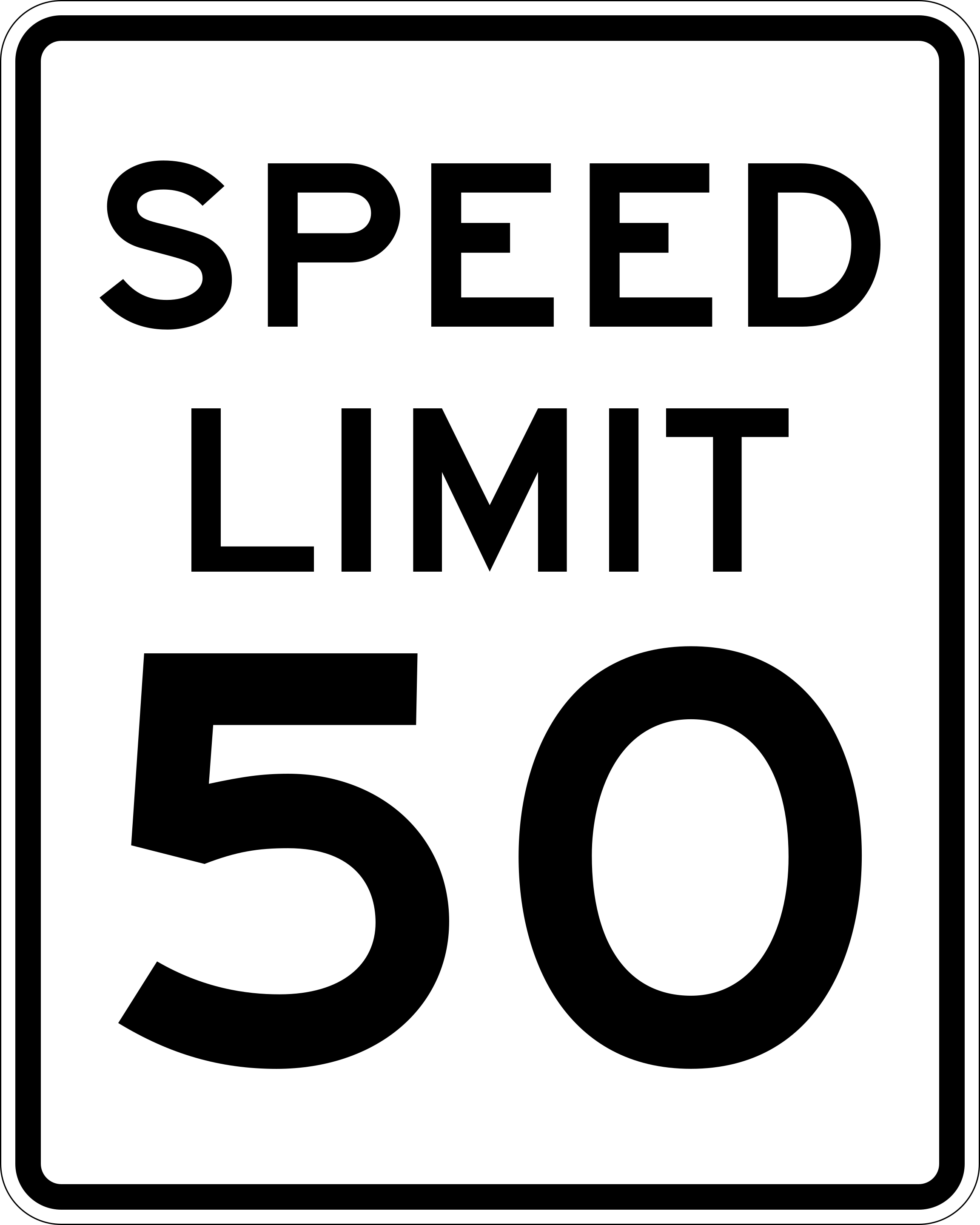
7. What does a Washington Speed Limit sign state under ideal conditions?
- The minimum speed for every Washington road
- A speed that must be used in every weather condition
- A recommended speed that may always be exceeded
- The maximum safe speed allowed or minimum safe speed required
Show answer
The maximum safe speed allowed or minimum safe speed required. Washington Speed Limit signs can communicate either a maximum safe speed allowed or a minimum safe speed required. The posted maximum is based on ideal conditions, so rain, fog, slippery pavement, or poor visibility may require a lower speed. A driver can still receive a ticket for moving too fast for conditions even when below the number on the sign. Do not treat the number as permission to ignore weather or as a universal minimum for every road.
Study this in the handbook: Traffic signs
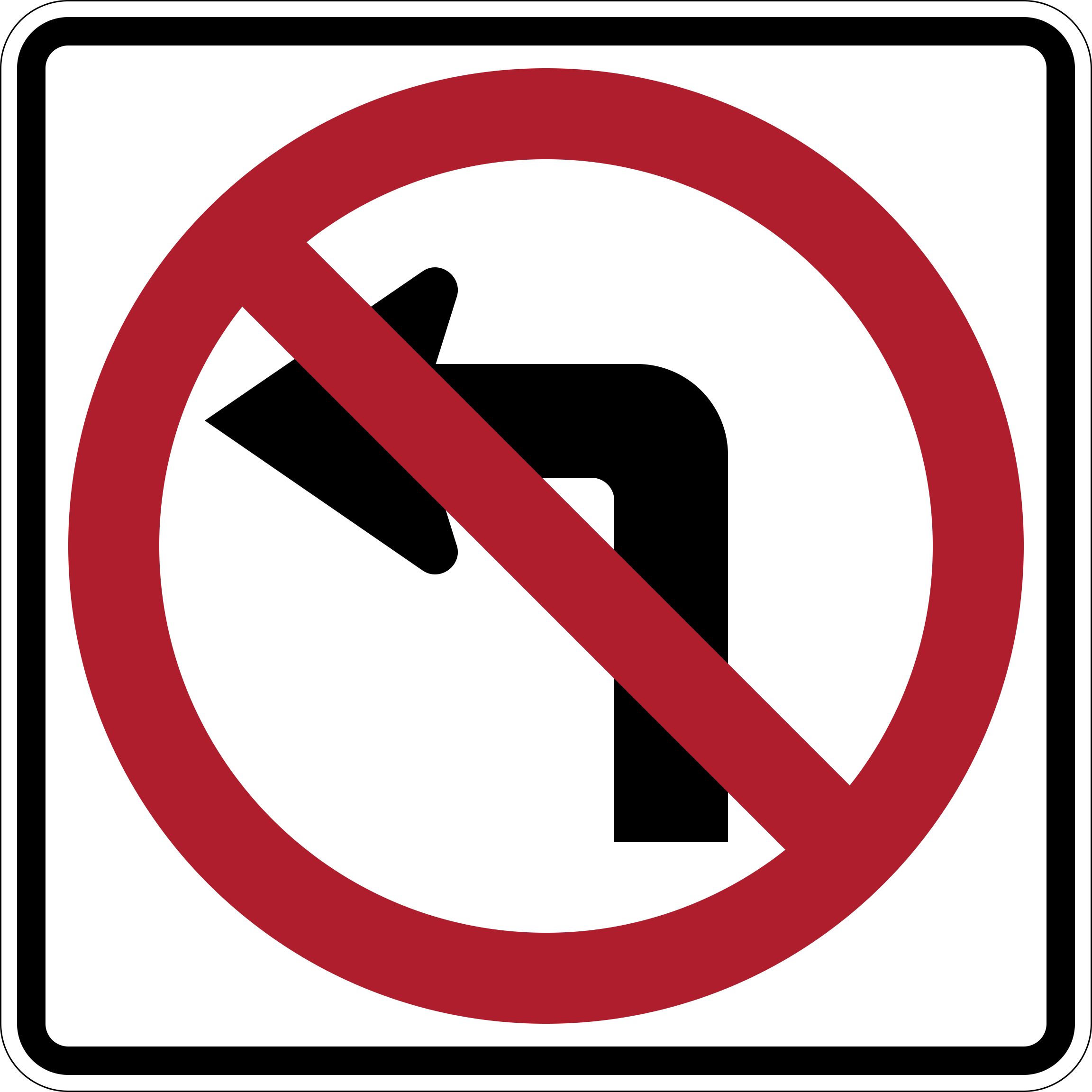
8. What do some Washington regulatory signs use to show that a symbolized action is not allowed?
- A blue rectangle around the symbol
- A green diamond below the symbol
- A yellow triangle beside the symbol
- A red circle with a red slash over the symbol
Show answer
A red circle with a red slash over the symbol. Some Washington regulatory signs place a red circle and slash over a symbol to show that the pictured action is prohibited. Read the symbol beneath the slash rather than treating the sign as a general ban on driving or stopping. A blue rectangle, green diamond, or yellow triangle does not express this prohibition under the guide’s sign system. For a left-turn symbol, the marked movement is the one restricted. Use the symbol’s direction and meaning as the cue, then check for other signs or signals that control the intersection.
Study this in the handbook: Traffic signs
9. What do Washington speed warning signs indicate?
- A mandatory speed that applies on every road nearby
- The distance to the next fuel station
- A recommended speed change for a potential hazard or road condition
- A temporary closure of every lane ahead
Show answer
A recommended speed change for a potential hazard or road condition. A speed warning sign recommends a change for a potential hazard or road condition, often a curve or turn. It is guidance tied to the upcoming roadway, not a universal mandatory speed for every nearby road. It also does not give the distance to a fuel station or close every lane ahead. Adjust for the road, weather, traffic, and visibility, then continue to obey the posted speed limit and any other controls. Treat the warning as an early cue to reduce speed before reaching the hazard rather than waiting until the curve or turn is already demanding sharper control.
Study this in the handbook: Traffic signs
10. By how much does the Washington guide say zipper merging improves traffic flow?
- By 10 percent
- It slows traffic
- By 5 percent
- By 60 percent
Show answer
By 60 percent. When a lane closes, zipper merging improves traffic flow by 60 percent, creates a predictable pattern that reduces sudden lane changes, and helps avoid the frustration of long lines and the temptation to cut in line. To zipper merge, stay in your lane and use both lanes until the designated merge area, then take turns entering the open lane. Alternating one vehicle at a time, like the teeth of a zipper coming together, is what makes the pattern predictable.
Study this in the handbook: Speed, following space and zipper merging
11. A new Washington resident over 18 holds a valid license from another state. How long do they have to get a Washington license?
- 10 days
- 30 days
- 60 days
- One year
Show answer
30 days. New residents who are licensed in another state have 30 days to obtain a Washington State driver license. If the out of state license is expired, the applicant must pass both the driving knowledge exam and the driving skills exam before receiving a Washington license, and the guide adds that some licenses can transfer without retaking the exams. Plan the move so the Washington license is in hand within that 30 day period.
Study this in the handbook: License exams, renewal and losing your license
12. Which BAC comparison matches Washington's guide for drivers under 21 and drivers age 21 or older?
- 0.08% under 21 and 0.02% for adults
- No BAC figure applies to either group
- 0.05% for both groups
- 0.02% under 21 and 0.08% for adults
Show answer
0.02% under 21 and 0.08% for adults. Washington lists two age-based BAC figures: 0.02% for drivers under 21 and 0.08% for drivers age 21 and older. Reversing those numbers would give minors the more permissive adult threshold, which the guide does not do. A shared 0.05% standard is also absent. The safest memory aid is to associate the smaller number with the under-21 rule and the larger adult threshold with age 21 and above.
Study this in the handbook: License exams, renewal and losing your license
13. In a Washington emergency zone, what must a driver do if moving over into a farther lane is not possible?
- Maintain the limit so traffic is not delayed
- Slow to at least 10 mph below the posted limit and never exceed 50 mph
- Accelerate to clear the area
- Stop beside the response vehicle
Show answer
Slow to at least 10 mph below the posted limit and never exceed 50 mph. If moving into a farther lane is not possible, the emergency-zone rule requires slowing to a minimum of 10 mph under the posted speed limit. The vehicle must also stay at or below 50 mph in that zone. Maintaining speed leaves roadside workers exposed, stopping beside the response vehicle can create a new obstruction, and acceleration increases the danger. Look well ahead for flashing lights, reduce speed before reaching the scene, and give the roadside operation as much room as the roadway allows. The two numbers are the memory cue.
Study this in the handbook: Railroad crossings, emergency vehicles and emergency zones
14. What does the Washington guide say about cutting into a ferry line?
- It is allowed with a reservation
- It is only discouraged
- It is allowed for local residents
- It is a traffic offense that can lead to a fine
Show answer
It is a traffic offense that can lead to a fine. Washington State Ferries are part of the state's highway network, so all rules of the road apply. Follow signs into the designated ferry lane and pull up behind vehicles already in line. Ferry line cutting is a traffic offense that can lead to a fine. In a ferry holding lane in a residential area, the guide also asks drivers not to block residential driveways or intersections.
Study this in the handbook: Speed, following space and zipper merging
15. Which is one circumstance under Washington rules when a driver must yield at an uncontrolled intersection?
- A vehicle has already entered the intersection
- You are traveling on the wider roadway
- You are approaching from the paved road
- Your vehicle is moving faster than the other vehicle
Show answer
A vehicle has already entered the intersection. At an uncontrolled intersection, Washington still applies normal right-of-way rules. One listed condition is that a vehicle is already in the intersection, so a driver entering must yield and avoid cutting across its path. Road width and vehicle speed do not decide this particular condition. Being on a paved road also does not automatically give priority, although a driver coming from an unpaved road has a separate duty to yield. Approach slowly, scan each direction, and check whether another vehicle entered first.
Study this in the handbook: Intersections, turns and roundabouts
16. At an unmarked Washington intersection, which road users have the right-of-way at the crosswalk?
- Pedestrians and bicyclists
- Only bicyclists wearing helmets
- The vehicle with the larger engine
- Only vehicles already in the intersection
Show answer
Pedestrians and bicyclists. Washington treats the crossing protection as present even when paint is missing. Pedestrians and bicyclists have the right-of-way at crosswalks and intersections whether the road is marked or not. The absence of stripes does not turn the space into vehicle priority, and helmet use or engine size does not decide who may proceed. As you approach an intersection, scan for people first and be ready to yield before entering the crossing.
Study this in the handbook: Pedestrians, school buses and transit buses
17. Your turn signals are not working and you plan to turn right. Which hand signal does the Washington guide describe?
- Left arm straight out with the fingers pointing left
- Left arm out with the fingers pointing to the ground
- Left arm out the window, bent so the fingers point to the sky
- Right arm extended out the passenger window
Show answer
Left arm out the window, bent so the fingers point to the sky. Washington's hand signals are all given with the left arm from the driver side window. For a right turn, put the arm out and bend it at the elbow so your fingers point to the sky. A straight arm pointing left is the left turn signal, and an arm pointing down tells drivers behind you that you are slowing or stopping. Use hand signals whenever one or both turn signals are not working, and give them before you begin the turn.
Study this in the handbook: Headlights, brake lights, tires and signals
18. You stop at an intersection with the painted stop line appearing under your side mirror. About how far is your front bumper from the line?
- About 3 to 6 inches
- About 3 to 6 feet
- Past the line by half a car length
- Exactly on top of the line
Show answer
About 3 to 6 inches. Reference points help you judge where the edges of your vehicle are. The Washington guide explains that when the stop line lines up under your side mirror, the front of your vehicle is about 3 to 6 inches from the line. That lets you stop close to the line without rolling over it into the crosswalk. Reference points vary by vehicle, so learn them in the car you drive. A similar check uses the center of the hood to judge lane position.
19. Why should you avoid following a snowplow too closely?
- Snowplows are not allowed to slow down
- Following a plow closely gives you better traction
- It can throw snow off the road and create blizzard like conditions that cut visibility
- Plows always stop suddenly to unload salt
Show answer
It can throw snow off the road and create blizzard like conditions that cut visibility. Snow removal equipment pushes snow up and off the road, and the Washington guide warns that this can cause blizzard like conditions. That reduced visibility falls on drivers who follow too closely, so stay well back and use caution near snow removal equipment. In winter conditions, the guide also calls for snow tires or chains when they are required and for slower speeds on slick roads.
Study this in the handbook: Large vehicles, motorcycles, bicycles and farm vehicles
20. What can happen to the fine for a second distracted driving violation in Washington?
- It can be doubled
- It is waived after a warning
- It stays the same as the first
- It is replaced by a parking ticket
Show answer
It can be doubled. A law enforcement officer can ticket you for breaking Washington's distracted driving law, and the guide warns that this can mean heavy fines. Fines after your first violation can be doubled, so repeat offenses cost more. Nothing in the guide converts the ticket into a warning or a parking citation. The simplest way to avoid the penalty is to put the phone away and silence it before driving.
Study this in the handbook: Distracted driving, emotions and road rage
QualitySpace is expanding to Washington
We are a California-based independent insurance brokerage working on licensing in more states. We cannot help with Washington insurance yet. Leave your email and we will let you know when we can.
Every question is written from the official Washington State Driver Guide. Need paper? Printable WA practice test with answer key.
Last verified 2026-10-05. How we check every question · Study all 500 as flashcards
Frequently asked questions
How many questions are on this Washington practice test?
This fixed set has 20 questions. It is test 4 of 25 from the 500 question Washington bank. The real WA exam asks 40 questions and you need 32 correct.
What is the passing score for the real Washington test?
32 out of 40 correct answers (80%) That figure comes from the official Washington source cited on the DMV facts page.
How does this fixed test relate to the full Washington bank?
Each numbered test is a fixed set of questions in a fixed order, so you can retake the same test later and compare. Every test mixes road signs and the other topics in about the same proportion as the full bank. Tests 1 to 25 together cover every question in the Washington bank once. The full practice page mixes the whole bank at random.
Last verified 2026-10-05. See the Washington DMV facts page for sourced state details.
Return to the full Washington practice test · Study road signs