
Test 1 of 25 · 20 questions · Free 2026
WA Permit Practice Test 1
Jump to the test ↓A fixed 20 question set from the Washington bank with answers and plain English explanations. The real WA exam is 40 questions, 80 percent to pass; take the full length version on the main practice page.
Question 1 of 20 · 0 right so far
All 20 questions in test 1
Every question below comes from the Washington question bank on this page. Open a question to see the correct answer and the explanation. Nothing here is hidden behind a signup.
1. You are approaching a steady red arrow traffic light in Washington. What must you do first?
- Slow down and turn without stopping
- Come to a complete stop
- Go ahead once pedestrians have cleared the crosswalk
- Proceed if the lane beside you is empty
Show answer
Come to a complete stop. The Washington guide lists the first step for a red arrow in one word: stop. Bring the car to a full stop behind the stop line or crosswalk, just as you would for a solid red light. Rolling through while slowing down is not a stop. A clear crosswalk or an empty lane next to you does not give you permission to move, and a red signal never gives you priority over people walking. This question tests the required initial stop.
Study this in the handbook: Traffic signals and rules of the road
2. In Washington, how far from a traffic signal, stop sign, or yield sign may you not park?
- Within 5 feet
- Within 15 feet
- Within 30 feet
- Within 75 feet
Show answer
Within 30 feet. Washington's do not park list includes parking within 30 feet of a traffic signal, stop sign, or yield sign. The guide frames the list around your responsibility to make sure your parked vehicle is not a hazard to others. Five feet applies to a different item, a driveway, alley, or private road. Fifteen feet is the fire hydrant distance, and 75 feet is the distance from a fire station driveway on the opposite side of the street.
Study this in the handbook: Parking rules and hills
3. What does Washington require when transporting an animal outside the passenger area, such as in a truck bed?
- Nothing, as long as the tailgate is up
- A speed under 35 mph
- A leash tied to the bumper
- A protective harness or enclosure so the animal cannot jump or fall out
Show answer
A protective harness or enclosure so the animal cannot jump or fall out. It is illegal for anyone to transport an animal outside a vehicle, such as in the bed of a truck, without a protective harness or enclosure so the animal cannot jump or fall out. Transporting an animal in a way that risks the animal or public safety is a misdemeanor under Washington's animal cruelty laws. Inside the vehicle, the guide separately warns that an animal loose in the cabin or riding on the driver's lap is a potential distraction.
4. What THC level makes a Washington driver under 21 subject to DUI consequences?
- More than 5 nanograms
- More than 2 nanograms
- Anything more than 0 nanograms of active THC
- Only a level that visibly impairs driving
Show answer
Anything more than 0 nanograms of active THC. Drivers under 21 face the same potential consequences as adults for anything more than 0 nanograms of active THC per milliliter of blood. The 5 nanogram figure is the threshold for drivers 21 and older. Two nanograms is not a Washington limit, and the rule does not wait for visible impairment. The same zero tolerance approach appears in the 0.02 percent BAC limit for drivers under 21.
Study this in the handbook: License exams, renewal and losing your license
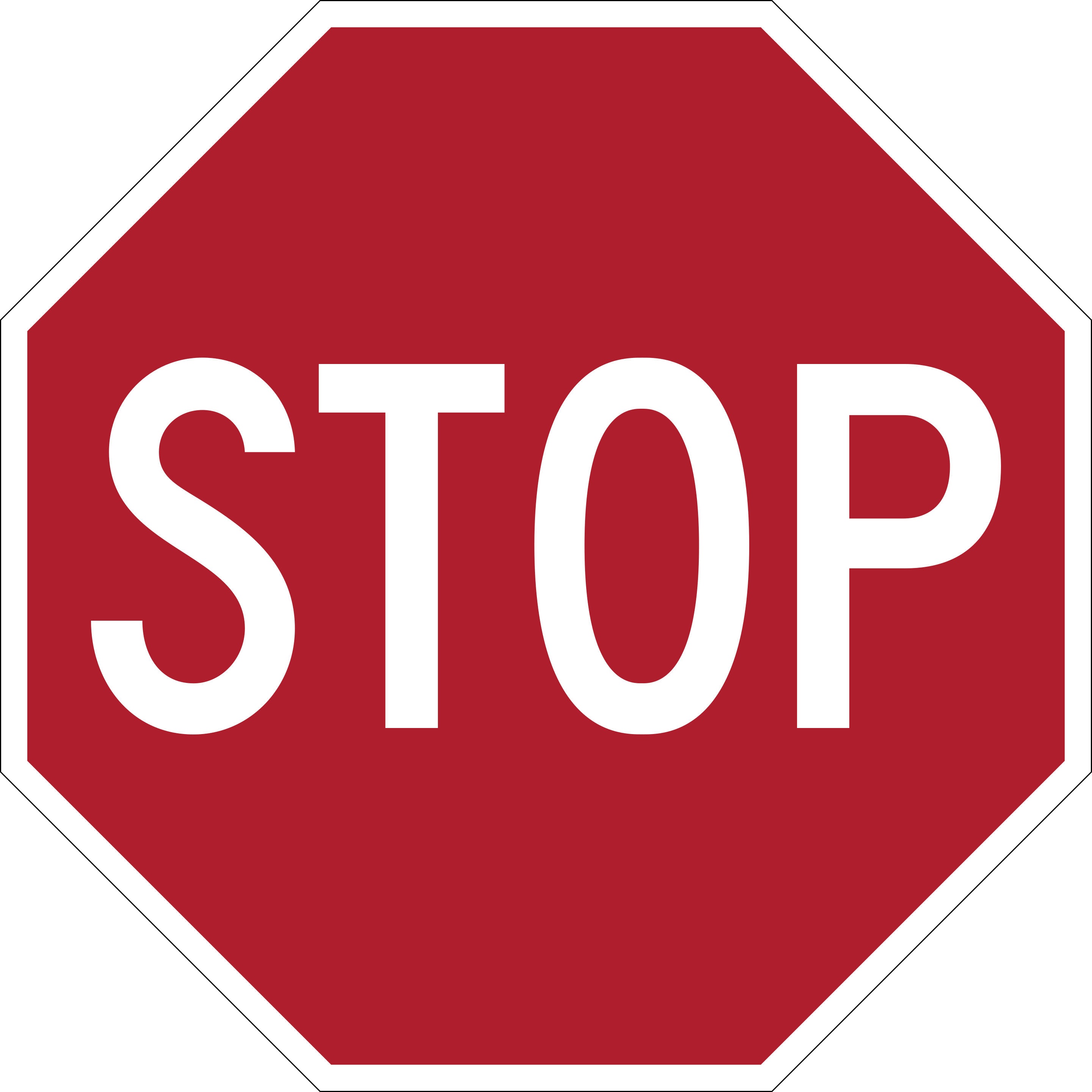
5. At a Washington stop sign, where must you stop before yielding?
- Only after entering the intersection
- At least 50 feet before the sign
- At the line, crosswalk, or corner
- Only when a pedestrian is visible
Show answer
At the line, crosswalk, or corner. Washington's stop sign rule identifies three possible stopping points: the stop line, the crosswalk, or the corner. After stopping, scan for crossing vehicles and pedestrians in every direction and yield the right of way. Waiting until the vehicle is already in the intersection is too late, even if the road looks empty. A stop sign requires a complete stop, not merely a rolling slowdown. Use the nearest marked stopping point, then proceed only after checking the entire intersection.
Study this in the handbook: Traffic signs
6. After selling or giving away a vehicle, when must a Washington owner file a Vehicle Report of Sale?
- Within 15 days
- Within five days
- Within 30 days
- Only if the buyer asks
Show answer
Within five days. If you sell, trade, gift, or dispose of your vehicle, file a Vehicle Report of Sale form within five days. Remove the license plates, pay the fee, and file at a vehicle licensing office or online. The report does not transfer ownership; the signed and dated title goes to the purchaser, who then has 15 days to transfer ownership to avoid penalty fees.
Study this in the handbook: License exams, renewal and losing your license
7. When may a Washington intermediate license holder wait to receive an updated physical license?
- Only until the driver turns 18
- Until the first traffic violation
- Only for the first six months
- Until the license is renewed
Show answer
Until the license is renewed. Intermediate license restrictions end automatically at age 18, but Washington does not require an immediate replacement card at that moment. The guide says the driver can wait until renewing the license to obtain an updated physical copy. The other time markers describe restriction phases or violations, not the timing of a replacement document. Keep the existing license and follow the lifted status while waiting for normal renewal.
Study this in the handbook: Instruction permits and the intermediate license
8. What minimum tire tread depth does the Washington guide give?
- Not less than 2/32 of an inch
- Not less than 1/32 of an inch
- Not less than 6/32 of an inch
- Any visible tread
Show answer
Not less than 2/32 of an inch. Worn tires can cause slipping and sliding, especially on wet roads, and the guide says tire tread should not be less than 2/32 of an inch. Low tire pressure also affects handling, and the proper inflation figure is on the Tire and Loading Information label on the driver's side door edge or in the owner's manual. Check both regularly rather than waiting for a problem.
Study this in the handbook: Headlights, brake lights, tires and signals
9. When enrolled in a driver training course, how early may a Washington teen apply for an instruction permit?
- At age 15
- At age 14
- At age 15 and one half
- At age 16
Show answer
At age 15. Enrollment in a driver training course permits an application as early as age 15. The age 15 and one-half figure applies when the applicant is not enrolling in a driver training course, so moving that number into the course scenario changes the condition. Fourteen is below the stated minimum, and waiting until 16 is unnecessarily late. Check the course start timing too, because the guide says the application is made one to ten days before the course starts.
Study this in the handbook: Instruction permits and the intermediate license
10. How must a driver respond to a flashing red traffic light in Washington?
- Slow down and continue without stopping
- Stop fully, then proceed when it is the driver's turn
- Accelerate before the signal changes
- Treat it as a green arrow
Show answer
Stop fully, then proceed when it is the driver's turn. A flashing red traffic light functions as a stop sign. The driver must come to a full stop, then proceed when it is the driver's turn. Merely slowing leaves the required stop incomplete, and acceleration or a green-arrow response ignores the signal's meaning. At the stop, scan for vehicles, pedestrians, and other right-of-way users before moving. A helpful visual cue is the red flash paired with stop-sign behavior: complete the stop first, then continue only when the intersection is safe and the turn order allows it.
Study this in the handbook: Traffic signals and rules of the road
11. What subjects can Washington traffic signs communicate to drivers?
- Only vehicle registration fees
- Traffic rules, hazards, roadway directions, and roadway services
- Only county boundaries
- Only weather forecasts
Show answer
Traffic rules, hazards, roadway directions, and roadway services. Washington describes traffic signs as information tools for several roadway needs. They can communicate rules, warn about hazards, provide directions, and identify roadway services. The narrower choices leave out major purposes and would make a driver overlook signs that control movement or point toward help. Read the sign’s shape, color, symbol, and words together so the message is understood before the vehicle reaches the sign.
Study this in the handbook: Traffic signals and rules of the road
12. According to the Washington guide, what is the most common impairment involved in fatal crashes?
- Polydrug use
- Cannabis alone
- Over the counter allergy medicine
- Fatigue alone
Show answer
Polydrug use. Polydrug use means mixing or taking more than one type of drug, such as alcohol with cannabis or with prescription medicine. The Washington guide states that polydrug use is the most common impairment involved in fatal crashes, because the combined effects can be greater than any single drug on its own. Alcohol is named as the most common single impairing substance in impaired driving crashes, but the combination is what the guide links most often to deaths.
Study this in the handbook: Alcohol, cannabis, medicine and fatigue
13. During which hours may a new Washington intermediate license holder not drive without an approved adult?
- 1 a.m. to 5 a.m.
- Midnight to 5 a.m.
- 10 p.m. to 5 a.m.
- 11 p.m. to 6 a.m.
Show answer
1 a.m. to 5 a.m.. Washington intermediate drivers may not drive between 1 a.m. and 5 a.m. unless accompanied by a parent, guardian or licensed driver at least 25 years old. Midnight, 10 p.m. and 11 p.m. start times are not the Washington window, so a teen driving home at 12:30 a.m. alone is still within the law. The nighttime restriction ends after one year of safe driving, and trips for agricultural purposes are exempt at any hour.
Study this in the handbook: Instruction permits and the intermediate license
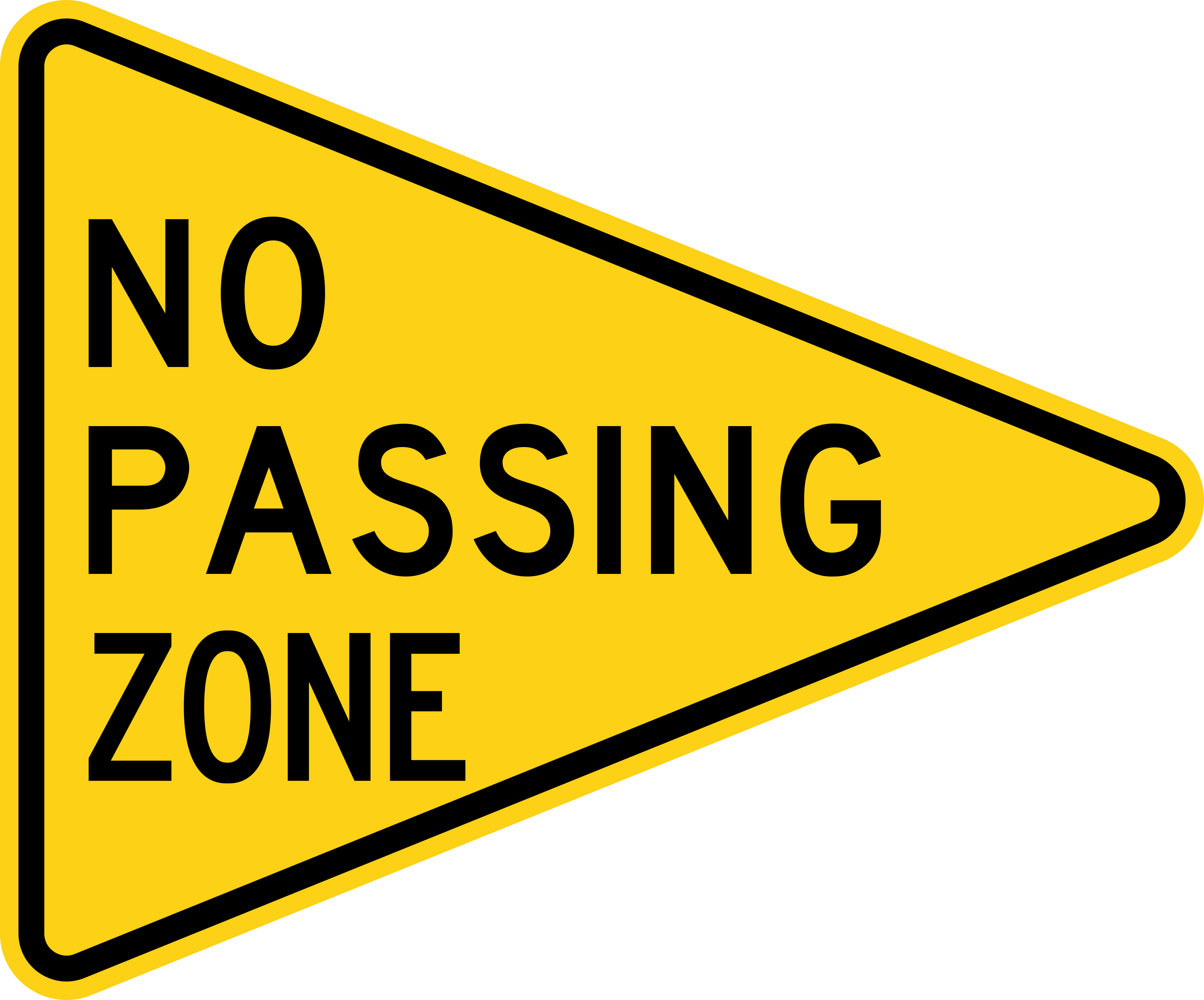
14. Where do Washington no-passing signs tell drivers passing is not allowed?
- Only when an emergency vehicle is present
- Only on roads that are unpaved
- Only at toll booths
- At locations identified by the sign
Show answer
At locations identified by the sign. No-passing signs identify places where passing is prohibited. The guide notes that they may appear near hills, curves, intersections, and other locations where a vehicle could enter the roadway. Pavement type, toll collection, or an emergency vehicle does not define this restriction. Stay behind the vehicle ahead until signs and markings show that passing can be completed legally and safely.
Study this in the handbook: Traffic signs
15. What does a double solid white line between lanes indicate?
- You may change lanes whenever you signal
- It is a barrier that you may not cross
- It separates traffic traveling in opposite directions
- It marks a lane where stopping is required
Show answer
It is a barrier that you may not cross. Double solid white lines separate lanes moving in the same direction but form a barrier that drivers may not cross. A turn signal does not authorize crossing the pair. Opposing traffic is separated by yellow lines, not double white lines, and the markings do not themselves require a stop. The practical cue is the repeated solid white boundary: remain on your side unless roadway instructions provide a different legal path. Plan lane changes before reaching the double line.
Study this in the handbook: Road markings, lanes and school zones
16. If you must leave a vehicle touching power lines because of fire, how does the Washington guide say to move away?
- Run as fast as possible
- Climb out onto the hood first
- Walk normally to the curb
- Jump clear with both feet landing together, then shuffle 35 feet away
Show answer
Jump clear with both feet landing together, then shuffle 35 feet away. If your vehicle contacts power lines and a fire forces you out, jump clear without touching the vehicle, keep your arms at your sides, and make sure both feet land together. Then shuffle 35 feet away to safety to avoid electric shock, since the guide warns that the ground around the vehicle could also be energized. Do not go back for belongings until you are told it is safe. Otherwise stay inside and call 911.
Study this in the handbook: Breakdowns, collisions and power lines
17. What headlight timing does Washington law specify?
- Only from midnight until dawn
- Only when another driver flashes headlights
- From sunset until one hour after sunrise
- From a half hour after sunset to a half hour before sunrise
Show answer
From a half hour after sunset to a half hour before sunrise. Washington law specifies headlights from one half hour after sunset until one half hour before sunrise. The guide also suggests an easier safety habit: use them all the time, especially in rain, snow, fog, or smoke. The midnight option begins too late, the one hour morning extension changes the stated window, and another driver's signal is irrelevant. Think of the rule as a half hour buffer on both sides of nighttime. Good lighting helps the driver see and helps other road users see the vehicle.
Study this in the handbook: Headlights, brake lights, tires and signals
18. When driving near a large truck, what should you do if you cannot see the driver’s mirrors?
- Stay beside the truck until you reach the next intersection
- Pass closely on the shoulder to leave the blind zone
- Move away from the truck because its driver cannot see you
- Assume the truck driver can see you through the side window
Show answer
Move away from the truck because its driver cannot see you. If you cannot see the driver’s mirrors, the guide says the truck driver cannot see you. The safest response is to avoid remaining in that blind zone and create space away from the large vehicle. Staying alongside prolongs the hidden position, and using the shoulder is not a normal passing maneuver. A side window does not defeat the mirror-based blind-zone warning. Treat the missing mirror view as a direct cue to change position safely and avoid lingering beside the truck.
Study this in the handbook: Large vehicles, motorcycles, bicycles and farm vehicles
19. What minimum space does the Washington guide recommend between your vehicle and the vehicle ahead when driving near other vehicles?
- At least twice the length of your vehicle
- Exactly one vehicle length at all times
- A distance measured only by the car behind you
- One tire length regardless of speed
Show answer
At least twice the length of your vehicle. The guide recommends leaving a distance at least twice the length of your vehicle from the vehicle ahead. This provides room to respond if traffic changes or the lead driver brakes. The one tire length and fixed one vehicle length choices are smaller or unsupported distances, while the car behind you does not determine the space needed ahead. Use the size of your own vehicle as the reference, then leave at least two of those lengths. Increase the margin further when weather, darkness, congestion, or a vulnerable road user reduces your options.
Study this in the handbook: Speed, following space and zipper merging
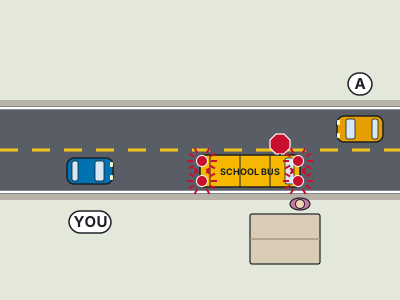
20. What must drivers traveling in the same direction as a Washington school bus do when its red lights flash and stop sign extends?
- Pass in the center turn lane
- Continue if no child is visible
- Stop
- Speed up to clear the bus
Show answer
Stop. A bus loading zone requires a complete stop when the red lights flash and the stop sign extends. Washington applies that command to every driver traveling in the same direction as the bus, not just to drivers who can see a child. Using the center turn lane is also prohibited as a way around the stop. Watch for the red signal and extended sign, stop, and wait until the bus indicates travel may resume.
Study this in the handbook: Pedestrians, school buses and transit buses
QualitySpace is expanding to Washington
We are a California-based independent insurance brokerage working on licensing in more states. We cannot help with Washington insurance yet. Leave your email and we will let you know when we can.
Every question is written from the official Washington State Driver Guide. Need paper? Printable WA practice test with answer key.
Last verified 2026-10-05. How we check every question · Study all 500 as flashcards
Frequently asked questions
How many questions are on this Washington practice test?
This fixed set has 20 questions. It is test 1 of 25 from the 500 question Washington bank. The real WA exam asks 40 questions and you need 32 correct.
What is the passing score for the real Washington test?
32 out of 40 correct answers (80%) That figure comes from the official Washington source cited on the DMV facts page.
How does this fixed test relate to the full Washington bank?
Each numbered test is a fixed set of questions in a fixed order, so you can retake the same test later and compare. Every test mixes road signs and the other topics in about the same proportion as the full bank. Tests 1 to 25 together cover every question in the Washington bank once. The full practice page mixes the whole bank at random.
Last verified 2026-10-05. See the Washington DMV facts page for sourced state details.
Return to the full Washington practice test · Study road signs