Every question below comes from the Rhode Island question bank on this page. Open a question to see the correct answer and the explanation. Nothing here is hidden behind a signup.
1. During the first twelve months of a Limited Provisional License, how many unrelated passengers under 21 may ride?
- Any number during daylight
- No more than two
- Up to four if belted
- No more than one
Show answer
No more than one. For the first twelve months of a Limited Provisional License, Rhode Island permits no more than one licensed passenger younger than 21. Full explanation in Test 1
2. At a Rhode Island intersection, how should you treat a flashing yellow light?
- Slow down, cover the brake, and proceed with caution
- Stop fully and wait for a green signal
- Accelerate because cross traffic must stop
- Treat it exactly like a flashing red signal
Show answer
Slow down, cover the brake, and proceed with caution. A flashing yellow signal calls for caution rather than an automatic full stop. Full explanation in Test 2
3. A Rhode Island driver age 30 has a BAC of 0.06% and shows other signs of impairment. Can the driver be convicted?
- No, because 0.08% is the only limit for adults
- Yes, a driver 21 or older with a BAC over 0.05% but under 0.08% can be convicted if there is other evidence of influence
- Only if the driver refuses a breath test
- Only if a crash occurred
Show answer
Yes, a driver 21 or older with a BAC over 0.05% but under 0.08% can be convicted if there is other evidence of influence. The manual explains that when a test shows a BAC in excess of .05% but less than . Full explanation in Test 3
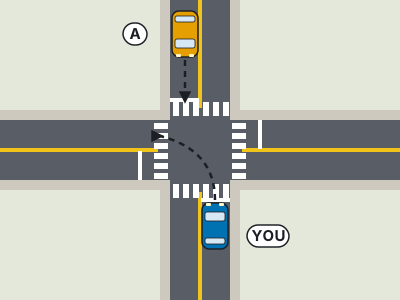
4. Before turning left at an intersection, which road user must the driver yield to?
- Only pedestrians already standing in a marked crosswalk
- Only vehicles larger than the turning vehicle
- Oncoming traffic, including an oncoming bicyclist
- No one, because a left turn has priority over straight traffic
Show answer
Oncoming traffic, including an oncoming bicyclist. A left turn crosses the path of people traveling toward the intersection. Full explanation in Test 4
5. Your vehicle stalls on railroad tracks and you know a train is approaching. What should you do?
- Push the vehicle along the tracks toward the crossing
- Remain inside while repeatedly trying the ignition
- Get everyone out and move as far from the tracks as possible
- Wait for the train to sound its horn before leaving
Show answer
Get everyone out and move as far from the tracks as possible. When a car stalls on the rails with a train coming, the manual says to get yourself and any passengers out of the vehicle and off the tracks Full explanation in Test 5
6. How much is the highway safety assessment that Rhode Island law charges a person found in violation of the chemical test refusal statute?
- $500
- $150
- $300
- $86
Show answer
$500. Rhode Island General Laws section 31-27-2. Full explanation in Test 6
7. What condition does this pedestrian crossing sign tell a driver to anticipate?

- People may cross ahead, so be prepared to yield
- Pedestrians are prohibited from entering the roadway
- Sidewalk repairs have closed the crossing permanently
- Only bicycles may use the marked crossing
Show answer
People may cross ahead, so be prepared to yield. A pedestrian crossing warning tells drivers to expect people crossing the roadway ahead. Full explanation in Test 7
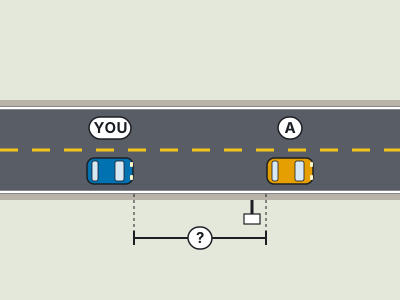
8. How does Rhode Island's three-second rule help a driver judge following distance?
- It permits tailgating when the road is dry
- It requires one car length for every ten miles per hour
- It uses a fixed roadside point and a three-second count
- It measures distance only by looking at the speedometer
Show answer
It uses a fixed roadside point and a three-second count. The three-second method starts when the vehicle ahead passes a fixed point, such as a sign or pole. Full explanation in Test 8
9. Under Rhode Island's texting law, which use of a wireless handset is prohibited while operating a motor vehicle?
- Calling emergency services during an actual emergency
- Using a phone only after parking in a legal space
- Composing, reading, or sending a text message
- Listening to a passenger's spoken directions
Show answer
Composing, reading, or sending a text message. The manual states that, regardless of age, a driver may not use a wireless handset to compose, read, or send a text message while operating Full explanation in Test 9
10. What is the first level in Rhode Island's graduated licensing system?
- Limited Provisional License
- Limited Instructional Permit
- Full Operator's License
- Commercial Driver's License
Show answer
Limited Instructional Permit. Rhode Island describes three graduated levels in sequence: limited instructional permit, limited provisional license, and full operator's li Full explanation in Test 10
11. What does a red arrow displayed at a traffic light require?
- Stop and do not proceed in the direction of the arrow
- Turn in the arrow's direction after yielding to pedestrians
- Continue straight until the arrow becomes flashing yellow
- Treat the arrow as permission to pass the intersection
Show answer
Stop and do not proceed in the direction of the arrow. A red arrow controls movement in the direction it points. The driver must stop and may not proceed that way until the signal changes. Full explanation in Test 1
12. When does a Rhode Island Limited Provisional License expire?
- On the holder's 18th birthday
- On the holder's 21st birthday
- One year after it is issued
- Five years after it is issued
Show answer
On the holder's 18th birthday. A Limited Provisional License expires on the holder's eighteenth birthday. It is a stage for drivers under 18, so it cannot run to age 21. Full explanation in Test 2
13. A warning sign showing two opposing arrows indicates what roadway condition?
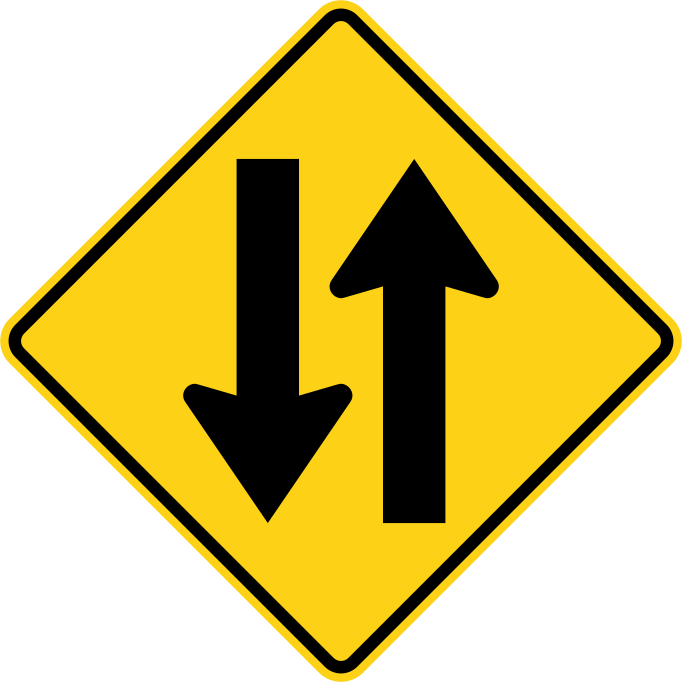
- Two-way traffic
- A one-way street ending at a freeway
- A divided highway with a center median
- A lane reserved for buses
Show answer
Two-way traffic. Two opposing arrows identify two-way traffic, meaning vehicles may travel toward you as well as in your direction. Full explanation in Test 3
14. At a Rhode Island four-way stop, two vehicles arrive at the same time. Which driver yields?
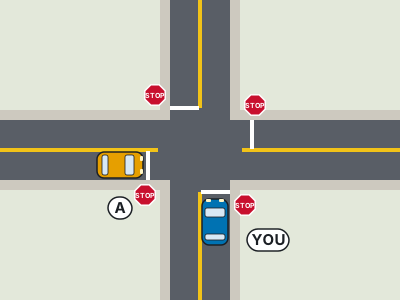
- The driver on the left yields to the vehicle on the right
- The driver on the right yields to the vehicle on the left
- The vehicle with the larger engine has priority
- Both drivers proceed together
Show answer
The driver on the left yields to the vehicle on the right. At a four-way stop, arrival order normally settles priority, but equal arrival creates a special tie rule. Full explanation in Test 4
15. After an emergency vehicle passes, what should you do before re-entering the traffic flow?
- Re-enter immediately without signaling because the lane is open
- Signal, check over your shoulder, and confirm another emergency vehicle is not coming
- Follow the emergency vehicle at a close distance
- Remain stopped indefinitely at the roadside
Show answer
Signal, check over your shoulder, and confirm another emergency vehicle is not coming. The first emergency vehicle may not be the only one responding. Full explanation in Test 5
16. When stopping at a Rhode Island intersection, how long should you completely stop before proceeding with caution?
- At least one second
- Until the vehicle behind you honks
- A minimum of three seconds
- Exactly ten seconds
Show answer
A minimum of three seconds. Rhode Island guidance calls for a complete stop that lasts at least three seconds. Full explanation in Test 6
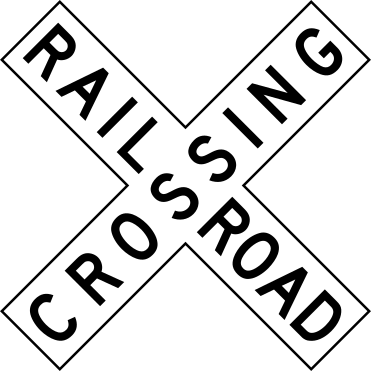
17. What does the RAILROAD CROSSING sign identify at the tracks?
- A pedestrian-only path that vehicles may not cross
- A hospital entrance where horns are prohibited
- A temporary construction detour around the tracks
- The crossing itself, where a driver must yield to trains
Show answer
The crossing itself, where a driver must yield to trains. The crossbuck marks the railroad crossing itself. Full explanation in Test 7
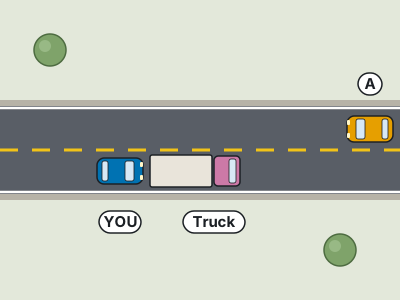
18. What does a broken yellow line between opposing traffic generally permit?
- Traveling only in the direction of an arrow
- Parking in the center of the roadway
- Passing another vehicle with care
- Crossing without checking opposing traffic
Show answer
Passing another vehicle with care. Broken yellow lines separate traffic traveling in opposite directions, and the manual says passing another vehicle is permitted with care. Full explanation in Test 8
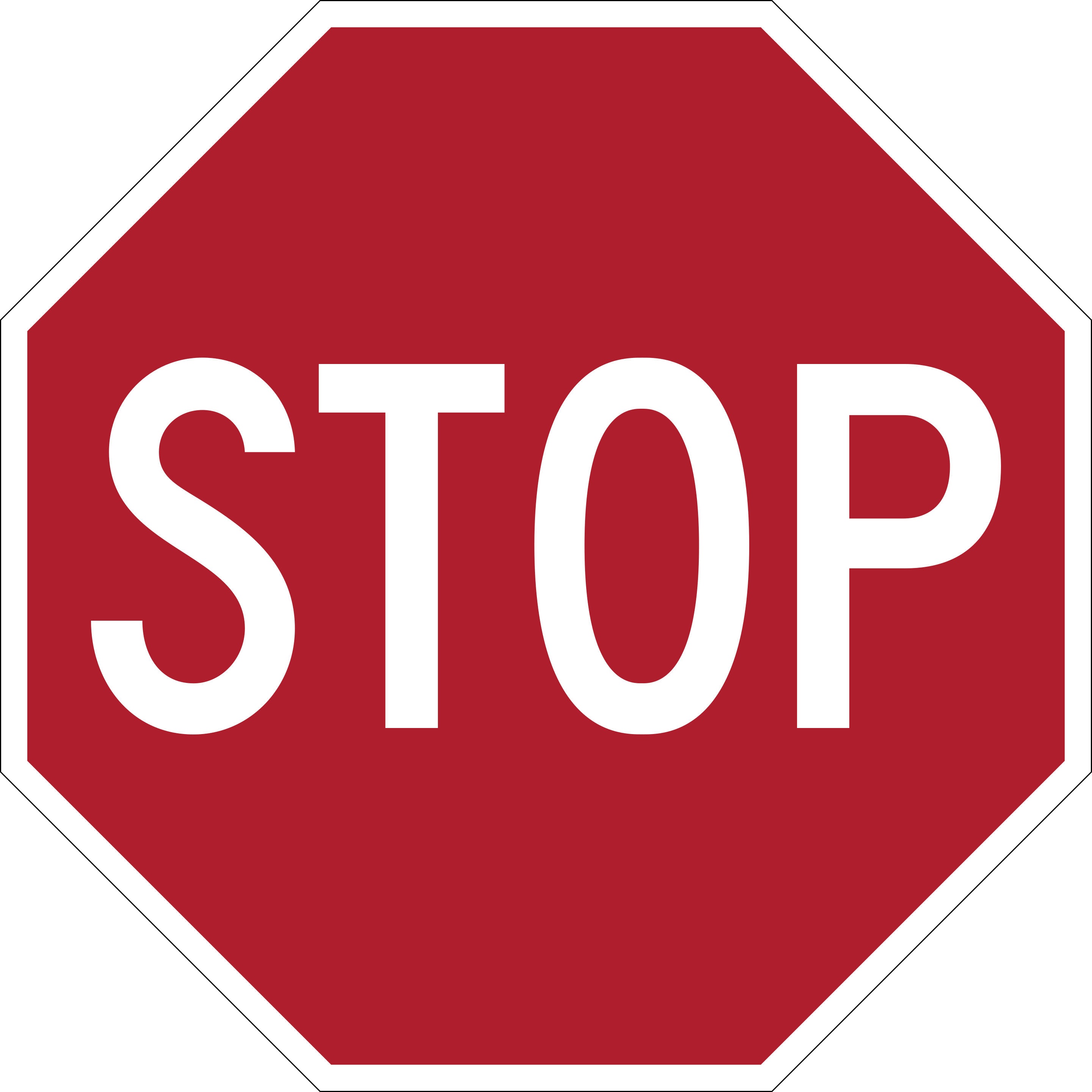
19. At this STOP sign, where should the vehicle stop before yielding?
- After entering the intersection, if cross traffic is present
- Before the crosswalk or stop line, then yield before proceeding
- Only beside the signpost when another car approaches
- At the next driveway beyond the intersection
Show answer
Before the crosswalk or stop line, then yield before proceeding. Rhode Island law requires every driver approaching a STOP sign to stop before entering the crosswalk on the near side of the intersection, o Full explanation in Test 9
20. After holding a Rhode Island Limited Instructional Permit for the required period and passing the road test, what comes next?
- A second classroom permit
- A Full Operator's License immediately
- A motorcycle-only permit
- A Limited Provisional License
Show answer
A Limited Provisional License. The next graduated stage is the Limited Provisional License. Full explanation in Test 10
21. A Rhode Island driver under 21 has a BAC of .05%. What charge applies?
- Nothing, .05% is under the legal limit
- Only a parking-level infraction
- Driving Under the Influence, the same as .08%
- Driving While Impaired, because .02% to under .08% is impaired for drivers under 21
Show answer
Driving While Impaired, because .02% to under .08% is impaired for drivers under 21. Rhode Island uses two thresholds. Any person of any age with a BAC of .08% or more is intoxicated and charged with drunk driving, DUI. Full explanation in Test 1
22. How close to a fire hydrant may a vehicle be parked in Rhode Island?
- No closer than 20 feet
- No closer than 15 feet
- No closer than 8 feet
- No closer than 30 feet
Show answer
No closer than 8 feet. Rhode Island's parking list prohibits parking within 8 feet of a fire hydrant. Full explanation in Test 2
23. A 17-year-old Rhode Island driver is found with a BAC of 0.03%. What license suspension does the table list for a first violation?
- 1 to 3 months
- 6 to 12 months
- Suspension until age 21
- No suspension, only a fine
Show answer
6 to 12 months. For a driver under 18 with a BAC of 0.02% to 0. Full explanation in Test 3
24. Which condition requires Rhode Island drivers to turn on their vehicle headlights?
- Driving at noon on a clear, dry day
- Driving only on a divided highway
- Carrying a passenger in daylight
- Using windshield wipers
Show answer
Using windshield wipers. Rhode Island requires headlights from sunset to sunrise, any time you cannot see 500 feet ahead, when it is raining or snowing, and any time Full explanation in Test 4
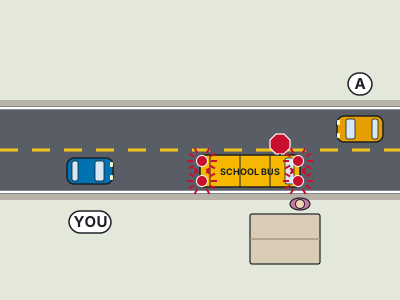
25. When must motorists stop for a school bus with flashing red lights?
- Only when following the bus on a two-lane road
- When approaching from either direction, until the red lights stop flashing
- Only if children are visible in the roadway
- Never when the bus is stopped on a private road
Show answer
When approaching from either direction, until the red lights stop flashing. Flashing red lights on a school bus require motorists approaching from either direction to make a full stop and remain stopped until the red Full explanation in Test 5
26. How should a driver respond to a flashing red traffic signal in Rhode Island?
- Slow down and continue without stopping
- Make a full stop, yield to traffic on both sides, then proceed when safe
- Treat it as a flashing yellow signal
- Stop only if a pedestrian is waiting
Show answer
Make a full stop, yield to traffic on both sides, then proceed when safe. A flashing red signal has the same stopping meaning as a stop sign. Full explanation in Test 6
27. A school bus displays flashing red lights. What must an approaching Rhode Island motorist do?
- Continue unless the bus is in a marked school zone
- Pass slowly if no children are visible
- Stop only when approaching from behind the bus
- Stop fully and remain stopped until the red lights stop flashing
Show answer
Stop fully and remain stopped until the red lights stop flashing. Flashing red bus lights require a full stop for motorists coming from either direction, and the vehicle must stay stopped until the red ligh Full explanation in Test 7
28. Before driving after snow or ice, what must a Rhode Island driver do with the vehicle?
- Remove snow and ice that limit vision and clear roof snow that could blow onto other vehicles
- Clear only the windshield while leaving the roof covered
- Wait for the vehicle to warm up without clearing it
- Brush snow onto the shoulder after entering traffic
Show answer
Remove snow and ice that limit vision and clear roof snow that could blow onto other vehicles. Rhode Island law makes the motorist responsible for removing snow and ice that limit vision and for clearing roof snow that might blow down Full explanation in Test 8
29. Your Rhode Island license is suspended. When does the suspension period begin to run?
- Only after your license has been surrendered or forwarded to the DMV
- On the date the court mails the notice
- On the date of the violation
- After you complete a driver course
Show answer
Only after your license has been surrendered or forwarded to the DMV. A suspended driver must turn in the license in person to the Operator Control Section, or the Accident Section if the order results from a c Full explanation in Test 9
30. A Rhode Island driver under 18 is convicted of a first DUI with a BAC of 0.08% or above. What suspension does the table list?
- 6 to 18 months
- 2 to 5 years
- 3 to 12 months
- 1 to 3 months
Show answer
6 to 18 months. The under 18 DUI table, for a BAC of 0.08% or above, lists a 6 to 18 month license suspension, a $500 highway safety assessment, and 10 to 6 Full explanation in Test 10
31. How far from a stop sign, traffic light, or flashing signal must a Rhode Island driver park?
- At least 8 feet
- At least 20 feet
- At least 30 feet
- At least 50 feet
Show answer
At least 30 feet. Rhode Island lists places where you may not park or stop, and one of them is within 30 feet of a flashing red or yellow light, a stop sign, Full explanation in Test 1
32. What does the yellow diamond sign with arrows around a circle warn a driver about?

- A one-way street ending ahead
- A railroad crossing with a stopped train
- A roundabout ahead
- A school bus loading zone only
Show answer
A roundabout ahead. The manual describes a yellow diamond warning sign showing an arrow with a circle pattern and two or more arrows pointing away from the circ Full explanation in Test 2
33. What roadway pattern is shown by a winding-road warning sign?

- The road surface is newly paved
- A series of curves lies ahead
- Strong crosswinds are guaranteed
- A four-way stop is immediately ahead
Show answer
A series of curves lies ahead. A winding-road warning means the driver should expect several bends rather than one isolated curve. Full explanation in Test 3
34. What is the minimum license suspension in Rhode Island for refusing a chemical test?
- 30 days
- One year
- Two years
- Six months
Show answer
Six months. The Rhode Island manual states that if you refuse to take a chemical test, your license will be suspended for a minimum of six months. Full explanation in Test 4
35. What does Rhode Island law prohibit a driver from wearing while operating a motor vehicle on a public highway?
- Earphones or headsets
- Prescription eyeglasses
- A winter hat with ear flaps
- A hands-free microphone attached to clothing
Show answer
Earphones or headsets. The listed Rhode Island law prohibits operating a motor vehicle on a public highway while wearing earphones or headsets. Full explanation in Test 5
36. What area does this five-sided school symbol warn drivers about?

- A school crossing or school zone where extra caution is needed
- A public park where pedestrians never cross
- An adult-only crosswalk near a hospital
- A railroad platform with no roadway crossing
Show answer
A school crossing or school zone where extra caution is needed. The five-sided school symbol marks a school crossing or school area. Full explanation in Test 6
37. Besides suspension, fines, and assessments, what other consequence can follow a Rhode Island chemical test refusal?
- Public community service and drunk driving school or alcohol treatment referral
- A vehicle repainting inspection and motorcycle test
- A permanent ban on public transportation
- Only a written warning with no program requirement
Show answer
Public community service and drunk driving school or alcohol treatment referral. The refusal rule includes public community service and drunk driving school or a referral to an alcohol treatment program, in addition to th Full explanation in Test 7
38. May a Rhode Island driver wear earphones or a headset while driving on a public highway?
- No, operating a vehicle on a public highway while wearing earphones or headsets is prohibited
- Yes, if the volume is low
- Yes, for navigation directions only
- Yes, in one ear only
Show answer
No, operating a vehicle on a public highway while wearing earphones or headsets is prohibited. Rhode Island lists among its driver rules that drivers are not allowed to operate a motor vehicle upon a public highway while wearing earpho Full explanation in Test 8
39. A Rhode Island limited provisional license holder is driving without supervision. During which period is that unsupervised driving permitted?
- Only from 6:00 AM to 10:00 PM
- From 5:00 AM to 1:00 AM
- Only from sunrise to sunset
- At any hour if the vehicle has a safety belt
Show answer
From 5:00 AM to 1:00 AM. The manual permits unsupervised driving from 5:00 AM through 1:00 AM, with additional allowances for travel to or from work and certain volu Full explanation in Test 9
40. According to Rhode Island's alcohol laws, what birthday marks the legal drinking age?
- The 18th birthday
- The 19th birthday
- The 21st birthday
- The 25th birthday
Show answer
The 21st birthday. Rhode Island's manual uses the twenty-first birthday as the dividing point in its underage alcohol provisions. Full explanation in Test 10
