
Test 2 of 10 · 20 questions · Free 2026
RI Permit Practice Test 2
Jump to the test ↓A fixed 20 question set from the Rhode Island bank with answers and plain English explanations.
Question 1 of 20 · 0 right so far
All 20 questions in test 2
Every question below comes from the Rhode Island question bank on this page. Open a question to see the correct answer and the explanation. Nothing here is hidden behind a signup.
1. At a Rhode Island intersection, how should you treat a flashing yellow light?
- Slow down, cover the brake, and proceed with caution
- Stop fully and wait for a green signal
- Accelerate because cross traffic must stop
- Treat it exactly like a flashing red signal
Show answer
Slow down, cover the brake, and proceed with caution. A flashing yellow signal calls for caution rather than an automatic full stop. Slow down, place the foot over the brake in case a hazard develops, and continue only after checking the intersection. A flashing red signal has a different rule and is treated as a stop sign, so applying that response to yellow is too restrictive. Never treat the permissive signal as a command to accelerate; the intersection still requires active observation.
Study this in the handbook: Traffic lights and roundabouts
2. When does a Rhode Island Limited Provisional License expire?
- On the holder's 18th birthday
- On the holder's 21st birthday
- One year after it is issued
- Five years after it is issued
Show answer
On the holder's 18th birthday. A Limited Provisional License expires on the holder's eighteenth birthday. It is a stage for drivers under 18, so it cannot run to age 21. One year is about how long the instructional permit lasts, and a fixed five year term does not describe the provisional license either. The passenger limit lasts only for the first twelve months of the provisional license, which is a separate time period from the license's expiration.
Study this in the handbook: The three levels of Rhode Island's graduated license
3. How close to a fire hydrant may a vehicle be parked in Rhode Island?
- No closer than 20 feet
- No closer than 15 feet
- No closer than 8 feet
- No closer than 30 feet
Show answer
No closer than 8 feet. Rhode Island's parking list prohibits parking within 8 feet of a fire hydrant. Fifteen feet is not the distance the Rhode Island manual gives. The same list bars parking within 20 feet of a crosswalk at an intersection, within 30 feet of a flashing red or yellow light, stop sign or traffic light, within 50 feet of the nearest rail of a railroad crossing, and in front of any driveway. Learn each distance with its own feature so the numbers do not blur together.
Study this in the handbook: Where you may not park or stop
4. What does the yellow diamond sign with arrows around a circle warn a driver about?

- A one-way street ending ahead
- A railroad crossing with a stopped train
- A roundabout ahead
- A school bus loading zone only
Show answer
A roundabout ahead. The manual describes a yellow diamond warning sign showing an arrow with a circle pattern and two or more arrows pointing away from the circle. That symbol announces roundabout exits and prepares the driver for circular, counterclockwise traffic. It is not the railroad crossing symbol, a one-way termination notice, or a message limited to school buses. Once the sign appears, reduce speed, identify the entrance, and plan your lane position before reaching the circle.
Study this in the handbook: Traffic lights and roundabouts
5. How does the Rhode Island three-second rule show that a driver is following too closely?
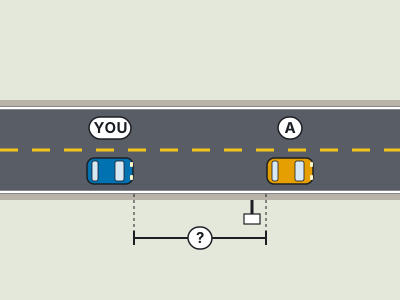
- The vehicle remains behind the lead vehicle for exactly one second
- The vehicle reaches the chosen fixed point before the count is finished
- The driver reaches the point only after counting ten seconds
- The driver uses the speedometer instead of a roadside reference
Show answer
The vehicle reaches the chosen fixed point before the count is finished. The following-distance check uses a fixed object such as a sign, pole, or line on the pavement. Begin counting after the vehicle ahead passes that object. If your vehicle reaches the same point before the count is complete, the gap is too short and you should drop back before counting again. A one-second gap is not the manual’s normal check, and ten seconds is not the stated threshold. Choose a visible reference, count steadily, and add more space when conditions reduce traction or visibility.
Study this in the handbook: Following distance, trucks and motorcycles
6. What does a flashing red traffic signal require a Rhode Island driver to do?
- Proceed before cross traffic reaches the intersection
- Slow down and continue without stopping
- Stop only if a pedestrian is visible
- Make a full stop and yield to vehicles on both sides
Show answer
Make a full stop and yield to vehicles on both sides. A flashing red signal is handled like a stop sign. The driver must make a full stop, then yield the right-of-way to vehicles approaching from the right and left before proceeding. A flashing yellow signal calls for slowing and caution, so treating the red indication as merely advisory confuses the two controls. Stopping only for a visible pedestrian also misses cross traffic. Look in both directions after the complete stop, and enter only when the intersection is clear and priority has been yielded.
Study this in the handbook: Traffic lights and roundabouts
7. Smoke is coming from under your vehicle’s hood. What should you do first?
- Remain inside and wait for the smoke to clear
- Open the hood wide and pour water on the engine
- Drive to the nearest fuel station
- Pull off, turn the ignition off, and move away from the vehicle
Show answer
Pull off, turn the ignition off, and move away from the vehicle. For smoke coming from under the hood, the manual gives three steps. First, pull immediately off the road, turn the ignition to the off position, and move away from the vehicle. Second, dial 911 for police and fire personnel. Third, unless you have a fire extinguisher, do not attempt to put out the fire. Staying inside keeps you next to the danger, and driving on to a fuel station keeps a burning vehicle on the road. The cue is smoke under the hood: stop, shut down, leave, and summon help.
Study this in the handbook: Skids, brake failure, blowouts and other emergencies
8. If a pedestrian faces a yellow or red traffic light, when may the pedestrian cross?
- Whenever the roadway appears empty
- Only when a Walk signal is showing
- As soon as a flashing hand appears
- Only after a driver waves the pedestrian across
Show answer
Only when a Walk signal is showing. The manual tells pedestrians facing a yellow or red light to cross only when the Walk signal is showing. An empty-looking roadway does not replace the signal because a vehicle may approach outside the pedestrian’s immediate view. A flashing hand is not the same instruction, and a driver’s wave cannot control the full intersection. Wait at the curb, watch the pedestrian signal, and begin only during the permitted Walk phase.
Study this in the handbook: Turn signals and roadway markings
9. After an emergency vehicle passes, what should a driver do before re-entering traffic?
- Turn left across traffic to follow the emergency vehicle
- Re-enter immediately without signaling
- Use the hazard lights and accelerate into the nearest lane
- Activate the turn signal and check over the shoulder for another emergency vehicle
Show answer
Activate the turn signal and check over the shoulder for another emergency vehicle. Rhode Island advises a driver to signal before returning to the traffic flow and to glance over the shoulder for another emergency vehicle. Re-entering immediately can place the vehicle in the path of a second responder, while hazard lights and acceleration do not replace a directional signal or a visual check. Turning across traffic to follow the first vehicle creates a separate conflict. Wait until the route is clear, signal the intended movement, check beside and behind the vehicle, then merge smoothly.
Study this in the handbook: Licenses, insurance, phones and other laws
10. For a Rhode Island driver age 21 or older, which BAC range is listed under the first DUI violation?
- 0.02% to less than 0.05%
- 0.1% to 0.15% only
- 0.08% to 0.1%
- 0.15% or above only
Show answer
0.08% to 0.1%. The adult DUI table begins its first violation category at a BAC of 0.08% to 0.1%. The choice “0.02% to less than 0.05%” belongs to a lower concentration and does not identify this adult DUI category. The two higher ranges are separate penalty bands with different listed consequences, not the opening range. A useful study cue is to separate the adult table by BAC bands before comparing suspension periods, fines, or community service requirements.
Study this in the handbook: Refusal and DUI penalties
11. Under Rhode Island's Basic Speed Law, what does the speed-limit sign represent?
- A speed that is always safe in rain or ice
- The maximum speed for ideal conditions
- A minimum speed required on every road
- A suggestion that may be ignored when traffic is light
Show answer
The maximum speed for ideal conditions. The manual explains that a speed-limit sign gives the maximum for ideal conditions, not a promise that the same pace is safe in every circumstance. Rain, snow, sleet, ice, road construction, pedestrians, or traffic can require a driver to slow below the posted number. The choice “A speed that is always safe in rain or ice” ignores those conditions, while the choices “A minimum speed required on every road” and “A suggestion that may be ignored when traffic is light” misstate what a limit does. Read the sign, then make a separate decision based on the surface, visibility, and surrounding road users.
Study this in the handbook: Speed limits and freeway driving
12. At what age may a Rhode Island resident apply for a Level One Limited Instructional Permit?
- Only after turning 18
- At 15 years old
- At 17 years and 6 months old
- At 16 years old
Show answer
At 16 years old. The Level One permit is available to an applicant who is at least sixteen and under eighteen, subject to the other application and testing requirements. Fifteen is too early for the permit, while seventeen years six months describes a later full-license milestone. Waiting until eighteen is not necessary to begin the graduated process. A practical study cue is to keep the starting age attached to Level One, then separately remember the six-month permit holding period and the one-year validity rule.
Study this in the handbook: The three levels of Rhode Island's graduated license
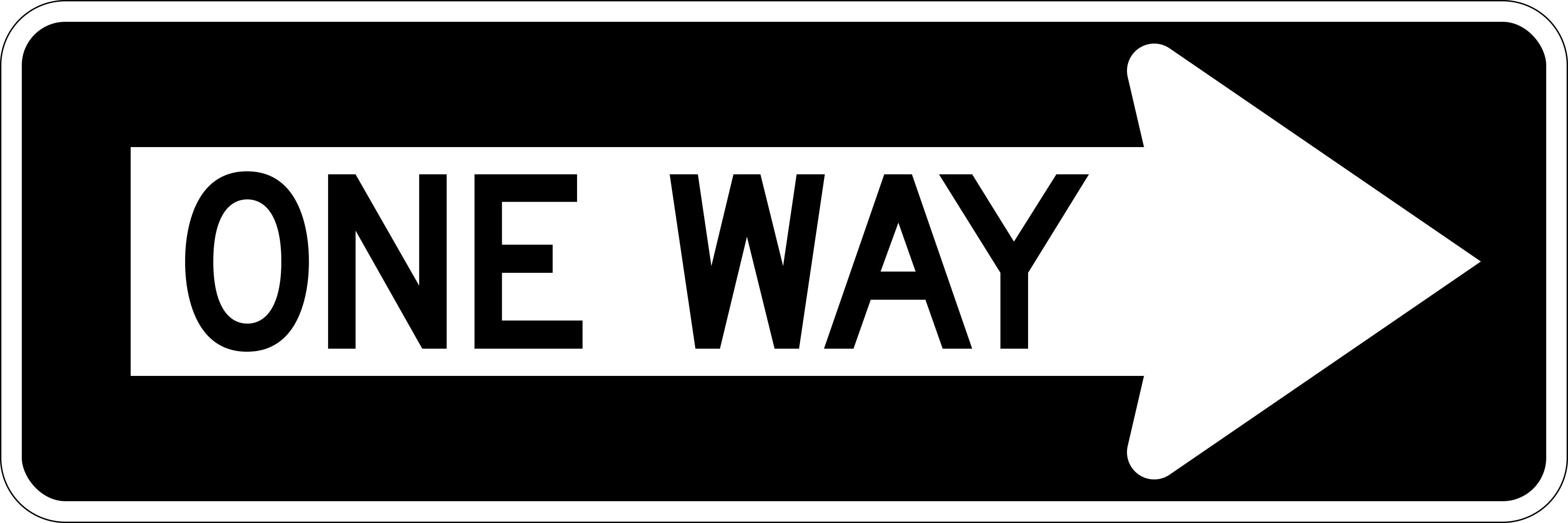
13. What travel pattern does the arrow on this ONE WAY sign identify?
- The next turn must be made only on red
- Traffic on the street travels only in the arrow's direction
- The right lane is reserved for passing vehicles
- Traffic may travel either way until the next block
Show answer
Traffic on the street travels only in the arrow's direction. ONE WAY identifies a roadway where traffic moves in the direction shown by the arrow. It does not authorize a turn on red, reserve a lane for passing, or permit opposing travel until another block. Before turning onto such a street, confirm that the vehicle will enter with the flow. The arrow’s direction is the key visual check whenever lane orientation is uncertain.
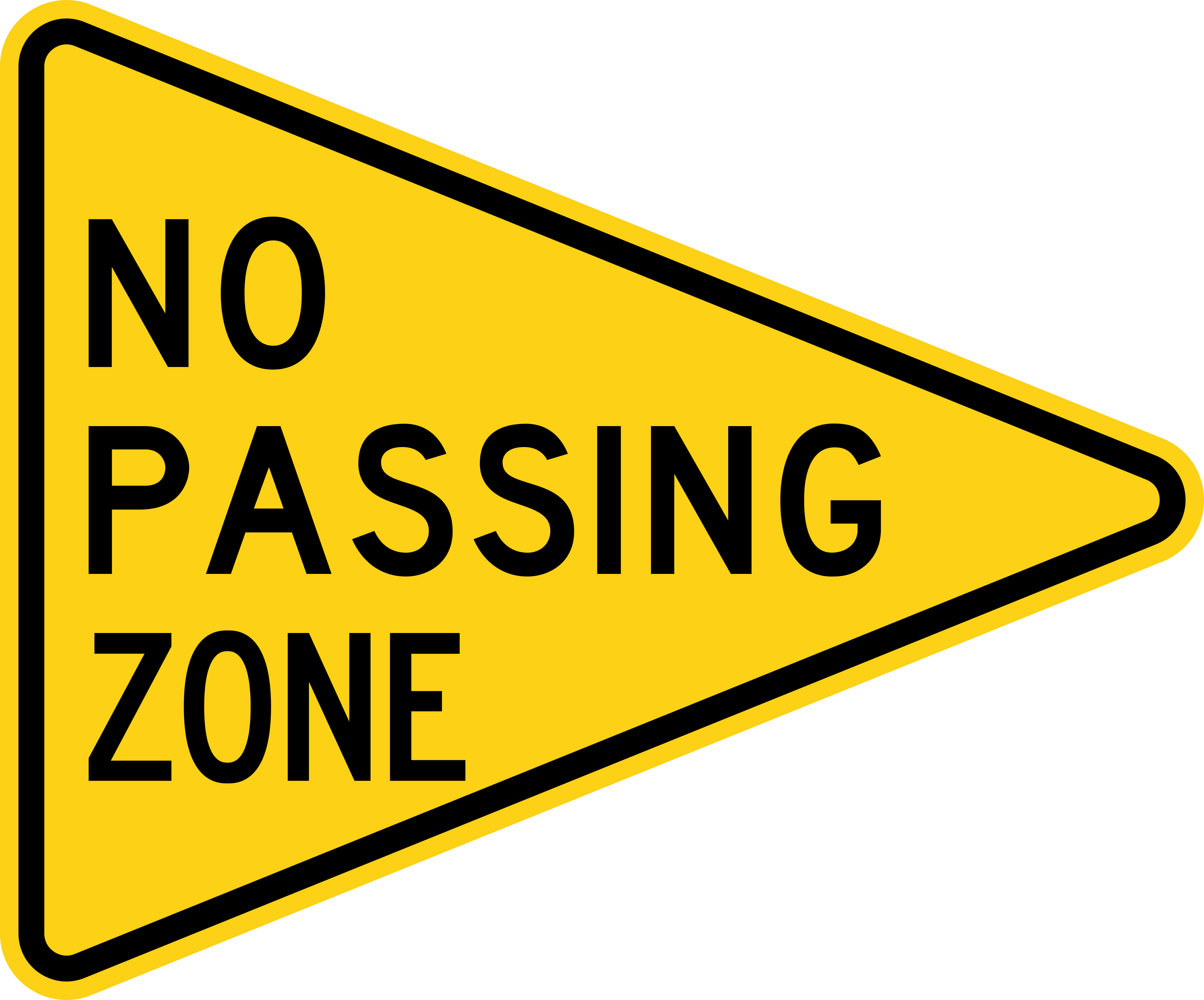
14. In which group of signs does the Rhode Island manual place this yellow pennant-shaped No Passing Zone sign?
- Recreation Signs
- Guide Signs
- Warning Signs
- Regulatory Signs
Show answer
Warning Signs. The Rhode Island manual shows the yellow pennant labeled No Passing Zone in its Warning Signs panel, alongside Yield Sign Ahead, Traffic Signal Ahead, and Stop Sign Ahead. The regulatory panel also has a No Passing Zone entry, but that one is the white rectangular DO NOT PASS sign, not the pennant. Guide signs help drivers find routes, exits, and services, and recreation signs are not a category in either panel. The yellow color and pennant shape are the clue that this sign sits with the warning signs, not the regulatory ones.
15. What is the only stated circumstance in which a Rhode Island minor may use a cell phone while driving?
- An emergency
- A hands-free call to a friend
- A call while stopped at a red light
- A work call during daylight
Show answer
An emergency. Drivers under eighteen are prohibited from using a cell phone while operating a motor vehicle, including hands-free devices and speakerphone. The manual gives one exception: an emergency. A red light does not automatically authorize a call, and neither a work purpose nor daylight changes the age-based rule. For a minor, connect cell phone use with the emergency exception only, not with the type of device or time of day.
Study this in the handbook: Licenses, insurance, phones and other laws
16. A Rhode Island driver is found operating a registered vehicle without proof of financial security in effect for the first time. What penalty may apply?
- A fine of $500 and a suspension of up to six months
- A $50 fine with no possible suspension
- A fine of $100 up to $250 and a suspension of up to 30 days
- A fine of $1,000 as a civil violation
Show answer
A fine of $100 up to $250 and a suspension of up to 30 days. Rhode Island law scales the penalty for operating without financial security in effect. A first offense can bring a suspension of up to 30 days and a fine of $100 up to $250. A second offense raises the possible suspension to six months with a $500 fine, and a third or later offense can bring a suspension of up to one year and a $1,000 civil fine. The flat $500 figure printed in the driver's manual matches only the second offense. A driver stopped without the insurance card has one business day to show coverage that existed at the time, so keep proof in the vehicle with the registration.
17. When should high beams be dimmed while meeting another vehicle at night?
- Only after the vehicles are within 50 feet of each other
- Promptly when the other vehicle is at least 500 feet ahead
- When the other vehicle reaches the same intersection
- Never, if the roadway has no streetlights
Show answer
Promptly when the other vehicle is at least 500 feet ahead. On an open highway at night, dim high beams promptly at least 500 feet ahead when approaching another vehicle. When following another vehicle at 200 feet or less, dim them as well so the driver ahead is not distracted or blinded. Waiting until 50 feet is much too late, and streetlight conditions do not cancel the courtesy and safety rule. The cue is distance, not whether the roadway feels bright: 500 feet when meeting, and 200 feet when following.
Study this in the handbook: Seat belts, child seats and headlights
18. A Rhode Island driver under 18 commits a second Driving While Impaired violation (BAC 0.02% to 0.08%). What happens to the license?
- A 30 day suspension
- A 6 month suspension
- A warning letter to the parents
- Suspension until age 21
Show answer
Suspension until age 21. The under 18 Driving While Impaired table lists a 6 to 12 month suspension for a first violation and a license suspension until age 21 for a second violation, along with a $150 highway safety assessment or community restitution. A third or later violation adds a further 2 year suspension. Thirty days and six months fall short of the second offense penalty, and the manual lists no warning letter option. Any measurable impairment at 0.02% or more is a violation for these drivers.
Study this in the handbook: Refusal and DUI penalties
19. When entering a Rhode Island roadway from a private driveway, where must the driver stop before reaching the curb?
- At the sidewalk
- Only after the front wheels cross the curb
- In the traffic lane beyond the curb
- At the nearest intersection
Show answer
At the sidewalk. A driver leaving a private road or driveway must stop at the sidewalk first, then continue to the curb line and stop again. The first stop creates a chance to detect pedestrians using the sidewalk. The second stop provides a separate view of approaching traffic. Waiting until the vehicle crosses the curb reverses the safety sequence, and stopping in the lane exposes the driver to a collision. Use the two-stop routine whenever a driveway crosses a sidewalk before joining the roadway.
Study this in the handbook: Right of way at intersections, rotaries and driveways
20. Which group of Rhode Island signs contains rules such as STOP, YIELD, and DO NOT ENTER?
- Regulatory signs
- Guide signs
- Tourist attraction signs
- Mile marker signs
Show answer
Regulatory signs. The manual places STOP, YIELD, and DO NOT ENTER under the heading Regulatory Signs. These signs communicate traffic controls that drivers must follow. Guide signs instead identify routes, exits, hospitals, food, or services. A mile marker reports location, and a tourist attraction sign points toward a destination. When a sign imposes a movement or entry rule, think regulatory before guide information.
QualitySpace is expanding to Rhode Island
We are a California-based independent insurance brokerage working on licensing in more states. We cannot help with Rhode Island insurance yet. Leave your email and we will let you know when we can.
Every question is written from the official Rhode Island Driver's Manual. Need paper? Printable RI practice test with answer key.
Last verified 2026-10-05. How we check every question · Study all 200 as flashcards
Frequently asked questions
How many questions are on this Rhode Island practice test?
This fixed set has 20 questions. It is test 2 of 10 from the 200 question Rhode Island bank.
How does this fixed test relate to the full Rhode Island bank?
Each numbered test is a fixed set of questions in a fixed order, so you can retake the same test later and compare. Every test mixes road signs and the other topics in about the same proportion as the full bank. Tests 1 to 10 together cover every question in the Rhode Island bank once. The full practice page mixes the whole bank at random.
Last verified 2026-10-05. See the Rhode Island DMV facts page for sourced state details.
Return to the full Rhode Island practice test · Study road signs