
Test 8 of 10 · 20 questions · Free 2026
RI Permit Practice Test 8
Jump to the test ↓A fixed 20 question set from the Rhode Island bank with answers and plain English explanations.
Question 1 of 20 · 0 right so far
All 20 questions in test 8
Every question below comes from the Rhode Island question bank on this page. Open a question to see the correct answer and the explanation. Nothing here is hidden behind a signup.
1. How does Rhode Island's three-second rule help a driver judge following distance?
- It permits tailgating when the road is dry
- It requires one car length for every ten miles per hour
- It uses a fixed roadside point and a three-second count
- It measures distance only by looking at the speedometer
Show answer
It uses a fixed roadside point and a three-second count. The three-second method starts when the vehicle ahead passes a fixed point, such as a sign or pole. The following driver counts through three seconds and drops back if the vehicle reaches that point before the count ends. It is not a car-length formula and does not excuse close following on dry pavement. In adverse weather or road conditions, the manual says to add another second or two, extending the cushion when stopping may take longer.
Study this in the handbook: Following distance, trucks and motorcycles
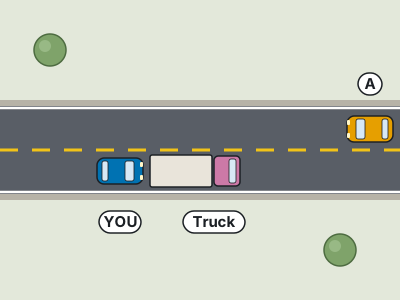
2. What does a broken yellow line between opposing traffic generally permit?
- Traveling only in the direction of an arrow
- Parking in the center of the roadway
- Passing another vehicle with care
- Crossing without checking opposing traffic
Show answer
Passing another vehicle with care. Broken yellow lines separate traffic traveling in opposite directions, and the manual says passing another vehicle is permitted with care. That permission does not mean a driver may cross without checking for opposing traffic, nor does the marking designate parking or an arrow-only movement. Before passing, confirm that the path is clear and the maneuver is lawful. The word care is the operational cue: permission still requires judgment and attention.
Study this in the handbook: Turn signals and roadway markings
3. Before driving after snow or ice, what must a Rhode Island driver do with the vehicle?
- Remove snow and ice that limit vision and clear roof snow that could blow onto other vehicles
- Clear only the windshield while leaving the roof covered
- Wait for the vehicle to warm up without clearing it
- Brush snow onto the shoulder after entering traffic
Show answer
Remove snow and ice that limit vision and clear roof snow that could blow onto other vehicles. Rhode Island law makes the motorist responsible for removing snow and ice that limit vision and for clearing roof snow that might blow down on the windshield or windows of other vehicles. Clearing only the windshield leaves the roof load that the law specifically mentions. Waiting for the engine to warm up does not remove anything, and entering traffic before clearing the vehicle creates the very hazard the rule targets. Before leaving, clear every window you look through and sweep the roof so nothing can blow onto drivers behind you.
Study this in the handbook: Licenses, insurance, phones and other laws
4. May a Rhode Island driver wear earphones or a headset while driving on a public highway?
- No, operating a vehicle on a public highway while wearing earphones or headsets is prohibited
- Yes, if the volume is low
- Yes, for navigation directions only
- Yes, in one ear only
Show answer
No, operating a vehicle on a public highway while wearing earphones or headsets is prohibited. Rhode Island lists among its driver rules that drivers are not allowed to operate a motor vehicle upon a public highway while wearing earphones or headsets. The rule is stated without a low volume, navigation, or one ear exception, so none of those conditions makes wearing them lawful. The same numbered list requires you to show your license and registration to an officer on request and to write your name in the officer's presence for identification. Leave earphones and headsets off before you start the vehicle.
Study this in the handbook: Licenses, insurance, phones and other laws
5. A Rhode Island Level 1 permit holder is driving with a qualified supervising driver. Who else may sit in the front seat?
- One friend under 21
- No one other than the supervising driver
- Any passenger wearing a seat belt
- A second licensed adult
Show answer
No one other than the supervising driver. At Level 1 the supervising driver must be seated beside the permit holder in the front seat, and no person other than the supervising driver may be in the front seat. That rules out a friend, a second licensed adult, or any other belted passenger in front. Seat belts are a separate requirement: every person in the vehicle must be fastened by a seat belt or child restraint. Passengers may ride in the back as long as they are belted.
Study this in the handbook: The three levels of Rhode Island's graduated license
6. At a stop sign, where must a driver stop?
- At the nearest point beyond the sign
- After entering the intersection to improve visibility
- Only when another vehicle is approaching
- Before the crosswalk or stop line, as applicable
Show answer
Before the crosswalk or stop line, as applicable. Rhode Island law says every driver approaching a stop sign shall stop before entering the crosswalk on the near side of the intersection. If there is no crosswalk, stop at a clearly marked stop line, and if there is neither, stop where you can see approaching traffic before entering the intersection. Rolling beyond the sign or entering the intersection first puts the vehicle past the stopping point. The duty applies even when no other vehicle is visible. Stop first, then check the intersection and proceed only when it is safe.
Study this in the handbook: Stopping, turning and passing
7. When must Rhode Island motorists use headlights during the day because of weather or visibility?
- Only after sunset, regardless of weather
- Only when the temperature is below freezing
- When weather reduces visibility or windshield wipers are in use
- Whenever another vehicle is within 200 feet
Show answer
When weather reduces visibility or windshield wipers are in use. Rhode Island requires headlights when daytime weather reduces visibility and whenever windshield wipers are operating because of rain, sleet, snow, or similar conditions. Waiting for sunset overlooks the daytime rule, and temperature alone does not decide whether lights are needed. The 200-foot figure belongs to dimming high beams behind another vehicle, not to turning headlights on. Use the wipers or reduced visibility as a practical reminder to activate headlights and select low beams in bad weather.
Study this in the handbook: Seat belts, child seats and headlights
8. On an undivided road, what must traffic do when a school bus displays flashing red lights?
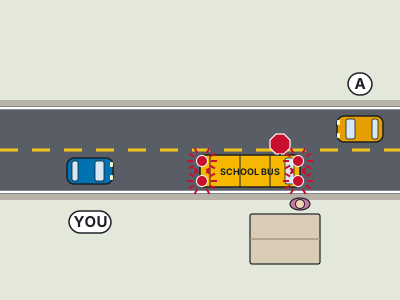
- Traffic approaching from either direction must stop and remain stopped
- Only vehicles directly behind the bus must stop
- Opposing traffic may continue at reduced speed
- All traffic may proceed once the bus doors close
Show answer
Traffic approaching from either direction must stop and remain stopped. The school-bus rule protects children who may cross from either side of an undivided roadway. When red lights flash, motorists approaching from both directions must make a full stop and stay stopped until the lights no longer flash. The behind-the-bus-only option ignores opposing traffic, and slowing without stopping is insufficient. Closing the doors is not the release condition. Watch for the red lights, stop completely, and wait for the bus signal to end before moving.
Study this in the handbook: Pedestrians, school buses and bicyclists
9. When may a Rhode Island driver stop within 50 feet of a railroad crossing?
- Never
- Any time the gates are up
- Only at night
- Only for a short time to load or unload passengers or packages
Show answer
Only for a short time to load or unload passengers or packages. Rhode Island lists places where you may not park or stop, including within 50 feet of the nearest rail of a railroad crossing. The same item gives one exception: you may stop for just a short time to load or unload passengers or packages. Gate position and time of day do not create exceptions, and the rule is not an absolute ban because the brief loading stop is allowed. Remember the related distances in the same list: 8 feet from a hydrant, 20 feet from a crosswalk at an intersection, and 30 feet from a stop sign or signal.
Study this in the handbook: Where you may not park or stop
10. At an uncontrolled intersection, how should a driver approach?
- Accelerate through before another vehicle arrives
- Assume the vehicle on the wider road always goes first
- Treat the intersection as if a yield sign were present
- Stop only if a pedestrian is visible
Show answer
Treat the intersection as if a yield sign were present. An uncontrolled intersection has no sign or signal assigning the right-of-way, so Rhode Island guidance says to treat it as if a yield sign were present. Slow down, scan in every direction, and yield when another road user has priority or the situation is uncertain. Road width does not automatically decide who proceeds, and accelerating removes reaction time. Waiting for a visible pedestrian is also too narrow because vehicles and bicycles may cross your path. The practical cue is absence of control, which means extra caution and yielding judgment.
Study this in the handbook: Traffic lights and roundabouts
11. What is the first step if the brake pedal goes to the floor?
- Turn off the engine immediately
- Pump the brake pedal
- Accelerate toward the shoulder
- Steer into oncoming traffic
Show answer
Pump the brake pedal. When the brake pedal drops to the floor, the manual first directs the driver to pump it. Several pumps may temporarily restore enough pressure to slow or stop the vehicle, so the driver can then continue with the other emergency steps. Downshifting and carefully engaging the parking brake are also part of the procedure, but they are not the first action asked for here. Do not accelerate or steer into danger. The practical cue is a sudden pedal with no resistance: pump promptly while looking for an open zone and preparing to reduce speed.
Study this in the handbook: Skids, brake failure, blowouts and other emergencies
12. After failing the Rhode Island road test, how long must an applicant wait before retaking it?
- At least 30 days
- At least 7 days
- Until the next business day
- At least 90 days
Show answer
At least 30 days. Failures must wait at least thirty days before retaking the road test, and there are no same day returns. If the test vehicle is rejected, for example for illegal window tint, or the applicant lacks proper documentation, the road test must be rescheduled. Seven days and the next day are not the rule, and 90 days is longer than required. Use the waiting period for supervised practice on the maneuvers that were failed.
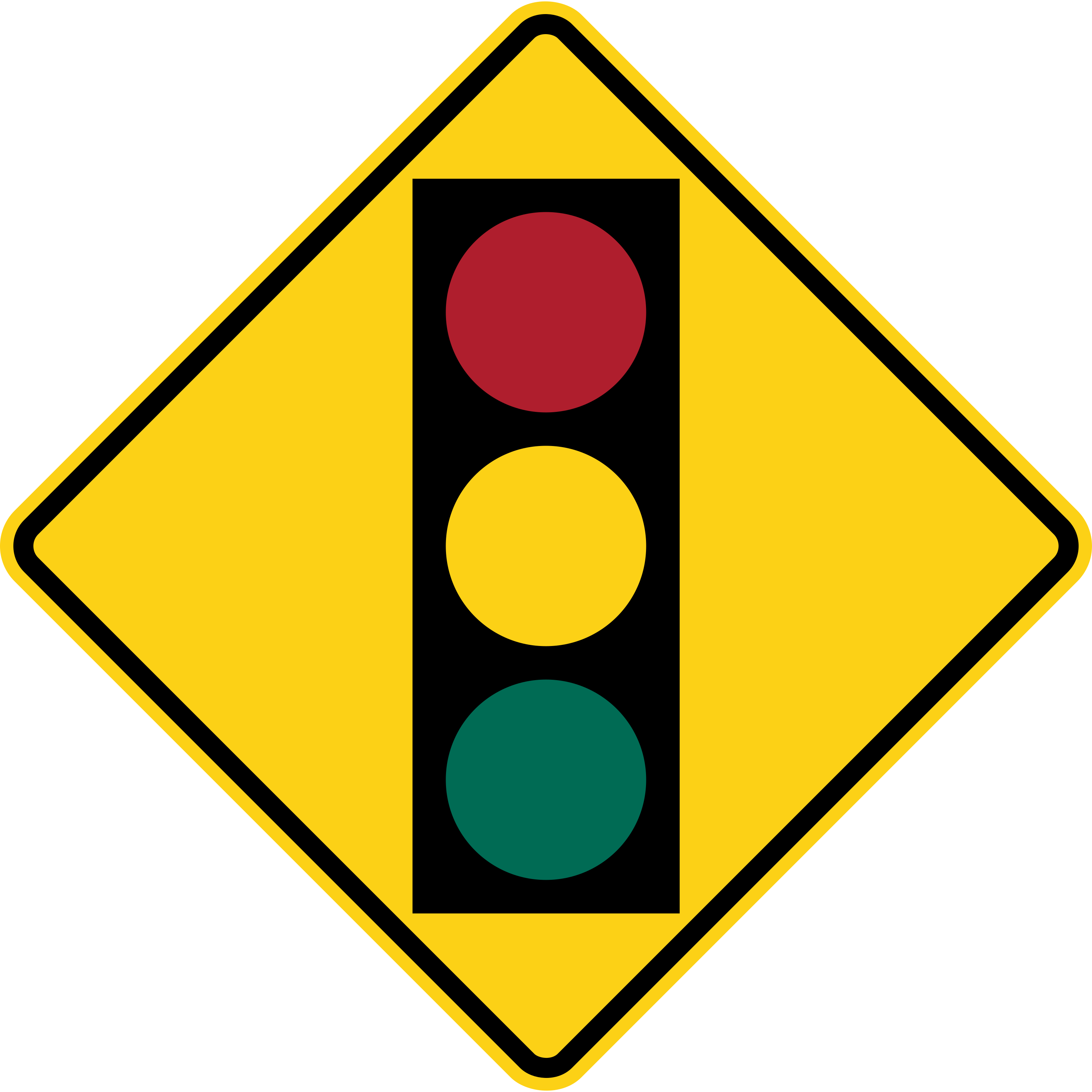
13. What should a driver expect after seeing this traffic signal warning sign?
- A police checkpoint will replace the next intersection
- A streetlight is broken and traffic control is suspended
- A traffic signal is ahead and requires preparation to obey it
- A signal applies only to vehicles turning left
Show answer
A traffic signal is ahead and requires preparation to obey it. The traffic signal warning sign announces a signal ahead, so the driver should adjust speed and prepare to respond to the upcoming light. It does not mean the light is broken, identify a police checkpoint, or limit the signal to left-turning traffic. Keep scanning beyond the warning sign until the actual intersection comes into view, then follow the displayed signal and lane markings.
14. A 17-year-old Rhode Island driver wants to take a non-emergency call on a hands-free speakerphone while driving. Is that allowed?
- Yes, because a speakerphone keeps both hands on the wheel
- Yes, if the driver has held a provisional license for six months
- Yes, if the call lasts less than one minute
- No, the under 18 ban includes hands-free devices and speakerphones
Show answer
No, the under 18 ban includes hands-free devices and speakerphones. Rhode Island prohibits drivers under 18 from using a cell phone while operating a motor vehicle, and the manual says this includes a prohibition on using a hands-free device or speakerphone. The only time a minor may use a cell phone while driving is an emergency, and a routine call is not one. Keeping both hands on the wheel does not create an exception, a short call is still phone use, and time on a provisional license does not change the rule. Until 18, let calls wait until you are parked.
Study this in the handbook: Licenses, insurance, phones and other laws
15. What hazard does the round yellow railroad symbol warn of?

- A roundabout controlled by a stop signal
- A railroad crossing ahead
- A bicycle crossing with no tracks nearby
- A dead-end road requiring a U-turn
Show answer
A railroad crossing ahead. The round yellow railroad symbol is an advance warning for a crossing ahead, giving the driver time to slow, look, and prepare to stop. It is different from a roundabout warning, bicycle crossing, or dead-end notice. The word ahead is the operational clue: the tracks are not necessarily at the sign, so begin scanning and manage speed before reaching them.
Study this in the handbook: Skids, brake failure, blowouts and other emergencies
16. What should a driver do when approaching a roundabout entrance?
- Enter clockwise so the nearest exit is reached sooner
- Stop inside the circle until every approaching vehicle has passed
- Yield to vehicles already in the roundabout, then enter counterclockwise through a safe gap
- Enter without yielding because traffic in the circle must stop
Show answer
Yield to vehicles already in the roundabout, then enter counterclockwise through a safe gap. Before entering a roundabout, slow down and yield to vehicles already circulating. Wait for a safe gap, then merge into the circle in a counterclockwise direction. Stopping inside the roundabout is not the normal procedure and can block traffic, while clockwise travel goes against the pattern described in the manual. Vehicles already in the circle do not owe entering traffic a stop. Scan for pedestrians too, because they retain priority at crossings. The cue is yield before entry, circulate counterclockwise, and exit to the right.
Study this in the handbook: Traffic lights and roundabouts
17. When a solid line is on your side of a two-way roadway, what does it mean?
- Change lanes freely if the road appears empty
- Pass whenever the vehicle ahead is moving below the limit
- Cross only to pass a truck or bus
- Do not pass or cross the line, except for listed emergencies or a legal turn
Show answer
Do not pass or cross the line, except for listed emergencies or a legal turn. The solid line on your side controls your movement, so passing and crossing it are prohibited in ordinary travel. The manual recognizes narrow exceptions, including an emergency, a breakdown, an object in the roadway, parking, or a legal turn. A slow vehicle does not cancel the restriction, and an empty road does not make a crossing automatically lawful. The useful visual cue is line placement: the solid line beside your lane means stay put unless an identified exception applies.
Study this in the handbook: Turn signals and roadway markings
18. What does a steady green traffic light allow a Rhode Island driver to do?
- Proceed without checking for anyone
- Proceed with caution while avoiding vehicles and pedestrians
- Treat the light as a stop sign
- Reverse through the intersection
Show answer
Proceed with caution while avoiding vehicles and pedestrians. A steady green light permits movement, but the manual pairs that permission with caution. The driver must avoid colliding with another vehicle or pedestrian. A green indication does not remove the need to scan the intersection, and it does not authorize reversing or treating the signal as a stop sign. Check the path before entering, especially for a pedestrian still clearing the crossing or a driver violating a red light. The useful cue is green means go only when clear, with the driver retaining responsibility for a safe path.
Study this in the handbook: Traffic lights and roundabouts
19. An adult Rhode Island driver has a BAC of 0.16% on a first DUI. What license suspension and fine does the table list?
- 30 to 180 day suspension and $100 to $300 fine
- 3 to 18 month suspension and $500 fine
- 2 year suspension and $1,000 fine
- No suspension on a first offense
Show answer
3 to 18 month suspension and $500 fine. At a BAC of 0.15% or above, a first violation is a misdemeanor with up to 1 year in prison, a 3 to 18 month license suspension, a $500 fine, a $500 highway safety assessment, and 20 to 60 hours of community service. The 30 to 180 day suspension belongs to the lowest adult BAC band, 0.08% to 0.1%. A 2 year suspension with a $1,000 fine is the second offense at 0.15% or above. Every adult DUI band in the table includes a suspension.
Study this in the handbook: Refusal and DUI penalties
20. What fine range does Rhode Island law set for a first chemical test refusal violation?
- $200 to $500
- $800 to $1,000
- $100 to $300
- $1,000 to $5,000
Show answer
$200 to $500. Rhode Island's refusal statute, R.I.G.L. 31-27-2.1, imposes for a first violation a fine of $200 to $500, ten to sixty hours of public community restitution, and a license suspension of six months to one year, plus a special course on driving while intoxicated or treatment. The manual's adult refusal table shows the same $200 to $500 fine. The $800 to $1,000 range is for a third or later refusal, the $100 to $300 range is the fine for a first DUI at 0.08% to 0.1%, and $1,000 to $5,000 is far above any refusal fine.
QualitySpace is expanding to Rhode Island
We are a California-based independent insurance brokerage working on licensing in more states. We cannot help with Rhode Island insurance yet. Leave your email and we will let you know when we can.
Every question is written from the official Rhode Island Driver's Manual. Need paper? Printable RI practice test with answer key.
Last verified 2026-10-05. How we check every question · Study all 200 as flashcards
Frequently asked questions
How many questions are on this Rhode Island practice test?
This fixed set has 20 questions. It is test 8 of 10 from the 200 question Rhode Island bank.
How does this fixed test relate to the full Rhode Island bank?
Each numbered test is a fixed set of questions in a fixed order, so you can retake the same test later and compare. Every test mixes road signs and the other topics in about the same proportion as the full bank. Tests 1 to 10 together cover every question in the Rhode Island bank once. The full practice page mixes the whole bank at random.
Last verified 2026-10-05. See the Rhode Island DMV facts page for sourced state details.
Return to the full Rhode Island practice test · Study road signs