
Test 3 of 10 · 20 questions · Free 2026
RI Permit Practice Test 3
Jump to the test ↓A fixed 20 question set from the Rhode Island bank with answers and plain English explanations.
Question 1 of 20 · 0 right so far
All 20 questions in test 3
Every question below comes from the Rhode Island question bank on this page. Open a question to see the correct answer and the explanation. Nothing here is hidden behind a signup.
1. A Rhode Island driver age 30 has a BAC of 0.06% and shows other signs of impairment. Can the driver be convicted?
- No, because 0.08% is the only limit for adults
- Yes, a driver 21 or older with a BAC over 0.05% but under 0.08% can be convicted if there is other evidence of influence
- Only if the driver refuses a breath test
- Only if a crash occurred
Show answer
Yes, a driver 21 or older with a BAC over 0.05% but under 0.08% can be convicted if there is other evidence of influence. The manual explains that when a test shows a BAC in excess of .05% but less than .08%, drivers 21 or older can be convicted if there is other evidence the driver was under the influence. So 0.08% is not a safe harbor. At .08% or more, the BAC alone is enough. Refusing a test and causing a crash are separate matters; neither is needed for a conviction here. A driver can even be convicted without a chemical test if the officer shows the court that alcohol affected driving.
Study this in the handbook: Alcohol, BAC limits and implied consent
2. A warning sign showing two opposing arrows indicates what roadway condition?
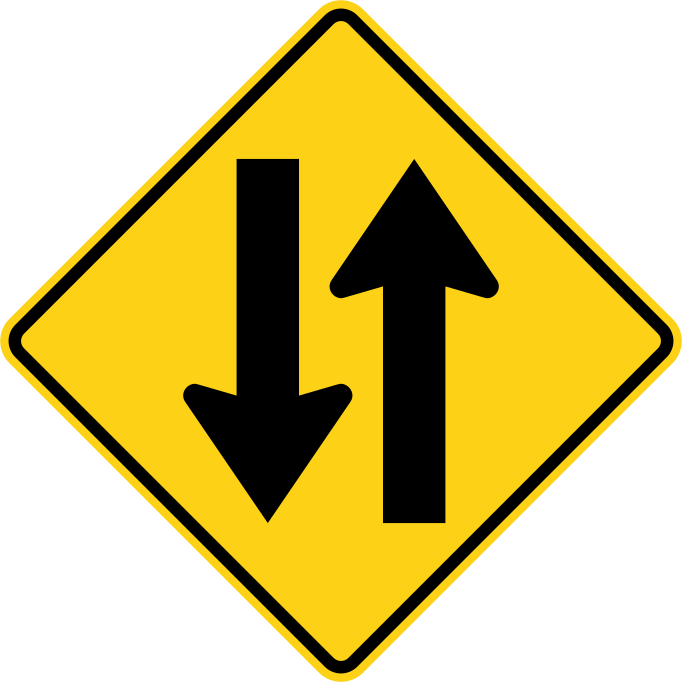
- Two-way traffic
- A one-way street ending at a freeway
- A divided highway with a center median
- A lane reserved for buses
Show answer
Two-way traffic. Two opposing arrows identify two-way traffic, meaning vehicles may travel toward you as well as in your direction. Keep right and scan carefully before crossing the centerline or passing. The one-way choice reverses the message because opposing traffic would not be expected on a one-way street. A divided highway uses a median to separate directions, and a bus lane is a use restriction rather than a direction warning. The practical cue is the pair of arrows: one points toward you and the other points away.
3. A 17-year-old Rhode Island driver is found with a BAC of 0.03%. What license suspension does the table list for a first violation?
- 1 to 3 months
- 6 to 12 months
- Suspension until age 21
- No suspension, only a fine
Show answer
6 to 12 months. For a driver under 18 with a BAC of 0.02% to 0.08%, a first Driving While Impaired violation brings a 6 to 12 month license suspension plus a $150 highway safety assessment or community restitution, a special course, and alcohol or drug treatment. One to three months is the first offense suspension for drivers 18 to 21, not under 18. Suspension until age 21 is the second violation penalty for this age group. The table lists a suspension for every violation, so no suspension is wrong.
Study this in the handbook: Refusal and DUI penalties
4. What roadway pattern is shown by a winding-road warning sign?

- The road surface is newly paved
- A series of curves lies ahead
- Strong crosswinds are guaranteed
- A four-way stop is immediately ahead
Show answer
A series of curves lies ahead. A winding-road warning means the driver should expect several bends rather than one isolated curve. Slow before the first bend and maintain a speed that leaves room to manage the following changes in direction. Newly paved pavement, crosswinds, and a four-way stop are separate conditions that are not conveyed by the repeated curved arrow. Keep scanning beyond the first bend because the next turn may hide traffic or a narrowing roadway. The repeated shape is the cue: the road will continue changing direction.
5. A vehicle stalls on railroad tracks while a train is approaching. Where should the occupants move?
- Exit and move as far from the tracks as possible
- Remain inside with hazard lights on
- Push the vehicle toward the nearest crossing gate
- Stand beside the vehicle to flag the train
Show answer
Exit and move as far from the tracks as possible. The manual puts personal escape ahead of protecting the stalled vehicle. Everyone should get out, leave the tracks, and move as far away as possible. Staying in the car or standing beside it leaves people inside the collision area. Pushing the vehicle is dangerous and wastes time when a train is coming. Once clear, the occupants should also consider the train’s direction when choosing where to run, since debris can travel with the train. The immediate cue is simple: abandon the vehicle and create maximum distance from the rails.
Study this in the handbook: Skids, brake failure, blowouts and other emergencies
6. What does the Rhode Island manual state about texting while driving?
- Texting is allowed with a hands-free device
- Texting is allowed for drivers over 21
- Texting is allowed whenever traffic is stopped
- Texting while driving is forbidden in Rhode Island
Show answer
Texting while driving is forbidden in Rhode Island. The manual gives a direct warning that texting while driving is forbidden in Rhode Island. The age, traffic-light, and hands-free choices all invent exceptions that are not stated in that warning. The broader law section also explains that a wireless handset may not be used to compose, read, or send a text while operating a motor vehicle. Treat the prohibition as applying to the activity itself, not merely to one type of phone or roadway condition.
Study this in the handbook: Licenses, insurance, phones and other laws
7. What following-distance adjustment is recommended during adverse weather or road conditions?
- Reduce the gap because slower traffic needs less space
- Add another second or two to the normal following distance
- Keep exactly three seconds in every condition
- Follow within one second when visibility is limited
Show answer
Add another second or two to the normal following distance. The normal three-second method is a starting point, not an unchanging measurement. When weather or the road surface is adverse, the manual says to add another second or two. That extra cushion provides more time when traction or visibility is reduced. Cutting the gap makes a sudden stop harder, and holding exactly three seconds ignores the stated adjustment. Use a fixed roadside object to count the interval, then increase it when rain, snow, ice, or another hazard is present.
Study this in the handbook: Following distance, trucks and motorcycles
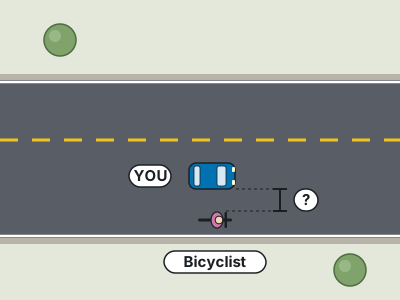
8. How much clearance should a motorist allow when passing a bicyclist?
- No extra space if the bicycle stays near the curb
- Exactly 6 inches
- One vehicle length regardless of speed
- As much as possible, about 3 to 5 feet
Show answer
As much as possible, about 3 to 5 feet. The bicycle guidance calls for as much clearance as possible, specifically identifying 3 to 5 feet as a useful passing space. That room protects a rider from contact and allows for movement around potholes, puddles, debris, or a sudden fall. Six inches is plainly inadequate, and a fixed vehicle length does not describe lateral clearance. Staying near the curb does not remove the risk. A driver should wait for a safe opportunity, leave the stated buffer, and be prepared to stop if the bicyclist moves into the lane.
Study this in the handbook: Pedestrians, school buses and bicyclists
9. What does Rhode Island require when a driver sees red lights flashing at a railroad crossing?
- Drive around any lowered gate
- Speed up to beat the train
- Stop, look, and listen
- Stop only if the train is already visible
Show answer
Stop, look, and listen. Flashing red signals at a railroad crossing require the driver to stop, look, and listen. The manual applies the same response when gates are being lowered, so the warning is enough even if a train cannot yet be seen. Trying to beat the train or driving around a lowered gate directly defeats the safety rule. The study cue is the three-part response in order: stop the vehicle, look for the train and crossing conditions, then listen before proceeding only when the crossing is clear and lawful.
Study this in the handbook: Skids, brake failure, blowouts and other emergencies
10. What is the legal status of a crosswalk at an intersection of public roads when no markings are painted?
- It becomes a crosswalk only during daylight
- It is still a legal crosswalk
- It is legal only if a crossing sign is present
- It is not a crosswalk until stripes are added
Show answer
It is still a legal crosswalk. The manual explains that every intersection of public roads constitutes a legal crosswalk, whether painted markings are present or not. The unmarked condition does not remove pedestrian crossing rights or the driver’s duty to use caution and yield. Daylight, a nearby sign, and visible stripes are not prerequisites. Drivers should therefore scan the corners and approach at a speed that leaves time to stop. A strong memory cue is that the intersection itself creates the legal crossing, while paint merely makes an existing crossing easier to see.
Study this in the handbook: Turn signals and roadway markings
11. In a Rhode Island work zone, what color and shapes identify construction signs?
- White, pentagonal or oval
- Blue, circular or octagonal
- Green, triangular or square
- Orange, diamond or rectangular
Show answer
Orange, diamond or rectangular. Construction signs in Rhode Island work zones are orange and may be diamond or rectangular. The other combinations borrow colors or shapes associated with unrelated sign functions and are not the construction-sign description in the manual. This visual cue helps a driver recognize warnings before, within, and after a work zone. When approaching roadwork, look for the orange panel first, then read the message and respond to the hazard it identifies.
Study this in the handbook: Stop signs, roundabout signs and work zones
12. A pedestrian with a white cane is about to cross the street ahead of you in Rhode Island. What must you do?
- Bring the vehicle to a complete stop before the intersection and yield the right of way
- Sound the horn to warn the pedestrian
- Flash the headlights and continue
- Slow down and drive around
Show answer
Bring the vehicle to a complete stop before the intersection and yield the right of way. When a pedestrian carrying a raised white cane, or guided by an identified guide dog, is crossing or trying to cross, Rhode Island law requires every approaching driver to come to a full stop before reaching the intersection or crossing point and to take whatever precautions are needed to avoid injuring the pedestrian. The penalty section sets a fine of not more than $250 for a violation; the $1,000 figure printed in the driver's manual does not match the current statute. Sounding the horn or flashing headlights does not help someone who cannot see you, and driving around the person is not a substitute for stopping.
Study this in the handbook: Pedestrians, school buses and bicyclists
13. What do solid roadway lines generally mean under Rhode Island’s roadway-marking guidance?
- Only motorcycles may cross them
- Passing is required immediately
- Passing and lane changes are not permitted
- They always mark traffic moving in opposite directions
Show answer
Passing and lane changes are not permitted. Solid lines separate lanes, and the manual says motorists are not permitted to pass other vehicles or change lanes across them. That restriction is not the same as saying every solid line separates opposing traffic. Yellow and white colors provide additional information about traffic direction and lane use. A solid line may be crossed in listed emergencies, such as a legal turn, breakdown, or object in the road. Treat the line as a barrier during ordinary travel, then look for a permitted condition before crossing it.
Study this in the handbook: Turn signals and roadway markings
14. A Rhode Island driver is transporting a 6-year-old who is 48 inches tall and weighs 50 pounds, and the car has an empty back seat. How must the child ride?
- In the front seat wearing an adult safety belt
- In any seat, as long as a parent is in the car
- In a rear seat, properly restrained in an approved child restraint system
- In a rear seat wearing only an adult safety belt
Show answer
In a rear seat, properly restrained in an approved child restraint system. Rhode Island's child restraint law requires anyone transporting a child under the age of eight who is less than 57 inches tall and less than 80 pounds to place the child in a rear seating position, properly restrained in a federally approved child restraint system. This child is 6, 48 inches, and 50 pounds, so all three limits apply. An adult belt alone is only for a child under eight who has reached 57 inches or 80 pounds, and the front seat is allowed only when there is no back seat or other children fill it.
Study this in the handbook: Seat belts, child seats and headlights
15. If a vehicle with conventional brakes is on a slippery road, how should the driver brake?
- Turn sharply while braking to find traction
- Press the brake pedal once as hard as possible
- Avoid slowing until the road becomes dry
- Gently pump the brakes while maintaining a suitable speed
Show answer
Gently pump the brakes while maintaining a suitable speed. For conventional brakes on a slippery road, the manual advises very gentle pumping while maintaining a speed appropriate for the conditions. A single hard application can promote a skid, and refusing to slow leaves too little control for changing traffic or roadway hazards. The advice differs for anti lock brakes, which should be pressed firmly without pumping. Know which braking system the vehicle has before an emergency, and reduce speed before the surface becomes hazardous.
Study this in the handbook: Skids, brake failure, blowouts and other emergencies
16. For the first twelve months of a Rhode Island limited provisional license, what passenger limit applies to a passenger younger than 21?
- No passengers younger than 21 under any circumstance
- No more than two passengers, including household members
- No more than one passenger, with immediate family and household members exempt
- No limit when every occupant is properly restrained
Show answer
No more than one passenger, with immediate family and household members exempt. During the first twelve months, the license allows no more than one licensed passenger younger than twenty-one. Immediate family and household members are exempt from that passenger rule. The two-passenger choice raises the numerical ceiling, while a complete ban ignores the stated family exception. Seat belts remain required for everyone, but restraint use does not turn the passenger limit into an unlimited allowance. When reviewing this rule, pair the twelve-month period with one qualifying young passenger.
Study this in the handbook: The three levels of Rhode Island's graduated license
17. How should a driver treat a posted SPEED LIMIT sign?
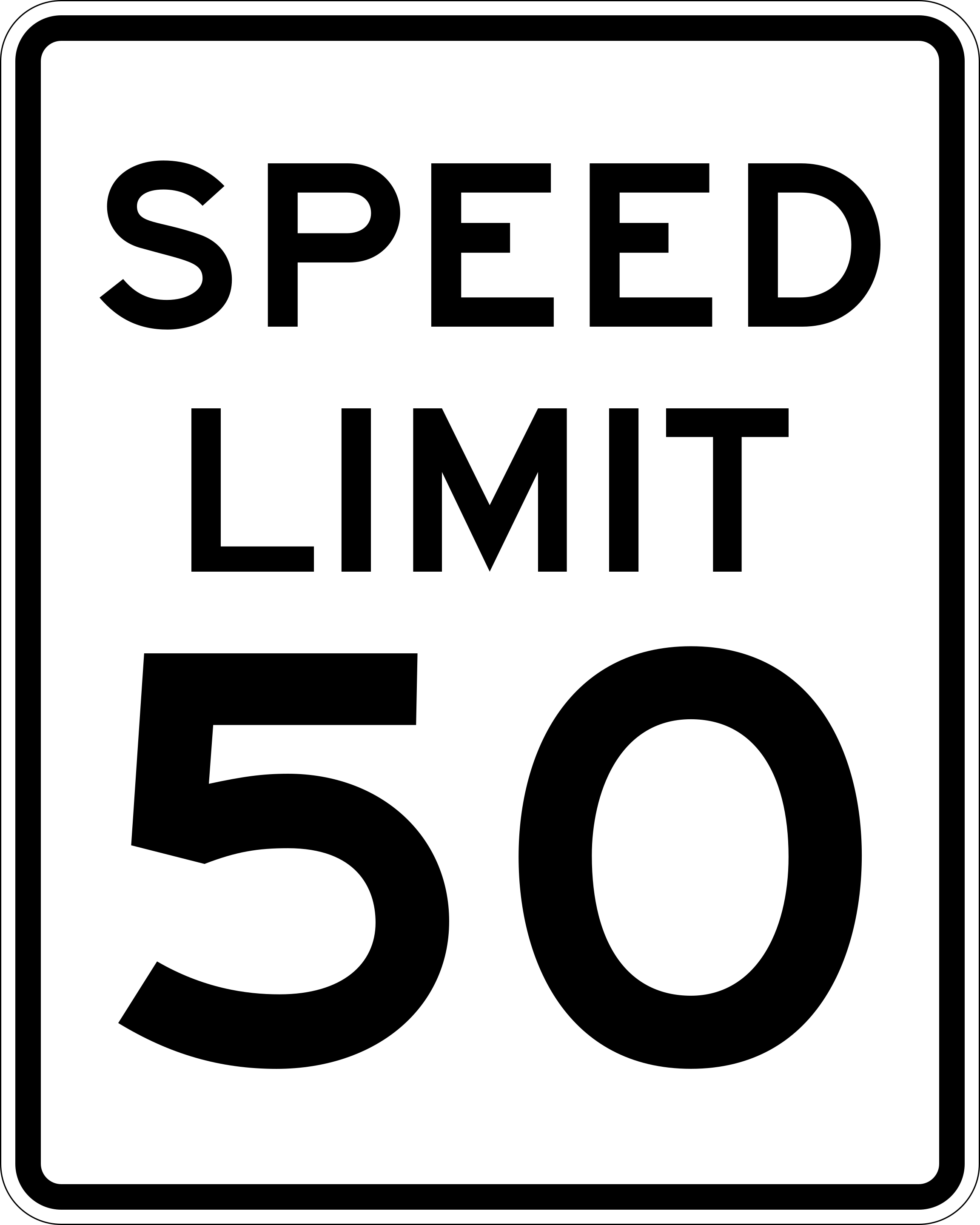
- As a regulatory maximum that still requires adjustment for conditions
- As an optional suggestion that may be exceeded in daylight
- As a minimum speed required on every roadway
- As a truck-only restriction that does not apply to cars
Show answer
As a regulatory maximum that still requires adjustment for conditions. SPEED LIMIT appears in the manual’s Regulatory Signs section, so it communicates a legal traffic rule rather than a casual suggestion. The posted number is not a required minimum and does not apply only to trucks. Drivers must also account for rain, snow, traffic, and visibility, choosing a safe speed even when that means traveling below the posted limit. Read the number before conditions change.
Study this in the handbook: Licenses, insurance, phones and other laws
18. An applicant under 18 is applying for a Rhode Island Limited Instructional Permit. How many hours of driver education must the completion certificate show?
- 20 hours
- 33 hours
- 50 hours
- 6 hours
Show answer
33 hours. Applicants under 18 must show a certificate for the 33 hour Rhode Island driver education class, administered by CCRI or an equivalent. Fifty hours is the supervised driving log needed later for the Limited Provisional License, so it is easy to mix up but it is not the classroom requirement. Twenty hours and six hours are not Rhode Island figures for this course. The certificate is presented at the DMV along with identity documents, the Social Security card, proof of residency, and the permit fee.
Study this in the handbook: The three levels of Rhode Island's graduated license
19. What does Rhode Island's Basic Speed Law require when weather or road conditions worsen?
- Stop in the traffic lane until conditions improve
- Continue at the posted limit regardless of conditions
- Match the speed of the fastest nearby vehicle
- Drive only as fast as the road conditions dictate
Show answer
Drive only as fast as the road conditions dictate. Rhode Island's Basic Speed Law requires a driver to choose a pace dictated by the actual road conditions. A posted limit is not a command to maintain that speed through snow, rain, sleet, ice, or construction. Matching another driver's speed can reproduce someone else's unsafe decision, and stopping in a travel lane creates a new hazard. Reduce speed smoothly, increase following room, and keep scanning for pedestrians, changing surfaces, and traffic that may need more time to react.
Study this in the handbook: Licenses, insurance, phones and other laws
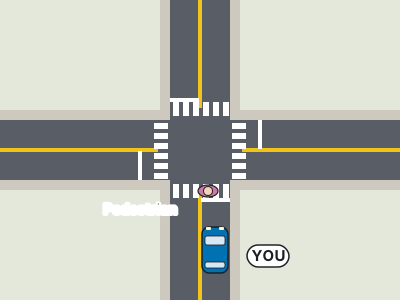
20. What must a Rhode Island motorist do when a pedestrian is in a marked crosswalk?
- Yield only if the pedestrian is running
- Accelerate before the pedestrian reaches the lane
- Yield to the pedestrian
- Use the horn instead of yielding
Show answer
Yield to the pedestrian. Pedestrians in a marked crosswalk receive priority, so the motorist must yield and allow the person to cross safely. Speeding up would increase the conflict, and the pedestrian does not need to be running for the duty to apply. A horn may warn someone in an emergency, but it cannot replace yielding. Scan crosswalks before entering them, cover the brake when visibility is limited, and wait until the crossing path is clear before continuing.
Study this in the handbook: Pedestrians, school buses and bicyclists
QualitySpace is expanding to Rhode Island
We are a California-based independent insurance brokerage working on licensing in more states. We cannot help with Rhode Island insurance yet. Leave your email and we will let you know when we can.
Every question is written from the official Rhode Island Driver's Manual. Need paper? Printable RI practice test with answer key.
Last verified 2026-10-05. How we check every question · Study all 200 as flashcards
Frequently asked questions
How many questions are on this Rhode Island practice test?
This fixed set has 20 questions. It is test 3 of 10 from the 200 question Rhode Island bank.
How does this fixed test relate to the full Rhode Island bank?
Each numbered test is a fixed set of questions in a fixed order, so you can retake the same test later and compare. Every test mixes road signs and the other topics in about the same proportion as the full bank. Tests 1 to 10 together cover every question in the Rhode Island bank once. The full practice page mixes the whole bank at random.
Last verified 2026-10-05. See the Rhode Island DMV facts page for sourced state details.
Return to the full Rhode Island practice test · Study road signs