Every question below comes from the Hawaii question bank on this page. Open a question to see the correct answer and the explanation. Nothing here is hidden behind a signup.
1. What must a driver do when a steady yellow X lane-control signal is displayed?
- Enter the lane and maintain speed
- Move out because the lane will be used for opposite-direction traffic
- Use the lane for passing only
- Stop in the lane and wait for a red X
Show answer
Move out because the lane will be used for opposite-direction traffic. A yellow X warns that the lane is being changed for traffic moving in the opposite direction, so the driver must move out of that lane. Full explanation in Test 1
2. After this HILL warning sign the road drops down a steep grade. According to the Hawaii manual, when should you downshift for engine braking?

- Before starting the downgrade
- Halfway down, once the vehicle has gained speed
- Only after the brakes begin to fade
- At the bottom of the hill
Show answer
Before starting the downgrade. Hawaii's manual says downshifting is a proper way to get extra braking effect from the engine when going down a steep grade, and that the do Full explanation in Test 2
3. What temporary permit does Hawaii describe for a driver who tests at .08 percent BAC or higher?
- A 7 day permit with no restrictions
- A 30 day temporary driving permit
- A 90 day commercial permit
- No temporary permit is issued
Show answer
A 30 day temporary driving permit. The administrative process described by the manual gives the driver a 30 day temporary driving permit when the BAC test reaches . Full explanation in Test 3
4. What maneuver is prohibited by the sign shown here?

- Driving straight through the controlled lane
- Making any left turn at the next intersection
- Passing a slower vehicle on a marked road
- Making a U-turn at that location
Show answer
Making a U-turn at that location. The crossed U-shaped arrow prohibits a U-turn at the location where the sign is posted. Full explanation in Test 4
5. What license must a Hawaii driver under age 18 operate on before becoming eligible for a class 3 driver’s license?
- A provisional license
- A full class 3 license
- A commercial driver’s license
- A motorcycle license
Show answer
A provisional license. A Hawaii driver under 18 must operate on a provisional license for at least six months before becoming eligible for a class 3 driver’s licen Full explanation in Test 5
6. A person with a white cane or a guide dog is in the roadway ahead. When must you stop?
- Always, regardless of the traffic signal or traffic situation
- Only when your signal is red
- Only when the person is in a marked crosswalk
- Only if the person raises the cane toward traffic
Show answer
Always, regardless of the traffic signal or traffic situation. Hawaii drivers must stop for all blind persons in the roadway, identified by a white cane or a guide dog, regardless of the traffic signal i Full explanation in Test 6
7. Under Hawaii's no fault insurance law, what medical bill amount opens the door to a lawsuit for bodily injury?
- Medical bills over $500
- Any amount, since you can sue for injury at any time
- Medical bills over $5,000
- No amount, since no fault law bars every injury lawsuit
Show answer
Medical bills over $5,000. Hawaii lets you sue or be sued for property damage at any time, but not for bodily injury unless medical bills exceed $5,000, the injury cau Full explanation in Test 7
8. What is the lowest BAC threshold for Hawaii's under-21 alcohol driving rule?
- .10 percent or more
- .08 percent or more
- .02 percent or more
- Only a BAC above .15 percent
Show answer
.02 percent or more. For a driver under 21, Hawaii's Zero Tolerance law prohibits a BAC of .02 percent or more. The adult . Full explanation in Test 8
9. Which Hawaii vehicles display a license plate on the rear only?
- Passenger cars
- Motorcycles, trailers and semitrailers
- Pickup trucks
- All vehicles registered in Hawaii
Show answer
Motorcycles, trailers and semitrailers. Hawaii requires motorcycles, trailers and semitrailers to display a license plate on the rear. Full explanation in Test 9
10. At what age may a person first obtain a Hawaii instruction permit?
- 15 1/2 years
- 14 years
- 18 years
- 19 years
Show answer
15 1/2 years. Hawaii sets the starting point for an instruction permit at 15 1/2 years. Full explanation in Test 10
11. According to the Hawaii manual, a driver with a blood alcohol content of more than .05 percent but less than .08 percent may be considered what?
- Under the influence of alcohol
- Completely unaffected by alcohol
- Sober once the driver drinks black coffee
- Impaired
Show answer
Impaired. The manual says a driver may be considered impaired when the blood alcohol content is more than .05 percent but less than .08 percent. Full explanation in Test 1
12. What must a Hawaii permit holder do before operating on a highway with an instruction permit?
- Wait until age 16 even if the permit was properly issued
- Drive alone only during daylight hours
- Carry a school identification card instead of a supervising driver
- Drive only when accompanied by a licensed driver at least 21 years old
Show answer
Drive only when accompanied by a licensed driver at least 21 years old. The permit is a supervised learning authorization, not an unrestricted license. Full explanation in Test 2
13. Before applying for a provisional license, how long must a minor hold a valid instruction permit?
- 90 days
- 30 days
- 180 days
- One full year
Show answer
180 days. The graduated licensing rules require a valid instruction permit to be held for 180 days before the provisional application. Full explanation in Test 3
14. What must a minor under 18 provide before entering Hawaii’s graduated licensing program?
- Consent from any adult neighbor
- Parental consent from each living parent or legal guardian, unless married or emancipated
- Only a school principal’s signature
- No consent when the applicant has passed the vision test
Show answer
Parental consent from each living parent or legal guardian, unless married or emancipated. A person younger than 18 must provide parental consent from each living parent or legal guardian unless the person is married or emancipated Full explanation in Test 4
15. What must a Hawaii instruction-permit applicant pass among the preliminary examinations?
- A written test on vehicle repairs and a parking-lot inspection
- Only a road test
- A vision screening test and a rules of the road test
- A medical test and a passenger-limit test
Show answer
A vision screening test and a rules of the road test. For an instruction permit, the graduated licensing list calls for a vision screening test and a rules of the road test. Full explanation in Test 5
16. You are driving in fog. If you cannot see at least how far ahead should you pull completely off the pavement and stop?
- One car length, about 20 feet
- 100 feet
- 500 feet
- Two car lengths, about 40 feet
Show answer
Two car lengths, about 40 feet. The manual says that if you are unable to see at least two car lengths, 40 feet, in fog you should pull completely off the pavement, stop, a Full explanation in Test 6
17. What is the minimum age for a Hawaii provisional license?
- 16 years
- 15 1/2 years
- 17 years
- 18 years
Show answer
16 years. The graduated licensing rules set 16 years as the minimum age for a provisional license. Full explanation in Test 7
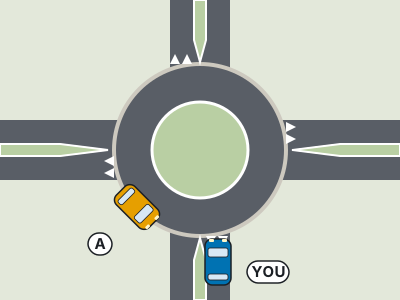
18. When approaching a roundabout, to whom must an entering driver yield?
- Only vehicles entering from the left
- Vehicles waiting behind the entry line
- Traffic already circulating in the roundabout
- No one, because entering traffic has priority
Show answer
Traffic already circulating in the roundabout. An entering vehicle must yield to traffic already circulating in the roundabout. Full explanation in Test 8
19. The vehicle you provide for a Hawaii road test must have which documents?
- A current registration, a current safety inspection certificate and an insurance identification card
- Only a current registration
- The certificate of title and a bill of sale
- Only an insurance identification card
Show answer
A current registration, a current safety inspection certificate and an insurance identification card. For the road test you must provide a vehicle in safe operating condition with a current registration, a current safety inspection certificat Full explanation in Test 9
20. Which tests does the Hawaii manual list for a person applying for a driver's license or instruction permit?
- A medical examination, a parking test and a county interview
- Only a written rules test and a vehicle registration check
- Vision, rules of the road and practical road performance tests
- A highway-speed test, a fuel-economy test and a vision waiver
Show answer
Vision, rules of the road and practical road performance tests. The manual lists three tests given when a person applies for a driver's license or instruction permit, as required: a vision test, a knowled Full explanation in Test 10
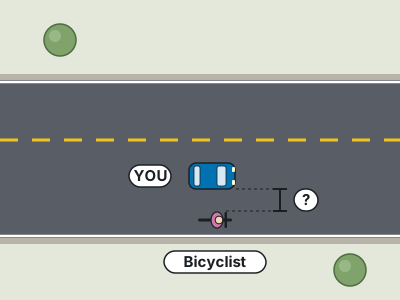
21. How much space should a motorist maintain when passing a bicyclist?
- No fixed space if the bicyclist is in a bike lane
- At least 6 inches until the front wheel clears
- One foot only when traffic is present
- At least 3 feet until safely past
Show answer
At least 3 feet until safely past. Motorists should keep at least three feet between the vehicle and bicyclist until the pass is safely completed. Full explanation in Test 1
22. When may a Hawaii provisional licensee drive between 11:00 p.m. and 5:00 a.m. under the ordinary nighttime rule?
- When accompanied by a licensed parent or guardian
- Whenever the licensee has no passengers
- Whenever the road is dry and well lit
- Only after holding the provisional license for six months
Show answer
When accompanied by a licensed parent or guardian. The ordinary nighttime permission requires accompaniment by a licensed parent or guardian. Full explanation in Test 2
23. Which single vehicles require a Hawaii class above Category 3 but below a CDL?
- Any vehicle over 10,000 pounds
- Any single vehicle with a GVWR of 18,001 to 26,000 pounds
- Vehicles over 26,001 pounds
- Buses only
Show answer
Any single vehicle with a GVWR of 18,001 to 26,000 pounds. Hawaii's license table places any single vehicle with a GVWR of 18,001 to 26,000 pounds in its own class above Category 3, while Class A cov Full explanation in Test 3
24. How many passengers under age 18 may a Hawaii provisional licensee transport when the passenger is not a household member?
- Only one
- Two
- Three
- As many as fit with seat belts
Show answer
Only one. A Hawaii provisional license allows transport of only one person under age 18 who is not a household member. Full explanation in Test 4
25. What action is prohibited by the red-circle sign shown here?

- Turning toward a marked public parking area
- Parking only during daylight hours
- Driving through a school zone at low speed
- Entering the restricted roadway or movement
Show answer
Entering the restricted roadway or movement. Hawaii classifies red-circle exclusion signs as signs that restrict or prohibit vehicles, vehicle movements, or some other activity. Full explanation in Test 5
26. When you stop in traffic behind another vehicle, how far back does the Hawaii manual say you should stop?
- Close enough to its bumper that no one can cut in
- Far enough back to see where its rear tires rest on the road
- Exactly one car length, regardless of the situation
- As close as possible to save space in the lane
Show answer
Far enough back to see where its rear tires rest on the road. The Hawaii manual says that when stopping in traffic, you should stop far enough behind the vehicle ahead so that you can see the point wher Full explanation in Test 6
27. If a vehicle begins to skid, what does the Hawaii manual recommend?

- Accelerate until the tires regain traction
- Apply the brakes sharply and turn hard
- Take immediate smooth corrective action
- Make a sudden steering change away from the skid
Show answer
Take immediate smooth corrective action. When a vehicle begins to skid, the manual calls for immediate smooth corrective action before control is lost. Full explanation in Test 7
28. How many documents are required to prove principal residence in Hawaii for a REAL ID application?
- One document
- Two documents
- Three documents
- No residence document
Show answer
Two documents. A REAL ID application requires two forms of proof for the principal residence address in Hawaii. Full explanation in Test 8
29. What does the arrow on this ONE WAY sign tell the driver?

- Turn in that direction only after stopping at a red light
- Travel on the street only in the arrow’s direction
- Use the right lane only for passing
- Expect two-way traffic around the next corner
Show answer
Travel on the street only in the arrow’s direction. The arrow identifies the only direction of travel permitted on the one-way street. Full explanation in Test 9
30. What do black and white traffic signs indicate in Hawaii?
- A guide to scenic areas
- A recreational destination
- A warning of road work
- A required action
Show answer
A required action. The manual uses black and white signs to communicate a required action, and it describes those signs as rectangular. Full explanation in Test 10
