
Test 3 of 10 · 20 questions · Free 2026
HI Permit Practice Test 3
Jump to the test ↓A fixed 20 question set from the Hawaii bank with answers and plain English explanations. The real HI exam is 30 questions, 80 percent to pass; take the full length version on the main practice page.
Question 1 of 20 · 0 right so far
All 20 questions in test 3
Every question below comes from the Hawaii question bank on this page. Open a question to see the correct answer and the explanation. Nothing here is hidden behind a signup.
1. What temporary permit does Hawaii describe for a driver who tests at .08 percent BAC or higher?
- A 7 day permit with no restrictions
- A 30 day temporary driving permit
- A 90 day commercial permit
- No temporary permit is issued
Show answer
A 30 day temporary driving permit. The administrative process described by the manual gives the driver a 30 day temporary driving permit when the BAC test reaches .08 percent or above. The period is not seven or 90 days, and the manual does not say that no temporary document is provided. This temporary status should not be confused with a final court outcome or permanent license action. The number to retain is 30 days, tied to the initial BAC based administrative step.
Study this in the handbook: Alcohol, drugs and the law
2. Before applying for a provisional license, how long must a minor hold a valid instruction permit?
- 90 days
- 30 days
- 180 days
- One full year
Show answer
180 days. The graduated licensing rules require a valid instruction permit to be held for 180 days before the provisional application. Thirty and 90 days shorten the required practice period, while one full year adds time the manual does not require. This is a sequence rule: supervised permit practice comes before the provisional stage. Track the permit issue date and count the full 180 days before scheduling the next step. The waiting period works alongside the separate age, examination, education, and road-test requirements, so reaching the day count alone does not complete the entire licensing process.
Study this in the handbook: The instruction permit
3. Which single vehicles require a Hawaii class above Category 3 but below a CDL?
- Any vehicle over 10,000 pounds
- Any single vehicle with a GVWR of 18,001 to 26,000 pounds
- Vehicles over 26,001 pounds
- Buses only
Show answer
Any single vehicle with a GVWR of 18,001 to 26,000 pounds. Hawaii's license table places any single vehicle with a GVWR of 18,001 to 26,000 pounds in its own class above Category 3, while Class A covers combinations of 26,001 pounds or more towing over 10,000 pounds and Class B covers single vehicles of 26,001 pounds or more. Category 3 itself stops at 18,000 pounds GVWR, so a single vehicle just above that weight already needs the higher class.
Study this in the handbook: The provisional license
4. Since when may a Hawaii license carry a veteran notation at the applicant's request?
- Since 1990
- Beginning October 1, 2014
- Only since 2023
- Never
Show answer
Beginning October 1, 2014. Beginning October 1, 2014, a Hawaii license applicant who wants it may have a notation of veteran placed on the front of the license, if the person served in the uniformed services of the United States and was discharged under conditions other than dishonorable. As of April 26, 2016, the notation may also be shown for persons who served in the armed forces of the Republic of Korea under United Nations command during the Korean conflict and are now United States citizens. The notation is optional and available on request, so 1990, 2023 and never are all wrong.
5. How should you approach a stopped emergency vehicle with flashing lights?
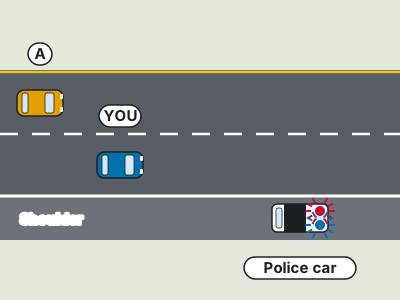
- Slow down or stop as appropriate and move away to leave an empty separating lane when safe
- Maintain speed in the adjacent lane
- Stop beside it with no space between vehicles
- Drive onto the shoulder toward the emergency vehicle
Show answer
Slow down or stop as appropriate and move away to leave an empty separating lane when safe. When approaching a stopped emergency vehicle with flashing lights, Hawaii directs drivers to slow down or stop as the situation requires and move away so an empty traffic lane separates the vehicles when that can be done safely. Maintaining speed ignores the roadside hazard, while stopping alongside or moving toward the responder reduces its protection. Scan early, check the adjacent lane, and create the separation without forcing another road user into danger.
Study this in the handbook: Backing, entering traffic, lanes and parking
6. What does Hawaii's slow moving vehicle emblem look like, and which vehicles must display it?
- A round red sign on all trucks
- A reflective 18 inch triangular emblem on vehicles designed for 25 mph or less
- A blue triangle on tractors only
- A square yellow sign on buses
Show answer
A reflective 18 inch triangular emblem on vehicles designed for 25 mph or less. The slow moving vehicle emblem is a highly reflective 18 inch, or 46 centimeter, triangular emblem required on the rear of vehicles designed to operate at speeds of 25 mph or less. When you see this emblem, the manual says to reduce speed and approach cautiously. A vehicle that slow closes the gap quickly, so begin easing off as soon as the triangle comes into view. The emblem is not a round red sign, a blue tractor marker, or a square yellow bus sign.
Study this in the handbook: Traffic device types, warning, guide and work zone signs
7. When is a driver prohibited from using the left half of the roadway?
- When approaching the top of a hill or traveling on a curve
- Whenever the road has a single lane in each direction
- Only when following a slow vehicle
- Whenever the weather is clear
Show answer
When approaching the top of a hill or traveling on a curve. A hill crest or curve can hide opposing traffic, so the manual prohibits driving on the left half when approaching the top of a hill or while on a curve. The rule is not triggered by every two lane road, by following a slow vehicle, or by clear weather. Visibility and the risk of an unseen vehicle control the restriction. Keep to the right through the blind portion and wait for a lawful passing opportunity with enough sight distance.
Study this in the handbook: Driving on the right and passing laws
8. What should you do if a tire suddenly blows out while driving?
- Accelerate to keep the damaged tire turning quickly
- Brake hard immediately and steer onto the shoulder
- Avoid braking, hold the wheel firmly, reduce speed gradually, then pull off safely
- Turn sharply toward the nearest traffic lane
Show answer
Avoid braking, hold the wheel firmly, reduce speed gradually, then pull off safely. A blowout can make the vehicle pull and can quickly reduce control. Do not apply the brakes at first, because braking may make the vehicle uncontrollable. Grip the steering wheel firmly, keep the vehicle in its lane, reduce speed gradually without braking, and then brake lightly at very low speed before pulling into a safe area. Braking hard immediately is the dangerous choice because it can worsen the loss of control. Acceleration and a sharp turn add forces when the tire is already failing. The cue is a sudden tire collapse or strong pull, followed by steady steering and a controlled exit.
Study this in the handbook: Blowouts, brake failure, skids and fires
9. What do Hawaii's Reduced Speed Ahead signs look like and tell you?
- Yellow diamonds warning of a curve
- Orange work zone signs
- Green guide signs
- The same color and shape as speed limit signs, giving advance notice of a lower limit ahead
Show answer
The same color and shape as speed limit signs, giving advance notice of a lower limit ahead. Hawaii's REDUCED SPEED AHEAD signs are the same color and shape as speed limit signs and give you advance notice to slow your vehicle to a lower speed limit posted ahead. They tell you to begin reducing your speed, and the new speed limit begins at the next speed limit sign. They are not yellow curve warnings, orange work zone signs, or green guide signs. Ease off early so you reach the next sign already at the new limit, because excessive speed for conditions is the major cause of most crashes.
Study this in the handbook: Traffic device types, warning, guide and work zone signs
10. You have a round green light and want to turn left. What is required?
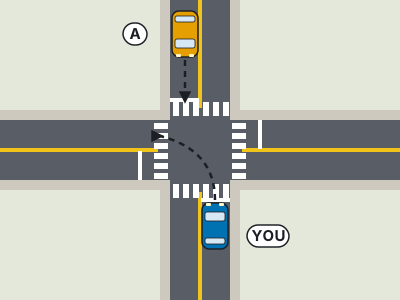
- Turn only after the vehicle behind you honks
- Turn immediately because green always gives a left turn priority
- Wait through the entire green phase for a red signal
- Move into the intersection, yield, and turn when clear
Show answer
Move into the intersection, yield, and turn when clear. A round green light permits movement, but a driver turning left must still yield to pedestrians and vehicles already in the intersection. Move into the intersection only when appropriate, watch the opposing approach, and complete the turn when a safe gap exists. The immediate-turn choice ignores the continuing yield duty. Waiting for red is unnecessary and may leave you blocking the intersection, while a horn from behind is not a traffic-control instruction. Keep the wheels controlled, maintain awareness of crosswalk users, and remember that the signal authorizes movement without removing other road users' priority.
Study this in the handbook: Traffic signals and lane control signals
11. At this sign, where must you stop before proceeding?

- At the stop line, then yield before proceeding
- Only after entering the crosswalk
- Only when another vehicle is visible
- After passing the intersection
Show answer
At the stop line, then yield before proceeding. A STOP sign requires a complete stop at the stop line, followed by yielding to approaching traffic before proceeding. If no stop line exists, the driver stops before a marked or unmarked crosswalk. The sign does not wait for another vehicle to appear, and stopping inside or beyond the intersection defeats the protected stopping point. If the first position does not provide a view, move ahead slowly and stop again where approaching traffic can be seen. Treat the line as the fixed cue for the first full stop.
Study this in the handbook: Sign colors, shapes and regulatory signs
12. How are Hawaii speed limits established for a particular roadway?
- By posted signs on that roadway
- By one identical statewide number
- By the driver's chosen travel speed
- By the vehicle's engine size
Show answer
By posted signs on that roadway. The driver must use the speed limit posted for the particular roadway. Hawaii does not make the driver's preference, engine size, or one universal number the controlling reference in this rule. A sign may establish a maximum, a minimum, or another designated limit, so the driver should actively watch for the applicable posting. The concrete habit is to read the sign before settling into speed, then adjust for conditions while staying within the displayed limit.
Study this in the handbook: Speed rules
13. When this alignment sign appears beside an obstruction, where should the driver go?
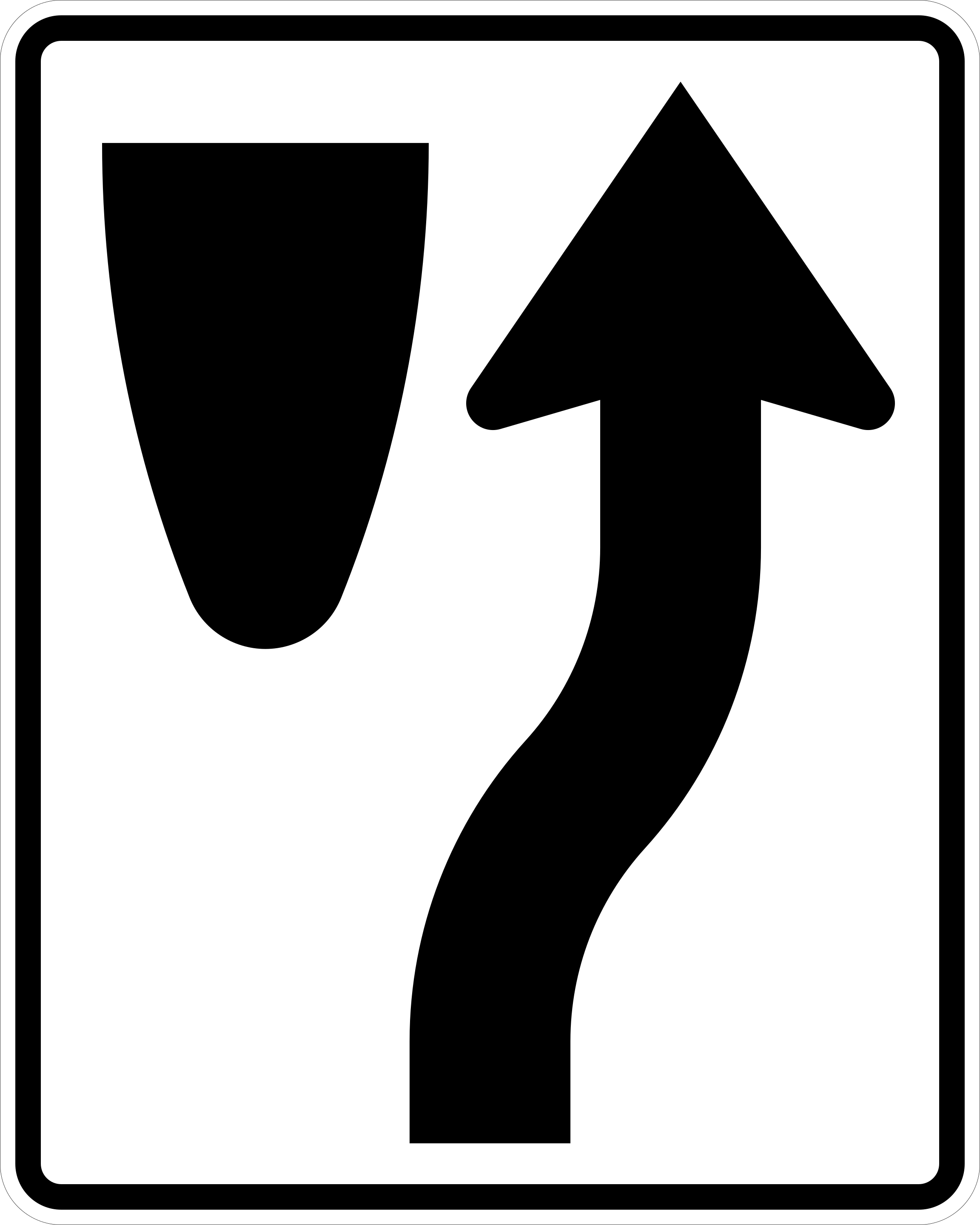
- Into the opposing lane to pass the obstruction quickly
- To the left regardless of the arrow
- To the right as indicated, keeping traffic moving safely
- Across the traffic island separating the lanes
Show answer
To the right as indicated, keeping traffic moving safely. An alignment sign shows where the driver must travel to permit traffic to move safely and smoothly. With the arrow directing traffic right around an obstruction, follow that path. The sign does not authorize crossing into opposing traffic or driving across a traffic island, and the arrow cannot be ignored in favor of a preferred side. Reduce speed, track the pavement markings, and leave room from the obstruction. The visual cue is the arrow’s direction, which controls the path through the narrowed area.
Study this in the handbook: Traffic device types, warning, guide and work zone signs
14. What does the Hawaii manual advise about braking when you make a turn?
- Brake hard in the middle of the turn
- Keep the same speed until the steering wheel is turned
- Cross the centerline to make the turn wider
- Slow down before the turn and avoid braking while turning
Show answer
Slow down before the turn and avoid braking while turning. Hawaii's braking guidance is direct: avoid braking while turning and slow down before you turn. The turns and curves section adds that braking or an abrupt change of speed in a turn or curve can cause you to lose control of the vehicle, and that you should make precise turns without swinging wide. Holding speed until the wheel is already turned leaves the slowing for the worst moment, braking hard mid turn is the exact thing to avoid, and crossing the centerline to widen the turn creates a conflict with oncoming traffic. Finish slowing while the wheels are straight.
15. According to the Hawaii manual, what are yellow centerlines used for?
- Marking the edge of the shoulder
- Marking lanes reserved for bicycles
- Separating lanes of traffic moving in the same direction
- Separating traffic moving in opposite directions
Show answer
Separating traffic moving in opposite directions. Hawaii's pavement marking section says yellow centerlines are used to separate traffic moving in opposite directions. When you see yellow down the middle of the road, expect oncoming vehicles on the other side and keep to the right of it. The manual then explains the variations: a single broken yellow line may be crossed to pass when it is safe, while double solid yellow lines and single solid no passing lines may be crossed only for a left turn into or from an alley, private road or driveway. Shoulder edges and bicycle lanes are not what the yellow centerline marks.
Study this in the handbook: Pavement markings
16. How old must you be before applying for a Hawaii license class that is larger than the class 3 driver's license?
- At least 16
- At least 18
- At least 21
- At least 25
Show answer
At least 21. Hawaii requires other license classes for certain larger vehicles, and the manual says you must be at least 21 years old before applying for any of them. Sixteen is the minimum age for a provisional license, and 18 is the age when the provisional stage no longer applies, so neither opens the larger classes. Twenty five is not a threshold in the manual. Each larger class or endorsement also requires its own special tests.
Study this in the handbook: The provisional license
17. How should speed change when a driver encounters worsening winter road conditions?
- Use high speed and hard braking to test the surface
- Maintain the posted limit regardless of traction
- Increase speed to keep the tires from touching ice
- Drive at a reduced speed and use the clear, dry portions when possible
Show answer
Drive at a reduced speed and use the clear, dry portions when possible. Hawaii's manual notes that winter creates hazards not found in Hawaii and gives suggestions for drivers heading to areas with winter conditions: drive at a reduced speed and use the clear, dry portions of the road wherever possible. A posted limit is a maximum, not a promise that the same pace is safe on a slick surface, and speeding up never adds traction. The manual also says to start out slowly and test the brakes gently once moving, rather than braking hard, and to keep a safe distance from the car ahead while watching for vehicles having trouble on the slippery surface.
Study this in the handbook: Rain, fog and night driving
18. Another vehicle is passing you on a Hawaii road. What does the law say about your speed?
- You must speed up so the pass finishes sooner
- You must match the passing vehicle's speed
- It is unlawful to increase your speed while being passed
- You must stop on the shoulder until it has passed
Show answer
It is unlawful to increase your speed while being passed. Hawaii's no passing rules end with a note that when you are being passed, it is unlawful to increase your speed. Speeding up or matching the other vehicle's speed makes the pass take longer and can leave the passing driver stuck in the opposing lane. Stopping on the shoulder is not required and can create a new hazard. Keep a steady speed and let the other driver complete the pass, and if you are moving more slowly than traffic, the manual says to keep to the right so others can pass you on your left.
Study this in the handbook: Driving on the right and passing laws
19. According to the Hawaii manual, what can failing to stop for a school bus with alternating red lamps flashing cost you?
- $100
- $1,000
- $250
- $5,000
Show answer
$1,000. The manual warns that failing to comply with the school bus stopping law can cost you $1,000. One hundred and 250 dollars understate that figure. Five thousand dollars is the maximum fine for violating the motor vehicle insurance law, not the school bus law. You must stop before reaching the bus and wait until it moves or its flashing red lamps are turned off.
Study this in the handbook: Pedestrian safety
20. According to the Hawaii manual, what should you do with the front wheels when you leave a vehicle unattended on a grade?
- Turn the wheels toward the curb
- Leave the wheels pointed straight ahead
- Leave the engine running with the parking brake set
- Shift into neutral so the car can settle
Show answer
Turn the wheels toward the curb. When you leave a vehicle unattended, the manual says to stop the engine, lock the ignition and remove the key, set the parking brake, and, when the vehicle is on a grade, turn the wheels toward the curb. Leaving the wheels straight skips the grade step the manual lists. Leaving the engine running breaks the rule to stop the engine. Neutral lets the vehicle roll and is not part of the procedure.
Study this in the handbook: Backing, entering traffic, lanes and parking
QualitySpace is expanding to Hawaii
We are a California-based independent insurance brokerage working on licensing in more states. We cannot help with Hawaii insurance yet. Leave your email and we will let you know when we can.
Every question is written from the official Hawaii Driver's Manual. Need paper? Printable HI practice test with answer key.
Last verified 2026-10-05. How we check every question · Study all 216 as flashcards
Frequently asked questions
How many questions are on this Hawaii practice test?
This fixed set has 20 questions. It is test 3 of 10 from the 216 question Hawaii bank. The real HI exam asks 30 questions and you need 24 correct.
What is the passing score for the real Hawaii test?
No more than 6 errors on the 30-question written examination, i.e. 24 of 30 correct (published by Maui County; Honolulu does not publish a passing score) That figure comes from the official Hawaii source cited on the DMV facts page.
How does this fixed test relate to the full Hawaii bank?
Each numbered test is a fixed set of questions in a fixed order, so you can retake the same test later and compare. Every test mixes road signs and the other topics in about the same proportion as the full bank. Tests 1 to 10 together cover 200 of the 216 questions in the Hawaii bank, each once. The full practice page mixes the whole bank at random.
Last verified 2026-10-05. See the Hawaii DMV facts page for sourced state details.