
Test 8 of 10 · 20 questions · Free 2026
HI Permit Practice Test 8
Jump to the test ↓A fixed 20 question set from the Hawaii bank with answers and plain English explanations. The real HI exam is 30 questions, 80 percent to pass; take the full length version on the main practice page.
Question 1 of 20 · 0 right so far
All 20 questions in test 8
Every question below comes from the Hawaii question bank on this page. Open a question to see the correct answer and the explanation. Nothing here is hidden behind a signup.
1. What is the lowest BAC threshold for Hawaii's under-21 alcohol driving rule?
- .10 percent or more
- .08 percent or more
- .02 percent or more
- Only a BAC above .15 percent
Show answer
.02 percent or more. For a driver under 21, Hawaii's Zero Tolerance law prohibits a BAC of .02 percent or more. The adult .08 threshold cannot be substituted because the age condition changes the rule. The .10 and .15 choices set levels even farther above the under 21 standard. Treat .02 as a very low threshold: any measurable drinking that reaches it can create a legal problem for a young driver, so the safe decision is not to drink and drive.
Study this in the handbook: Alcohol, drugs and the law
2. When approaching a roundabout, to whom must an entering driver yield?
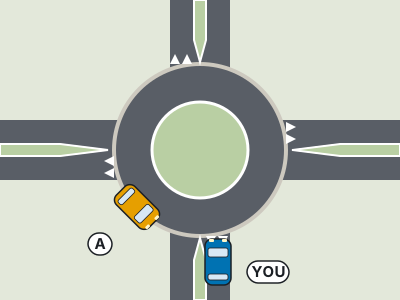
- Only vehicles entering from the left
- Vehicles waiting behind the entry line
- Traffic already circulating in the roundabout
- No one, because entering traffic has priority
Show answer
Traffic already circulating in the roundabout. An entering vehicle must yield to traffic already circulating in the roundabout. The circulating stream has priority, so the approaching driver should slow down, look to the left for traffic, and enter only when there is a safe gap. Yielding to vehicles waiting behind you does not address the conflict inside the circle, and entering traffic never has priority. The left-only option is too narrow, because the manual says to yield to all traffic, including bicyclists, already in the roundabout. Think of it as joining a flow that is already moving.
Study this in the handbook: Right of way and roundabouts
3. How many documents are required to prove principal residence in Hawaii for a REAL ID application?
- One document
- Two documents
- Three documents
- No residence document
Show answer
Two documents. A REAL ID application requires two forms of proof for the principal residence address in Hawaii. Each document must include the applicant's name and the Hawaii residence address. One document is insufficient, while three is more than the stated requirement. The no-document choice overlooks the security requirements. Examples include a current utility bill, telephone bill, bank statement, or medical statement. Before applying, compare the names and address details so both records actually establish the same principal residence.
Study this in the handbook: Documents, tests and renewal
4. When must a trailer towed in Hawaii be equipped with brakes and breakaway protection?
- Only when it weighs more than 10,000 pounds
- When loaded it weighs more than half the towing vehicle's weight or is 3,000 pounds or more
- Only when people ride in it
- Never, if the towing vehicle has good brakes
Show answer
When loaded it weighs more than half the towing vehicle's weight or is 3,000 pounds or more. A loaded trailer that weighs more than half the weight of the towing vehicle, or is 3,000 pounds or more, must have brakes and breakaway protection. Ten thousand pounds is far above the stated threshold. Riding in a house trailer is prohibited, so passengers are not the test for brakes. Good brakes on the towing vehicle do not excuse a heavy trailer from the rule. Every trailer must also have safety chains attached to the towing vehicle's frame.
Study this in the handbook: Trucks, motorcycles, bicycles and school buses
5. When passing a motorcycle, how much lane space should the motorist allow it?
- Only the motorcycle's handlebar width
- Half a lane
- A full lane
- No space if the motorist signals
Show answer
A full lane. The manual says to allow a full lane to the motorcycle when passing and never to crowd into the same lane as the cycle. Handlebar width or half a lane means sharing the lane, which the manual rules out. A turn signal communicates intent but does not replace clearance. Complete the pass only when there is enough room, then return to the original lane after the motorcycle is safely clear rather than cutting back early, because returning too soon can force a rider to swerve.
Study this in the handbook: Trucks, motorcycles, bicycles and school buses
6. What driving examination must a Hawaii applicant pass before receiving a provisional license?
- A passenger-management interview
- Only the rules of the road test
- A vehicle-maintenance examination
- A road test
Show answer
A road test. The graduated licensing list specifically requires the applicant to pass a road test before the provisional license is issued. The rules test is part of the earlier preliminary examinations, but naming it alone leaves out the practical evaluation needed at this stage. Vehicle maintenance and passenger interviews are not the listed gateway. Prepare for the road test as a demonstration of actual control and traffic handling, then keep that requirement distinct from the written knowledge work completed for the instruction permit.
Study this in the handbook: The instruction permit
7. Between 11:00 p.m. and 5:00 a.m., whom must a Hawaii instruction permit holder have as the accompanying driver?
- A parent or guardian
- Any licensed passenger at least 21
- A coworker with a valid permit
- No accompanying driver when the trip is for school
Show answer
A parent or guardian. The nighttime condition is narrower than the ordinary permit rule. Between 11:00 p.m. and 5:00 a.m., the accompanying person must be the permit holder’s parent or guardian. Being at least 21 and licensed is not sufficient by itself during those hours, so the general-supervisor choice is too broad. A coworker with only a permit cannot qualify, and a school trip does not erase the nighttime condition. Treat the clock as a separate checkpoint: if the drive falls inside that window, verify the parent or guardian relationship before departure.
Study this in the handbook: The instruction permit
8. What must a driver do when a pedestrian is caught in an intersection as the signal changes?
- Stop only if the pedestrian is in a marked lane
- Continue because the light changed
- Sound the horn and drive around the pedestrian
- Yield until the pedestrian has cleared the intersection
Show answer
Yield until the pedestrian has cleared the intersection. A changing signal does not erase the pedestrian's need to finish crossing. The driver must yield and wait until the person has cleared the intersection. Proceeding solely because the light changed creates a conflict, and a horn is not a substitute for yielding. The marked lane limitation is also too narrow because the protection concerns a pedestrian already in the intersection. Look beyond the signal head before moving, especially when a crossing began during the prior phase.
Study this in the handbook: Pedestrian safety
9. Which Hawaii agency is identified with the State Driver's Manual and Motor Vehicle Safety Office?
- The State of Hawaii Department of Transportation
- The Honolulu Police Department
- The Federal Motor Carrier Safety Administration
- The Hawaii Department of Education
Show answer
The State of Hawaii Department of Transportation. The publication identifies the State of Hawaii Department of Transportation and its Motor Vehicle Safety Office as the responsible state agency. The Honolulu Police Department is a local law enforcement agency, while the Federal Motor Carrier Safety Administration and Department of Education have different responsibilities. Knowing the issuing agency helps distinguish the state driver's licensing guidance from commercial federal rules or school programs. For official updates, use the transportation department resources listed in the manual.
10. A new vehicle is inspected on the date it is first sold in Hawaii. When is its next safety inspection due?
- Six months after that initial inspection
- One year after that initial inspection
- Five years after that initial inspection
- Two years after that initial inspection
Show answer
Two years after that initial inspection. New vehicles do not need to be inspected again until two years after their initial inspection on the date they are first sold. Six months is the inspection interval for ambulances. One year is the normal interval for other vehicles once the new vehicle period is over. Five years is not a figure in the manual. After the first two years, the yearly inspection rule applies.
Study this in the handbook: Vehicle equipment, inspection and registration
11. On an open road with two lanes in your direction and free-flowing traffic, which lane should you normally use?
- The left lane, regardless of speed
- The right lane, using the left lane for passing or entering traffic
- Either lane while continually changing lanes
- The shoulder whenever the right lane is occupied
Show answer
The right lane, using the left lane for passing or entering traffic. With two lanes traveling in the same direction on an open road, the manual directs a driver to use the right lane when traffic is free flowing. The left lane is available for passing or for vehicles entering from the right. Choosing the left lane regardless of speed ignores that division of use. Continual lane changes create conflicts, and the shoulder is not a substitute travel lane. Keep a steady pace in the right lane, move left for a specific passing or merging reason, and return when the maneuver is complete.
Study this in the handbook: Backing, entering traffic, lanes and parking
12. How do drivers under 20 compare in Hawaii's crash statistics?
- They have the fewest crashes
- They have about twice as many crashes as expected for their number of drivers
- They crash at the same rate as everyone
- They crash half as often
Show answer
They have about twice as many crashes as expected for their number of drivers. Hawaii's crash statistics show that the youngest drivers, under age 20, have about twice as many crashes as would be expected for the number of drivers in that group. As driver age increases, crashes keep falling until about 50 to 54, the group with the fewest crashes, and starting at age 55 crashes occur more frequently again. So drivers under 20 neither have the fewest crashes nor match everyone else, and they certainly do not crash half as often. For a new driver, the figure is a reason to treat every trip with extra care while experience builds.
Study this in the handbook: Attitude, age and distraction
13. A driver has stopped at a red light in Hawaii and is making a right turn that no sign prohibits. Whom must the driver yield to?
- Only vehicles approaching from the left
- Only pedestrians in a marked crosswalk
- All pedestrians and all vehicles
- No one, once the vehicle has fully stopped
Show answer
All pedestrians and all vehicles. Hawaii allows a right turn on red after stopping unless a sign prohibits it, and the manual adds that the driver must yield to all pedestrians and all vehicles when making that turn. Yielding only to traffic from the left misses pedestrians and other vehicles, and limiting the duty to a marked crosswalk ignores people crossing elsewhere in the turn path. Coming to a full stop is required, but it does not give the driver priority over anyone. Stop first, scan the crosswalk and every approaching lane, and turn only once all of them are clear.
Study this in the handbook: Traffic signals and lane control signals
14. At a stop sign with no stop line, where must the driver stop first?
- Before crossing any marked or unmarked crosswalk
- With the front bumper in the intersection
- After passing the nearest crosswalk
- Only when another vehicle is approaching
Show answer
Before crossing any marked or unmarked crosswalk. A stop sign requires a complete stop, and the first stopping point is the stop line when one is present. If no line exists, stop before entering a marked or unmarked crosswalk. The vehicle may need to move ahead slowly for a second stop when the first position blocks the view, but it must not begin by entering the intersection. Waiting only for visible traffic also misses the sign's independent command.
Study this in the handbook: Speed rules
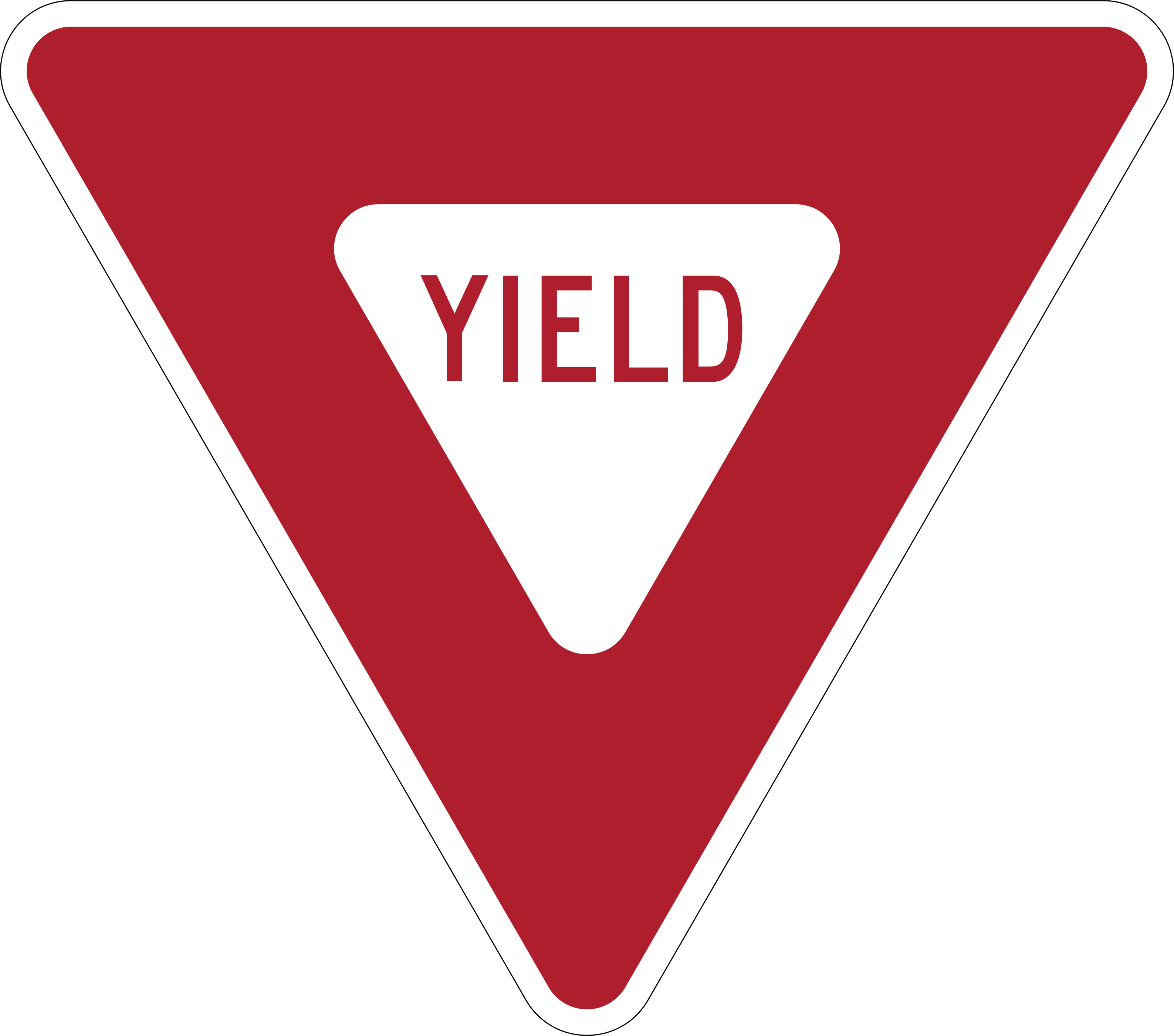
15. What should a driver do when approaching this YIELD sign?
- Ignore pedestrians if no vehicle is approaching
- Make a complete stop every time, even when the road is empty
- Accelerate to enter before all other traffic
- Be ready to stop and stop if right-of-way traffic is present
Show answer
Be ready to stop and stop if right-of-way traffic is present. A YIELD sign means other traffic has the right-of-way, so the driver must approach prepared to stop. A complete stop is needed when traffic with priority is present, but the manual does not require stopping in every empty-road situation. Accelerating into a gap can cut off traffic, and pedestrians are part of the road users who must be considered. Reduce speed early, scan the approach, and stop if necessary. The key cue is readiness: yield control belongs to the traffic already entitled to proceed.
Study this in the handbook: Speed rules
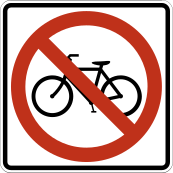
16. What does this sign with a red circle and slash over a bicycle mean?
- Bicycles may use the full lane here
- A bicycle lane begins ahead
- Bicycles are prohibited on this roadway
- Watch for bicyclists crossing ahead
Show answer
Bicycles are prohibited on this roadway. Hawaii's manual pictures this NO BICYCLES sign among the exclusion signs, which contain a red circle on a white background or a red circle with a red diagonal. Exclusion signs restrict or prohibit vehicles, vehicle movements, or some other activity, so bicycles may not use the roadway this sign controls. It does not give bicycles the full lane or announce a bicycle lane, and it is not a crossing warning, because the manual says warning signs are usually diamond shaped with a yellow background. Read a red circle and slash as a prohibition, then identify what is crossed out.
Study this in the handbook: Traffic device types, warning, guide and work zone signs
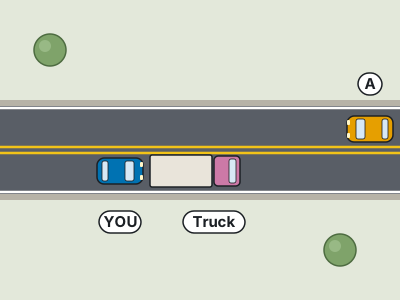
17. What do double solid yellow centerlines generally mean?
- Passing is required in both directions
- Passing is prohibited in both directions
- Only trucks may cross them
- They separate lanes traveling the same direction
Show answer
Passing is prohibited in both directions. Double solid yellow lines mark the center of a roadway where passing is prohibited in both directions. They are not same-direction lane dividers, and they do not create a special passing privilege for trucks. The restriction still allows a narrowly defined crossing for a left turn into or from an alley, private road, or driveway. Read the centerline before attempting a maneuver, and distinguish a permitted turn crossing from an unlawful pass.
Study this in the handbook: Pavement markings
18. If a fire starts in your vehicle, what should you do first?
- Drive to a safe area, stop, switch off the ignition, and get everyone away
- Open the hood immediately and pour water onto the engine
- Keep driving until the fuel tank is empty
- Leave everyone inside while you search the trunk for tools
Show answer
Drive to a safe area, stop, switch off the ignition, and get everyone away. A vehicle fire calls for distance from traffic and from poisonous smoke. Move to a safe area, stop, turn off the ignition and electrical switches, then get every occupant out and away from the vehicle. Opening the hood to pour water is not in the procedure, and the manual says not to use water for gasoline, oil or electrical fires. Continuing to drive increases exposure and can worsen the danger. Leaving passengers inside while gathering equipment ignores the manual's priority of evacuation. If a fire is large, seek assistance rather than attempting to extinguish it yourself.
Study this in the handbook: Blowouts, brake failure, skids and fires
19. Which speed principle applies even when no reduced speed sign is posted?
- Choose a safe speed based on the area, road, traffic, pedestrians, weather, and light
- Drive faster whenever the road is empty
- Always drive exactly at the posted maximum
- Use the same speed in daylight and darkness
Show answer
Choose a safe speed based on the area, road, traffic, pedestrians, weather, and light. Hawaii's basic speed rule requires a safe, appropriate speed for the setting and conditions. The posted maximum is an upper limit, not a target that overrides rain, darkness, pedestrians, traffic, or a difficult road surface. The choice “Drive faster whenever the road is empty” mistakes an empty roadway for permission to disregard conditions, and the choice “Always drive exactly at the posted maximum” treats the sign as a required speed. Before relying on the limit, scan the environment and adjust your pace so the vehicle remains controllable and stopping space remains available.
Study this in the handbook: Speed rules
20. What do crosswalk lines show, and what must drivers do for pedestrians there?
- They warn pedestrians to yield to every vehicle
- They mark a passing area where cars have priority
- They identify a parking space when no sign is present
- They show where pedestrians may safely cross, and drivers must stop for them
Show answer
They show where pedestrians may safely cross, and drivers must stop for them. Crosswalk lines show pedestrians where to safely cross and supplement signs warning drivers that pedestrians may be present. Hawaii's manual states that drivers must stop for pedestrians in crosswalks. The passing, parking, and universal pedestrian-yield choices reverse or misstate that protective function. Slow as you approach a marked crossing, search both sides for people, and be prepared to stop before the crosswalk. The painted lines are not permission to continue through; they identify a place where the driver's attention and yielding duty increase.
Study this in the handbook: Pedestrian safety
QualitySpace is expanding to Hawaii
We are a California-based independent insurance brokerage working on licensing in more states. We cannot help with Hawaii insurance yet. Leave your email and we will let you know when we can.
Every question is written from the official Hawaii Driver's Manual. Need paper? Printable HI practice test with answer key.
Last verified 2026-10-05. How we check every question · Study all 216 as flashcards
Frequently asked questions
How many questions are on this Hawaii practice test?
This fixed set has 20 questions. It is test 8 of 10 from the 216 question Hawaii bank. The real HI exam asks 30 questions and you need 24 correct.
What is the passing score for the real Hawaii test?
No more than 6 errors on the 30-question written examination, i.e. 24 of 30 correct (published by Maui County; Honolulu does not publish a passing score) That figure comes from the official Hawaii source cited on the DMV facts page.
How does this fixed test relate to the full Hawaii bank?
Each numbered test is a fixed set of questions in a fixed order, so you can retake the same test later and compare. Every test mixes road signs and the other topics in about the same proportion as the full bank. Tests 1 to 10 together cover 200 of the 216 questions in the Hawaii bank, each once. The full practice page mixes the whole bank at random.
Last verified 2026-10-05. See the Hawaii DMV facts page for sourced state details.