
Test 5 of 10 · 20 questions · Free 2026
HI Permit Practice Test 5
Jump to the test ↓A fixed 20 question set from the Hawaii bank with answers and plain English explanations. The real HI exam is 30 questions, 80 percent to pass; take the full length version on the main practice page.
Question 1 of 20 · 0 right so far
All 20 questions in test 5
Every question below comes from the Hawaii question bank on this page. Open a question to see the correct answer and the explanation. Nothing here is hidden behind a signup.
1. What license must a Hawaii driver under age 18 operate on before becoming eligible for a class 3 driver’s license?
- A provisional license
- A full class 3 license
- A commercial driver’s license
- A motorcycle license
Show answer
A provisional license. A Hawaii driver under 18 must operate on a provisional license for at least six months before becoming eligible for a class 3 driver’s license. A full class 3 license is the later goal, not the document used during this part of the program. A commercial or motorcycle license concerns different vehicle categories and does not satisfy the under-18 progression described here. The key cue is the age qualifier: under 18 triggers the provisional stage, and the six-month period must be completed before the class 3 step.
Study this in the handbook: The instruction permit
2. What must a Hawaii instruction-permit applicant pass among the preliminary examinations?
- A written test on vehicle repairs and a parking-lot inspection
- Only a road test
- A vision screening test and a rules of the road test
- A medical test and a passenger-limit test
Show answer
A vision screening test and a rules of the road test. For an instruction permit, the graduated licensing list calls for a vision screening test and a rules of the road test. A road test belongs to a later practical milestone, so selecting it alone skips the preliminary permit examinations. Vehicle repair, parking inspection, medical testing, and passenger-limit testing are not the pair named in this section. The useful study cue is to prepare for both seeing and knowing before supervised driving begins: the permit stage tests visual readiness and road-rule understanding.
Study this in the handbook: The instruction permit
3. What action is prohibited by the red-circle sign shown here?
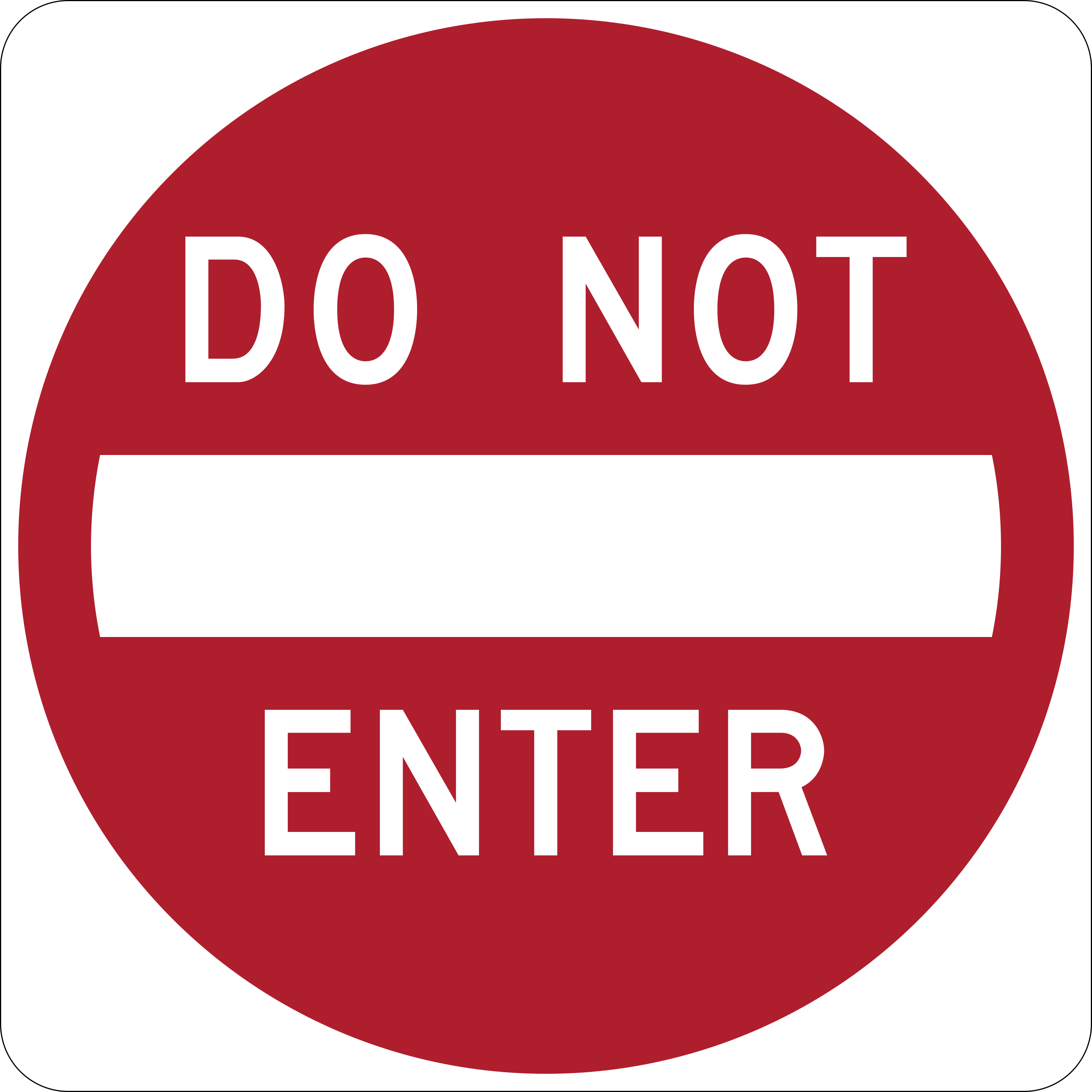
- Turning toward a marked public parking area
- Parking only during daylight hours
- Driving through a school zone at low speed
- Entering the restricted roadway or movement
Show answer
Entering the restricted roadway or movement. Hawaii classifies red-circle exclusion signs as signs that restrict or prohibit vehicles, vehicle movements, or some other activity. The DO NOT ENTER sign pictured in the manual among these exclusion signs therefore bars entry into the roadway it faces. It is not a parking-hours notice, a school-zone instruction, or a direction toward public parking. The immediate driving cue is the red circle and the words: do not drive past the sign into that roadway. Find a lawful route instead of treating the sign as a suggestion to proceed slowly.
Study this in the handbook: Traffic device types, warning, guide and work zone signs
4. Since what year have all vehicles been equipped with electric turn, stop and hazard signals, according to the Hawaii manual?
- 1950
- 1980
- 2000
- 1968
Show answer
1968. Electric stop signals have been standard for more than 50 years, most vehicles built since the early 1950s have electric turn signals, and since 1968 all vehicles have been equipped with electric turn, stop and hazard warning four way flash signals. Stop lamps operate automatically with the service brake, and all these signals must be kept in working order, with hand signals used only if they fail.
Study this in the handbook: Turn signals and railroad crossings
5. Hawaii's no passing rules include a school bus. When does that rule forbid passing it?
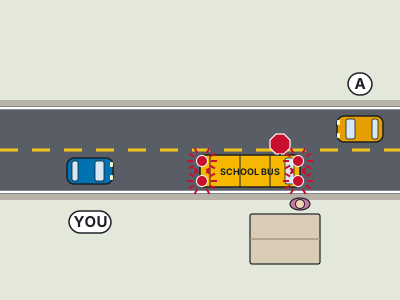
- Only inside a posted school zone
- Only when a child is visible near the bus
- When the bus is on the same roadway with its flashing lights operating
- Only when the bus is in the lane directly ahead of you
Show answer
When the bus is on the same roadway with its flashing lights operating. Hawaii's no passing rules list a school bus on the same roadway with its flashing lights operating as a situation where you must not pass. The trigger is the bus and its operating lights, not a posted school zone or whether you can see a child. When the bus is stopped with alternating red lamps flashing, the manual's school bus law also requires drivers in the lane occupied by the bus and in all adjacent lanes to stop before reaching it, and to wait until the bus resumes motion or the red lamps are turned off.
Study this in the handbook: Trucks, motorcycles, bicycles and school buses
6. How should a Hawaii driver determine the speed limit when traveling on a road with posted signs?
- Use 35 mph unless a police officer gives a different instruction
- Follow the posted maximum and minimum limits, while adjusting for conditions
- Choose any speed that matches the fastest nearby vehicle
- Use the speed printed on the vehicle registration card
Show answer
Follow the posted maximum and minimum limits, while adjusting for conditions. Hawaii treats posted signs as the source of maximum and minimum speed limits, but the driver still has to select a safe speed for traffic, weather, light, pedestrians, and the road itself. A posted maximum is not a command to drive that fast when conditions call for less. The choice about matching the fastest nearby vehicle is unsafe because surrounding traffic cannot replace the legal sign or the prudent-speed rule. Read the sign, scan the conditions, and slow further near schools, playgrounds, or marked school crossings when children are present.
Study this in the handbook: Speed rules
7. When does Hawaii's manual say to replace tires?
- When tread is under 1/2 inch
- Every two years regardless
- When tread is less than 1/16 inch
- Only after a blowout
Show answer
When tread is less than 1/16 inch. Replace tires that have less than 1/16 inch of tread, and check that the vehicle does not pull to either side under braking; a simple brake test is to apply the brakes rather hard at 4 to 8 mph in a safe place. Proper inflation extends tire life and improves handling, and the manual says good tread depth helps prevent hydroplaning, which can begin at 35 mph, because worn or bald tires hydroplane at lower speeds.
Study this in the handbook: Vehicle equipment, inspection and registration
8. A person is convicted of drunk driving while unlicensed. For how long can that person not be licensed in Hawaii?
- Six months after the conviction
- Two years after the conviction
- One year after the conviction
- Four years after the conviction
Show answer
Two years after the conviction. Hawaii lists drunk driving while unlicensed among the reasons a person cannot be licensed, and the bar lasts for a period of two years after the conviction. Six months and one year are shorter than the stated period. Four years is longer than the period the manual sets. The rule means an unlicensed drunk driver cannot simply apply for a license right after the case ends.
9. Which of these situations prevents a person from being licensed to drive in Hawaii?
- Having a vehicle registered in a different county
- Having held an instruction permit for 180 days
- Needing corrective lenses to drive
- Having outstanding traffic citations
Show answer
Having outstanding traffic citations. The manual's list of who cannot be licensed includes anyone who has outstanding traffic citations, so unpaid or unresolved tickets must be cleared first. Where a vehicle is registered is a registration matter and is not on that list. Holding an instruction permit for 180 days is a requirement a young applicant must meet, not a reason for refusal. Needing corrective lenses is handled as a restriction printed on the license, not a bar to licensing.
10. Hawaii prohibits driving on the left half of the roadway when you are within what distance of an intersection or railroad crossing?
- 50 feet
- 100 feet
- 200 feet
- 500 feet
Show answer
100 feet. You must not drive on the left half of the roadway when approaching within 100 feet of, or passing through, an intersection or railroad crossing. The same 100 foot distance applies near a bridge or tunnel when you cannot see oncoming vehicles. Fifty feet is too short, while 200 and 500 feet are not the distances the manual gives. Cross traffic and trains can appear suddenly at these places, so passing there is dangerous.
Study this in the handbook: Driving on the right and passing laws
11. Which headlights should a driver use when driving in fog?
- Low beam headlamps
- High beam headlamps
- Parking lamps only
- No lights until the fog clears
Show answer
Low beam headlamps. Fog reflects high beam light back toward the driver and can also reduce the approaching driver's ability to see. For that reason, the manual directs a driver who must continue in fog to sharply reduce speed and use low beam headlamps. High beams make the visual problem worse, while parking lamps alone or no lights do not provide the required illumination and visibility. If sight distance becomes extremely short, the safer response is to leave the pavement completely and stop with hazard signals on.
Study this in the handbook: Rain, fog and night driving
12. What does this rectangular DO NOT PASS sign require on a two or three lane road?
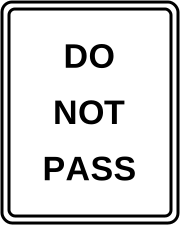
- Pass only on the right shoulder
- Pass only when no oncoming vehicle is in sight
- Do not pass another vehicle where the sign is posted
- Pass only vehicles moving below the speed limit
Show answer
Do not pass another vehicle where the sign is posted. Hawaii describes DO NOT PASS signs as rectangular signs marking locations where you must not pass on two or three lane roads, and the manual states in capitals that you must not pass another vehicle where these signs are posted. An empty oncoming lane does not create an exception, a slow vehicle ahead does not either, and the shoulder is not a passing lane, because you may not drive off the pavement to pass. Stay behind the vehicle ahead; the manual says a PASS WITH CARE sign marks the end of a no passing zone.
Study this in the handbook: Traffic device types, warning, guide and work zone signs
13. Which category of traffic device tells a driver that an action is required and failure may bring a penalty?
- Decorative roadside markers
- Warning devices
- Guide and information signs
- Regulatory devices
Show answer
Regulatory devices. Regulatory devices establish commands or restrictions, such as stopping, traveling in a direction, or limiting speed. Ignoring one can bring a penalty because the device requires action. Warning devices describe hazards, while guide and information signs help with navigation or trip information. Decorative markers have no role in the manual's three categories. On a test question, look for the phrase action required: that points to the regulatory category rather than a caution or destination message.
Study this in the handbook: Traffic device types, warning, guide and work zone signs
14. If an emergency vehicle is directly behind you in heavy traffic, what should you do?
- Stop immediately in the lane
- Keep moving slowly until you can get out of the way
- Race ahead of the emergency vehicle
- Turn around and follow it
Show answer
Keep moving slowly until you can get out of the way. Heavy traffic may prevent an immediate move to the side. In that setting, Hawaii instructs the driver to keep moving slowly until an opening allows the vehicle to leave the emergency vehicle's path. Stopping immediately in the lane can trap the responder behind you, while racing or turning around creates additional hazards. Keep scanning for a safe escape space, signal your movement when useful, and clear the route without abrupt braking or a risky maneuver.
Study this in the handbook: Emergency vehicles
15. How far before a turn or lane change must a driver generally signal?
- Only after beginning the maneuver
- At least 10 feet
- At least 100 feet
- Only when another vehicle is nearby
Show answer
At least 100 feet. Hawaii requires a turn signal for at least 100 feet before every turn or lane change. Signaling after the maneuver begins gives other road users too little time to understand the plan, and waiting for another vehicle is not the rule. The signal communicates intent but does not grant the right to move, so the driver must still check and yield as needed. Activate it early, maintain it through the maneuver, and confirm the path is clear before changing direction.
Study this in the handbook: Turn signals and railroad crossings
16. The vehicle ahead of you has stopped to let a pedestrian cross the street. What does Hawaii law say?
- Do not pass the stopped vehicle
- Pass on the left if the lane is clear
- Pass slowly while sounding your horn
- Pass on the right if the pedestrian is on the left side
Show answer
Do not pass the stopped vehicle. The manual lists passing a vehicle stopped to allow a pedestrian to cross as prohibited by law. The rule covers passing on either side of the stopped vehicle, so neither the left nor the right side is an exception. A clear adjacent lane does not create an exception, and sounding the horn does not make passing lawful. Stop and wait until the pedestrian has finished crossing.
Study this in the handbook: Pedestrian safety
17. What does a Hawaii Pass With Care sign look like, and what does it mark?
- A yellow pennant marking the start of a no passing zone
- A rectangular black and white sign marking the end of a no passing zone
- A red circle with a slash
- A green guide sign
Show answer
A rectangular black and white sign marking the end of a no passing zone. Hawaii's manual describes PASS WITH CARE signs as rectangular black and white signs that indicate the end of a no passing zone. The yellow pennant on the left side of the road is the NO PASSING ZONE sign, and it points to the beginning of the zone instead. A red circle with a slash is an exclusion sign, and green belongs to guide and information signs. The end of a no passing zone does not mean it is safe to pass; the manual says it means there is increased visibility ahead, so still confirm a clear, safe gap before moving left.
Study this in the handbook: Traffic device types, warning, guide and work zone signs
18. What should a driver do if a vehicle cannot keep up with traffic?
- Stop immediately in the lane
- Stay in the left lane to make others pass on the shoulder
- Increase speed beyond the posted limit
- Move as far to the right as possible
Show answer
Move as far to the right as possible. A driver who cannot keep up with traffic should move as far to the right as possible. This reduces conflicts with faster vehicles and gives other traffic a clearer path around the slower vehicle. Remaining in the left lane makes passing harder, while speeding beyond the posted limit creates a new hazard and violates the speed control. Stopping in the travel lane is dangerous unless an emergency requires it. Watch the flow behind you, maintain a safe speed for the conditions, and use the right side to minimize interference when your vehicle is slower.
Study this in the handbook: Following distance, turns and freeways
19. What is the smallest following interval the Hawaii manual says you should ever have behind the vehicle ahead?
- Two seconds
- One second
- Half a second
- One car length at any speed
Show answer
Two seconds. To check your interval, note when the vehicle ahead passes a marker and count one thousand one, one thousand two. If you reach two before your vehicle reaches the marker, you have at least a two second interval, and the manual says you should never have less. One second and half a second are shorter than that minimum. A fixed car length is not the measure the manual uses; it counts seconds past a marker.
Study this in the handbook: Following distance, turns and freeways
20. At a stop sign leading onto a protected route, what must the driver do?
- Stop and yield to all traffic on the protected route
- Proceed without stopping if the route looks clear
- Yield only to vehicles approaching from the left
- Enter first if you signal before the stop line
Show answer
Stop and yield to all traffic on the protected route. In Hawaii's right of way diagrams, a driver facing a stop sign where the road meets a protected route must stop and then yield to all traffic on that protected route. The stop is required even when the route looks clear, and yielding only to vehicles from the left ignores traffic coming from the other direction. Signaling before the stop line does not create priority or replace the stop. Come to a complete stop at the line, check both directions, and enter or cross only when the gap is safe, because traffic already on the protected route goes first.
Study this in the handbook: Right of way and roundabouts
QualitySpace is expanding to Hawaii
We are a California-based independent insurance brokerage working on licensing in more states. We cannot help with Hawaii insurance yet. Leave your email and we will let you know when we can.
Every question is written from the official Hawaii Driver's Manual. Need paper? Printable HI practice test with answer key.
Last verified 2026-10-05. How we check every question · Study all 216 as flashcards
Frequently asked questions
How many questions are on this Hawaii practice test?
This fixed set has 20 questions. It is test 5 of 10 from the 216 question Hawaii bank. The real HI exam asks 30 questions and you need 24 correct.
What is the passing score for the real Hawaii test?
No more than 6 errors on the 30-question written examination, i.e. 24 of 30 correct (published by Maui County; Honolulu does not publish a passing score) That figure comes from the official Hawaii source cited on the DMV facts page.
How does this fixed test relate to the full Hawaii bank?
Each numbered test is a fixed set of questions in a fixed order, so you can retake the same test later and compare. Every test mixes road signs and the other topics in about the same proportion as the full bank. Tests 1 to 10 together cover 200 of the 216 questions in the Hawaii bank, each once. The full practice page mixes the whole bank at random.
Last verified 2026-10-05. See the Hawaii DMV facts page for sourced state details.