
Test 10 of 10 · 20 questions · Free 2026
HI Permit Practice Test 10
Jump to the test ↓A fixed 20 question set from the Hawaii bank with answers and plain English explanations. The real HI exam is 30 questions, 80 percent to pass; take the full length version on the main practice page.
Question 1 of 20 · 0 right so far
All 20 questions in test 10
Every question below comes from the Hawaii question bank on this page. Open a question to see the correct answer and the explanation. Nothing here is hidden behind a signup.
1. At what age may a person first obtain a Hawaii instruction permit?
- 15 1/2 years
- 14 years
- 18 years
- 19 years
Show answer
15 1/2 years. Hawaii sets the starting point for an instruction permit at 15 1/2 years. That is younger than the 16 year minimum for a provisional license and the 17 year minimum for a regular class 3 license. A 14 year old therefore cannot qualify yet, while 18 or 19 describes an age well after the permit stage opens rather than the minimum. Picture the permit as the supervised entry step: age 15 1/2 opens eligibility, but it does not allow unsupervised driving.
Study this in the handbook: The instruction permit
2. Which tests does the Hawaii manual list for a person applying for a driver's license or instruction permit?
- A medical examination, a parking test and a county interview
- Only a written rules test and a vehicle registration check
- Vision, rules of the road and practical road performance tests
- A highway-speed test, a fuel-economy test and a vision waiver
Show answer
Vision, rules of the road and practical road performance tests. The manual lists three tests given when a person applies for a driver's license or instruction permit, as required: a vision test, a knowledge test about rules of the road and traffic control devices, and a practical road test. The choice that substitutes a registration check leaves out both the vision requirement and the driving evaluation. The knowledge and road tests may be waived for some applicants, such as holders of a valid license from another state, but that exception never turns the process into a medical exam or interview. Separate what you see, what you know, and what you demonstrate.
Study this in the handbook: The provisional license
3. What do black and white traffic signs indicate in Hawaii?
- A guide to scenic areas
- A recreational destination
- A warning of road work
- A required action
Show answer
A required action. The manual uses black and white signs to communicate a required action, and it describes those signs as rectangular. They are not the color code for road work, which is orange, or for guide and information signs, which commonly use green, blue, or brown. A driver should read the wording and obey the action rather than treating the sign as optional information. Color and shape together provide a quick recognition cue before the text can be read fully.
Study this in the handbook: Sign colors, shapes and regulatory signs
4. What factors increase the extent of hydroplaning?
- Only the vehicle's engine size
- Lower speed and dry pavement
- Higher speed and more water on the highway
- Only the color of the roadway
Show answer
Higher speed and more water on the highway. Hydroplaning becomes more extensive as vehicle speed rises and as the amount of water on the highway increases. Dry pavement and slower travel reduce those two contributing conditions, while engine size and pavement color have no role in the manual's explanation. The danger is loss of tire contact, which can remove braking, acceleration, and steering control. Slow before entering deeper water, maintain good tread and inflation, and treat standing water as a reason to reduce speed rather than a surface to cross quickly.
Study this in the handbook: Rain, fog and night driving
5. What is the purpose of a two-way left turn channelization lane?
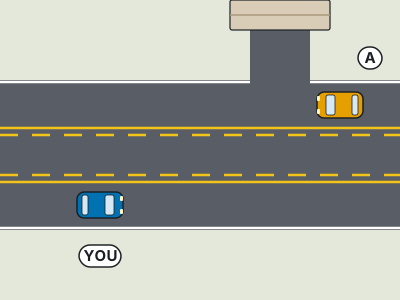
- It is reserved for emergency vehicles
- It is a shared lane for passing in either direction
- It is a stopping lane for loading passengers
- It is for left turns only, not passing
Show answer
It is for left turns only, not passing. The center lane formed by a solid and dashed yellow combination may be used by vehicles traveling either direction for left turn maneuvers only. It must never be used for passing. The shared passing choice confuses two-way access with permission to overtake. Loading passengers or reserving the lane for emergency vehicles is not the marking's function. Enter the lane only when preparing for a left turn, keep alert for opposing users, and leave it promptly after the turn. The paired yellow markings in the roadway are the cue to think turn channel, not passing lane.
Study this in the handbook: Pedestrian safety
6. What is the safest initial response when your vehicle begins to skid?
- Make a large, sudden turn away from the skid
- Stop or reduce the action that caused the control problem
- Press the accelerator harder to force the tires straight
- Lock the brakes until the vehicle stops rotating
Show answer
Stop or reduce the action that caused the control problem. A skid means the tires have lost some of their ability to guide the vehicle. The first response is smooth and measured: stop or reduce whatever you were doing when control began to fail. If braking caused the slide, release the brakes; if acceleration contributed, ease off the accelerator. A large steering movement can create an opposite skid, and more power does not restore traction. Locking the brakes removes steering control. Keep the wheel movement firm but gentle, steer into the direction of the rear skid, and return the wheel toward straight ahead as control returns.
Study this in the handbook: Blowouts, brake failure, skids and fires
7. If your vehicle starts to skid, which steering response does the Hawaii manual recommend?
- Turn the wheel in the direction the rear is skidding and avoid a large sudden turn
- Brake hard and turn sharply away from the skid
- Accelerate to force the tires straight
- Close your eyes until the vehicle stops
Show answer
Turn the wheel in the direction the rear is skidding and avoid a large sudden turn. During a skid, Hawaii advises easing off the accelerator, avoiding the brakes, and turning the steering wheel in the direction the rear of the vehicle is skidding. The movement should be firm but not a large sudden turn. Hard braking and a sharp opposite correction can intensify the loss of control, while acceleration adds the force that helped create the problem. Once the skid stops, guide the wheel back toward straight ahead and make small corrections until control returns.
Study this in the handbook: Blowouts, brake failure, skids and fires
8. Why might downshifting fail to help at high speed in an automatic transmission vehicle, according to the Hawaii manual?
- At 60 mph and above most automatic transmissions will not downshift until speed is reduced
- Downshifting is illegal
- Automatics have no lower gears
- The engine will stall
Show answer
At 60 mph and above most automatic transmissions will not downshift until speed is reduced. An automatic transmission can usually be downshifted at normal speeds by moving the selector to the next lower position, but the manual says that at high speeds of 60 miles per hour and above most automatic transmissions will not downshift. In that case you must first reduce the vehicle speed so the transmission can make the downshift. Downshifting is not illegal and automatics do have lower gears. The manual also warns that routine downshifting is not recommended because it slows the vehicle with no stop lamp warning to drivers behind, so use it only to supplement the brakes.
Study this in the handbook: Backing, entering traffic, lanes and parking
9. A Hawaii driver refuses a requested alcohol test. Can the driver still be charged with driving under the influence?
- No, refusing the test ends any DUI charge
- Yes, the driver may still be charged with driving under the influence
- Only if a second officer saw the driving
- Only if the driver is under 21
Show answer
Yes, the driver may still be charged with driving under the influence. The manual says a driver may be charged with driving under the influence of alcohol even though he refuses the test. Refusal therefore does not end the case; it adds the risk of losing the license through administrative revocation, since a refusal leads to the license being taken away with a 30 day temporary permit. No second witness is required. The rule is not limited to drivers under 21. The test can also help, because it can prove that you are not under the influence.
Study this in the handbook: Alcohol, drugs and the law
10. After you drive through water, what does the Hawaii manual tell you to do with your brakes?
- Test them, and if braking is reduced, apply them lightly several times
- Press them hard until the wheels lock to dry them
- Avoid using them until they dry on their own
- Drive faster so moving air dries them
Show answer
Test them, and if braking is reduced, apply them lightly several times. The Hawaii manual says to always test the action of the brakes after driving through water. If the braking action has been reduced, apply the brakes lightly several times until proper braking action has been restored. Avoiding the brakes leaves you unsure whether they work when you need them, locking the wheels risks a skid, and speeding up only increases the distance you would need to stop with weak brakes. Make the test early, at low speed and with room around you, so a weak result is discovered safely.
11. What does the yellow pennant-shaped sign identify?
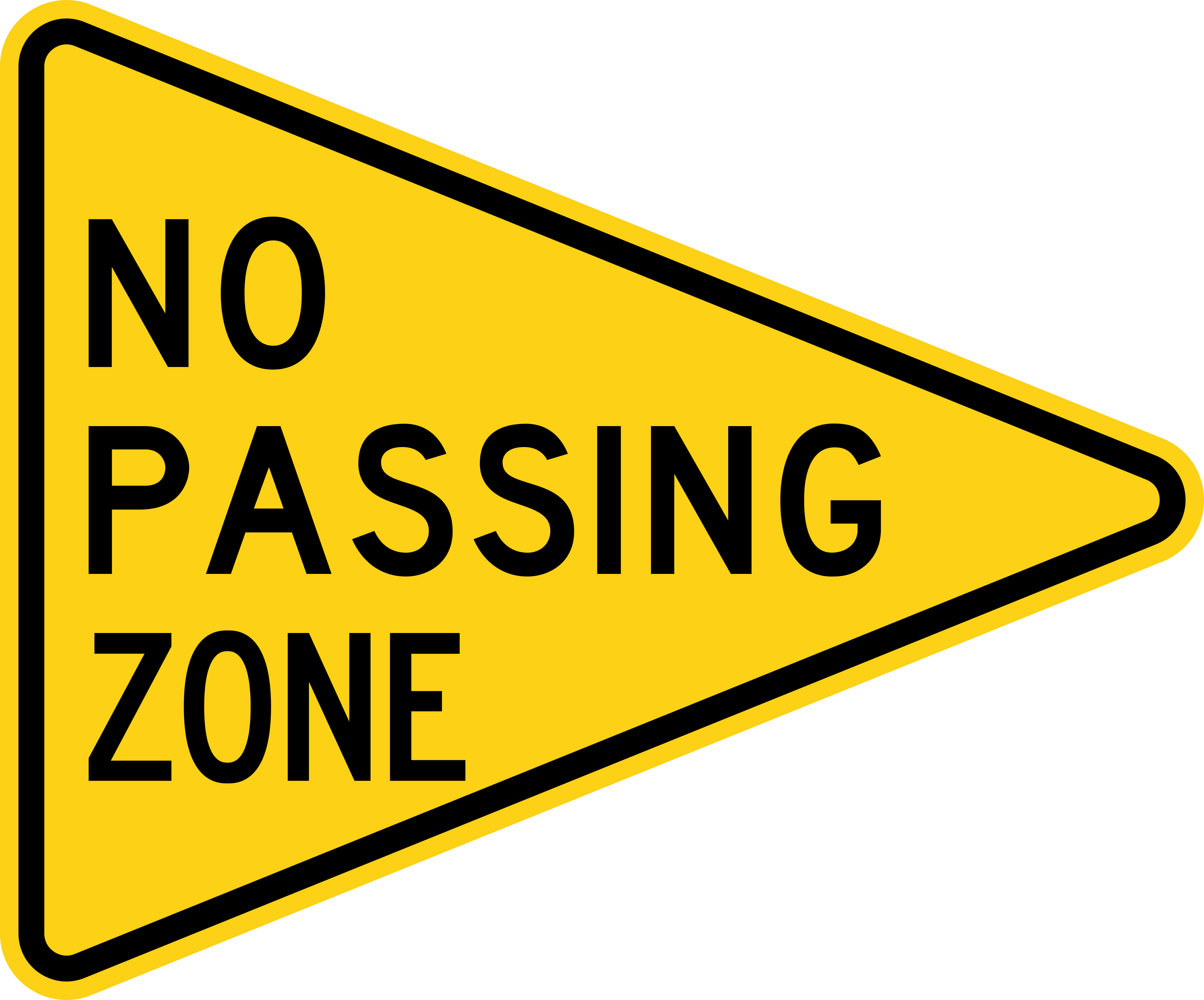
- The end of a no-passing zone
- The beginning of a no-passing zone
- A place where passing is required
- A roadside recreation area
Show answer
The beginning of a no-passing zone. The pennant is placed on the left side of the road and points to the beginning of a no-passing zone. The driver should stay behind the vehicle ahead and obey the restriction rather than treating the sign as an invitation to overtake. The end of a zone uses different information, and neither passing nor recreation is required by this warning. Even after the restriction ends, visibility and traffic conditions still determine whether a pass is safe.
Study this in the handbook: Traffic device types, warning, guide and work zone signs
12. Before entering a public street from a private driveway, what must the driver do?
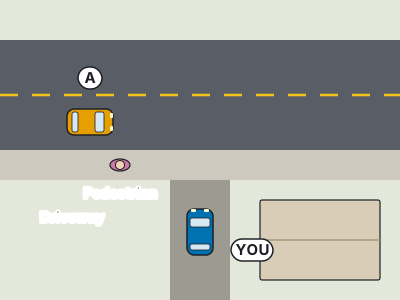
- Sound the horn, then merge without stopping
- Stop and yield to traffic on the public street
- Yield only to vehicles approaching from the left
- Stop only when a posted sign requires it
Show answer
Stop and yield to traffic on the public street. A driveway is not treated like a road with equal priority. The driver must stop before entering the public street and yield to traffic using that street. Sounding the horn does not replace the stop, and the duty is not limited to vehicles from one direction. Waiting for a special driveway sign also misses the rule because the obligation comes from the act of entering the public roadway. Use a simple memory cue: private property gives way to the established flow on the street.
Study this in the handbook: Right of way and roundabouts
13. How should you respond to a yellow flashing traffic signal?
- Treat it as a red flashing signal
- Stop and remain stopped until green
- Accelerate before cross traffic moves
- Proceed only with caution
Show answer
Proceed only with caution. A yellow flashing signal allows movement only with caution. It is not a command to stop and wait for green, and it does not invite a driver to rush through before another stream of traffic moves. The red-flashing choice confuses two different signal rules: red flashing has the meaning of a stop sign, while yellow flashing is a cautious proceed instruction. Reduce speed, check the intersection and nearby road users, then continue only when the path is clear.
Study this in the handbook: Traffic signals and lane control signals
14. How long may a visitor use a compact foreign driver's license with an International Driving Permit in Hawaii?
- For 30 days after arrival
- For 90 days after arrival
- For one year after the date of entry into the USA
- With no limit, as long as the foreign license is valid
Show answer
For one year after the date of entry into the USA. Hawaii exempts holders of a compact foreign driver's license accompanied by an International Driving Permit from getting a Hawaii license, but only for one year after the date of entry into the USA. Thirty days and 90 days are shorter than the stated period. The exemption is not open ended, so a still valid foreign license does not extend it. The manual counts the year from the first port of entry into the United States.
15. How often must a Hawaii driver appear in person before the examiner of drivers to renew a license?
- Never, every renewal can be done by mail
- Every renewal, because mail renewal is not allowed
- Only when the driver changes address
- Every other renewal, because renewal by mail is allowed only once in a row
Show answer
Every other renewal, because renewal by mail is allowed only once in a row. The manual lets you renew your license once by mail, but you must present yourself before the examiner of drivers every other renewal. That means mail renewals cannot be repeated indefinitely. It also means mail renewal is allowed, so appearing every single time is not required. An address change is not what triggers the in person renewal. A vision test must be passed before any renewal.
Study this in the handbook: Documents, tests and renewal
16. Which age group has the fewest crashes in Hawaii's statistics?
- Drivers under 20
- Drivers over 75
- Drivers about 50 to 54 years of age
- Drivers 25 to 30
Show answer
Drivers about 50 to 54 years of age. Hawaii's crash statistics show the youngest drivers, under age 20, have about twice as many crashes as expected for their numbers, crashes then decline with age until about 50 to 54, the group with the least crashes, and starting at age 55 crashes occur more frequently again. Drivers over 75 have more crashes but still fewer than drivers under 25.
Study this in the handbook: Attitude, age and distraction
17. Which two types of travel are named as exceptions to Hawaii’s provisional-license nighttime restriction?
- Driving to a party, or driving to a restaurant
- Driving to or from employment, or to or from a school-authorized activity
- Driving to a sporting event, or driving to a friend’s home
- Driving to a store, or driving to a repair shop
Show answer
Driving to or from employment, or to or from a school-authorized activity. The manual names two specific travel purposes: going to or from employment and going to or from the driver’s school-authorized activity. A social outing, restaurant visit, sporting event, personal visit, store trip, or repair errand is not included in that wording. The exception is therefore purpose-specific, not a general license to drive after 11:00 p.m. without a licensed parent or guardian. When planning a late trip, first ask whether the destination is work or a school-authorized activity; if it is neither, the parent or guardian requirement applies.
Study this in the handbook: The provisional license
18. The registered owner of a Hawaii vehicle changes his or her name. How must the county agency be told?
- In writing, within 60 days after the change
- By telephone, within 10 days after the change
- In person, within 30 days after the change
- Only at the next registration renewal
Show answer
In person, within 30 days after the change. A name change on a vehicle's ownership record requires the registered owner to appear in person at the appropriate county agency within thirty days after the change, bringing proof of the change. Sixty days is longer than allowed, and a phone call is not the stated method. Waiting until the next renewal misses the deadline. Note the contrast with an address change, which is reported in writing within the same 30 days.
19. What kind of information is normally provided by a green highway sign?
- Directions, distances and names of exits or places
- A warning that road work is beginning
- A rule prohibiting a turn or lane movement
- A signal that opposing traffic has the right-of-way
Show answer
Directions, distances and names of exits or places. Green signs are guide and information signs. The manual says these signs give information about your location and the location of places and services, and typical examples are route markers, location and distance signs, park signs, recreation signs, and service information signs. Road work warnings use orange, and a turn or lane prohibition is a regulatory message. Right of way comes from regulatory signs, signals and the right of way rules, not from a green guide sign. Read the destination information early enough to choose the correct lane without a last second maneuver.
20. What does a single broken yellow centerline allow when the road is clear?
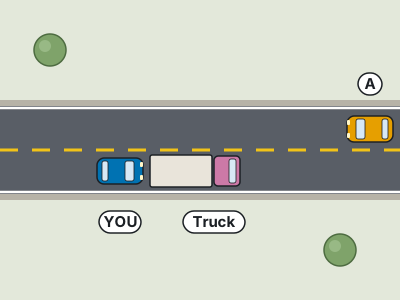
- Treating the road as one-way traffic
- Driving on the line until the next intersection
- Passing without checking for opposing traffic
- Crossing to pass another vehicle when it is safe
Show answer
Crossing to pass another vehicle when it is safe. A single broken yellow line marks the center of a two-lane road and separates opposing directions. You must normally drive to its right, but you may cross it to pass another vehicle when the maneuver is safe. The line is not a lane to occupy, and its broken pattern does not remove the need to check for oncoming traffic, sight distance and other restrictions. It also does not make the road one-way. A broken yellow centerline is therefore a conditional passing cue: clear visibility and a safe gap are required before moving left.
Study this in the handbook: Pavement markings
QualitySpace is expanding to Hawaii
We are a California-based independent insurance brokerage working on licensing in more states. We cannot help with Hawaii insurance yet. Leave your email and we will let you know when we can.
Every question is written from the official Hawaii Driver's Manual. Need paper? Printable HI practice test with answer key.
Last verified 2026-10-05. How we check every question · Study all 216 as flashcards
Frequently asked questions
How many questions are on this Hawaii practice test?
This fixed set has 20 questions. It is test 10 of 10 from the 216 question Hawaii bank. The real HI exam asks 30 questions and you need 24 correct.
What is the passing score for the real Hawaii test?
No more than 6 errors on the 30-question written examination, i.e. 24 of 30 correct (published by Maui County; Honolulu does not publish a passing score) That figure comes from the official Hawaii source cited on the DMV facts page.
How does this fixed test relate to the full Hawaii bank?
Each numbered test is a fixed set of questions in a fixed order, so you can retake the same test later and compare. Every test mixes road signs and the other topics in about the same proportion as the full bank. Tests 1 to 10 together cover 200 of the 216 questions in the Hawaii bank, each once. The full practice page mixes the whole bank at random.
Last verified 2026-10-05. See the Hawaii DMV facts page for sourced state details.