
Test 11 of 25 · 20 questions · Free 2026
HI Permit Practice Test 11
Jump to the test ↓A fixed 20 question set from the Hawaii bank with answers and plain English explanations. The real HI exam is 30 questions, 80 percent to pass; take the full length version on the main practice page.
Question 1 of 20 · 0 right so far
All 20 questions in test 11
Every question below comes from the Hawaii question bank on this page. Open a question to see the correct answer and the explanation. Nothing here is hidden behind a signup.
1. After alerting an oncoming driver who is in your lane, where does the manual direct you to go?
- Into the oncoming lane to swing around the other car
- Straight ahead while braking as hard as possible
- To the right, out of the lane
- Onto the raised median strip
Show answer
To the right, out of the lane. The manual says to quickly slow your vehicle and steer to the right out of the lane into any available clear area, and it adds in capital letters that you must not enter the oncoming traffic lane. Driving off the road is acceptable if necessary, avoiding solid objects and pedestrians. Swinging left puts you head-on into the space the wrong-way driver may correct into, hard braking straight ahead keeps you in the collision path, and the median is not an escape surface. Right and out is the move.
Study this in the handbook: Blowouts, brake failure, skids and fires
2. The freeway entrance lane is clear. What sequence does the manual describe for merging?
- Hold ramp speed until a gap appears beside you
- Stop at the merge point, then pull out
- Cross directly to the far lane
- Signal, then bring your speed up to match freeway traffic
Show answer
Signal, then bring your speed up to match freeway traffic. When the entrance lane is clear, the manual says to use your turn signal to indicate the merge and then increase the speed of your vehicle to match that of the freeway traffic. Matching speed turns the merge into a lane change instead of a surprise. Holding ramp speed creates a closing-rate problem, stopping at the merge point is the dangerous habit the manual warns against, and crossing to the far lane immediately ignores the near lane you just joined. Signal early, accelerate and settle in.
3. How should a lap belt fit a Hawaii occupant?
- Loosely across the stomach so it never feels tight on the body
- Snugly across the hip bones and the lower part of the abdomen
- High over the ribs where it stays visible above the clothing line
- Under one arm so the shoulder portion can rest more comfortably
Show answer
Snugly across the hip bones and the lower part of the abdomen. Belt geometry decides whether a crash load spreads over bone or crushes soft tissue. Hawaii places the lap belt snugly across the hip bones and the lower part of the abdomen. A loose belt across the stomach lets the body slide under it and loads organs directly. Riding high over the ribs puts force on the chest cage. Tucking webbing under an arm defeats the shoulder harness design. After buckling, tug the lap portion low and tight, then settle the shoulder strap across the chest before moving off.
Study this in the handbook: Seat belts and children
4. After the start up computer check finishes, what should happen to Hawaii warning lamps?
- They should remain lit while driving
- They should stay lit until the first full stop
- They matter only on long trips
- They should no longer be illuminated
Show answer
They should no longer be illuminated. A healthy start in Hawaii ends with a dark panel: after the computer check, the warnings should no longer be illuminated. A lamp that stays on is the vehicle reporting a system fault, not normal operation. Staying lit until the first stop is not a normal pattern either. Trip length does not change what a lit lamp means. Learn each symbol in the owner manual so a glowing icon names its system at a glance. Oil, brake and temperature warnings in particular call for stopping safely and investigating before driving farther.
5. You must walk along a highway after a breakdown. How does the manual say to walk?
- On the shoulder with your back to traffic
- In the travel lane so drivers see you
- Facing traffic and well clear of the roadway
- On the freeway, next to the barrier
Show answer
Facing traffic and well clear of the roadway. The manual says to walk facing traffic and well clear of the roadway, and it adds that you should not walk on freeways at all; stay with the vehicle until help arrives. Facing traffic lets you see a drifting car and step farther off the road, while walking with your back to traffic leaves that decision to the driver behind you. The travel lane and the freeway shoulder are both too close to fast vehicles. Use a phone from inside the car whenever you can.
Study this in the handbook: Blowouts, brake failure, skids and fires
6. You see people walking on or crossing the roadway ahead. What should you do?
- Speed up slightly and pass before they step out
- Move to the left lane and maintain your speed
- Sound the horn once and continue at the same speed
- Slow down and be prepared to stop for them
Show answer
Slow down and be prepared to stop for them. When you see persons walking on or crossing the roadway, slow down and be prepared to stop. People on foot can change direction without the signals a vehicle gives, and children near the roadway can move even less predictably. Speeding up to pass first shortens the time either of you has to correct a mistake. Changing lanes at the same speed still carries that speed toward the walkers, and a horn note without slowing leaves your stopping distance unchanged. Ease off early and be ready to halt.
Study this in the handbook: Pedestrian safety
7. What share of Hawaii traffic deaths are pedestrians, according to the manual?
- About 5 percent
- About 20 percent
- About 10 percent
- About 40 percent
Show answer
About 20 percent. The manual reports that 20 percent of all traffic fatalities in Hawaii are pedestrians, and most of those killed are not drivers. That share is high enough that every driver should scan sidewalks, shoulders and crosswalks rather than watching only for cars. Five or ten percent would understate the risk, and forty percent overstates it. The figure is a reminder that a pedestrian has no physical protection, so the driver carries most of the responsibility for avoiding the crash.
Study this in the handbook: Pedestrian safety
8. What does the manual say about headsets or earphones that cover both ears?
- Do not drive with them
- Fine if the volume stays low
- Fine on long freeway trips
- Fine for quick phone calls
Show answer
Do not drive with them. The manual is direct: do not drive with headsets or earphones that cover or go in both ears, because they make it too hard to hear emergency horns or sirens. A volume cap does not cure the sealing effect of both-ear coverage, the freeway is the last place to be deaf to sirens, and phone calls do not justify blocking your hearing. If you use audio on the road, keep one ear open at most and the volume low enough that the traffic around you remains audible.
Study this in the handbook: Attitude, age and distraction
9. A driver feels stimulated after a few drinks. What does the manual say that feeling means?
- The alcohol is acting as a stimulant and sharpening reflexes
- Inhibitions are lowered, causing loss of caution
- The driver has burned off the alcohol
- The driver is ready to drive safely
Show answer
Inhibitions are lowered, causing loss of caution. If you feel stimulated after drinking, the manual explains that the feeling comes from lowered inhibitions, which causes a loss of caution and self-control. Alcohol is a depressant, so the energy is not a sign of sharper reflexes or a cleared bloodstream. Feeling ready to drive is exactly the misjudgment the warning describes. The stimulant feeling can lead a driver to take a gap that is too small or to skip a seat belt. Judge fitness by the amount consumed and the time elapsed, not by how lively you feel.
Study this in the handbook: Alcohol, drugs and the law
10. When you switch the ignition on, what should the equipment warning lamps on the instrument panel do?
- Stay off until the engine warms up
- Flash three times and then clear
- All illuminate
- Only the fuel lamp lights
Show answer
All illuminate. Under pre-starting, the manual says the equipment warning lamps on the instrument panel should all be illuminated when the ignition switch is turned on, and a warning lamp that is not illuminated indicates that the lamp itself is not functioning. The bulb check depends on every lamp lighting at key-on; a dark lamp cannot warn you later. Warming up, a fixed flash pattern and a lone fuel lamp are not the check. If any lamp stays dark at start-up, have it fixed before you rely on the panel.
11. What does the manual say about signaling when no other vehicles are in sight?
- Signal every time
- Signal only when traffic is near
- Skip the signal on empty streets
- Use the hazard lamps instead
Show answer
Signal every time. When slowing down, turning or changing lanes, you must signal to let others know what you plan to do, and the manual adds that you must signal every time, even when there are no other vehicles in sight. The habit matters because traffic, cyclists and pedestrians appear faster than you expect, and skipping signals on quiet streets breaks the pattern that keeps you safe. Hazard lamps announce a stopped or disabled car, not a maneuver. Signal first, every time, and make it automatic.
Study this in the handbook: Turn signals and railroad crossings
12. What does the manual say about driving even when only slightly intoxicated?
- The driver is prone to serious mistakes
- The driver is safer because reactions are relaxed
- The risk is limited to night driving
- The driver can compensate by going slower
Show answer
The driver is prone to serious mistakes. The manual warns that people who drive even when slightly intoxicated are prone to serious mistakes that can have devastating consequences. A low BAC still blunts judgment and slows the response to a child, a cyclist or a changing light, and the driver may not notice the loss. Relaxed reactions are not safer, the danger is not limited to darkness, and slowing down does not restore the ability to judge a gap. The only reliable plan is to separate drinking from driving. Set a sober ride before the first drink rather than rating yourself afterward.
Study this in the handbook: Alcohol, drugs and the law
13. Whose disabled parking placard must a vehicle display to use a Hawaii accessible parking space?
- A placard borrowed from any other driver
- A placard issued to the disabled person being transported
- A placard issued to the vehicle owner regardless of who is transported
- No placard when no regular parking space is available
Show answer
A placard issued to the disabled person being transported. Hawaii's accessible-parking rule ties the placard to the disabled person being transported in the vehicle. A vehicle cannot qualify merely because a placard was borrowed, because the owner has one for another situation, or because regular spaces are full. A placard issued to the disabled person being transported preserves both parts of the rule: the placard must be issued to that person, and that person must be the passenger being transported. The parking space is reserved for the qualifying person, not for general convenience when ordinary parking is difficult to find.
Study this in the handbook: Backing, entering traffic, lanes and parking
14. A bicyclist is caught violating a traffic law. What penalty applies?
- No penalty, because bicycles are not vehicles
- A warning only for the first violation
- The same penalties that apply to drivers
- Impoundment of the bicycle for thirty days
Show answer
The same penalties that apply to drivers. Bicyclists caught violating traffic laws are subject to the same penalties as drivers. Bicycles are legally considered vehicles, with the rights and duties that follow, so running a signal or ignoring a sign carries the same consequence on two wheels as on four. The violation is not excused by the size of the vehicle, a first offense does not convert the penalty into a warning under this rule, and impoundment for thirty days is not the stated consequence. Obey signs, signals and lane markings on a bicycle exactly as you would in a car.
Study this in the handbook: Trucks, motorcycles, bicycles and school buses
15. On a paved street with two or more marked lanes in each direction, which pass does the manual permit?
- Passing on the shoulder during congestion
- Passing in either direction at will
- Passing on the right
- Passing on the left only at intersections
Show answer
Passing on the right. Among the conditions under which you may pass to the right of another vehicle is a paved street or highway with two or more lanes marked for traffic in each direction. The pass happens within the marked lanes, not on the shoulder, and multi-lane flow still follows signs and markings rather than driver preference. Intersections are where passing is most restricted, not a special permission zone. Use the lane to the right for a slower vehicle, signal, and return to your lane when clear.
Study this in the handbook: Driving on the right and passing laws
16. How must a Hawaii driver operate a vehicle in relation to traffic signs, signals and pavement markings?
- As indicated by them
- Only when an officer is present
- As a suggestion when traffic is light
- Only on state highways
Show answer
As indicated by them. Traffic control devices govern driving everywhere in Hawaii: operate the vehicle as indicated by traffic signs, signals and pavement markings. Their authority does not depend on an officer watching, and light traffic does not demote them to suggestions. County roads carry the same duty as state highways. A stop line, a lane arrow and a red lamp each direct a specific action. Reading them early, well before the intersection, gives you time to comply smoothly instead of braking hard at the last moment.
Study this in the handbook: Driving on the right and passing laws
17. Some bicyclists ride against traffic even though it is illegal. Why does the Hawaii manual single this out for drivers?
- Wrong-way riding leads to about 25% of bicycle-car crashes, so watch for it especially when turning
- Wrong-way riders are mostly experienced cyclists who can reliably dodge cars turning across their path
- Wrong-way riding causes most bicycle crashes after dark on rural highways with no lighting
- Wrong-way riding matters only inside marked bicycle lanes during the morning commute
Show answer
Wrong-way riding leads to about 25% of bicycle-car crashes, so watch for it especially when turning. Riding against traffic is illegal, yet inexperienced bicyclists do it often enough that the behavior leads to approximately 25% of all bicycle-car crashes in Hawaii. The danger peaks when a driver turns, because a rider approaching from the unexpected direction enters the turn path faster than a driver scanning only the legal direction expects. Experienced riders are not the group named in the manual, and the warning is not limited to dark rural roads or marked lanes. Before any turn, sweep the edge of the road on both sides for a rider coming the wrong way.
Study this in the handbook: Trucks, motorcycles, bicycles and school buses
18. How should a Hawaii vehicle respond to small movements of the steering wheel?
- Slowly, with a delay
- Quickly
- Only at low speed
- With extra free play first
Show answer
Quickly. Responsive steering answers small wheel movements quickly in Hawaii equipment standards. A delayed reply suggests looseness or wear between the wheel and the road wheels. Limiting response to low speed misunderstands the check, since highway lane keeping depends on prompt reaction. Extra free play before anything happens is itself the defect being screened out. Wiggle the wheel gently on a straight road during a check drive. The car should track the input at once; a pause means steering parts need attention soon.
Study this in the handbook: Vehicle equipment, inspection and registration
19. What does continuous brake use on a long downgrade do, per the manual?
- Improves pedal feel over time
- Cools the drums for firmer stops
- Charges the hydraulic system
- Makes the brakes ineffective
Show answer
Makes the brakes ineffective. Under downgrade speed control, the manual warns that the continuous application of brakes to control speed on downgrades will cause the brakes to become ineffective, a condition more dangerous with large vehicles. Riding the pedal down a long hill overheats the braking surfaces until they barely grip. The fix is to select a lower gear before the grade and let the engine hold the speed, using the brakes in short, firm applications. A fade begins quietly, so set the gear early.
20. What kind of control does the SPEED LIMIT sign provide?
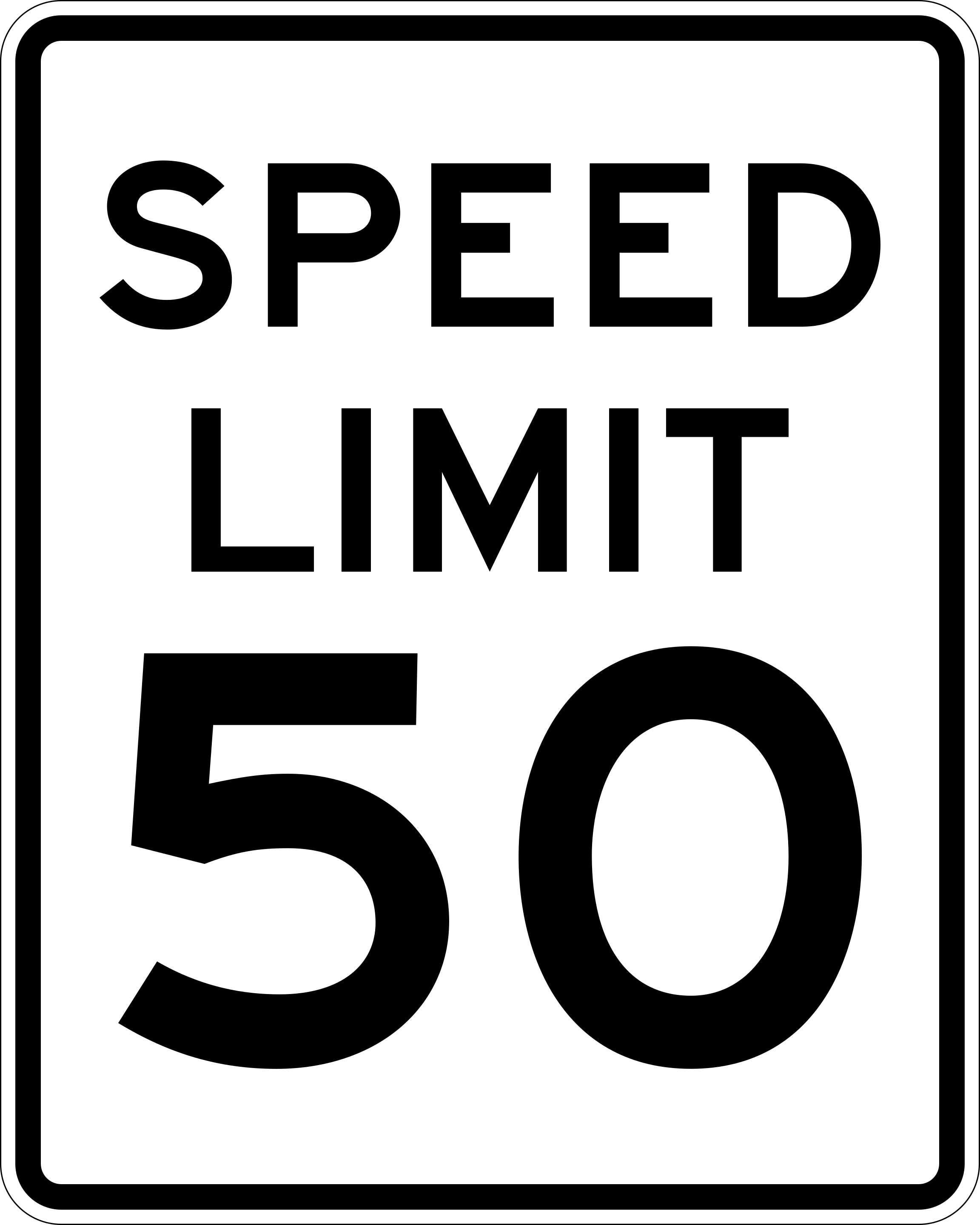
- An advisory speed that may always be exceeded
- A regulatory maximum and, where shown, minimum speed
- A truck-only restriction
- A warning that the road is about to close
Show answer
A regulatory maximum and, where shown, minimum speed. Speed limit signs are regulatory black-and-white signs that establish maximum and minimum speeds. The driver must not exceed the posted maximum or drive below the posted minimum. Calling the number advisory removes its legal force, while the sign does not apply only to trucks or announce a road closure. Conditions still matter: Hawaii’s basic law requires a speed that is reasonable and prudent for the area, traffic, road, weather, pedestrians, and light. Use the posted number as an upper boundary, then slow further when conditions demand it.
Study this in the handbook: Speed rules
Every question is written from the official Hawaii Driver's Manual. Need paper? Printable HI practice test with answer key.
Last verified 2026-10-05. How we check every question · Study all 500 as flashcards
Frequently asked questions
How many questions are on this Hawaii practice test?
This fixed set has 20 questions. It is test 11 of 25 from the 500 question Hawaii bank. The real HI exam asks 30 questions and you need 24 correct.
What is the passing score for the real Hawaii test?
No more than 6 errors on the 30-question written examination, i.e. 24 of 30 correct (published by Maui County; Honolulu does not publish a passing score) That figure comes from the official Hawaii source cited on the DMV facts page.
How does this fixed test relate to the full Hawaii bank?
Each numbered test is a fixed set of questions in a fixed order, so you can retake the same test later and compare. Every test mixes road signs and the other topics in about the same proportion as the full bank. Tests 1 to 25 together cover every question in the Hawaii bank once. The full practice page mixes the whole bank at random.
Last verified 2026-10-05. See the Hawaii DMV facts page for sourced state details.