
Key points
Before backing, visually check the area behind the vehicle, then turn and look back instead of relying on mirrors.
Source: Handbook p. 64
“Visually check the area to the rear of the vehicle before entering. Turn around and look to the rear; do not rely on rear-view mirrors.”
Hawaii Driver's Manual, Handbook p. 64When leaving a driveway, always stop before crossing the sidewalk area; failing to stop is unlawful.
Source: Handbook p. 64
“Always stop before entering the roadway. The stop should be made before crossing the sidewalk area. Failure to stop is unlawful.”
Hawaii Driver's Manual, Handbook p. 64With two lanes in your direction and free flowing traffic, use the right lane and the left lane for passing.
Source: Handbook p. 65
“In open area when traffic is free-flowing, use the right lane; use the left lane for passing or when vehicles are entering from the right.”
Hawaii Driver's Manual, Handbook p. 65With three or more lanes, choose the center lanes, which have fewer traffic conflicts.
Source: Handbook p. 65
“Three or More Lanes in the Direction of Travel. Choose the center lanes as there will be fewer traffic conflicts.”
Hawaii Driver's Manual, Handbook p. 65Whether you park uphill or downhill, turn the wheels to the right.
Source: Handbook p. 71
“Whether you park uphill or downhill turn the wheels to the right.”
Hawaii Driver's Manual, Handbook p. 71When parallel parking, back until the car is at about a 45 degree angle, then straighten the front wheels.
Source: Handbook p. 72
“Back slowly, turning steering wheel sharp right until your car is at about 45degree angle with the street. Quickly straighten front wheels and back slowly.”
Hawaii Driver's Manual, Handbook p. 72Parked bumpers should be no closer than 2 feet from other vehicles unless marked otherwise.
Source: Handbook p. 72
“Front and rear bumpers should not be closer than two feet from the other vehicles when in parked position unless the street is otherwise marked.”
Hawaii Driver's Manual, Handbook p. 72Curbside wheels must be within 12 inches of the curb, or fully within a marked stall.
Source: Handbook p. 73
“When parallel parked, the vehicle's curbside wheels shall be within 12 inches of the curb (30cm), or completely within the marked parking stall.”
Hawaii Driver's Manual, Handbook p. 73Do not park on a public street for a continuous period of more than 24 hours.
Source: Handbook p. 29
“for a continuous period of more than 24 hours.”
Hawaii Driver's Manual, Handbook p. 29
Numbers to know
| Number | What it means | Manual |
|---|---|---|
| 45 degrees | angle to reach while backing into a parallel space | Handbook p. 72 |
| 2 feet | closest your bumpers should be to other parked vehicles | Handbook p. 72 |
| 12 inches | maximum distance of curbside wheels from the curb | Handbook p. 73 |
| 24 hours | longest you may park continuously on a public street | Handbook p. 29 |
Recognize these signs
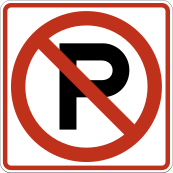
No parking 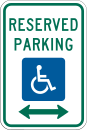
Accessible parking
3 questions from the Hawaii practice test
1. What should a driver do before backing a vehicle?
- Rely only on the rear-view mirrors
- Visually check the area behind the vehicle
- Accelerate quickly to shorten the maneuver
- Back first, then look for children
Show answer
Visually check the area behind the vehicle. Before backing, the driver should visually check the area to the rear and then turn around to look behind the vehicle. Hawaii's manual warns that the view in rear-view mirrors is too small to rely on for this purpose. Accelerating quickly reduces the time to react, and looking for children only after movement begins is especially dangerous in residential areas. Back slowly, use an outside guide when the rear cannot be seen, and watch the front clearance if turning. The essential cue is a direct look before the vehicle starts moving backward.
2. In Hawaii's parallel parking steps, at what angle should the car be to the street before straightening the wheels?
- About 90 degrees
- About 10 degrees
- About a 45 degree angle
- Parallel to the curb
Show answer
About a 45 degree angle. To parallel park, pull even with the front car about 18 inches from it with rear bumpers even, then back slowly turning the wheel sharp right until the car is at about a 45 degree angle with the street, quickly straighten the front wheels and back slowly, and when your front bumper is even with the other car's rear bumper turn sharply left as far as possible to finish.
3. On an open road with two lanes in your direction and free-flowing traffic, which lane should you normally use?
- The left lane, regardless of speed
- The right lane, using the left lane for passing or entering traffic
- Either lane while continually changing lanes
- The shoulder whenever the right lane is occupied
Show answer
The right lane, using the left lane for passing or entering traffic. With two lanes traveling in the same direction on an open road, the manual directs a driver to use the right lane when traffic is free flowing. The left lane is available for passing or for vehicles entering from the right. Choosing the left lane regardless of speed ignores that division of use. Continual lane changes create conflicts, and the shoulder is not a substitute travel lane. Keep a steady pace in the right lane, move left for a specific passing or merging reason, and return when the maneuver is complete.
Practice this topic
Lock it in with safe driving questions from the free Hawaii practice test. Every answer comes with a plain English explanation.
Source: the Hawaii Driver's Manual, Chapter X: Safe Driving Techniques. This lesson is a plain English summary, not the law itself; where it differs, the manual and the statute govern. Last checked 2026-09-27.