
Key points
A trailer weighing over half the towing vehicle, or 3,000 pounds or more, needs brakes and breakaway protection.
Source: Handbook p. 87
“If your loaded trailer weighs more than half the weight of the towing vehicle or is 3,000 pounds or more, the trailer must be equipped with brakes, and breakaway protection.”
Hawaii Driver's Manual, Handbook p. 87About 10% to 15% of the trailer weight should rest on the hitch.
Source: Handbook p. 88
“About 10% to 15% of the trailer weight should be on the vehicle's trailer hitch.”
Hawaii Driver's Manual, Handbook p. 88Over two thirds of car and motorcycle crashes happen when a car driver turns in front of the rider.
Source: Handbook p. 89
“Research shows that over two-thirds of the car/motorcycle crashes are the result of a car driver turning in front of the motorcyclist.”
Hawaii Driver's Manual, Handbook p. 89Allow at least a 2 second following distance behind a motorcycle.
Source: Handbook p. 93
“When driving behind a motorcycle, allow at least a 2-second following distance.”
Hawaii Driver's Manual, Handbook p. 93When passing a motorcycle, allow it a full lane.
Source: Handbook p. 94
“When passing a motorcycle, allow a full lane to the motorcycle.”
Hawaii Driver's Manual, Handbook p. 94Keep at least 3 feet between your vehicle and a bicyclist until you have safely passed.
Source: Handbook p. 97
“Motorists should maintain at least 3 feet of space between the bicyclist and their vehicle until they have safely passed.”
Hawaii Driver's Manual, Handbook p. 97Although not always legally required, the manual advises wearing a bicycle helmet every time you ride.
Source: Handbook p. 98
“Wear a bicycle helmet every time you ride. Although you may not be legally required to wear a helmet, it is a good idea.”
Hawaii Driver's Manual, Handbook p. 98When a school bus stops with red lamps flashing, traffic in its lane and adjacent lanes must stop until it moves or the lamps turn off.
Source: Handbook p. 96
“the driver of any motor vehicle on the same highway in the lane occupied by the school bus and all lanes adjacent to the lane occupied by the school bus shall stop the driver's vehicle before reaching the school bus and shall not proceed until the school bus resumes motion or the flashing red signal lamps are turned off.”
Hawaii Driver's Manual, Handbook p. 96Failing to stop for a school bus can cost you $1,000.
Source: Handbook p. 96
“Failure to comply with this law (291C-95, HRS) can cost you $1,000.”
Hawaii Driver's Manual, Handbook p. 96
Numbers to know
| Number | What it means | Manual |
|---|---|---|
| 3,000 pounds | trailer weight that requires brakes | Handbook p. 87 |
| 10% to 15% | share of trailer weight on the hitch | Handbook p. 88 |
| 2 seconds | minimum following distance behind a motorcycle | Handbook p. 93 |
| 3 feet | minimum space when passing a bicyclist | Handbook p. 97 |
| $1,000 | cost of failing to stop for a school bus | Handbook p. 96 |
Recognize these signs
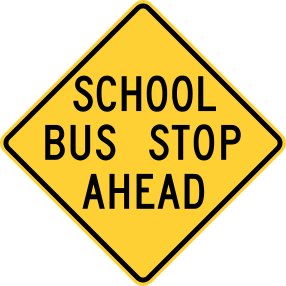
School bus stop ahead 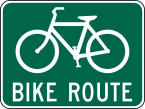
Bike route
3 questions from the Hawaii practice test
1. What minimum following distance should a driver allow behind a motorcycle?
- At least two seconds
- At least one second
- At least five feet
- The same distance used behind a parked car
Show answer
At least two seconds. The motorcycle guidance calls for at least a two second following distance. That space gives the rider room to maneuver or stop and gives the driver more time to judge a narrow vehicle's speed and position. One second and five feet are smaller or differently measured cushions, while a parked car is not a moving comparison. Increase the gap when visibility, pavement, or traffic makes reactions harder. The simple road habit is to count two seconds after the motorcycle passes a fixed object before your vehicle reaches it.
2. What does the Hawaii manual say about the legal requirement to wear a bicycle helmet?
- It may not be legally required, but wearing one is a good idea
- It is legally mandatory for every bicyclist
- It is required only for riders older than 40
- It is required only when riding faster than 15 MPH
Show answer
It may not be legally required, but wearing one is a good idea. The manual recommends a helmet every time a person rides, while acknowledging that wearing one may not be legally required. That distinction separates a strong safety recommendation from a universal legal mandate. The age and speed conditions in the other choices are not the manual’s explanation. Serious head injuries can occur even on a short or slow ride, so the concrete habit is to put on the helmet before moving the bicycle, regardless of distance, pace, or the rider’s age.
3. Hawaii's no passing rules include a school bus. When does that rule forbid passing it?
- Only inside a posted school zone
- Only when a child is visible near the bus
- When the bus is on the same roadway with its flashing lights operating
- Only when the bus is in the lane directly ahead of you
Show answer
When the bus is on the same roadway with its flashing lights operating. Hawaii's no passing rules list a school bus on the same roadway with its flashing lights operating as a situation where you must not pass. The trigger is the bus and its operating lights, not a posted school zone or whether you can see a child. When the bus is stopped with alternating red lamps flashing, the manual's school bus law also requires drivers in the lane occupied by the bus and in all adjacent lanes to stop before reaching it, and to wait until the bus resumes motion or the red lamps are turned off.
Practice this topic
Lock it in with safe driving questions from the free Hawaii practice test. Every answer comes with a plain English explanation.
Source: the Hawaii Driver's Manual, Chapter XI: Trucks, Trailers, Buses and Motorcycles. This lesson is a plain English summary, not the law itself; where it differs, the manual and the statute govern. Last checked 2026-09-27.