
25 question exam format · Real sign images & audio · Free

CT Permit Practice Test

Practice the Connecticut knowledge test the way it is actually given: 25 questions, 80 percent to pass. Every question has a plain English explanation and narrated audio. 180 questions in the bank, free, no account required.

Question bank
180
State
Connecticut
Format
Fixed question set
Cost
Free

The real Connecticut knowledge test is the DMV exam used for a learner permit. This page contains the full free 180 question study bank, with an explanation after each answer. Use the numbered 20 question tests below when you want a fixed study session.

The real Connecticut knowledge test: 25; passing score 20 of 25 correct (80%) (official source). This practice bank has 180 questions.

Alcohol and DUIEmergenciesLaws and paperworkRight of wayRoad signsSafe drivingSignals and markingsSpeed limits

180-question bank · Real sign images & audio · Free

Connecticut practice test has 180 questions. Every question comes with a plain-English explanation the moment you answer.

Real exam format: 25 questions, 20 correct to pass.

Start here

Run 20 questions to warm up.

Find your gaps

Diagnose weak topics and retry what you've missed.

Simulate the real thing

Practice under graded exam conditions or run the whole bank.

Random draw every attempt. Scored against the 80% passing standard.

Free means actually free: no subscription, no auto-renew, no card required, no locked features. This site is funded by our insurance work, not by test-prep charges.

See facts and key topics for Connecticut DMV (minimum age, fees, wait times, question counts by topic) before you start, or print it to bring with you on test day.

How to use this CT practice test

  1. Take the 25 question exam-length practice test above once, untimed, to find your weak topics.
  2. Work through the numbered 20 question sets below. Each one is fixed, so a second attempt is a fair comparison.
  3. Read the explanation on every miss. The wording comes from the Connecticut Driver's Manual, which is what the examiners use.
  4. When you pass three sets in a row at 80 percent or better, book the real test.

CT practice tests, 20 questions each

Fixed sets in a fixed order so you can retake one and compare your score.

  1. Test 1
  2. Test 2
  3. Test 3
  4. Test 4
  5. Test 5
  6. Test 6
  7. Test 7
  8. Test 8
  9. Test 9

Printable CT practice test with answer key

Frequently asked questions

How many questions are in the Connecticut practice bank?

This free page contains the full 180 question bank. The numbered tests each contain 20 fixed questions.

How does this practice test relate to the real Connecticut test?

The real test facts are shown above from the official source. This page is an educational practice bank and is separate from the DMV test.

Can I use the Connecticut practice test for free?

Yes. The practice questions, explanations, and numbered tests are free to use with no account required.

Last verified 2026-09-05 against the Connecticut Driver's Manual, which sets the real exam at 25 questions and 20 correct to pass.

All 25 questions, CT exam length

Every question below comes from the Connecticut question bank on this page. Open a question to see the correct answer and the explanation. Nothing here is hidden behind a signup.

  1. 1. What BAC level is defined as measurable alcohol for Connecticut's under-21 zero-tolerance rule?

    1. 0.02% or more
    2. 0.08% or more
    3. 0.10% or more
    4. 0.15% or more
    Show answer

    0.02% or more. Connecticut defines the under-21 zero-tolerance threshold as . Full explanation in Test 1

  2. 2. When may a driver enter an intersection under Connecticut's instruction not to block it?

    1. Only when the driver can get completely through without stopping
    2. Whenever the light is green, even if traffic is stopped
    3. Only after sounding the horn
    4. Whenever the vehicle has entered halfway
    Show answer

    Only when the driver can get completely through without stopping. The driver should not enter an intersection unless there is room to get all the way through without stopping. Full explanation in Test 1

  3. 3. On dry pavement with good tires and brakes, about how far can it take to stop at 50 mph?

    1. About 400 feet
    2. About 50 feet
    3. About 100 feet
    4. About 200 feet
    Show answer

    About 400 feet. The manual estimates about 400 feet at 50 mph to react to something seen and bring the vehicle to a stop when pavement is dry and the tires Full explanation in Test 1

  4. 4. If an officer's hand signal conflicts with a traffic light, which instruction controls?

    1. The officer's hand signal
    2. The traffic light
    3. The last signal a driver noticed
    4. The signal given by another driver
    Show answer

    The officer's hand signal. A driver must obey the directions of a police officer who is directing traffic, even when those directions conflict with the light. Full explanation in Test 2

  5. 5. For a driver under 21 whose DUI test result is .02 percent or higher, what IID period does the manual list after reinstatement?

    1. At least one year
    2. At least six months
    3. No IID is required
    4. Permanent revocation
    Show answer

    At least one year. Connecticut's zero-tolerance rule applies to a driver under 21 with a measurable alcohol level of .02 percent or higher. Full explanation in Test 2

  6. 6. During months seven through twelve after licensing, which passengers may be added to the Connecticut teen driver's permitted passenger group?

    1. Any friend with a valid license
    2. Members of the driver's immediate family
    3. All passengers under age 21
    4. Only a driving instructor
    Show answer

    Members of the driver's immediate family. Connecticut expands the passenger allowance during the second six months of a teen license. Full explanation in Test 2

  7. 7. Why can a Connecticut driver receive a ticket while traveling at the posted speed limit?

    1. Posted limits apply only to motorcycles
    2. The limit is enforceable only in daylight
    3. Posted limits assume ideal conditions, so the speed may be too fast for wet, icy, low-visibility, or heavy-traffic conditions
    4. A ticket is possible only when the speedometer is broken
    Show answer

    Posted limits assume ideal conditions, so the speed may be too fast for wet, icy, low-visibility, or heavy-traffic conditions. Connecticut's posted speed limits are based on ideal conditions. Full explanation in Test 3

  8. 8. What movement is prohibited by a red slash over a left-turn arrow?

    1. Turning left from that approach
    2. Turning around in the roadway
    3. Changing lanes to the left
    4. Driving straight through the intersection
    Show answer

    Turning left from that approach. A red circle and slash over a left-turn symbol prohibits the left-turn movement shown by the symbol. Full explanation in Test 3

  9. 9. How should you respond to a pedestrian-crossing warning sign?

    1. Watch for people in your path and be prepared to slow or stop
    2. Accelerate so pedestrians have less time in the road
    3. Assume pedestrians must wait for every vehicle
    4. Use the sign as permission to park near the crossing
    Show answer

    Watch for people in your path and be prepared to slow or stop. A PEDESTRIAN CROSSING warning tells you that people may cross your path. Full explanation in Test 3

  10. 10. What driving adjustment is called for by the skidding-car warning?

    1. Reduce speed, avoid hard braking or sudden direction changes, and increase following distance
    2. Maintain speed and brake sharply if the pavement shines
    3. Move onto the shoulder whenever the road is wet
    4. Follow more closely so other vehicles cannot spray your windshield
    Show answer

    Reduce speed, avoid hard braking or sudden direction changes, and increase following distance. SLIPPERY WHEN WET warns that wet pavement reduces traction. Full explanation in Test 4

  11. 11. An emergency vehicle approaches from any direction using its siren. What should you do?

    1. Pull as near to the right edge as possible and stop
    2. Continue in your lane until the emergency vehicle passes
    3. Move left and maintain your current speed
    4. Stop immediately in the middle of the intersection
    Show answer

    Pull as near to the right edge as possible and stop. A responding emergency vehicle needs a clear path, so the driver should move toward the right edge or as near to it as possible and stop. Full explanation in Test 4

  12. 12. What must a driver do when using windshield wipers in rain or snow?

    1. Turn on the headlights as well
    2. Use parking lights only
    3. Switch off all exterior lights
    4. Use high beams regardless of traffic
    Show answer

    Turn on the headlights as well. Connecticut requires headlights when wipers are in use because rain and snow can make a vehicle difficult for other road users to see. Full explanation in Test 4

  13. 13. What does the eight-sided shape of a stop sign tell a driver?

    1. The sign is a stop instruction
    2. The sign warns of a railroad crossing
    3. The sign marks a school zone
    4. The sign identifies a guide route
    Show answer

    The sign is a stop instruction. The eight-sided outline is a shape cue for stop. It tells the driver to make a complete stop and then yield before proceeding. Full explanation in Test 5

  14. 14. How much time does the Connecticut manual say you need to pass at 55 mph?

    1. About 3 seconds
    2. About 10 seconds, needing a 10 second opening in oncoming traffic
    3. About 30 seconds
    4. About 1 second
    Show answer

    About 10 seconds, needing a 10 second opening in oncoming traffic. At a speed of 55 mph you need about 10 seconds to pass, which means a 10 second opening in oncoming traffic and enough sight distance. Full explanation in Test 5

  15. 15. What is required when driving through a Connecticut work zone?

    1. Obey the signs and flaggers, reduce speed, and stay alert
    2. Maintain the normal speed if workers are not immediately visible
    3. Change lanes without signaling to clear the work area quickly
    4. Watch only for construction trucks and ignore changing traffic patterns
    Show answer

    Obey the signs and flaggers, reduce speed, and stay alert. Work zones can contain workers, equipment, lane shifts, alternating closures, and surfaces that change from day to day. Full explanation in Test 5

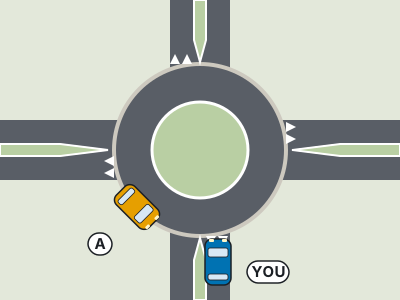
  16. 16. You approach a Connecticut roundabout with more than one lane. How do you decide which lane to use?

    1. Follow the posted signs and lane-use controls for your intended movement
    2. Always use the outside lane
    3. Always use the inside lane
    4. Pick whichever lane is empty
    Show answer

    Follow the posted signs and lane-use controls for your intended movement. Multi-lane roundabouts assign movements to lanes before you enter, and the signs and pavement arrows on the approach tell you which lane ser Full explanation in Test 6

  17. 17. What suspension does a Connecticut 16 or 17 year old face for speeding 20 mph over the limit?

    1. A 30 day suspension
    2. A 60 day suspension, a $175 restoration fee and court fines
    3. A one year suspension
    4. A warning
    Show answer

    A 60 day suspension, a $175 restoration fee and court fines. For a 16 or 17 year old, speeding 20 mph over the speed limit under section 14-219 brings a 60 day suspension, a $175 license restoration fe Full explanation in Test 6

  18. 18. What does a first street racing conviction bring a Connecticut teen driver?

    1. A 30 day suspension
    2. A $100 fine
    3. A six month suspension, a $175 restoration fee, and court fines or up to one year in jail
    4. No penalty beyond points
    Show answer

    A six month suspension, a $175 restoration fee, and court fines or up to one year in jail. Street racing under section 14-224(c) brings a 16 or 17 year old a six month suspension, a $175 license restoration fee, and court fines or Full explanation in Test 6

  19. 19. How does stopping distance at 60 mph compare with 30 mph, according to the Connecticut manual?

    1. Exactly twice
    2. Over three times the distance, not twice
    3. About the same
    4. Half the distance
    Show answer

    Over three times the distance, not twice. Stopping at 60 mph does not take twice the distance it takes at 30 mph, as one might think, but over three times the distance, because braki Full explanation in Test 7

  20. 20. What do warning signs tell drivers?

    1. That a special situation or hazard is ahead
    2. That a parking space is legally reserved
    3. That the road is always one-way
    4. That a destination's distance is being shown
    Show answer

    That a special situation or hazard is ahead. Warning signs alert drivers to a special situation or hazard ahead and tell them to slow down and be prepared to stop if needed. Full explanation in Test 7

  21. 21. A broken yellow line is beside a solid yellow line. Which side may pass?

    1. Traffic beside the broken line, when the maneuver is safe
    2. Traffic beside the solid line, whenever no vehicle is visible
    3. Neither side, because any yellow line prohibits passing
    4. Both sides, if drivers activate their turn signals
    Show answer

    Traffic beside the broken line, when the maneuver is safe. The paired marking assigns different rules to the two sides. Full explanation in Test 8

  22. 22. How long does Connecticut's parent teen driving agreement remain in effect?

    1. 30 days
    2. Until the road test
    3. At least 12 months, or until age 18, whichever is later
    4. Six months
    Show answer

    At least 12 months, or until age 18, whichever is later. The parent teen driving agreement remains in effect for 12 months at a minimum or until the age of 18, whichever is later. Full explanation in Test 8

  23. 23. What steering position does the manual recommend?

    1. Place both hands on opposite sides of the steering wheel
    2. Release the wheel so the vehicle can correct itself
    3. Use one hand at the bottom of the wheel
    4. Hold the wheel loosely with both hands
    Show answer

    Place both hands on opposite sides of the steering wheel. The manual recommends placing both hands on opposite sides of the steering wheel. Full explanation in Test 8

  24. 24. If your vehicle breaks down on a highway, what is the safest first move when possible?

    1. Move it off the road and away from traffic
    2. Leave it in the travel lane with the hood closed
    3. Stand behind it and wave at approaching vehicles
    4. Change a tire immediately in the traffic lane
    Show answer

    Move it off the road and away from traffic. A disabled vehicle can become a collision hazard when other drivers do not see it in time. Full explanation in Test 9

  25. 25. When may a driver enter an intersection during heavy traffic?

    1. When there is room to get through without stopping
    2. Even with a green signal while the far side is full
    3. After stopping in the middle of the intersection
    4. Only when the vehicle behind begins to move
    Show answer

    When there is room to get through without stopping. Heavy traffic can turn an ordinary intersection into a blockage hazard. Full explanation in Test 9

How this test works

Study the rules, then check the explanation

This page uses the prepared Connecticut question bank exactly as provided. Start the test, choose an answer, and read the explanation before moving on. Retakes serve the same 180 questions so you can work through the state set without losing your place.

Want a one-page summary to study or print? See the Connecticut DMV cheat sheet, with the most-missed rules from this same question bank.

Looking for another state? Go back to the DMV practice test hub. California remains on the established California DMV practice test page.

Are you a library or school? See the free DMV practice test partner resource for a copy ready listing and referral link.

QualitySpace is expanding to Connecticut

We are a California-based independent insurance brokerage working on licensing in more states. We cannot help with Connecticut insurance yet. Leave your email and we will let you know when we can.