
Test 1 of 10 · 20 questions · Free 2026
CT Permit Practice Test 1
Jump to the test ↓A fixed 20 question set from the Connecticut bank with answers and plain English explanations. The real CT exam is 25 questions, 80 percent to pass; take the full length version on the main practice page.
Question 1 of 20 · 0 right so far
All 20 questions in test 1
Every question below comes from the Connecticut question bank on this page. Open a question to see the correct answer and the explanation. Nothing here is hidden behind a signup.
1. Why should a driver leave a space cushion behind the vehicle ahead?
- To create time and room to react if traffic changes
- To prevent every other driver from merging
- To make the vehicle ahead travel faster
- To avoid using the mirrors while following
Show answer
To create time and room to react if traffic changes. A space cushion gives the driver a margin when the vehicle ahead brakes, changes lanes, or encounters a hazard. It also reduces the need for an abrupt maneuver. The cushion cannot prevent all merges, force another vehicle to accelerate, or replace mirror checks. Think of the gap as usable reaction space, not wasted pavement. Increase it when visibility, weather, traffic, or the behavior of the vehicle ahead makes stopping less predictable.
Study this in the handbook: Motorcycles, Trucks and Slow Vehicles
2. How should a driver treat a flashing red traffic light?
- As a flashing yellow signal requiring no stop
- As a green light when the intersection looks clear
- As a stop sign, stopping fully before proceeding when safe
- As a signal to reverse away from the intersection
Show answer
As a stop sign, stopping fully before proceeding when safe. A flashing red signal has the same meaning as a stop sign. The driver must make a full stop, then may proceed only when the crossing area is safe. Treating it like green or flashing yellow skips the required stop, while reversing is not the prescribed response. Reduce speed as you approach, identify the stop point, check for traffic and pedestrians, and move only after yielding as the intersection requires.
Study this in the handbook: Traffic Lights, Arrows and HAWK Signals
3. What warning equipment makes an approaching emergency vehicle entitled to the right-of-way?
- A siren, air horn, or red or blue flashing light
- A vehicle color of white or silver
- A four-way flasher without an audible warning
- A parking light used on the shoulder
Show answer
A siren, air horn, or red or blue flashing light. Connecticut gives emergency vehicles priority when they are using a siren, air horn, or red or blue flashing light. The vehicle color does not determine the duty to yield, and ordinary hazard or parking lights do not replace the listed warning equipment. Once you identify the qualifying warning, check mirrors, move toward the right edge when possible, and stop. The equipment list is the recognition cue that separates an emergency response from an ordinary vehicle stopped or traveling nearby.
Study this in the handbook: Right of Way at Intersections
4. What is required when driving through a Connecticut work zone?
- Watch only for construction trucks and ignore changing traffic patterns
- Maintain the normal speed if workers are not immediately visible
- Change lanes without signaling to clear the work area quickly
- Obey the signs and flaggers, reduce speed, and stay alert
Show answer
Obey the signs and flaggers, reduce speed, and stay alert. Work zones can contain workers, moving equipment, lane shifts, alternating lane closures, and traffic patterns that can change daily. Drivers must follow the instructions on work zone warning signs and from flaggers while slowing down, obeying posted speed limits, and staying alert to conditions around them. The absence of a visible worker does not cancel the warning, and a lane change made without signaling adds danger. A useful cue is to keep scanning beyond the first barricade until the roadway clearly leaves the work area.
Study this in the handbook: Railroad Crossings and Work Zones
5. Which offense by a Connecticut driver under 18 rules out youthful offender status?
- A first speeding ticket
- Parking in a fire lane
- Driving under the influence of alcohol or drugs
- An expired registration
Show answer
Driving under the influence of alcohol or drugs. Someone under 18 who commits negligent homicide with a motor vehicle, evades responsibility after a crash with death or serious injury, or drives under the influence of alcohol or drugs cannot be treated as a youthful offender. Speeding, parking and registration problems are not on that list. Youthful offenders adjudicated for reckless driving, driving under suspension, or street racing still have the record sent to DMV for license suspension.
Study this in the handbook: Teen Suspensions and Operator Retraining
6. When parking at a curb in Connecticut, how far from the curb may your wheels be?
- No more than two feet
- No more than one foot
- No more than 18 inches
- Any distance, if your hazard lights are on
Show answer
No more than one foot. The Connecticut no parking list includes parking more than one foot from the curb. Two feet and 18 inches are wider than the rule allows, and hazard lights do not make an improper parking position legal. Parking close to the curb keeps your vehicle out of the travel lane. When parked on a hill, the manual also tells you to turn your wheels sharply toward the side of the road or curb.
Study this in the handbook: Right of Way at Intersections
7. A Connecticut driver refuses the chemical test after a DUI arrest. For how long must the driver use an ignition interlock device after reinstatement?
- No interlock is required after a refusal
- At least 30 days
- At least one year
- Only if the driver is under 18
Show answer
At least one year. Regardless of age, refusing the test brings a suspension of at least 45 days and an ignition interlock device as a condition of reinstatement, required for at least one year or longer depending on prior offenses. Refusing does not avoid the interlock, 30 days is not the period, and the rule applies to all ages. An adult who fails the test faces a six month minimum interlock period, so refusing brings a longer interlock requirement than failing.
Study this in the handbook: Alcohol, Testing and DUI Suspensions
8. You are an adult driver, not a peace officer, firefighter, or ambulance driver, stopped at a red light in Connecticut. May you use your hand-held phone for a personal, nonemergency call?
- Yes, because the vehicle is not moving
- Yes, for texting only
- Yes, if the engine is turned off at the light
- No, the ban also covers stops for traffic, road conditions, or a signal
Show answer
No, the ban also covers stops for traffic, road conditions, or a signal. Connecticut bans hand-held phones and mobile electronic devices while operating a vehicle on a public highway, and the ban also applies when the vehicle is temporarily stopped for traffic, road conditions, or a traffic sign or signal. So a red light is not an exception, texting is not allowed, and turning off the engine at a light does not change it. The law does allow use in an emergency, such as contacting police, fire, or a hospital, and adult peace officers, firefighters, and ambulance drivers have their own exception. Otherwise, wait until you are safely parked on the side or shoulder.
Study this in the handbook: Teen Suspensions and Operator Retraining
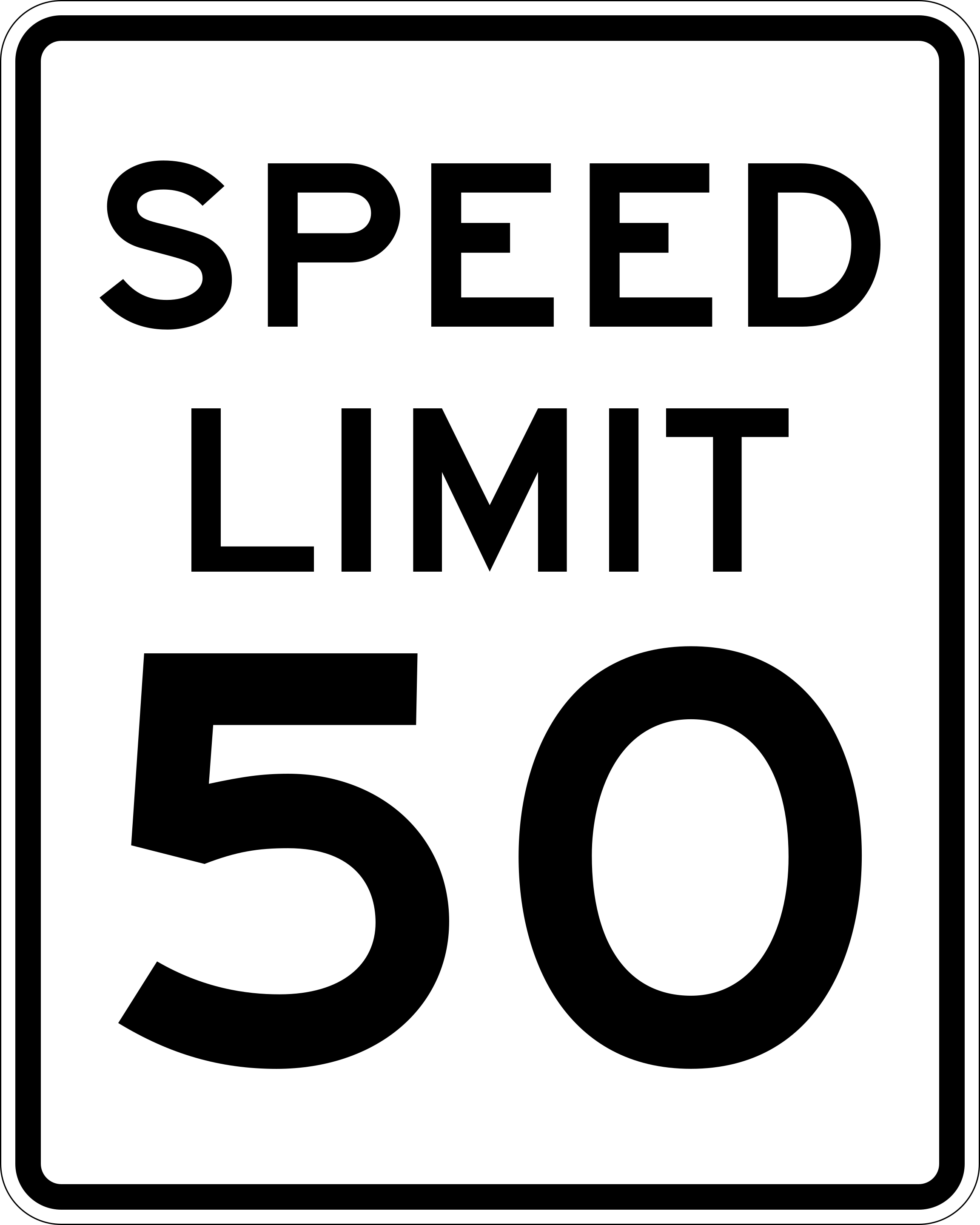
9. What does a posted SPEED LIMIT sign identify?
- The speed allowed only for commercial vehicles
- A suggested speed used only during rain
- The minimum speed required in every lane
- The maximum speed that should be driven on that roadway
Show answer
The maximum speed that should be driven on that roadway. A SPEED LIMIT sign identifies the maximum speed that should be driven on the roadway. It is not merely a rain-time suggestion, a minimum speed, or a rule limited to commercial vehicles. Even at the posted maximum, conditions such as traffic, visibility, pavement, or weather may call for a slower pace. Use the number as an upper boundary, then adjust below it when the road environment requires more time and stopping distance.
Study this in the handbook: Sign Shapes and Regulatory Signs
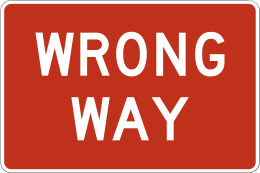
10. A red rectangular WRONG WAY sign is facing you on a divided highway. What action is required?
- Move left into the opposing traffic lane
- Continue until the next interchange
- Stop driving past it and turn around when safe
- Use the shoulder to pass the sign at reduced speed
Show answer
Stop driving past it and turn around when safe. A WRONG WAY sign identifies travel in an unauthorized direction, such as against traffic on a divided highway or ramp. Do not continue beyond the sign. The safest response is to stop progressing, check for traffic, and turn around only where that maneuver can be completed legally and safely. Continuing to the next interchange leaves you traveling against the intended flow. Moving left makes the conflict worse, while using the shoulder does not make wrong-way travel lawful. Treat the sign as an urgent direction error, not as a routine warning.
Study this in the handbook: Sign Shapes and Regulatory Signs
11. In a reversible lane, what does a green arrow above the lane tell you?
- The lane is reserved for emergency vehicles
- You may use the lane beneath the arrow
- You must leave the lane immediately
- Traffic may travel there only in the opposite direction
Show answer
You may use the lane beneath the arrow. Reversible lanes change direction at different times, so the overhead signal controls whether your direction may use the lane. A green arrow means the lane beneath it is available. A red X means it cannot be used, a flashing yellow X identifies a turning-only lane, and a steady yellow X warns that the use is changing. The practical cue is to inspect the signal before entering, because the same pavement can serve opposing traffic at another time of day. Never treat a reversible lane as permanently belonging to your side.
Study this in the handbook: Pavement Markings and Special Lanes
12. A bus traveling in your direction signals to reenter traffic. What should you do?
- Yield to the bus
- Pass it before it moves
- Maintain speed because buses must wait
- Stop in the travel lane and wave it through
Show answer
Yield to the bus. Connecticut requires drivers to yield to a bus traveling in the same direction when the bus appropriately signals. The yielding action gives the bus a safe opening to return to traffic. Passing before the bus moves creates a conflict, while maintaining speed ignores the bus's signal. Slow smoothly, leave room, and let the bus merge when safe. Watch for this especially near stops, where passengers and repeated starts make abrupt passing risky.
Study this in the handbook: Right of Way at Intersections
13. What must a driver do when using windshield wipers in rain or snow?
- Switch off all exterior lights
- Use parking lights only
- Turn on the headlights as well
- Use high beams regardless of traffic
Show answer
Turn on the headlights as well. Connecticut requires headlights when wipers are in use because rain and snow can make a vehicle difficult for other road users to see. Parking lights alone do not provide the required visibility, and turning off exterior lighting makes the vehicle less conspicuous. High beams are not automatically appropriate and can create glare. The simple driving cue is to pair the wipers with headlights whenever precipitation requires the wipers.
Study this in the handbook: Headlights, Horn and Turn Signals
14. How long does Connecticut's parent teen driving agreement remain in effect?
- 30 days
- Until the road test
- Six months
- At least 12 months, or until age 18, whichever is later
Show answer
At least 12 months, or until age 18, whichever is later. The parent teen driving agreement remains in effect for 12 months at a minimum or until the age of 18, whichever is later. It records the curfew, passenger limits, no phone use, seat belt rules and how insurance, gas and maintenance costs will be divided, and both parent and teen sign a commitment to safety, with consequences for breaking it spelled out.
Study this in the handbook: Teen Training, Passengers and Curfew
15. What should a driver do when rain, ice, poor visibility, or heavy traffic makes the posted speed unsafe?
- Reduce speed below the posted limit as conditions require
- Keep the posted limit because it is always safe
- Match the speed of the fastest nearby vehicle
- Use the shoulder to avoid slowing traffic
Show answer
Reduce speed below the posted limit as conditions require. Posted limits assume ideal conditions. When the road is wet or icy, visibility is poor, or traffic is heavy, the driver must slow enough to manage the reduced traction, view, or stopping space. Holding the posted number does not guarantee safety, and following the fastest vehicle can compound the risk. The shoulder is not a substitute for choosing a safe speed. Watch the road ahead and reduce speed before conditions force a sudden response.
Study this in the handbook: Traffic Lights, Arrows and HAWK Signals
16. How many moving violation convictions require a Connecticut driver age 25 or older to attend operator retraining?
- One
- Two
- Five
- Three or more
Show answer
Three or more. A motorist 25 or older with three or more moving or suspension violation convictions must attend and pass a certified operator retraining program. Drivers 24 or younger reach the requirement at two violations, so two is the answer only for younger drivers. One is too few, and five is more than the rule allows. The program covers vehicle operation, the attitudes behind aggressive driving, and safe driving practice.
Study this in the handbook: Teen Suspensions and Operator Retraining
17. Under Connecticut law, when is leaving a crash scene a crime?
- Only if your vehicle was damaged
- When someone was injured or killed and you leave before police have talked to you
- Never, if you exchanged phone numbers
- Only if you were at fault
Show answer
When someone was injured or killed and you leave before police have talked to you. It is a crime to leave a crash site involving your vehicle when there is an injury or death before police have talked to you and collected the information they need. Damage to your own car and fault are not the test, and swapping phone numbers does not satisfy the duty. If any person is hurt or killed, police must be notified. Evading responsibility after a crash with death or serious injury also rules out youthful offender status.
Study this in the handbook: Avoiding Collisions and After a Crash
18. A warning sign shows a reduction in lanes in your direction. What should you anticipate?

- Changing lanes or allowing another vehicle to merge into your lane
- An added lane for your direction
- A mandatory stop at the lane boundary
- A two-way roadway beginning immediately
Show answer
Changing lanes or allowing another vehicle to merge into your lane. The REDUCTION IN LANES sign warns that fewer lanes will continue in the direction you are traveling. Be prepared either to change lanes or to allow another vehicle to merge into yours. It does not promise an added lane, require a stop at the taper, or announce two-way traffic. Check mirrors early, signal before moving, and adjust speed so the merge happens with space rather than at the point where pavement disappears.
Study this in the handbook: Warning, School and Guide Signs
19. What does an orange roadway sign generally warn drivers about?
- A nearby hospital or fuel station
- Construction or maintenance dangers ahead
- A route destination and distance
- A permanent speed limit
Show answer
Construction or maintenance dangers ahead. Orange signs identify temporary or active work conditions, including construction and maintenance projects. They may warn about people working near the road, reduced speeds, detours, equipment, or a changing surface. Blue signs point to services, green signs guide drivers to destinations, and a speed limit is a regulatory message rather than the general meaning of orange. When you see orange, expect the roadway to change and follow any flagger, lane control, reduced speed, or detour instruction shown. The color is your early work-zone cue.
Study this in the handbook: Railroad Crossings and Work Zones
20. If another driver is following too closely and there is a right lane, what should you do?
- Brake sharply to make the driver increase the gap
- Move over to the right and let the driver pass
- Speed up until the tailgater cannot keep up
- Block the right lane so the driver must remain behind
Show answer
Move over to the right and let the driver pass. The manual advises a driver being tailgated to move to the right when a right lane is available. That gives the following driver a path around you and reduces the pressure to react suddenly. Sharp braking can cause a rear-end crash, and speeding turns the situation into a contest. Blocking the passing path keeps the conflict beside you. Make the lane change only after checking that it is safe, then allow the other driver to continue ahead without retaliation.
Study this in the handbook: Space Cushion and Following Distance
QualitySpace is expanding to Connecticut
We are a California-based independent insurance brokerage working on licensing in more states. We cannot help with Connecticut insurance yet. Leave your email and we will let you know when we can.
Every question is written from the official Connecticut Driver's Manual. Need paper? Printable CT practice test with answer key.
Last verified 2026-10-05. How we check every question · Study all 210 as flashcards
Frequently asked questions
How many questions are on this Connecticut practice test?
This fixed set has 20 questions. It is test 1 of 10 from the 210 question Connecticut bank. The real CT exam asks 25 questions and you need 20 correct.
What is the passing score for the real Connecticut test?
20 of 25 correct (80%) That figure comes from the official Connecticut source cited on the DMV facts page.
How does this fixed test relate to the full Connecticut bank?
Each numbered test is a fixed set of questions in a fixed order, so you can retake the same test later and compare. Every test mixes road signs and the other topics in about the same proportion as the full bank. Tests 1 to 10 together cover 200 of the 210 questions in the Connecticut bank, each once. The full practice page mixes the whole bank at random.
Last verified 2026-10-05. See the Connecticut DMV facts page for sourced state details.
Return to the full Connecticut practice test · Study road signs