
Test 6 of 10 · 20 questions · Free 2026
CT Permit Practice Test 6
Jump to the test ↓A fixed 20 question set from the Connecticut bank with answers and plain English explanations. The real CT exam is 25 questions, 80 percent to pass; take the full length version on the main practice page.
Question 1 of 20 · 0 right so far
All 20 questions in test 6
Every question below comes from the Connecticut question bank on this page. Open a question to see the correct answer and the explanation. Nothing here is hidden behind a signup.
1. How long does a Connecticut vehicle owner have to fix an emissions failure?
- 60 days to repair and have the emissions rechecked
- One year
- There is no deadline
- 10 days
Show answer
60 days to repair and have the emissions rechecked. A Connecticut vehicle may be required to have an emissions inspection at an authorized station, and if the vehicle does not pass you are given 60 days to have the problem fixed and the emissions rechecked. The manual pairs this rule with advice to follow the vehicle owner's manual for routine maintenance, noting that some tasks you can do yourself while a qualified mechanic must handle others.
2. At an intersection without signs or signals, which approaching vehicle has priority?
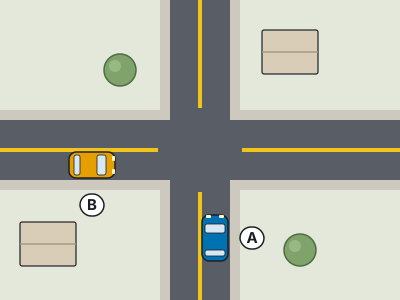
- The vehicle approaching from the right
- The vehicle approaching from the left
- The vehicle traveling at the higher speed
- The vehicle with its turn signal on
Show answer
The vehicle approaching from the right. At an intersection with no stop sign, yield sign, or oncoming traffic signal, the driver must yield to vehicles coming from the right. The manual stresses that the law says who must yield and does not give anyone the right-of-way, so the vehicle on the right should still drive carefully. Speed and a turn signal do not establish priority. Reduce speed, scan both directions, and be prepared to yield. The practical cue is to check the vehicle on your right before entering an intersection without traffic control.
Study this in the handbook: Right of Way at Intersections
3. If your vehicle breaks down on a highway, what is the safest first move when possible?
- Change a tire immediately in the traffic lane
- Leave it in the travel lane with the hood closed
- Stand behind it and wave at approaching vehicles
- Move it off the road and away from traffic
Show answer
Move it off the road and away from traffic. A disabled vehicle can become a collision hazard when other drivers do not see it in time. If you can, get the vehicle off the road and away from moving traffic. Then use emergency flashers and other warnings, and never stand in the roadway. Leaving the car in a travel lane is dangerous even if the hood is raised, and changing a tire in that lane exposes you to passing vehicles. Your first cue is space: create as much separation from traffic as the situation allows before handling the mechanical problem.
Study this in the handbook: Headlights, Horn and Turn Signals
4. What does a pennant-shaped sign on the left side of a two-way road identify?
- A no-passing restriction begins
- A train crossing is approaching
- A school crossing only
- A lane reserved for buses
Show answer
A no-passing restriction begins. The pennant is a special sign shape used to mark the beginning of a no-passing zone. Its placement on the left side of a two-lane, two-way road reinforces that it applies to traffic facing the sign. The manual adds that the sign is posted where no passing pavement markings are also used, so the sign and the paint confirm each other. A circle tells you a railroad crossing is ahead, a pentagon marks school zones and crossings, and nothing in the pennant's meaning relates to buses. Treat the pennant as a firm no-passing cue.
Study this in the handbook: Sign Shapes and Regulatory Signs
5. On dry pavement with good tires and brakes, about how far can it take to stop at 50 mph?
- About 200 feet
- About 50 feet
- About 100 feet
- About 400 feet
Show answer
About 400 feet. The manual estimates about 400 feet at 50 mph to react to something seen and bring the vehicle to a stop when pavement is dry and the tires and brakes are in good condition. The 50-foot and 100-foot choices underestimate the combined space needed for perception, reaction, and braking. About 200 feet is the separate figure given for 30 mph, so it belongs to a different speed. Use the surface and equipment conditions as part of the rule, then connect 50 mph with a full city-block distance before assuming a visible hazard can be avoided.
Study this in the handbook: Speed Limits and Stopping Distance
6. What must you do when approaching a roundabout with traffic already circulating?
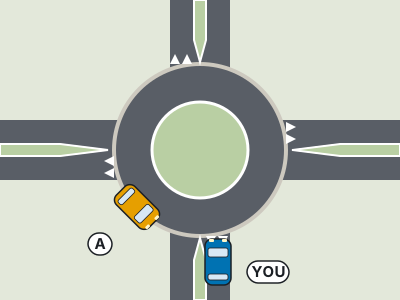
- Yield, then enter when a sufficient gap is available
- Stop inside the circle to let entering traffic merge
- Enter immediately because entering vehicles have priority
- Drive clockwise until you reach your exit
Show answer
Yield, then enter when a sufficient gap is available. Traffic already circulating in a roundabout has priority over traffic entering it. Slow down as you approach, yield to circulating vehicles and to pedestrians in the crosswalk, then enter when there is a sufficient gap in traffic. Once inside, do not stop to let another vehicle enter from a different leg. Use your right turn signal when you are about to reach your intended exit, and yield to pedestrians in the crosswalk on the exiting leg. The entering vehicle must fit into the existing flow rather than force that flow to stop.
Study this in the handbook: Roundabouts, Traffic Circles and U-Turns
7. What does a steady yellow traffic light mean for a driver approaching the intersection?
- The driver should accelerate through every time
- The driver has a new protected right of way
- The signal is about to turn red and the driver must stop if safe
- The intersection is closed to all traffic
Show answer
The signal is about to turn red and the driver must stop if safe. A steady yellow light announces that the signal is about to change to red. The driver must stop when a safe stop is possible. It is not a new protected movement, and accelerating through every yellow defeats the warning. A yellow light also does not mean the intersection is closed. Check the stopping distance, brake smoothly when appropriate, and avoid entering if the vehicle cannot clear the intersection before the signal changes.
Study this in the handbook: Traffic Lights, Arrows and HAWK Signals
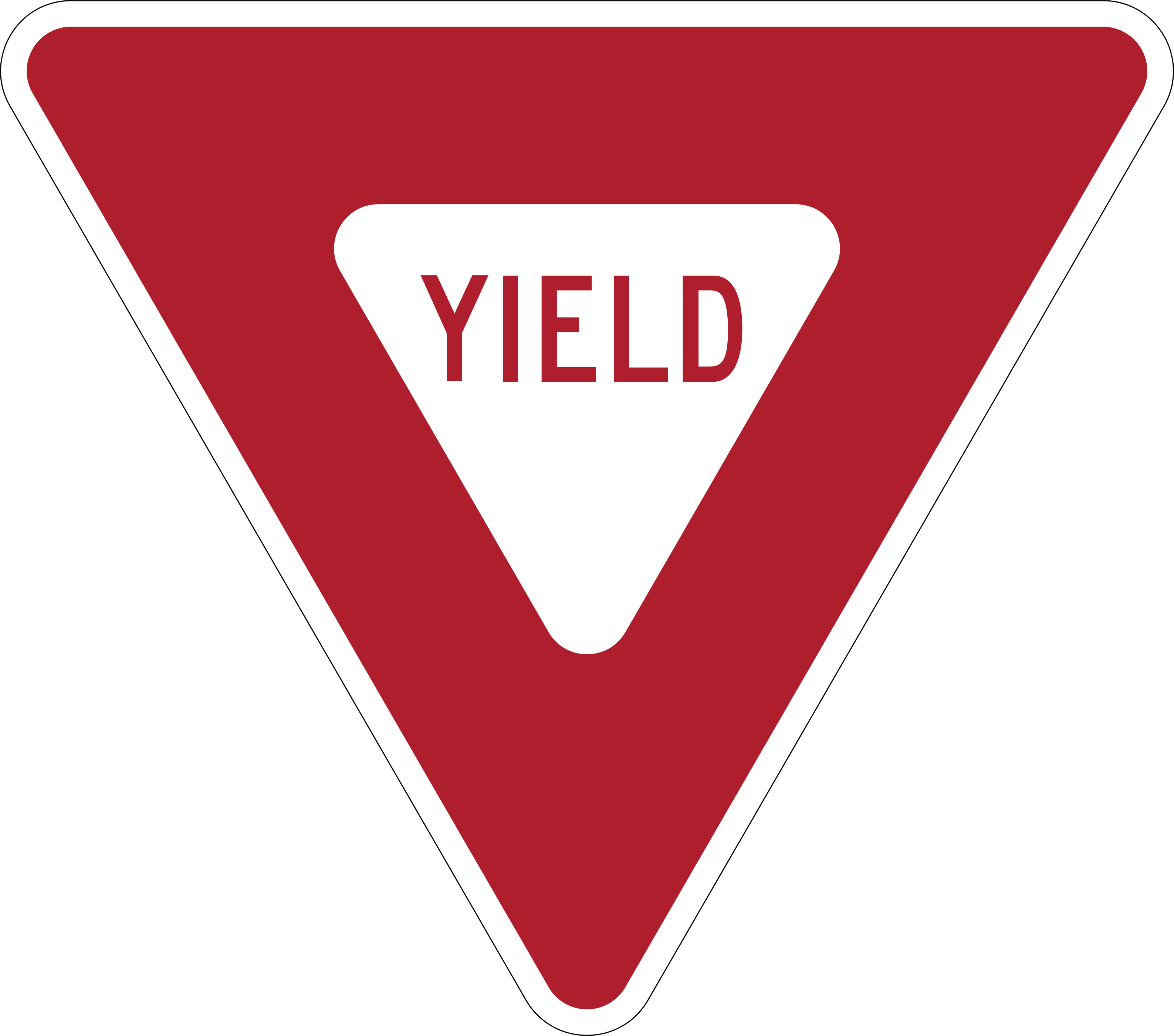
8. What does the red and white downward-pointing triangle require?
- Speed up to enter before cross traffic
- Slow to a reasonable speed and yield the right-of-way, stopping if necessary
- Stop every time, even when no traffic is present
- Ignore the sign when traveling on the main road
Show answer
Slow to a reasonable speed and yield the right-of-way, stopping if necessary. A triangular YIELD sign tells the driver to slow to a speed reasonable for the conditions and yield the right-of-way. Stopping is required when necessary, not automatically in every situation. Speeding into the intersection reverses the sign's instruction, and being on a main road does not erase the duty to yield where the sign applies. The downward-pointing triangle is the visual cue. Pair its shape with the conditional stop rule: reduce speed, assess traffic and pedestrians, then stop if the situation requires it.
Study this in the handbook: Sign Shapes and Regulatory Signs
9. Two lanes are approaching a yellow MERGE warning. What does it tell drivers?

- Traffic in the right lane must stop before merging
- Only the left lane may continue
- The two lanes are about to become one and both drivers must merge smoothly
- The roadway is becoming two separate one-way roads
Show answer
The two lanes are about to become one and both drivers must merge smoothly. A MERGE warning means two lanes of traffic are about to become one. Drivers in both lanes share responsibility for fitting together smoothly, using signals and adjusting speed without sudden competition for space. The sign does not grant one lane automatic priority, require the other lane to stop, or announce a divided roadway. Identify the lane that will continue, check mirrors and blind spots, and create a predictable gap before the lane reduction arrives.
Study this in the handbook: Warning, School and Guide Signs
10. What does a solid white line between lanes generally tell you?
- Stop before the line at every intersection
- Cross freely whenever you want to pass
- The lanes carry traffic in opposite directions
- Stay in your lane unless a special situation requires a change
Show answer
Stay in your lane unless a special situation requires a change. Solid white lane lines separate lanes traveling in the same direction and advise drivers to remain in their lane unless a special situation requires a change. They are different from dashed white lines, which indicate that a lane change may be made when safe. A solid white line is not a center line for opposing traffic, and it is not automatically a stop line. Before crossing one, identify the reason, check mirrors and blind spots, signal, and confirm that the maneuver will not interfere with another road user.
Study this in the handbook: Pavement Markings and Special Lanes
11. What penalty does a Connecticut teen driver face for a first reckless driving conviction?
- A 30 day suspension
- A $50 fine
- Loss of license until 21
- A six month suspension, a $175 restoration fee, and court fines or up to 30 days in jail
Show answer
A six month suspension, a $175 restoration fee, and court fines or up to 30 days in jail. A first reckless driving conviction under section 14-222 brings a 16 or 17 year old driver a six month suspension, a $175 license restoration fee, and court fines or imprisonment of not more than 30 days or both; a repeat offense brings a one year suspension and up to a year in jail. Street racing carries the same six month and one year suspensions.
Study this in the handbook: Teen Suspensions and Operator Retraining
12. What test can show that a driver is traveling too fast for the available sight distance?
- The one-second parking-space rule
- The four-second sight-distance rule
- The ten-minute fuel-economy test
- The two-car-length rule at every speed
Show answer
The four-second sight-distance rule. The four-second sight-distance rule checks whether the driver can stop within the distance that is visible. Pick a stationary object at the farthest clear point and count for four seconds. Reaching the object before the count ends means the vehicle is moving too fast for that sight distance and should slow down. The other choices are not tests described in the manual. Use a sign or telephone pole as the reference, and remember that speed must match visibility, not just the posted limit.
Study this in the handbook: Distractions, Fatigue and Aggressive Driving
13. On a packed-snow road, how should a driver adjust speed?
- Increase speed so the tires stay warm
- Keep the posted speed unless visibility is poor
- Cut the speed in half
- Reduce speed by about 10 mph, regardless of the road surface
Show answer
Cut the speed in half. Connecticut gives a specific reduction for packed snow: cut your speed in half. The roughly 10 mph reduction belongs to a wet road, not every slippery surface. Keeping the posted speed assumes dry-road traction and leaves less time to respond when the tires grip poorly. Increasing speed makes a skid more likely and gives the driver less control. Treat the surface as the deciding cue, then make the larger packed-snow reduction before continuing.
Study this in the handbook: Slippery Roads, Hydroplaning and Curves
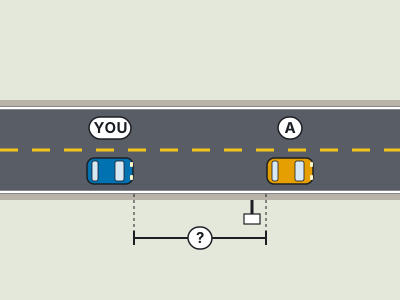
14. What following gap does Connecticut's three-second rule establish for ordinary conditions?
- No closer than one second
- No closer than three seconds
- No closer than six seconds
- No closer than ten seconds
Show answer
No closer than three seconds. The manual uses a stationary sign, pole, or similar point to measure the space behind another vehicle. After that vehicle passes the point, count one-one-thousand, two-one-thousand, three-one-thousand. Reaching the mark before the count ends means the gap is too short, so the driver should drop back and try again. One second leaves little reaction time, while six and ten seconds are not the manual's ordinary baseline. Bad weather, darkness, trailers, and other conditions can require even more room than the three-second minimum.
Study this in the handbook: Space Cushion and Following Distance
15. An emergency vehicle approaches from any direction using its siren. What should you do?
- Continue in your lane until the emergency vehicle passes
- Pull as near to the right edge as possible and stop
- Move left and maintain your current speed
- Stop immediately in the middle of the intersection
Show answer
Pull as near to the right edge as possible and stop. A responding emergency vehicle needs a clear path, so the driver should move toward the right edge or as near to it as possible and stop. Continuing in the lane can obstruct the response, while moving left may place the vehicle in the emergency vehicle's path. If already in an intersection, clear that intersection before pulling over. Remain stopped until the emergency vehicle has passed unless an authorized official directs otherwise.
Study this in the handbook: Pedestrians, Bicyclists and Horses
16. Where may a Connecticut adult driver use a hand-held cell phone?
- While driving under 25 mph
- At a stop sign
- While parked safely on the side or shoulder of a highway
- In stop-and-go traffic
Show answer
While parked safely on the side or shoulder of a highway. Hand-held use is allowed once the vehicle is parked safely on the side or shoulder of the highway. Driving slowly does not make hand-held use legal, and stopping at a stop sign or in stop-and-go traffic is still covered by the ban on temporary stops. Adults may otherwise use only hands-free accessories. Drivers who are 16 or 17 may not use any phone, even hands-free, except to call for emergency help.
Study this in the handbook: Teen Suspensions and Operator Retraining
17. In a very heavy downpour, what should a driver do if visibility becomes too poor to continue safely?
- Pull off the road in a safe place and wait until it clears
- Turn on high beams and continue at the posted speed
- Follow the vehicle ahead more closely for guidance
- Stop in the travel lane until the rain ends
Show answer
Pull off the road in a safe place and wait until it clears. The manual recognizes that heavy rain can reduce the visible roadway to a dangerously short distance. If the driver cannot see well enough to drive, the safe response is to leave the travel lane and wait in a safe place until conditions clear. High beams do not make it safe to continue through a nearly invisible roadway. Following closely reduces reaction space, and stopping in the lane creates a collision hazard. Treat severely reduced visibility as a reason to exit traffic, not as a reason to accelerate or guess.
Study this in the handbook: Headlights, Horn and Turn Signals
18. A driver sees a diamond sign ahead. What kind of information does its shape provide?
- A mandatory stop at the sign
- Special conditions or hazards ahead
- A route number and travel distance
- A railroad crossing only
Show answer
Special conditions or hazards ahead. A diamond sign is a warning sign. It alerts the driver to a special condition or hazard ahead, so the driver should be ready to slow or stop. It does not automatically impose a full stop, which is associated with the octagonal shape. Route numbers and distances are guide information, while a railroad crossing has its own circular sign shape. The useful driving cue is to recognize the diamond early and prepare for the condition beyond it.
Study this in the handbook: Sign Shapes and Regulatory Signs
19. What is the only thing that will sober a Connecticut driver up, according to the manual?
- Coffee
- A cold shower
- Fresh air and exercise
- Time
Show answer
Time. There is no way to sober up quickly; coffee, fresh air, exercise or cold showers will not help, and time is the only thing that will sober you up. Specialty drinks can hold more alcohol and count the same as several normal drinks. Plan ahead for social drinking by going with others and agreeing on a driver who will not drink, or using public transportation or a cab if one is available.
Study this in the handbook: Alcohol, Testing and DUI Suspensions
20. A Connecticut parent's teen gets a learner's permit. What training must the parent or legal guardian complete?
- None; only the teen trains
- A 30 hour classroom course
- Two hours of instruction with the teen on teen driving laws and dangers
- A road test of their own
Show answer
Two hours of instruction with the teen on teen driving laws and dangers. A parent or legal guardian of a 16 or 17 year old permit holder must complete two hours of instruction with the teen on the laws for drivers under 18 and the dangers of teen driving. The session may be offered by a commercial driving school or a secondary school, and it is included in the eight hour program already required for every 16 and 17 year old. The 30 hour course is the teen's classroom program, the parent does not retake a road test, and saying no parent training is needed contradicts the law.
Study this in the handbook: Teen Training, Passengers and Curfew
QualitySpace is expanding to Connecticut
We are a California-based independent insurance brokerage working on licensing in more states. We cannot help with Connecticut insurance yet. Leave your email and we will let you know when we can.
Every question is written from the official Connecticut Driver's Manual. Need paper? Printable CT practice test with answer key.
Last verified 2026-10-05. How we check every question · Study all 210 as flashcards
Frequently asked questions
How many questions are on this Connecticut practice test?
This fixed set has 20 questions. It is test 6 of 10 from the 210 question Connecticut bank. The real CT exam asks 25 questions and you need 20 correct.
What is the passing score for the real Connecticut test?
20 of 25 correct (80%) That figure comes from the official Connecticut source cited on the DMV facts page.
How does this fixed test relate to the full Connecticut bank?
Each numbered test is a fixed set of questions in a fixed order, so you can retake the same test later and compare. Every test mixes road signs and the other topics in about the same proportion as the full bank. Tests 1 to 10 together cover 200 of the 210 questions in the Connecticut bank, each once. The full practice page mixes the whole bank at random.
Last verified 2026-10-05. See the Connecticut DMV facts page for sourced state details.
Return to the full Connecticut practice test · Study road signs