
Test 9 of 10 · 20 questions · Free 2026
CT Permit Practice Test 9
Jump to the test ↓A fixed 20 question set from the Connecticut bank with answers and plain English explanations. The real CT exam is 25 questions, 80 percent to pass; take the full length version on the main practice page.
Question 1 of 20 · 0 right so far

All 20 questions in test 9
Every question below comes from the Connecticut question bank on this page. Open a question to see the correct answer and the explanation. Nothing here is hidden behind a signup.
1. What roadway arrangement follows a DIVIDED HIGHWAY BEGINS sign?
- U-turns are required at the median
- All traffic will share one undivided lane
- A median or divider splits the highway into two one-way roadways
- The road becomes a four-way intersection
Show answer
A median or divider splits the highway into two one-way roadways. DIVIDED HIGHWAY BEGINS announces that a median or divider will separate the highway into two roadways, with each roadway carrying one-way traffic. Keep right as directed and watch for the physical separation to develop ahead. The sign does not describe an undivided lane, require a U-turn, or identify an intersection. Reduce distractions while the layout changes, and follow lane markings rather than trying to cross the median or divider.
2. What road situation is identified by a five-sided pentagon sign?

- A school zone or school crossing
- A hospital entrance
- A recreational park entrance
- A pedestrian bridge only
Show answer
A school zone or school crossing. The five-sided pentagon marks school zones and warns about school crossings. Children may be crossing or playing nearby, so slow down, watch carefully, and be ready to stop. A separate downward arrow plaque can identify the actual crosswalk location. The shape does not indicate a hospital, park, or pedestrian bridge. Scan both sides of the road for children and obey any crossing guard or signal that controls movement.
Study this in the handbook: Warning, School and Guide Signs
3. During what hours does Connecticut's teen driving curfew apply?
- 11 p.m. to 5 a.m., except for travel for employment, school, religious activities, medical necessity, or as a Safe Ride Program driver
- 9 p.m. to 6 a.m. with no exceptions
- Midnight to 4 a.m.
- There is no curfew
Show answer
11 p.m. to 5 a.m., except for travel for employment, school, religious activities, medical necessity, or as a Safe Ride Program driver. Connecticut restricts 16 and 17 year old licensed drivers from driving between 11 p.m. and 5 a.m. The exceptions are travel for employment, school, religious activities, or medical necessity, or driving as an assigned driver in the Safe Ride Program. The passenger and curfew restrictions also do not apply to active volunteer fire, ambulance, or emergency medical service members responding to or returning from an emergency call. A curfew violation is a graduated license violation that brings a suspension.
Study this in the handbook: Teen Training, Passengers and Curfew
4. After a stopped school bus finishes flashing its red lights, when may traffic proceed?
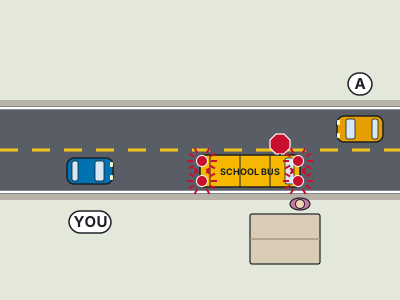
- Immediately when the last red light goes dark
- After children have completely left the roadway and it is safe
- When the driver behind starts moving
- After passing the bus on the shoulder
Show answer
After children have completely left the roadway and it is safe. The end of the red flashing signal is not the only condition. Drivers must continue watching for children and may proceed only after the children have completely left the roadway and it is safe. Following another driver or using the shoulder does not replace that check. Keep the vehicle stopped, scan along both sides of the bus and the road, and resume slowly only when no child remains in the travel path.
Study this in the handbook: Right of Way at Intersections
5. What does a green turn arrow permit when the arrow is illuminated?
- A turn in the arrow direction while the path remains free of oncoming and crossing traffic
- A turn across pedestrians without yielding
- A U-turn in any lane regardless of signs
- A turn while ignoring vehicles already in the intersection
Show answer
A turn in the arrow direction while the path remains free of oncoming and crossing traffic. A green arrow allows a driver to turn in the arrow direction, but the movement still depends on the path being clear of oncoming or crossing traffic. The arrow does not cancel pedestrian safety, override a vehicle already occupying the intersection, or authorize every type of turn. Confirm that the intended lane and crossing area are open, then steer through the turn without assuming the signal protects against every conflict.
Study this in the handbook: Traffic Lights, Arrows and HAWK Signals
6. At an intersection without a working stop light, what must a driver do?
- Proceed first if the driver reaches the line before others
- Treat the signal as a flashing yellow light
- Stop as though the intersection were controlled by a stop sign
- Wait for a police officer before moving
Show answer
Stop as though the intersection were controlled by a stop sign. An inoperative stop light does not make the intersection uncontrolled. The manual directs drivers to stop as if a stop sign governs the crossing. A flashing yellow interpretation would allow movement without the required stop, and reaching the line first does not establish a right to proceed. After stopping, scan for traffic and pedestrians, then continue only when the intersection is safe.
Study this in the handbook: Railroad Crossings and Work Zones
7. What is the lowest BAC threshold for Connecticut's under-21 alcohol driving rule?
- 0.15% or more
- 0.08% or more
- 0.10% or more
- 0.02% or more
Show answer
0.02% or more. Connecticut defines the under-21 zero-tolerance threshold as .02 percent or more, and the rule applies on both public roads and private property. A response using .08 percent describes the usual adult per se threshold, not this youth rule. The word measurable is useful here because the law does not require a high BAC before consequences begin. When studying this item, connect under 21 with .02 percent and remember that the location does not create an exception.
Study this in the handbook: Zero Tolerance for Drivers Under 21
8. When entering a roadway from a driveway or private alley, whom must you yield to?
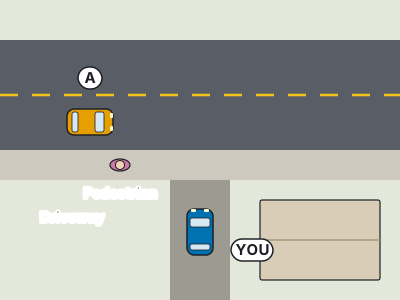
- Traffic already on the roadway
- Only vehicles approaching from the left
- Only pedestrians on the sidewalk
- No one if you stop first
Show answer
Traffic already on the roadway. A driver entering from a driveway or private alley must yield to vehicles already traveling on the roadway. Stopping before the edge is prudent, but stopping first does not create priority. The rule also is not limited to traffic from one direction because the roadway may carry vehicles from either side. Pause at the entrance, scan for vehicles and pedestrians, and enter only after the roadway is clear.
Study this in the handbook: Right of Way at Intersections
9. A school bus is stopped with red lights flashing on your side of a two-way road. What is required?
- Continue if you are traveling toward the bus
- Pass slowly if no children are visible
- Stop only if the bus driver extends the stop arm
- Stop and remain stopped until it is safe to proceed
Show answer
Stop and remain stopped until it is safe to proceed. A stopped school bus displaying flashing red lights requires a stop whether the bus is on your side, across the road, or at an approaching intersection. The driver must wait until the red lights stop flashing, watch for children beside the road, and proceed only after they have completely left the roadway and it is safe. Visibility of children does not remove the duty to stop. The physical-barrier exception applies only to a bus traveling toward you on the other side of a divided roadway.
Study this in the handbook: Emergency Vehicles, Move Over and School Buses
10. What is the safest response when another driver behaves aggressively toward you?
- Use your vehicle to block the driver's path
- Chase the driver so you can explain the problem
- Avoid retaliation and leave punishment to the police
- Race ahead to prove that you will not be intimidated
Show answer
Avoid retaliation and leave punishment to the police. The manual recommends self-control when another road user drives aggressively. Do not turn the vehicle into a tool for retaliation or compete with the other driver. Chasing, blocking, and racing can turn an unsafe encounter into a crash or a road-rage confrontation. Leave enforcement to police and report the conduct after reaching your destination. A useful cue is to create distance and keep driving defensively, rather than trying to teach the other driver a lesson in traffic.
Study this in the handbook: Distractions, Fatigue and Aggressive Driving
11. What fine does Connecticut law set when a driver age 18 or older is cited for not wearing a seat belt?
- $10
- A warning only
- $500
- $50
Show answer
$50. Under section 14-100a of the Connecticut General Statutes, a driver who is 18 or older, and a passenger riding with that driver, commits an infraction and is fined $50 for a seat belt violation. The higher $75 fine applies when the operator is under 18, and to passengers riding with an under 18 operator, and the manual's own $75 figure matches that under 18 rate. The statute also says no points may be assessed for this violation. With a two part belt system, wear both the lap and shoulder belt, because either part alone greatly reduces protection.
12. During months seven through twelve after licensing, which passengers may be added to the Connecticut teen driver's permitted passenger group?
- Any friend with a valid license
- Only a driving instructor
- All passengers under age 21
- Members of the driver's immediate family
Show answer
Members of the driver's immediate family. Connecticut expands the passenger allowance during the second six months of a teen license. Months seven through twelve add members of the driver's immediate family to the people already permitted during the first six months. The rule does not open the vehicle to every licensed friend or every person under 21. A driving instructor was already part of the earlier permitted group, so that option does not describe the new category. The timing is the key cue: immediate family becomes the additional group after month six.
Study this in the handbook: Teen Training, Passengers and Curfew
13. What score is required to pass Connecticut's learner's permit knowledge test?
- 15 correct out of 20
- 20 correct out of 25
- 18 correct out of 25
- 23 correct out of 30
Show answer
20 correct out of 25. The Connecticut knowledge test contains 25 questions, and an applicant needs 20 correct answers to pass. That is an 80 percent threshold. The 18-of-25 choice understates the required score, while the 23-of-30 option changes both the test length and passing count. The manual also says the test must be passed before the learner's permit is issued. For a quick check, pair the test size of twenty-five with the passing count of twenty rather than estimating a percentage.
Study this in the handbook: The Learner's Permit and License Tests
14. What happens to a Connecticut driver under 18 convicted of violating the cell phone law?
- A $50 fine only
- A warning
- Nothing until age 18
- A license suspension, plus a moving violation counted toward operator retraining
Show answer
A license suspension, plus a moving violation counted toward operator retraining. A 16 or 17 year old who violates Connecticut's cell phone law is charged with a moving violation, and if the operator is under age 18 a conviction results in a license suspension. It also counts as a moving violation when determining whether attendance in the operator retraining program is required. Drivers who are 16 or 17 may not use any cell phone or mobile electronic device while driving, not even a hands free one.
Study this in the handbook: Seat Belts, Child Seats and Phone Laws
15. A broken yellow line is beside a solid yellow line. Which side may pass?
- Traffic beside the solid line, whenever no vehicle is visible
- Traffic beside the broken line, when the maneuver is safe
- Neither side, because any yellow line prohibits passing
- Both sides, if drivers activate their turn signals
Show answer
Traffic beside the broken line, when the maneuver is safe. The paired marking assigns different rules to the two sides. Passing is permitted on the side of the broken yellow line, while it is not permitted on the side of the solid yellow line. A clear view or a turn signal does not cancel the solid-line restriction. The claim that every yellow line prohibits passing ignores the broken-line permission. Before moving left, identify which line is nearest your vehicle and confirm that the maneuver is safe.
Study this in the handbook: Pavement Markings and Special Lanes
16. What do all red signs mean in Connecticut?
- They mark construction
- They are warnings only
- They are regulatory signs that must be obeyed, such as STOP, YIELD, DO NOT ENTER and WRONG WAY
- They give directions
Show answer
They are regulatory signs that must be obeyed, such as STOP, YIELD, DO NOT ENTER and WRONG WAY. All red signs are regulatory signs and must be obeyed; they include STOP, YIELD, DO NOT ENTER and WRONG WAY. Some black and white signs are also regulatory, while yellow is used for warning signs, orange warns of construction and maintenance projects, and green guide signs tell you where you are, which way to go, and the distance. The manual says the shapes and colors of signs give clues about the types of information they provide.
Study this in the handbook: Sign Shapes and Regulatory Signs
17. What is the safest first response when tires begin to lose traction on a wet roadway?
- Ease off the gas and keep the steering wheel straight
- Brake hard and turn sharply toward the shoulder
- Accelerate to push the tires through the water
- Turn repeatedly from side to side
Show answer
Ease off the gas and keep the steering wheel straight. The manual describes hydroplaning as tires riding up on water and losing contact with the road. When traction fades, the driver should ease off the gas and hold the steering wheel straight. Turning should wait unless an emergency requires it, and any necessary turn should be slow. Hard braking, acceleration, or repeated steering can make the vehicle skid before the tires reconnect with the pavement. A good cue is to reduce speed before standing water becomes a crisis and make no abrupt input while the tires are floating.
Study this in the handbook: Slippery Roads, Hydroplaning and Curves
18. How should speed change as a road becomes wet, packed with snow, and then icy?
- Keep the posted speed in all three conditions
- Increase speed to maintain tire momentum
- Slow only after the vehicle starts sliding
- Reduce speed about 10 mph on wet roads, halve it on packed snow, and crawl on ice
Show answer
Reduce speed about 10 mph on wet roads, halve it on packed snow, and crawl on ice. Connecticut gives progressively stronger speed guidance as traction declines. On a wet road, the manual says to reduce speed by about 10 mph. On packed snow, cut speed in half. On ice, slow to a crawl because driving there is very dangerous. Waiting for a slide means the correction comes too late, and the posted limit does not guarantee safe traction. Increasing speed makes stopping and steering harder. The cue is to respond to the surface immediately, starting with the first sign of rain, snow, or sleet.
Study this in the handbook: Slippery Roads, Hydroplaning and Curves
19. At a railroad crossing, what right-of-way rule applies to an approaching train?
- The driver yields only when gates are down
- The train must yield to road traffic
- The driver must yield to the train
- The driver has priority if already on the crossing
Show answer
The driver must yield to the train. A train crossing the roadway has the right of way, so the driver must yield and remain clear until the crossing is safe. Gates and flashing lights are additional warnings, not the only situations in which yielding matters. The choice saying the train yields reverses the rule, and being on the crossing first does not create permission to remain in the path of a train. Approach slowly, look and listen in both directions, and never enter unless there is enough room to clear the tracks completely.
Study this in the handbook: Railroad Crossings and Work Zones
20. Which statement describes the special Connecticut cell phone rule for a licensed driver aged 16 or 17?
- Hands-free calls are permitted, but texting is not
- All phone use is prohibited, including hands-free use
- Phone use is allowed when the vehicle is stopped in traffic
- Only mobile devices with screens are prohibited
Show answer
All phone use is prohibited, including hands-free use. For a 16- or 17-year-old, Connecticut prohibits every type of cell phone or mobile electronic device while driving, and that includes hands-free equipment. The rule is broader than the adult restriction on hand-held use. A stopped vehicle in traffic is not a safe loophole because the manual also prohibits device use during temporary stops caused by traffic, road conditions, or a control signal. The age of the driver and the words including a hands-free device are the key cues.
Study this in the handbook: Distractions, Fatigue and Aggressive Driving
QualitySpace is expanding to Connecticut
We are a California-based independent insurance brokerage working on licensing in more states. We cannot help with Connecticut insurance yet. Leave your email and we will let you know when we can.
Every question is written from the official Connecticut Driver's Manual. Need paper? Printable CT practice test with answer key.
Last verified 2026-10-05. How we check every question · Study all 210 as flashcards
Frequently asked questions
How many questions are on this Connecticut practice test?
This fixed set has 20 questions. It is test 9 of 10 from the 210 question Connecticut bank. The real CT exam asks 25 questions and you need 20 correct.
What is the passing score for the real Connecticut test?
20 of 25 correct (80%) That figure comes from the official Connecticut source cited on the DMV facts page.
How does this fixed test relate to the full Connecticut bank?
Each numbered test is a fixed set of questions in a fixed order, so you can retake the same test later and compare. Every test mixes road signs and the other topics in about the same proportion as the full bank. Tests 1 to 10 together cover 200 of the 210 questions in the Connecticut bank, each once. The full practice page mixes the whole bank at random.
Last verified 2026-10-05. See the Connecticut DMV facts page for sourced state details.
Return to the full Connecticut practice test · Study road signs