
Key points
A crossbuck means the same as a yield sign; you must yield to crossing trains.
Source: Handbook p. 52
“This sign has the same meaning as a “Yield” sign. You must yield to crossing trains.”
Connecticut Driver's Manual, Handbook p. 52At gates with flashing lights, stop when the lights begin to flash and stay stopped until the gates rise and the lights stop.
Source: Handbook p. 52
“Stop when the lights begin to flash and before the gate lowers. Remain stopped until the gates are raised and the lights stop flashing.”
Connecticut Driver's Manual, Handbook p. 52Never start across the tracks unless there is room for your vehicle on the far side.
Source: Handbook p. 51
“Never start to cross if there is not room for your vehicle on the far side and if you will have to stop on the tracks”
Connecticut Driver's Manual, Handbook p. 51A blue Emergency Notification System sign at a crossing gives a phone number to report problems.
Source: Handbook p. 51
“A blue colored Emergency Notification System sign can be found at highway-rail grade crossings”
Connecticut Driver's Manual, Handbook p. 51At crossings with more than one track, wait until the train is well down the track; another may be hidden.
Source: Handbook p. 15
“At crossings with more than one track, wait until the passing train is well down the track before starting to cross.”
Connecticut Driver's Manual, Handbook p. 15Work zone signs are orange with black letters or symbols.
Source: Handbook p. 15
“All temporary signs in work zones have an orange background and black letters or symbols.”
Connecticut Driver's Manual, Handbook p. 15Speeding or endangering a worker in a work zone can bring fines up to $1,000 and points.
Source: Handbook p. 15
“anyone convicted of speeding, disobeying traffic control devices, using an improper lane or endangering a highway worker within a work zone could face fines of up to $1,000, can be assessed points against his or her driver’s license”
Connecticut Driver's Manual, Handbook p. 15Distracted driving fines are doubled for hand held phone use in a work zone.
Source: Handbook p. 15
“distracted driving fines are doubled for anyone convicted of illegally using a hand-held cellphone or mobile electronic device while driving in a work zone.”
Connecticut Driver's Manual, Handbook p. 15
Recognize these signs

Railroad crossing ahead 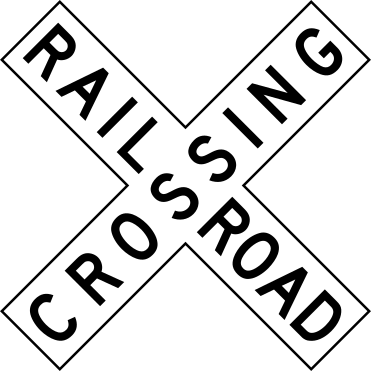
Railroad crossbuck 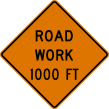
Road work ahead 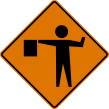
Flagger ahead 
Detour
3 questions from the Connecticut practice test
1. What does a white railroad crossbuck require when trains are crossing?
- Stop only if a gate is lowered
- Speed up to clear the tracks first
- Yield to crossing trains
- Treat the tracks as a normal intersection with no special duty
Show answer
Yield to crossing trains. A railroad crossbuck carries a yield meaning for trains. Approach the tracks cautiously, reduce speed, look and listen, and give the train the right-of-way. Do not race to clear the crossing or wait for a gate before taking the warning seriously. A crossbuck is not an ordinary intersection sign with no special duty. If signals, gates, or a train indicate danger, remain clear of the tracks until the crossing is safe.
2. A railroad crossbuck has the same meaning as which traffic sign?
- Do Not Enter
- Stop
- Yield
- Speed Limit
Show answer
Yield. The white X-shaped railroad crossbuck carries the meaning of a yield sign, so a driver must yield to crossing trains. That does not mean every crossing requires a routine stop when no train is present, which is why Stop is too broad. The crossbuck is also not a restriction on entry or a speed-limit sign. Slow as you approach, look and listen along the tracks, and enter only when you can yield safely and clear the crossing.
3. What does an orange roadway sign generally warn drivers about?
- A nearby hospital or fuel station
- Construction or maintenance dangers ahead
- A route destination and distance
- A permanent speed limit
Show answer
Construction or maintenance dangers ahead. Orange signs identify temporary or active work conditions, including construction and maintenance projects. They may warn about people working near the road, reduced speeds, detours, equipment, or a changing surface. Blue signs point to services, green signs guide drivers to destinations, and a speed limit is a regulatory message rather than the general meaning of orange. When you see orange, expect the roadway to change and follow any flagger, lane control, reduced speed, or detour instruction shown. The color is your early work-zone cue.
Practice this topic
Lock it in with road signs questions from the free Connecticut practice test. Every answer comes with a plain English explanation.
Source: the Connecticut Driver's Manual, Know the Road: Traffic Signs. This lesson is a plain English summary, not the law itself; where it differs, the manual and the statute govern. Last checked 2026-09-27.