Every question below comes from the Arkansas question bank on this page. Open a question to see the correct answer and the explanation. Nothing here is hidden behind a signup.
1. If your vehicle begins to hydroplane, what should you do?
- Accelerate until the tires cut through the water
- Brake hard and turn quickly toward the shoulder
- Slowly take your foot off the gas and keep the steering wheel straight
- Turn the wheel back and forth rapidly
Show answer
Slowly take your foot off the gas and keep the steering wheel straight. During hydroplaning, the tires have lost contact with the road because they are riding on water. Full explanation in Test 1
Study this in the handbook: Slippery Roads and Hydroplaning
2. After a minor Arkansas crash, what does state law say to do with your vehicle if it can be moved?
- Leave it exactly where it stopped for the police
- Drive home and report later
- Push it into the median
- Move it from the roadway so it does not block traffic
Show answer
Move it from the roadway so it does not block traffic. Arkansas law says that if you are in a traffic crash you should move the vehicle from the roadway so it does not block traffic. Full explanation in Test 2
Study this in the handbook: Vehicle Emergencies and Crashes
3. What license penalty can a court order for violating Arkansas's law on moving over for a stopped police vehicle?
- A warning only
- Suspension of the license for up to six months
- A permanent revocation
- A one year mandatory revocation
Show answer
Suspension of the license for up to six months. A driver found guilty of failing to move over for a stopped law enforcement vehicle with its lights on can be fined, jailed, or both, and th Full explanation in Test 3
Study this in the handbook: Emergency Vehicles and the Move Over Law
4. In Arkansas, smoking tobacco in a vehicle is prohibited when it carries a passenger younger than what age?
- 12
- 14
- 16
- 18
Show answer
14. The secondhand-smoke rule prohibits knowingly smoking tobacco in a motor vehicle when a child passenger is less than fourteen years old. Full explanation in Test 4
Study this in the handbook: Seat Belts, Child Seats and Littering
5. For a first littering conviction in Arkansas, what is the maximum fine described in the study guide?
- $250
- $500
- $1,000
- $2,000
Show answer
$1,000. The first-offense littering penalty can reach one thousand dollars, with community service also possible. Full explanation in Test 5
Study this in the handbook: Seat Belts, Child Seats and Littering
6. How should you adjust your speed on packed snow, according to the Arkansas guide?
- Keep the posted speed
- Cut your speed in half
- Slow by 5 mph
- Speed up to keep momentum
Show answer
Cut your speed in half. On packed snow, the guide says to cut your speed in half, and on ice you must slow to a coast. Full explanation in Test 6
Study this in the handbook: Speed Limits and Road Conditions
7. At what age may an Arkansas applicant obtain a non-restricted Class D license?
- 21
- 14
- 16
- 18
Show answer
18. The manual sets 18 as the minimum age for a non-restricted license. Full explanation in Test 7
Study this in the handbook: Who Needs a License and Vision Rules
8. For which ages does Arkansas issue the Intermediate License?
- 16 to 18
- 14 to 16
- 18 to 21
- 15 to 17
Show answer
16 to 18. The Intermediate License is a restricted license for drivers between 16 and 18. Full explanation in Test 8
Study this in the handbook: Instruction Permits and Graduated Licenses
9. A 25 year old Arkansas driver wants to send a quick text at a slow speed. What does the Arkansas guide say?
- It is allowed for drivers over 21
- Text messages are not allowed regardless of age
- It is allowed with one hand on the wheel
- It is allowed on rural roads
Show answer
Text messages are not allowed regardless of age. The Arkansas guide states that text messages are not allowed regardless of age. Full explanation in Test 9
Study this in the handbook: Instruction Permits and Graduated Licenses
10. During which hours may an Arkansas Intermediate License holder not drive unless an exception applies?
- Midnight to 5:00 am
- 10:00 pm to 5:00 am
- 11:00 pm to 4:00 am
- 9:00 pm to 6:00 am
Show answer
11:00 pm to 4:00 am. An intermediate driver may not drive between 11:00 pm and 4:00 am unless a licensed driver 21 or older is along, or the trip is to or from a Full explanation in Test 10
Study this in the handbook: Instruction Permits and Graduated Licenses
11. You hear sirens while your vehicle is inside an intersection. What is the safest next move?
- Stop immediately in the intersection
- Drive through the intersection, then pull over to the right
- Turn left and follow the emergency vehicle
- Remain stopped until the emergency vehicle turns away
Show answer
Drive through the intersection, then pull over to the right. A driver who is in an intersection should clear that intersection before pulling over for the approaching emergency vehicle. Full explanation in Test 1
Study this in the handbook: Emergency Vehicles and the Move Over Law
12. What is the minimum age to apply for an Arkansas instruction permit?
- 16
- 15
- 14
- 13
Show answer
14. An applicant must be at least 14 to apply for an Arkansas instruction permit, and must pass the knowledge exam and vision test to receive it Full explanation in Test 2
Study this in the handbook: Instruction Permits and Graduated Licenses
13. Who must ride with a 15 year old driving on an Arkansas Learner's License?
- No one, once the license is issued
- A licensed driver at least 21 years old
- Any licensed driver 16 or older
- A parent, even if unlicensed
Show answer
A licensed driver at least 21 years old. A Learner's License holder must be accompanied by a licensed driver who is at least 21, and all passengers must wear seat belts. Full explanation in Test 3
Study this in the handbook: Instruction Permits and Graduated Licenses
14. Within what period must a person who becomes an Arkansas resident obtain an Arkansas driver's license?
- Within 10 calendar days
- Within six months
- Within 60 calendar days
- Within 30 calendar days
Show answer
Within 30 calendar days. A new Arkansas resident has thirty calendar days to obtain an Arkansas driver's license for driving on state streets and highways. Full explanation in Test 4
Study this in the handbook: Who Needs a License and Vision Rules
15. What should an Arkansas driver do when rain or ice makes the posted speed unsafe?
- Maintain the posted number because it is always safe
- Adjust speed to current road conditions
- Increase speed to reduce time on the road
- Use the posted speed only after turning on hazard lights
Show answer
Adjust speed to current road conditions. Arkansas treats posted speed limits as values for ideal conditions. Full explanation in Test 5
Study this in the handbook: Speed Limits and Road Conditions
16. How close to a fire hydrant may you park in Arkansas?
- No closer than 10 feet
- No closer than 30 feet
- No closer than 20 feet
- No closer than 15 feet
Show answer
No closer than 15 feet. Arkansas prohibits parking within 15 feet of a fire hydrant. Full explanation in Test 6
Study this in the handbook: Parking Rules and Accessible Parking
17. What cell phone activity may an Arkansas Learner's License holder use while operating a motor vehicle?
- Talking or texting whenever the phone is hands-free
- Cell phone use only during an emergency
- Texting only at red lights
- Talking only when a licensed adult is beside the driver
Show answer
Cell phone use only during an emergency. The learner stage carries a narrow emergency exception. Full explanation in Test 7
Study this in the handbook: Instruction Permits and Graduated Licenses
18. How much more likely are distracted teens who text while driving to crash, according to research cited in the Arkansas guide?
- 23 times more likely
- Twice as likely
- No more likely
- Half as likely
Show answer
23 times more likely. National research has found that distracted teens who are texting while driving are 23 times more likely to be involved in a crash, and thos Full explanation in Test 8
Study this in the handbook: Work Zones
19. What does the yellow warning sign shown here tell a driver about the roadway?

- The roadway has reached its maximum legal speed
- A special situation or hazard may be along the road ahead
- A parking space is reserved beyond the sign
- The driver must turn at the next intersection
Show answer
A special situation or hazard may be along the road ahead. A yellow warning sign gives advance notice of something that may affect driving ahead. Full explanation in Test 9
Study this in the handbook: Stop, Yield and Regulation Signs
20. When may a vehicle with an Arkansas Special Certificate (accessible parking hang tag) park in an accessible space?
- Whenever the tag is hanging from the mirror
- Whenever a family member drives
- Only when the person with the disability is present in the vehicle
- Only on weekdays
Show answer
Only when the person with the disability is present in the vehicle. A Special Certificate is registered to the person with the disability and can move between vehicles, but that person must be present in the Full explanation in Test 10
Study this in the handbook: Parking Rules and Accessible Parking
21. If moving over for a stationary roadside vehicle is unsafe or impossible, what should you do?
- Reduce speed to a safe level and proceed with caution
- Maintain the posted speed and pass close to the vehicle
- Stop in the traffic lane until the roadside vehicle leaves
- Use the shoulder to avoid making any adjustment
Show answer
Reduce speed to a safe level and proceed with caution. Arkansas's Move Over guidance provides a fallback when changing lanes cannot be done safely: reduce speed to a safe level for the conditions Full explanation in Test 1
Study this in the handbook: Emergency Vehicles and the Move Over Law
22. What should you do if you reach a stationary object before finishing the four second sight distance count?
- Speed up to finish the count sooner
- Slow down because you are going too fast for the conditions
- Keep the same speed because the object is stationary
- Stop in the travel lane and wait for the object to move
Show answer
Slow down because you are going too fast for the conditions. The four second sight distance rule checks whether your speed matches what you can see ahead. Full explanation in Test 2
Study this in the handbook: Speed Limits and Road Conditions
23. What restraint is required for an Arkansas child younger than six who weighs less than 60 pounds?
- A properly secured child passenger safety seat
- A lap belt without any child seat
- An adult shoulder belt only
- No restraint when seated in the rear
Show answer
A properly secured child passenger safety seat. Arkansas requires this child to ride in a child passenger safety seat that is properly secured to the vehicle. Full explanation in Test 3
Study this in the handbook: Seat Belts, Child Seats and Littering
24. A school bus is stopped with red lights flashing. When may a driver pass it?
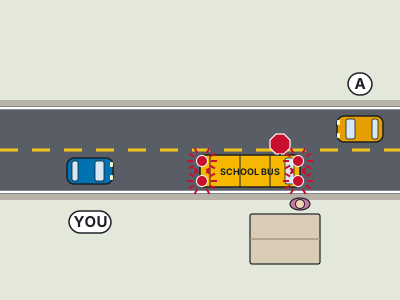
- Whenever the driver is traveling in the opposing lane
- As soon as no child is visible near the roadway
- After slowing to five miles per hour
- After the bus finishes loading or unloading and begins moving without red lights
Show answer
After the bus finishes loading or unloading and begins moving without red lights. A driver approaching a stopped school bus with red lights flashing must make a complete stop and remain stopped. Full explanation in Test 4
Study this in the handbook: Stopping for School Buses
25. How much following space should a driver allow behind a motorcycle?
- At least four to six seconds
- The same one second used behind a passenger car
- One car length at every speed
- No more than two seconds because motorcycles stop quickly
Show answer
At least four to six seconds. The guide calls for at least four to six seconds when following a motorcycle. Full explanation in Test 5
Study this in the handbook: Trucks, Motorcycles and Bicycles
26. A yellow warning sign with a crossing symbol is approaching. What is the safest response?

- Stop immediately in the travel lane even when the road is clear
- Maintain speed because warning signs are only suggestions for pedestrians
- Slow down, watch for the warned condition, and be ready to stop
- Move onto the shoulder to avoid crossing traffic
Show answer
Slow down, watch for the warned condition, and be ready to stop. The crossing symbol alerts the driver to a possible intersection or crossing hazard ahead. Full explanation in Test 6
Study this in the handbook: Stop, Yield and Regulation Signs
27. How close to a stop sign, traffic signal, or yield sign may you park in Arkansas?
- No closer than 15 feet
- No closer than 30 feet
- No closer than 50 feet
- No closer than 5 feet
Show answer
No closer than 30 feet. Arkansas prohibits parking within 30 feet of a traffic signal, stop sign, or yield sign, and the same 30 feet applies to a pedestrian safety Full explanation in Test 7
Study this in the handbook: Parking Rules and Accessible Parking
28. When should a driver use emergency flashers or hazard lights?
- To replace a turn signal during every lane change
- To warn other drivers of an emergency or broken-down vehicle
- To claim priority while entering an intersection
- To tell following drivers that a turn is optional
Show answer
To warn other drivers of an emergency or broken-down vehicle. Emergency flashers warn other drivers about an emergency, a broken-down vehicle, or a car parked on the side of the road. Full explanation in Test 8
Study this in the handbook: Headlights, Horn and Signals
29. At what alcohol concentration can an Arkansas driver be arrested for driving while intoxicated?
- 0.08 percent or more in breath or blood
- 0.04 percent or more in breath or blood in every case
- 0.02 percent or more in breath or blood
- 0.10 percent or more in breath only
Show answer
0.08 percent or more in breath or blood. The guide identifies 0.08 percent in breath or blood as the concentration for arrest for driving while intoxicated. The 0. Full explanation in Test 9
Study this in the handbook: Drinking and Driving
30. According to the Arkansas guide, which driving ability is affected first by alcohol?
- Hearing
- Judgment
- Night vision only
- Steering strength
Show answer
Judgment. The guide says the first driving ability affected by alcohol is judgment. Full explanation in Test 10
Study this in the handbook: Drinking and Driving
31. What is Isaac's Law in Arkansas?
- A law requiring child seats until age 8
- A person who negligently causes a death while violating the school bus law faces a Class C felony for negligent homicide
- A law banning texting for teens
- A law setting school zone speed limits
Show answer
A person who negligently causes a death while violating the school bus law faces a Class C felony for negligent homicide. Isaac's Law, section 5-10-105, makes a person who violates the school bus stopping law and negligently causes the death of another person su Full explanation in Test 1
Study this in the handbook: Stopping for School Buses
32. A driver enters a road from a driveway. To whom must the driver yield?
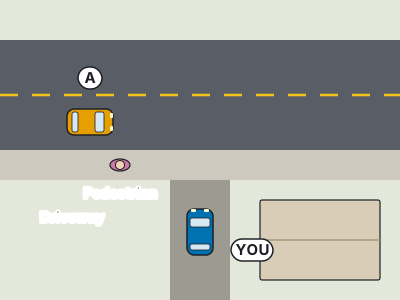
- No one because the driveway is private
- Only traffic approaching from the left
- Only traffic approaching from the right
- Vehicles already on the main road
Show answer
Vehicles already on the main road. Traffic already traveling on the main road has priority over a vehicle emerging from a driveway, alley, or roadside. Full explanation in Test 2
Study this in the handbook: Right of Way at Intersections
33. When must a driver stop for a school bus displaying flashing red lights in Arkansas?
- Only when traveling behind the bus in the same lane
- Only when the bus is stopped at a marked school zone
- Only when a crossing guard is visible
- Whenever approaching the bus, unless an opposite lane is separated by a median at least 20 feet wide
Show answer
Whenever approaching the bus, unless an opposite lane is separated by a median at least 20 feet wide. A stopped bus with flashing red lights requires a complete stop regardless of whether the driver is behind it, opposite it, or approaching a Full explanation in Test 3
Study this in the handbook: Stopping for School Buses
34. How far before a turn or lane change should you begin using your turn signal?
- 100 feet
- 25 feet
- 50 feet
- 200 feet
Show answer
100 feet. Arkansas directs drivers to use turn signals 100 feet before a lane change, a right turn, a left turn, a merge, or parking. Full explanation in Test 4
Study this in the handbook: Headlights, Horn and Signals
35. What information does an Emergency Notification System sign at a highway rail crossing provide?
- A detour route for every nearby road
- The train's exact arrival time and speed
- The posted speed limit for the highway
- A railroad contact and the specific crossing identification
Show answer
A railroad contact and the specific crossing identification. An Emergency Notification System sign supplies critical contact information for a highway rail crossing. Full explanation in Test 5
Study this in the handbook: Warning and Railroad Crossing Signs
36. Before turning right on red in Arkansas, what must a driver do?
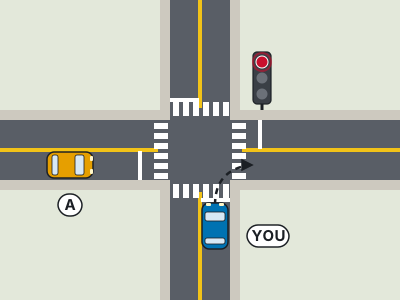
- Slow down and turn without stopping if the lane looks clear
- Make a complete stop and check for opposing traffic and pedestrians
- Wait for a green arrow even when no sign restricts the turn
- Stop in the crosswalk to improve the view
Show answer
Make a complete stop and check for opposing traffic and pedestrians. A right turn on red begins with a complete stop and a check for opposing traffic. Full explanation in Test 6
Study this in the handbook: Turns, Lane Changes and Passing
37. An emergency vehicle approaches with flashing lights and a siren. What should you do?
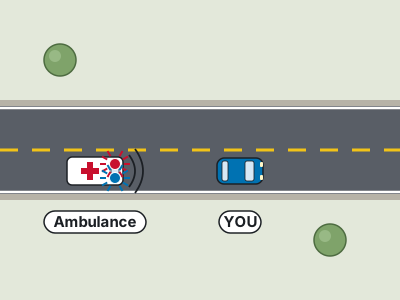
- Pull to the right edge, or as near to the right as possible
- Stop in the intersection where you first hear the siren
- Follow the emergency vehicle closely through traffic
- Move left and maintain your current speed
Show answer
Pull to the right edge, or as near to the right as possible. Arkansas directs a driver facing an approaching emergency vehicle with flashing lights and sirens to pull to the right edge of the road, or Full explanation in Test 7
Study this in the handbook: Emergency Vehicles and the Move Over Law
38. What can happen to someone who illegally uses another person's accessible parking certificate in Arkansas?
- A $10 parking fee
- A verbal warning
- Nothing if the owner gave permission
- A Class A misdemeanor for fraud, with fines from $100 to $500 for a first offense
Show answer
A Class A misdemeanor for fraud, with fines from $100 to $500 for a first offense. Anyone who illegally uses another person's special certificate has committed fraud and can be found guilty of a Class A misdemeanor under Ar Full explanation in Test 8
Study this in the handbook: Parking Rules and Accessible Parking
39. What do Arkansas warning signs tell a driver to do?

- Increase speed before reaching the sign
- Slow down and be prepared to stop if necessary
- Ignore the roadway condition unless a signal is present
- Stop immediately at every warning sign
Show answer
Slow down and be prepared to stop if necessary. Warning signs give advance information about a hazard or special situation along the road ahead. Full explanation in Test 9
Study this in the handbook: Warning and Railroad Crossing Signs
40. For how long is an Arkansas instruction permit valid, counted from the date the knowledge exam is passed?
- It remains valid for five years
- It expires after six months
- It is issued for two years
- It is valid only until the next birthday
Show answer
It is issued for two years. The instruction permit runs for two years from the date the applicant passes the knowledge exam. Full explanation in Test 10
Study this in the handbook: Instruction Permits and Graduated Licenses
