
Test 13 of 25 · 20 questions · Free 2026
AR Permit Practice Test 13
Jump to the test ↓A fixed 20 question set from the Arkansas bank with answers and plain English explanations.
Question 1 of 20 · 0 right so far
All 20 questions in test 13
Every question below comes from the Arkansas question bank on this page. Open a question to see the correct answer and the explanation. Nothing here is hidden behind a signup.
1. In Arkansas, how does a driver start the two-second following-distance count?
- Count when your front bumper first passes the vehicle ahead of you
- Count only while stopped and waiting at a traffic light ahead
- Count from when its rear passes a fixed point until you reach it
- Estimate car lengths by eye without using any roadside point
Show answer
Count from when its rear passes a fixed point until you reach it. The count begins the moment the back of the lead vehicle clears a fixed spot on the roadside. A sign, pole, or pavement mark can serve as that spot. Reaching it too quickly shows the gap is thin, so dropping back and counting again restores space. Guessing by car lengths alone is unreliable because speed changes what a safe gap looks like. Repeating the count after slowing confirms that the new spacing truly holds.
Study this in the handbook: Emergency Vehicles and the Move Over Law
2. What alcohol concentration is safe for operating a vehicle in Arkansas?
- There is no safe alcohol concentration for operating a vehicle
- Any amount below the arrest limit is safe to drive on
- One drink worth of alcohol is always safe for driving
- Alcohol is safe for driving if you also ate a full meal
Show answer
There is no safe alcohol concentration for operating a vehicle. No alcohol concentration is described as safe for operating a vehicle. Staying below an arrest limit is a legal line, not a safety promise, and impairment can begin before that point. One drink can still affect a driver, so treating it as always safe is wrong. Food may slow how fast alcohol enters the blood, yet it does not make drinking and driving safe. The clear rule for a teen to remember is simple: drinking and driving do not mix at any level.
Study this in the handbook: Drinking and Driving
3. Vehicles are building up behind you because you are driving much slower in Arkansas. What should you do?
- Keep blocking the line so others slow down
- Pull over and allow the vehicles to pass
- Speed up well beyond the flow of traffic
- Brake often so drivers behind keep back
Show answer
Pull over and allow the vehicles to pass. Driving far below the pace of same-direction traffic can be as disruptive as speeding. Cars stacking up behind you may pass in risky places or follow too closely. Pulling over where it is safe lets that line clear and restores a steadier flow. Then reenter at a pace that matches traffic and conditions. If your vehicle cannot keep up on hills, give others room and time to get around you safely.
Study this in the handbook: Speed Limits and Road Conditions
4. When merging with traffic from a ramp in Arkansas, at what speed should you enter the main road?
- At the same speed as other traffic
- Much slower than traffic already on the road
- Only after stopping at the end of the ramp
- Faster than all traffic to claim a gap
Show answer
At the same speed as other traffic. Entering a busy road works best when your speed matches the vehicles already there. Ramps on high-speed roads give room to build that pace before you pull on. A slow entry forces drivers behind to brake, while a stop at the ramp end leaves you trying to join fast traffic from zero. Check blind spots over your shoulder, use the ramp fully, and choose a gap with space around your vehicle.
Study this in the handbook: Speed Limits and Road Conditions
5. Flashing lights appear behind you on a dark road and you are unsure the driver is a real police officer. What does the guide tell you to do?
- Speed up and keep driving until you reach your own driveway
- Stop in the lane and lock the doors to wait
- Signal, pull to the nearest well-lit spot, and call 9-1-1
- Pull onto the shoulder and turn off the lights
Show answer
Signal, pull to the nearest well-lit spot, and call 9-1-1. If you are unsure that the person stopping you is an actual police officer, the guide says to activate your turn signal, pull to the nearest well-lit location, dial 9-1-1, and ask for confirmation that it is an officer. This answers the doubt without ignoring the stop. Speeding away, stopping in a travel lane, or sitting in the dark on the shoulder either avoids the stop or leaves you in a poor spot.
6. A car follows very close behind you on a multi-lane road. What is the safest way to handle it?
- Slow down quickly so the driver backs off
- Speed up until the driver falls behind
- Move right if you can and let it pass
- Brake lightly to flash your tail lights
Show answer
Move right if you can and let it pass. The guide says that if the car behind you is following too close, or you are being tailgated, you should move into the right lane if possible. This lets the tailgater go around you. The guide adds that you should never slow down too quickly to discourage a tailgater, because it will increase the risk of being hit from behind. Speeding up or braking to send a message only adds risk.
7. You approach a yield sign where cross traffic is moving steadily through the intersection. What must you do?
- Slow down and yield, stopping if traffic requires it
- Keep your speed and merge into the gap
- Stop completely every time, even if no traffic is anywhere near
- Honk and go because the sign is only a suggestion
Show answer
Slow down and yield, stopping if traffic requires it. A yield sign is triangular and shows the word YIELD or YIELD RIGHT OF WAY. The guide says it means the driver must slow down or yield the right of way to traffic in the intersection, and when approaching a yield sign you must yield to other vehicles and stop when necessary. With steady cross traffic you will need to stop, but with no traffic you may proceed after slowing.
Study this in the handbook: Stop, Yield and Regulation Signs
8. How must car drivers in Arkansas treat bicycles using public streets?
- Bicycles must always yield to every car at every place
- Bicycles belong only on sidewalks and parking lots
- Bicycles have the same rights and responsibilities as other vehicles
- Bicycles may ignore all lane sharing duties
Show answer
Bicycles have the same rights and responsibilities as other vehicles. A bicycle on a public street is traffic, not an obstacle outside the rules. Riders hold the same basic rights and duties as other vehicle users and share traffic lanes. Drivers should predict bicycle movement, leave room, and respect lawful lane use. Riders also must follow traffic duties rather than moving at random. Treating a bicycle as a vehicle helps everyone choose safer gaps and turns.
Study this in the handbook: Trucks, Motorcycles and Bicycles
9. You are about to enter an Arkansas work zone and wonder whether a lower speed applies. How will you be told?
- A flagger will call out the limit as you drive past
- The speed is always cut by half
- A reduced limit is not required in work zones
- A reduced speed will be posted in the work zone
Show answer
A reduced speed will be posted in the work zone. The guide says that through many work zones the speed limits may be reduced and lane use may be restricted for safety. Any reduced speed will be clearly posted within the work zone, and if there are no reduced speed limits posted, drivers should obey the normally posted speed limit. Watch the signs as you enter, and begin to slow down when you see them.
Study this in the handbook: Phone Laws and Distracted Driving
10. What authority does a flagger have in an Arkansas work zone?
- None, because flaggers only advise drivers who pass
- Only police officers may direct traffic inside a work zone
- Flaggers are legally authorized to direct traffic in work zones
- Flaggers may direct traffic only during night work hours
Show answer
Flaggers are legally authorized to direct traffic in work zones. Flaggers hold legal authority to direct traffic in Arkansas work zones and to manage flow through temporary road conditions. Their paddles and flags carry the force of law, not friendly advice. Police also direct traffic at times, but the flagger on site holds authority without waiting for an officer. That authority applies in daylight and at night whenever the flagger is posted. Treat every flagger direction as a binding order and follow it at once.
Study this in the handbook: Work Zones
11. You think about passing a slower vehicle on a two-lane road. What space check must you make before you pull out?
- Make sure the car ahead is not going faster than you
- Make sure you can stay in the passing lane
- Make sure the car behind you has dropped back
- Make sure there is room to return to your lane
Show answer
Make sure there is room to return to your lane. The guide says never to pass unless you have enough space to return to the driving lane. Before you pass, look ahead for road conditions and traffic that could cause other vehicles to move into your lane, and do not assume other drivers will make room for you. If there is not enough space to get back, a pass can end with you trapped in the oncoming lane.
Study this in the handbook: Pavement Markings and Lane Use
12. Parked vehicles block your view of crossing traffic at an intersection. What should you do?
- Ease forward until you can see crossing traffic
- Wait for the cars beside you to go through first
- Honk and go once the nearest lane looks clear
- Turn into the crosswalk and look from there
Show answer
Ease forward until you can see crossing traffic. The guide says to make sure you can clearly see crossing traffic before entering an intersection. If you are stopped and your view of a cross street is blocked, you should ease forward until you can see. Moving forward slowly lets you see approaching traffic without entering the path of vehicles. Honking and going, or pulling into the crosswalk, puts you in danger before you can see.
Study this in the handbook: Stopping Distance and Following
13. A tow truck with flashing lights is stopped on the shoulder, and you cannot move over because of traffic. What should you do?
- Hold your speed and stay in your current lane
- Slow down to a safe speed for conditions
- Speed up to pass the tow truck quickly
- Stop in the lane beside the tow truck
Show answer
Slow down to a safe speed for conditions. The guide says that if you are unable to move over, you should reduce your speed to a safe level for conditions, or to a legally mandated speed. Arkansas has expanded its move over law to include other vehicles with flashing lights, including ARDOT vehicles, construction vehicles, utility vehicles, and tow trucks. The law protects people working beside the road from being struck by passing vehicles.
Study this in the handbook: Emergency Vehicles and the Move Over Law
14. What does the red slash over the truck symbol on this Arkansas sign mean?
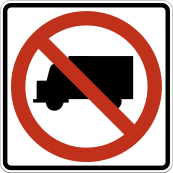
- Trucks are prohibited at this place
- Trucks must stop and check in
- Trucks may enter to deliver only
- A truck route begins here
Show answer
Trucks are prohibited at this place. A regulation sign with a red circle and a red slash over a symbol prohibits the pictured use. The slash over the truck symbol means trucks may not use that street or area. It is not a check in point, and it gives no delivery exception for entering. A truck route sign would guide trucks toward a road built for them, which is the reverse message. Whatever picture sits under the slash, that use is barred at the signed place.
Study this in the handbook: Stop, Yield and Regulation Signs
15. You park on a hill with a curb beside your car. How should you point the wheels?
- Straight ahead, because the brake alone will hold the car
- Turn them sharply away from traffic, toward the curb
- Toward the road so you can pull out easily later
- Straight ahead with the parking brake set firmly
Show answer
Turn them sharply away from traffic, toward the curb. The guide says that when parking on a hill, you should turn the wheels sharply away from traffic to prevent the car from rolling into traffic. It also says a driver standing on a distinct grade must not leave a vehicle unattended without first effectively setting the parking brake and turning the wheels to the curb or side of the highway. Both steps are needed because either one alone can fail.
Study this in the handbook: Parking Rules and Accessible Parking
16. A driver follows too close behind you on an Arkansas road with several lanes. What should you do?
- Brake suddenly to warn the driver back
- Speed up far beyond traffic flow
- Stop in your lane until the driver passes
- Move into the lane to your right when clear
Show answer
Move into the lane to your right when clear. A tailgater shrinks your safety margin from behind, so creating space beats punishing the other driver. Check mirrors and your blind spot, signal, and shift right when a clear gap opens. Traffic in the right lane may be slower, so match its speed smoothly. Sudden braking can cause the very rear crash you fear, and racing ahead only adds new risks. Stopping in a live lane blocks everyone. A calm lane change lets the impatient driver pass and restores your cushion.
Study this in the handbook: Pedestrians, Sidewalks and Traffic Circles
17. An Arkansas driver hears sirens but cannot tell which direction they come from. What does the guide advise?
- Wait until the vehicle is visible behind you
- Pull over without hesitating when sirens or lights appear
- Speed up until the direction becomes clear
- Pull over only if lights appear ahead of you
Show answer
Pull over without hesitating when sirens or lights appear. Sirens and flashing lights call for the same quick response no matter which direction they come from. Arkansas tells drivers not to hesitate when pulling over. Waiting to figure out whether the emergency vehicle is behind, ahead, or crossing can waste the seconds that crew needs. Sound can bounce between buildings and traffic, so direction may be unclear early on. Moving safely toward the right edge early creates space in every case and keeps traffic from bunching up around the emergency route.
Study this in the handbook: Emergency Vehicles and the Move Over Law
18. In Arkansas, what gap does a driver need when crossing traffic to get across the road?
- A gap just wide enough to nose into the near lane
- A large gap to get across the road
- No gap is needed if the horn is used
- A gap equal to one car length at any speed
Show answer
A large gap to get across the road. Crossing traffic means your vehicle occupies lanes where others travel at speed, so the opening must allow a complete crossing. Entering and then hesitating in the middle invites trouble from both directions. A generous gap also leaves room to accelerate smoothly without spinning wheels or stalling. One car length shrinks to nothing when cross traffic moves quickly. Waiting a few extra seconds for a truly open stretch is a cheap trade.
Study this in the handbook: Stopping Distance and Following
19. The guide names inattention as the leading cause of car crashes. Which habit helps most against it?
- Glance at your passengers often to stay relaxed
- Look only at the lane lines beside your car
- Check your phone whenever you stop at a light
- Keep your eyes fixed on the road ahead
Show answer
Keep your eyes fixed on the road ahead. The Arkansas guide says the leading cause of car crashes is inattention. To guard against it, it advises practicing good defensive driving by being alert and keeping your eyes fixed on the road ahead. Looking away to chat, staring only at the lines beside you, or checking a phone all pull your attention from the traffic scene. A steady, wide view ahead gives you the most time to react.
Study this in the handbook: Stopping Distance and Following
20. Before crossing railroad tracks in Arkansas, what space must a driver be sure of?
- Room to stop on the tracks if needed
- A gap in the fence beside the tracks
- Space to shift gears on the tracks
- Enough room on the opposite side of the tracks
Show answer
Enough room on the opposite side of the tracks. A driver should cross tracks only with enough room on the opposite side to clear them fully. Stopping on the tracks traps the vehicle in the train path if traffic ahead halts. A gap in a fence beside the tracks gives no safe exit, and shifting gears while crossing can stall a manual vehicle on the rails. Check that the far side can hold the whole vehicle before rolling onto the tracks, and never try to beat a train that is coming.
Study this in the handbook: Warning and Railroad Crossing Signs
Every question is written from the official Arkansas Driver License Study Guide. Need paper? Printable AR practice test with answer key.
Last verified 2026-10-05. How we check every question · Study all 500 as flashcards
Frequently asked questions
How many questions are on this Arkansas practice test?
This fixed set has 20 questions. It is test 13 of 25 from the 500 question Arkansas bank.
How does this fixed test relate to the full Arkansas bank?
Each numbered test is a fixed set of questions in a fixed order, so you can retake the same test later and compare. Every test mixes road signs and the other topics in about the same proportion as the full bank. Tests 1 to 25 together cover every question in the Arkansas bank once. The full practice page mixes the whole bank at random.
Last verified 2026-10-05. See the Arkansas DMV facts page for sourced state details.
Return to the full Arkansas practice test · Study road signs