
Test 6 of 10 · 20 questions · Free 2026
AR Permit Practice Test 6
Jump to the test ↓A fixed 20 question set from the Arkansas bank with answers and plain English explanations.
Question 1 of 20 · 0 right so far
All 20 questions in test 6
Every question below comes from the Arkansas question bank on this page. Open a question to see the correct answer and the explanation. Nothing here is hidden behind a signup.
1. How should you adjust your speed on packed snow, according to the Arkansas guide?
- Keep the posted speed
- Cut your speed in half
- Slow by 5 mph
- Speed up to keep momentum
Show answer
Cut your speed in half. On packed snow, the guide says to cut your speed in half, and on ice you must slow to a coast. Keeping the posted speed or slowing just 5 mph leaves far too little margin, and speeding up for momentum invites a skid. Slow down at the first sign of rain, snow, or sleet, and avoid driving on icy roads if possible.
Study this in the handbook: Speed Limits and Road Conditions
2. How close to a fire hydrant may you park in Arkansas?
- No closer than 10 feet
- No closer than 30 feet
- No closer than 20 feet
- No closer than 15 feet
Show answer
No closer than 15 feet. Arkansas prohibits parking within 15 feet of a fire hydrant. Twenty feet is the Arkansas distance for crosswalks and fire station driveways, 30 feet is for stop signs, signals and yield signs, and 10 feet is too close. Keeping hydrants clear lets firefighters reach water quickly. Other Arkansas no parking spots include bridges, overpasses, tunnels, and underpasses, and anywhere blocking a driveway or alley.
Study this in the handbook: Parking Rules and Accessible Parking
3. A yellow warning sign with a crossing symbol is approaching. What is the safest response?

- Stop immediately in the travel lane even when the road is clear
- Maintain speed because warning signs are only suggestions for pedestrians
- Slow down, watch for the warned condition, and be ready to stop
- Move onto the shoulder to avoid crossing traffic
Show answer
Slow down, watch for the warned condition, and be ready to stop. The crossing symbol alerts the driver to a possible intersection or crossing hazard ahead. The appropriate response is to reduce speed, observe carefully, and remain prepared to stop if traffic or a person enters the path. Maintaining speed misunderstands the purpose of a warning sign, while stopping immediately in a clear lane can create a new hazard. Moving onto the shoulder is not a standard response and may place the vehicle where other road users do not expect it. Let the sign extend your observation time before the crossing point, especially where another road may bring traffic from either side.
Study this in the handbook: Stop, Yield and Regulation Signs
4. Before turning right on red in Arkansas, what must a driver do?
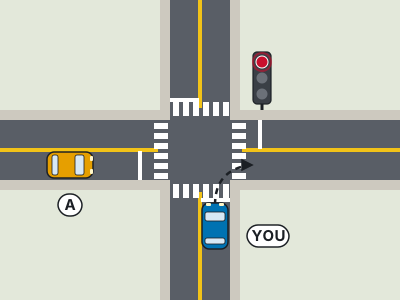
- Slow down and turn without stopping if the lane looks clear
- Make a complete stop and check for opposing traffic and pedestrians
- Wait for a green arrow even when no sign restricts the turn
- Stop in the crosswalk to improve the view
Show answer
Make a complete stop and check for opposing traffic and pedestrians. A right turn on red begins with a complete stop and a check for opposing traffic. The driver must also look for pedestrians in or near the crosswalk and must not block or stop within that crosswalk. A clear-looking lane does not remove the stop requirement, and a green arrow is not automatically required unless another signal or sign controls the movement. Check for a sign prohibiting right on red, stop at the proper line, yield to road users with priority, and turn only after the path is safe.
Study this in the handbook: Turns, Lane Changes and Passing
5. What causes nearly 60 percent of motorcycle crashes at intersections, according to the Arkansas guide?
- Other vehicles turning left in front of the motorcyclist
- Motorcycles running red lights
- Wet pavement
- Motorcycle brake failure
Show answer
Other vehicles turning left in front of the motorcyclist. Over 40 percent of all motorcycle crashes occur at intersections, and nearly 60 percent of those were caused by other vehicles turning left in front of the motorcyclist, a failure to yield right of way. Motorcycles are small and easy to miss in a quick look, and their speed is hard to judge. Before turning left, look again specifically for a motorcycle and wait.
Study this in the handbook: Trucks, Motorcycles and Bicycles
6. What penalty does Arkansas list for passing a stopped school bus with its red lights flashing?
- A misdemeanor with a fine of $250 to $1,000, up to 90 days in jail, or both
- A $25 parking ticket
- A warning for a first offense
- Automatic license revocation for life
Show answer
A misdemeanor with a fine of $250 to $1,000, up to 90 days in jail, or both. Drivers passing a stopped school bus with red lights flashing will be charged with a misdemeanor and on conviction fined a minimum of $250, not to exceed $1,000, with up to 90 days in jail, or both. A driver who disobeys the law and causes a death is charged with a felony, and under Isaac's Law negligent homicide is a Class C felony. Stop and stay stopped until the lights go off.
Study this in the handbook: Stopping for School Buses
7. What is the Arkansas response to a stopped law enforcement vehicle with its emergency lights on?
- Drive closer so the officer can identify your vehicle
- Move to the farthest lane away on a multilane highway when possible
- Use the shoulder to pass without changing speed
- Stop directly behind the vehicle in the traffic lane
Show answer
Move to the farthest lane away on a multilane highway when possible. On a multilane highway, Arkansas requires drivers to move over whenever possible, placing the vehicle in the farthest lane away from a stopped law enforcement vehicle with its lights on. This protects officers and others involved in the stop from traffic passing too close. Driving closer or stopping behind the vehicle creates the exposure the rule is designed to reduce. The shoulder is not a shortcut for passing, and using it at speed can endanger people or disabled vehicles. Look ahead, prepare early, and change lanes only after checking that the new lane is clear.
Study this in the handbook: Emergency Vehicles and the Move Over Law
8. Under Arkansas' Child Passenger Protection Act, which children must ride in a child passenger safety seat?
- All children under 12
- Only infants under 1 year
- Children under 8 regardless of weight
- Children under 6 who weigh less than 60 pounds
Show answer
Children under 6 who weigh less than 60 pounds. A child who is less than six years of age and who weighs less than 60 pounds shall be restrained in a child passenger safety seat properly secured to the vehicle, and all children under 15 must wear appropriate safety restraints while the vehicle is in motion. Several organizations loan child seats to families who need them. The seat rule applies only while both conditions are true, so a child who is six or older, or who weighs 60 pounds or more, falls under the general restraint requirement instead.
Study this in the handbook: Seat Belts, Child Seats and Littering
9. What is the maximum displacement for a motorized bicycle or motorcycle under an Arkansas Motorized Bicycle Certificate?
- 50 cubic centimeters
- 25 cubic centimeters
- 100 cubic centimeters
- 250 cubic centimeters
Show answer
50 cubic centimeters. The Motorized Bicycle Certificate is limited to a motorized bicycle or motorcycle displacing fifty cubic centimeters or less. The 250 cubic centimeter figure belongs to the MD license, and 25 or 100 do not match the certificate rule. Because the wording says maximum displacement, the permitted figure includes engines at that size and anything smaller. A practical recall link is MB with 50, while the separate MD credential reaches 250.
Study this in the handbook: Who Needs a License and Vision Rules
10. What does a solid double yellow line in the center of the roadway mean?
- Passing is prohibited for vehicles traveling in either direction
- Passing is required in both directions
- Only buses may use the opposite lane
- Drivers may cross freely to change direction
Show answer
Passing is prohibited for vehicles traveling in either direction. A solid double yellow center line separates traffic moving in opposite directions and prohibits passing for vehicles traveling either way. The line is not an instruction to pass, and it does not reserve the opposing lane for buses. Crossing freely to change direction ignores the restriction, although the manual gives a separate driveway exception when no opposing traffic approaches the planned turn site. Look at the center marking before moving left, and wait for a lawful opportunity to turn or pass.
Study this in the handbook: Pavement Markings and Lane Use
11. What fine may Arkansas impose for violating the primary seat belt law?
- A mandatory $100 fine and license suspension
- A fine not exceeding $50, with no court costs
- A fine not exceeding $25, plus court costs or fees
- A warning only for a first violation
Show answer
A fine not exceeding $25, plus court costs or fees. The seat belt violation carries a fine not exceeding twenty-five dollars, and court costs or fees may also apply. The primary enforcement rule means an officer may make the traffic stop based on the seat belt violation itself, but it does not raise the listed fine to fifty or one hundred dollars. A warning-only response is not the statutory consequence described. Keep the amount and the added court costs together when recalling this penalty.
Study this in the handbook: Seat Belts, Child Seats and Littering
12. A new Arkansas resident wants to transfer a license from another state. How long can that license have been expired?
- No more than 30 calendar days
- No more than one year
- Any length, if it was once valid
- No more than 90 days
Show answer
No more than 30 calendar days. To transfer, the out of state license must be a valid hard copy that has not been expired for more than 30 calendar days. One year and 90 days are longer than allowed, and a license that was once valid but long expired does not qualify. New residents also have 30 calendar days after becoming residents to get an Arkansas license, and the applicant cannot be suspended or revoked in any state.
Study this in the handbook: Who Needs a License and Vision Rules
13. What do red circle and slash regulation signs tell a driver?
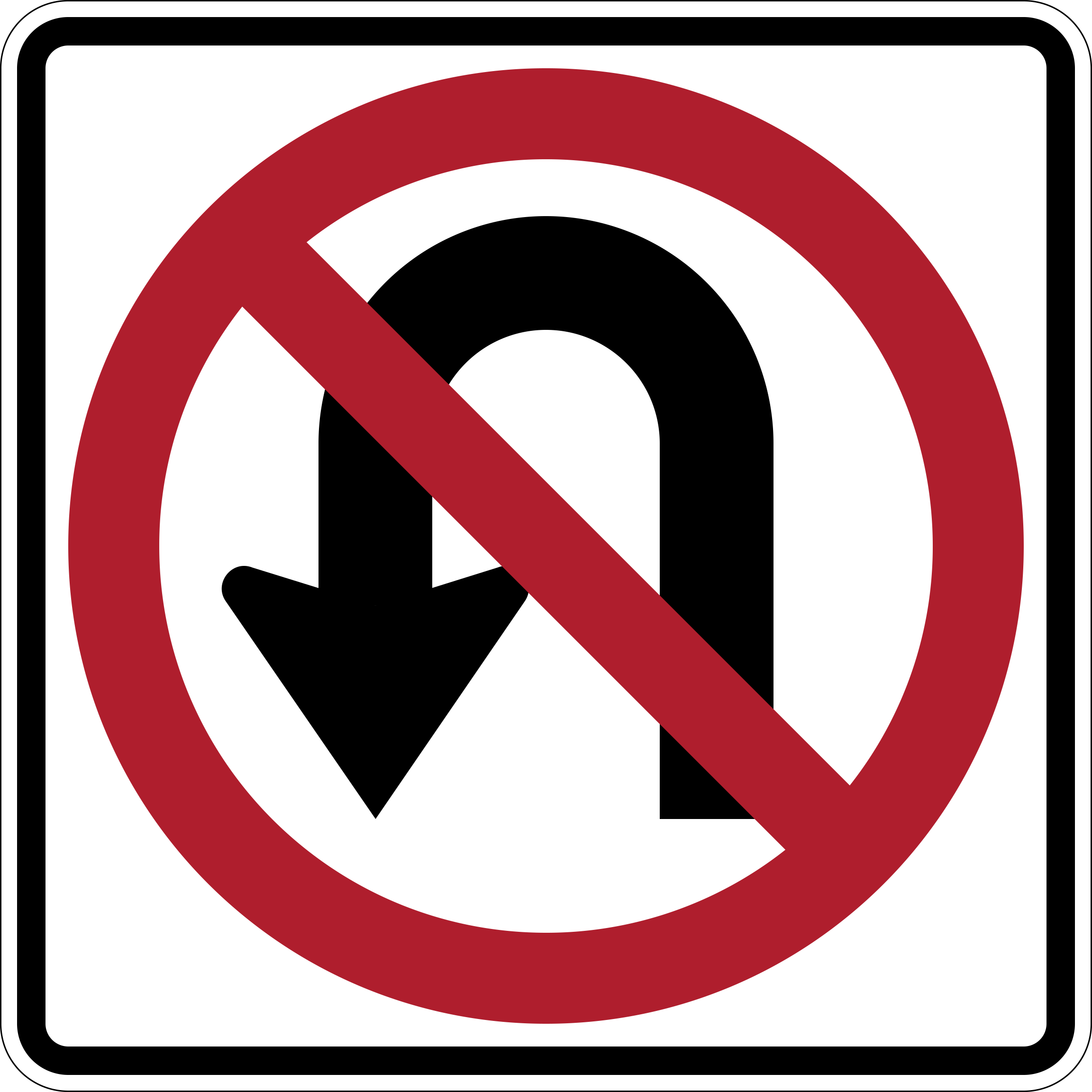
- A railroad crossing is immediately ahead
- A passing lane is opening
- A particular maneuver is prohibited
- The road surface is slippery
Show answer
A particular maneuver is prohibited. A red circle with a slash marks a regulation that prohibits a particular maneuver. The rule might forbid a turn in one direction or prohibit a U-turn. The passing choice confuses a restriction with permission to use a lane, while the railroad and slippery-road choices describe warning information shown by different signs. When this symbol appears, read the picture inside it and avoid the movement shown. The useful cue is the slash itself: it means do not perform the maneuver represented by the symbol.
Study this in the handbook: Stop, Yield and Regulation Signs
14. For a driver age 21 or older operating a noncommercial vehicle in Arkansas, what is the lowest BAC covered by the general alcohol per se threshold?
- 0.05%
- 0.02%
- 0.08%
- 0.10%
Show answer
0.08%. For a driver who is at least 21, Arkansas identifies 0.08 percent BAC or BrAC as the DWI threshold in the guide. The 0.02 percent figure belongs to the under-21 rule, while 0.05 and 0.10 are not the adult threshold presented here. Do not use a personal sense of sobriety to estimate legality. The numerical limit is the exam fact to remember for this age group.
Study this in the handbook: Drinking and Driving
15. What charge does an Arkansas driver face for passing a stopped school bus illegally and causing a person's death?
- A traffic infraction with a $250 fine
- A misdemeanor with 90 days in jail
- No extra charge beyond the passing fine
- A felony
Show answer
A felony. Drivers who fail to obey the school bus law and cause the death of a person are charged with a felony. The misdemeanor with a $250 to $1,000 fine and up to 90 days in jail is the penalty for passing a stopped bus when no one is killed, so those choices describe the lesser offense. Under Isaac's Law, negligently causing a death this way is a Class C felony negligent homicide.
Study this in the handbook: Stopping for School Buses
16. What is the safest response when a hill or curve blocks a driver's view of the roadway ahead?
- Accelerate to clear the hidden area quickly
- Adjust speed so the vehicle can stop if needed
- Keep the same speed if the road is dry
- Pass because an approaching vehicle would be visible
Show answer
Adjust speed so the vehicle can stop if needed. A hidden area beyond a hill or curve may contain a stopped vehicle, person, or oncoming traffic. The guide says to adjust speed so the driver can stop if necessary. Dry pavement does not reveal what is out of sight, and acceleration reduces the available reaction margin. Passing is especially unsafe when the view is blocked. Use the visual cue of limited sight distance: reduce speed early enough to stop within what can actually be seen.
Study this in the handbook: Speed Limits and Road Conditions
17. When do the Arkansas work zone rules in this section apply?
- Only when a work zone is closed to all traffic
- When workers are present in a work zone
- Only after a driver receives a second citation there
- Whenever a vehicle is parked on a shoulder
Show answer
When workers are present in a work zone. The section is specifically headed as applying when workers are present in a work zone. That condition is different from closing the road, receiving multiple citations, or seeing any vehicle on a shoulder. Drivers should slow down, watch the work area, and follow signs, flaggers, barrels, and cones when the condition exists. The heading is the key cue for the rule's scope. A mobile or active project still requires attention when workers are present, even if traffic continues through the area.
Study this in the handbook: Work Zones
18. At a flashing red signal, what must happen before the driver proceeds?
- Never enter it, because the intersection is closed
- Continue without a full stop, as at a flashing yellow
- Go straight through, as on a green signal
- Make a complete stop, then proceed only when it is safe
Show answer
Make a complete stop, then proceed only when it is safe. A flashing red light carries the same stopping requirement as a stop sign. The driver must come to a complete stop and proceed only when the intersection is safe. Treating it like a flashing yellow skips the required stop, while the green choice invents permission that the signal does not provide. The intersection is not automatically closed, so never entering it is too broad. Before moving, check for crossing traffic, pedestrians, and any other road user with the right of way. A complete stop gives the driver a deliberate point to make that safety check.
Study this in the handbook: Traffic Lights and Arrows
19. Which roadway controls are described as regulation signs?
- The name of every business along the route
- Only advance notice of hills and slippery pavement
- Rules for traffic direction, lane use, turning, parking, and special instructions
- Weather forecasts for the next intersection
Show answer
Rules for traffic direction, lane use, turning, parking, and special instructions. Regulation signs communicate rules that govern how traffic may move or where it may stop. The guide lists direction, lane usage, turning, parking, and other special instructions. A hazard warning about a slippery roadway belongs to a different sign function. Business names and weather forecasts are not the purpose of regulation signs. Usually white rectangles or squares with black or red symbols, these signs should be read as requirements or prohibitions and followed before making the maneuver.
Study this in the handbook: Stop, Yield and Regulation Signs
20. If you miss your exit on a roadway, what should you do?
- Use the shoulder to reverse toward the exit
- Back up in the travel lane
- Stop where you are and wait for traffic to clear
- Continue to a safe turnaround area
Show answer
Continue to a safe turnaround area. Arkansas says never to back a vehicle in a travel lane. If an exit or turn is missed, continue until reaching a safe turnaround area. Reversing in the lane or on the shoulder can surprise drivers who are moving forward and can create a collision. Stopping in a travel lane is also prohibited, even when the reason is confusion or a missed turn. Keep the vehicle moving with traffic, choose a lawful place to change direction, and treat a missed exit as a navigation problem rather than an emergency requiring an immediate reversal.
Study this in the handbook: Pavement Markings and Lane Use
QualitySpace is expanding to Arkansas
We are a California-based independent insurance brokerage working on licensing in more states. We cannot help with Arkansas insurance yet. Leave your email and we will let you know when we can.
Every question is written from the official Arkansas Driver License Study Guide. Need paper? Printable AR practice test with answer key.
Last verified 2026-10-05. How we check every question · Study all 200 as flashcards
Frequently asked questions
How many questions are on this Arkansas practice test?
This fixed set has 20 questions. It is test 6 of 10 from the 200 question Arkansas bank.
How does this fixed test relate to the full Arkansas bank?
Each numbered test is a fixed set of questions in a fixed order, so you can retake the same test later and compare. Every test mixes road signs and the other topics in about the same proportion as the full bank. Tests 1 to 10 together cover every question in the Arkansas bank once. The full practice page mixes the whole bank at random.
Last verified 2026-10-05. See the Arkansas DMV facts page for sourced state details.
Return to the full Arkansas practice test · Study road signs