
Test 1 of 10 · 20 questions · Free 2026
AR Permit Practice Test 1
Jump to the test ↓A fixed 20 question set from the Arkansas bank with answers and plain English explanations.
Question 1 of 20 · 0 right so far
All 20 questions in test 1
Every question below comes from the Arkansas question bank on this page. Open a question to see the correct answer and the explanation. Nothing here is hidden behind a signup.
1. If your vehicle begins to hydroplane, what should you do?
- Accelerate until the tires cut through the water
- Brake hard and turn quickly toward the shoulder
- Slowly take your foot off the gas and keep the steering wheel straight
- Turn the wheel back and forth rapidly
Show answer
Slowly take your foot off the gas and keep the steering wheel straight. During hydroplaning, the tires have lost contact with the road because they are riding on water. The manual advises slowly removing your foot from the gas and keeping the steering wheel straight. Do not try to stop or turn until the tires regain grip. Hard braking, rapid steering, or acceleration can increase the loss of control. If an emergency requires steering, move the wheel slowly. The useful cue is a light, steady response: ease off the accelerator, hold your path, and wait for traction to return before changing direction.
Study this in the handbook: Slippery Roads and Hydroplaning
2. You hear sirens while your vehicle is inside an intersection. What is the safest next move?
- Stop immediately in the intersection
- Drive through the intersection, then pull over to the right
- Turn left and follow the emergency vehicle
- Remain stopped until the emergency vehicle turns away
Show answer
Drive through the intersection, then pull over to the right. A driver who is in an intersection should clear that intersection before pulling over for the approaching emergency vehicle. Stopping in the junction can block the emergency route and expose the vehicle to cross traffic. Turning to follow the emergency vehicle does not clear its path, and the guide warns against driving to the scene of an accident or other disaster. Waiting inside the intersection delays everyone. Once clear, signal, move toward the right edge or as near to it as possible, and stop. The visual cue is simple: clear the box first, then yield at the roadside.
Study this in the handbook: Emergency Vehicles and the Move Over Law
3. If moving over for a stationary roadside vehicle is unsafe or impossible, what should you do?
- Reduce speed to a safe level and proceed with caution
- Maintain the posted speed and pass close to the vehicle
- Stop in the traffic lane until the roadside vehicle leaves
- Use the shoulder to avoid making any adjustment
Show answer
Reduce speed to a safe level and proceed with caution. Arkansas's Move Over guidance provides a fallback when changing lanes cannot be done safely: reduce speed to a safe level for the conditions or a legally mandated speed. Passing close at the posted speed leaves little room for the people working beside the road. Stopping in a travel lane can create a rear-end hazard, and using the shoulder is not a general escape route. Scan ahead for stopped emergency, construction, utility, or tow vehicles, slow early, and give the roadside activity as much space as traffic conditions safely allow.
Study this in the handbook: Emergency Vehicles and the Move Over Law
4. What is Isaac's Law in Arkansas?
- A law requiring child seats until age 8
- A person who negligently causes a death while violating the school bus law faces a Class C felony for negligent homicide
- A law banning texting for teens
- A law setting school zone speed limits
Show answer
A person who negligently causes a death while violating the school bus law faces a Class C felony for negligent homicide. Isaac's Law, section 5-10-105, makes a person who violates the school bus stopping law and negligently causes the death of another person subject to a Class C felony for negligent homicide. A death caused this way is treated far more seriously than the passing offense itself. The ordinary penalty for illegally passing a stopped bus is a misdemeanor with a fine of $250 to $1,000 and up to 90 days in jail.
Study this in the handbook: Stopping for School Buses
5. What may a left-turning driver do at a flashing yellow arrow?
- Turn left without checking for opposing traffic
- Turn left after yielding to oncoming traffic and pedestrians
- Stop and wait until the arrow turns green
- Proceed straight only because left turns are prohibited
Show answer
Turn left after yielding to oncoming traffic and pedestrians. A flashing yellow arrow permits a left turn, but the turning driver must yield to oncoming traffic and pedestrians before proceeding with caution. The choice “Turn left without checking for opposing traffic” removes the required yielding step, so it would create a conflict with traffic that already has priority. A flashing yellow arrow is not a red signal requiring a wait for green, and it does not prohibit the movement. Look through the intersection, yield to people and opposing vehicles, then make the turn only when the path is clear.
Study this in the handbook: Traffic Lights and Arrows
6. What should a driver do when approaching the yellow warning sign shown here?

- Treat the sign as a legal speed limit
- Accelerate to clear the warned area quickly
- Slow down and be prepared to stop for a hazard ahead
- Ignore it unless a police officer is present
Show answer
Slow down and be prepared to stop for a hazard ahead. Arkansas uses yellow warning signs to call attention to hazards or special situations ahead. The driver should reduce speed, scan for the condition shown, and be ready to stop if traffic or the roadway requires it. Treating the sign as a posted speed limit is a mistake because a warning sign advises about conditions rather than setting the maximum legal speed. The useful cue is the yellow background with a black symbol: read it as advance notice, then adjust before reaching the hazard. That early adjustment leaves time for a vehicle, pedestrian, curve, or other road condition that may appear beyond the sign.
Study this in the handbook: Stop, Yield and Regulation Signs
7. What steering and braking response is advised when a vehicle begins to skid?
- Release the steering wheel and wait for the tires to recover
- Press the brake pedal firmly while turning opposite the skid
- Stay off the brake and steer where you want the vehicle to go
- Accelerate sharply to force the tires back onto the roadway
Show answer
Stay off the brake and steer where you want the vehicle to go. When a vehicle skids, avoid the brake because braking can make the slide worse. Steer toward the direction you want the vehicle to travel and continue gentle corrections as the vehicle begins to straighten. Firm braking combined with an opposite turn can intensify the loss of control. Releasing the wheel removes the driver's ability to guide the vehicle, while hard acceleration does not restore tire grip. Keep your eyes on the intended path and use calm, measured steering until control returns.
Study this in the handbook: Vehicle Emergencies and Crashes
8. Which trip is an exception to the Arkansas Intermediate License night driving restriction?
- Driving home from a friend's party
- Going out for late food
- Driving anywhere with one teen passenger
- Driving to or from a job
Show answer
Driving to or from a job. Intermediate drivers may drive during the 11:00 pm to 4:00 am restricted hours when driving to and from a school activity, church activity, job, or an emergency, or when a licensed driver 21 or older is present. A friend's party and a late food run are not listed purposes. A teen passenger does not create an exception; only a licensed adult 21 or older does.
Study this in the handbook: Instruction Permits and Graduated Licenses
9. Within how many days must an Arkansas Special Certificate for accessible parking be returned after the holder moves or dies?
- 30 days
- 10 days
- 90 days
- It never has to be returned
Show answer
30 days. Special Certificates must be returned to the Department of Motor Vehicles, Special Division, within 30 days of moving or in case of death. Ten days is shorter than the rule, 90 days is longer, and saying it never has to be returned is wrong. Returning it keeps others from misusing a certificate, which is fraud under Arkansas law. A second misuse offense brings a fine of $250 to $1,000 and a six month license suspension.
Study this in the handbook: Parking Rules and Accessible Parking
10. What does a yield sign require when traffic is present in the intersection?
- Stop only when the sign is painted red and white
- Accelerate so the driver enters before cross traffic
- Slow or stop and yield to traffic that has the right of way
- Continue without checking because the sign gives priority
Show answer
Slow or stop and yield to traffic that has the right of way. A yield sign requires the driver to slow down or stop as needed and give the right of way to traffic in the intersection or to traffic the driver is crossing or entering. Accelerating into the gap reverses that duty. The color option is unreliable because the manual describes more than one color combination, while the meaning remains the same. Continuing without checking is especially dangerous because the sign does not grant priority. Approach with enough control to stop, scan both directions, and proceed only after the conflicting traffic has cleared or yielded.
Study this in the handbook: Stop, Yield and Regulation Signs
11. A driver nearing a flashing yellow signal should do what?
- Treat the intersection as closed to all traffic
- Stop completely and wait for a green light
- Accelerate because the signal gives priority
- Slow down and proceed with caution
Show answer
Slow down and proceed with caution. A flashing yellow signal tells the driver to slow down and proceed with caution. It does not impose the complete stop associated with a flashing red light, but it also does not grant unrestricted priority. Accelerating through the intersection reduces time to respond to crossing traffic or pedestrians. The closed intersection choice is too broad because vehicles may proceed when the path is safe. Reduce speed early, scan the intersection, and be ready to yield or stop if another road user creates a conflict. The signal calls for controlled movement, not a race to clear the crossing.
Study this in the handbook: Traffic Lights and Arrows
12. What total stopping distance does the Arkansas guide give for a passenger car at 55 mph?
- About 50 feet
- About 500 feet
- About 1,000 feet
- About 225 feet
Show answer
About 225 feet. The average passenger car traveling at 55 miles per hour can stop within a total of 225 feet, and at 40 mph the total is about 124 feet. Those figures assume good tires, good brakes and dry pavement. If you cannot see a safe length ahead at your speed, you are not driving at a safe speed. Adjust speed to conditions and obey posted limits.
Study this in the handbook: Stopping Distance and Following
13. At an intersection with stop signs at all corners, which vehicle should go first?
- The vehicle that flashes headlights
- The vehicle with the largest engine
- The vehicle that arrived first
- The vehicle farthest from the intersection
Show answer
The vehicle that arrived first. After making a complete stop, the vehicle that arrived first goes first at an all-corner stop. Engine size, headlight signals, and distance from the intersection are not the deciding tests. If arrival order is unclear, drivers should communicate carefully and avoid forcing another vehicle to brake. The key sequence is complete stop, determine who arrived first, then proceed while checking the intersection.
Study this in the handbook: Right of Way at Intersections
14. When may a driver enter an intersection on a green light?
- Whenever the driver intends to turn around inside
- Whenever the light is green, even if traffic is stopped
- Only after the vehicle behind honks
- Only when the driver can get through without stopping in it
Show answer
Only when the driver can get through without stopping in it. A green light does not authorize entering a blocked intersection. The driver must be able to proceed through without stopping there, otherwise the vehicle would obstruct cross traffic and create gridlock. A following driver’s horn and an intention to turn around do not change that requirement. Look beyond the signal before moving, and wait behind the line when the far side lacks enough space.
Study this in the handbook: Right of Way at Intersections
15. What minimum uncorrected visual acuity is required for an unrestricted Arkansas license?
- 20/40
- 20/20
- 20/70
- 20/100
Show answer
20/40. An unrestricted license requires minimum uncorrected visual acuity of 20/40. The 20/70 figure belongs to corrected acuity for a restricted license, so it is not the unrestricted standard. The perfect-vision choice is stricter than the guide requires, and 20/100 is weaker than the stated threshold. Applicants should distinguish uncorrected from corrected vision and unrestricted from restricted licensing before selecting a figure.
Study this in the handbook: Who Needs a License and Vision Rules
16. What can happen when an Arkansas law enforcement officer instructs a driver to take an alcohol test?
- The driver may refuse without any licensing consequence
- The driver may delay testing until after consulting a passenger
- The driver must provide only a urine sample
- The driver is compelled by law, and refusal can cost the driver license
Show answer
The driver is compelled by law, and refusal can cost the driver license. Arkansas requires a driver to submit when a law enforcement officer instructs the driver to take an alcohol test. Refusal can result in loss of the driver's license, so treating the request as optional is dangerous. The guide does not limit the officer to urine; it lists breath, urine, or saliva as possible tests. A passenger cannot postpone the legal duty. The key cue is compelled testing paired with a licensing consequence for refusal.
Study this in the handbook: Drinking and Driving
17. A posted SPEED LIMIT sign displays the maximum speed for ideal conditions. What should happen when conditions worsen?
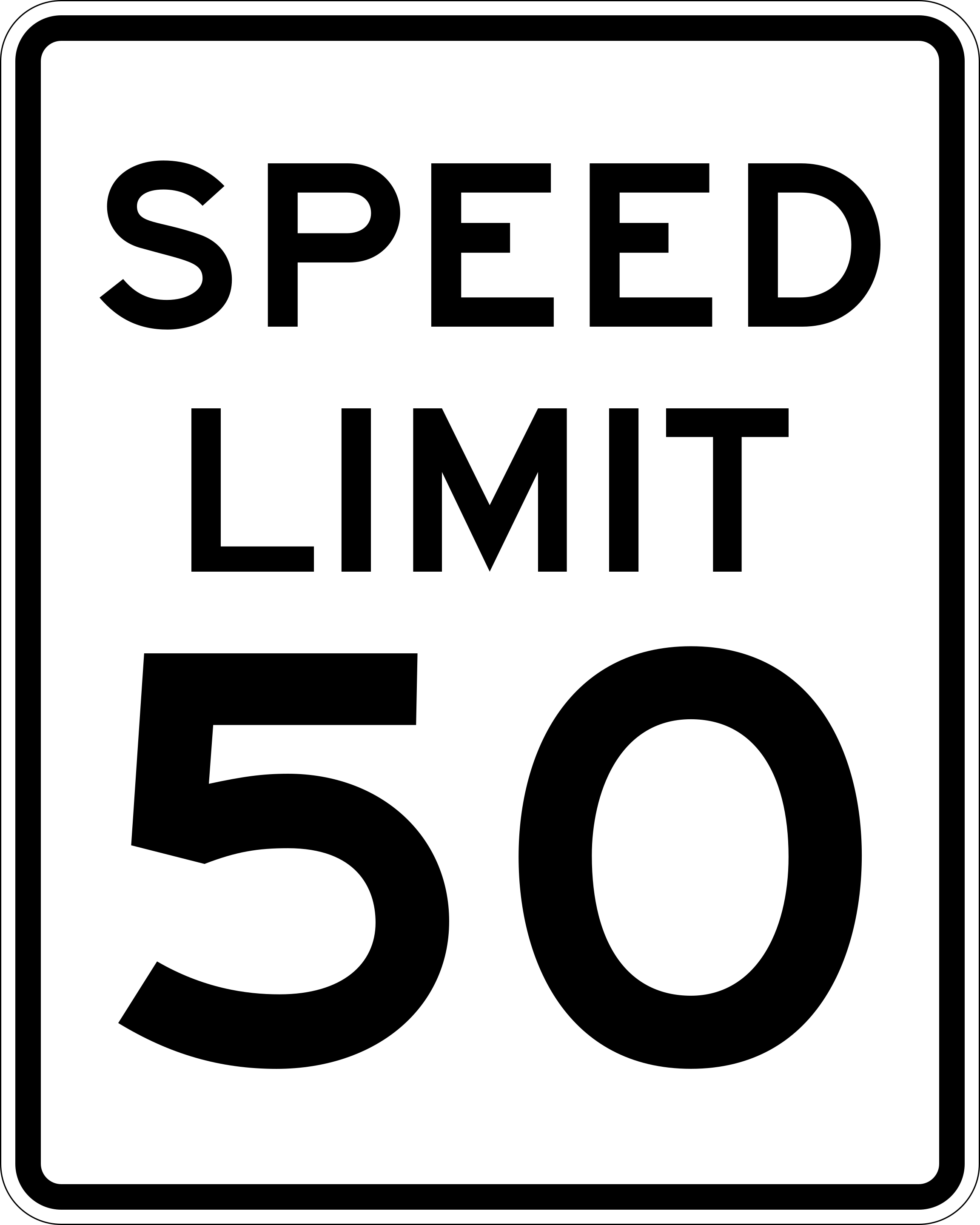
- Keep the posted maximum because it applies in every condition
- Reduce speed for hazards such as slippery roads or poor visibility
- Increase speed briefly to clear the hazardous section
- Ignore the sign unless a police vehicle is nearby
Show answer
Reduce speed for hazards such as slippery roads or poor visibility. The posted maximum is intended for ideal conditions, not as a target that must be maintained during rain, slick pavement, or poor visibility. Reduce speed as conditions arise so the vehicle has more time and traction to respond. Keeping the maximum regardless of weather can overwhelm available stopping distance. Accelerating through a hazard increases risk, and enforcement presence does not determine whether the sign applies. Treat the number as an upper boundary, then choose a slower safe speed when the roadway demands it.
Study this in the handbook: Traffic Lights and Arrows
18. What movement is barred by this crossed-out right arrow?
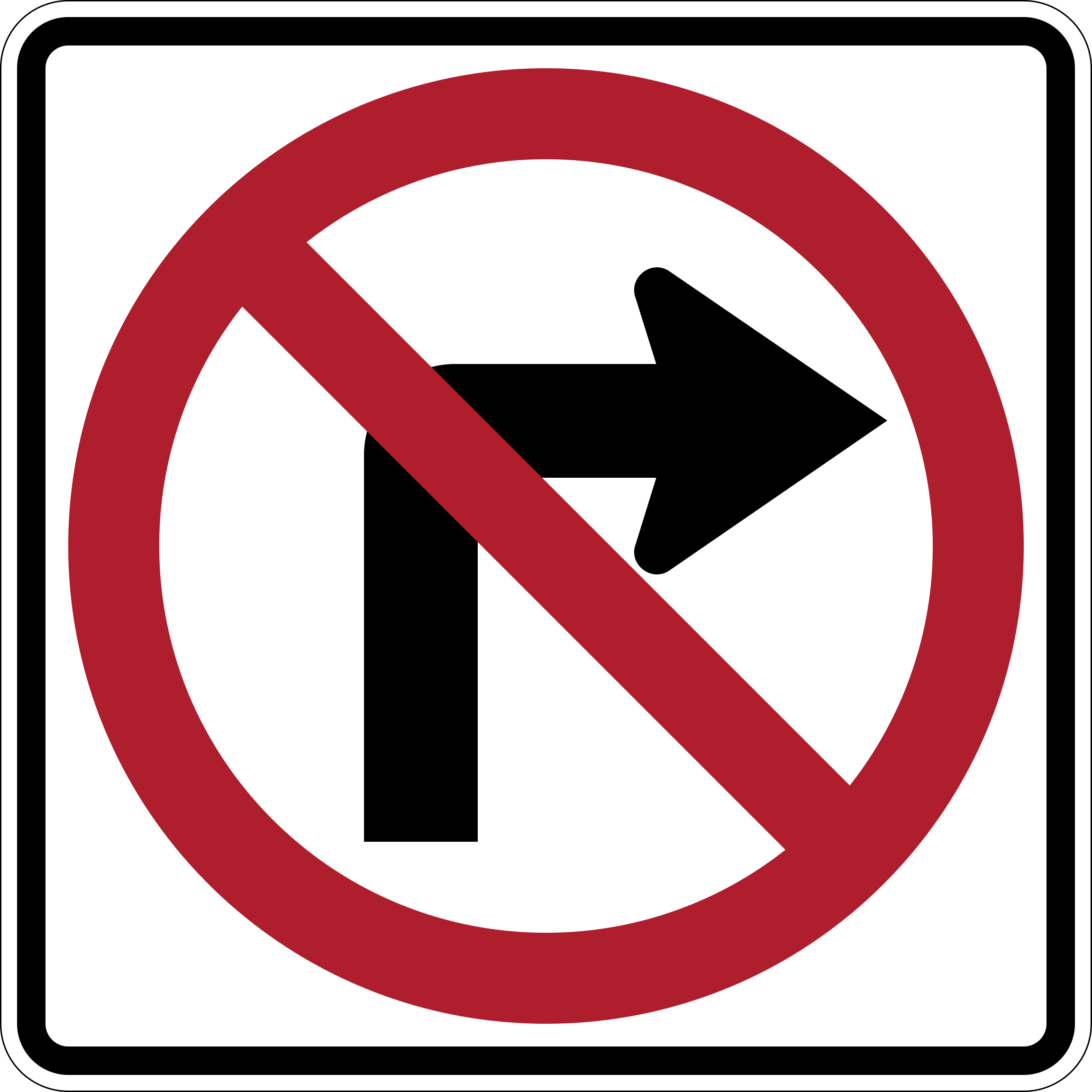
- Turning right at the signed location
- Turning left after yielding to traffic
- Continuing straight through the intersection
- Slowing before entering the intersection
Show answer
Turning right at the signed location. The symbol shows a right-turn arrow with a red slash, so the restricted movement is a right turn at that signed location. A left turn, straight movement, or slowing down is not automatically prohibited by this particular symbol. Regulation signs communicate turning and other traffic instructions, and the slash applies to the maneuver pictured beneath it. Before choosing a route, identify the arrow first; then keep the vehicle out of the forbidden turn path and follow any remaining lane or signal controls.
Study this in the handbook: Stop, Yield and Regulation Signs
19. In what share of fatal traffic crashes is alcohol involved, according to the Arkansas guide?
- About 5 percent
- About 80 percent
- Approximately 38 percent
- About 1 percent
Show answer
Approximately 38 percent. Alcohol is involved in approximately 38 percent of traffic crashes in which someone is killed. A drinker's chances of a crash are far greater than a non drinker's, and there is no safe alcohol concentration for operating a vehicle. Alcohol reaches the brain in 15 to 40 minutes, and judgment is the first driving ability it affects. The body clears about one drink per hour.
Study this in the handbook: Drinking and Driving
20. Why should you leave extra space behind a police vehicle, ambulance, or fire truck?
- Those vehicles are required to stay below the speed limit
- Those vehicles need room to work
- The space gives you permission to pass on the shoulder
- The extra distance guarantees they will not stop suddenly
Show answer
Those vehicles need room to work. Police vehicles, ambulances, and fire trucks may need room to work, so following too closely can interfere with an emergency response. Extra space gives the driver time to react if the vehicle slows, stops, turns, or positions itself near an incident. Their speed is not the reason for the gap, and the shoulder is not a passing lane. The distance also cannot guarantee that a sudden stop will never occur. Ease off the accelerator and preserve a useful cushion.
Study this in the handbook: Emergency Vehicles and the Move Over Law
QualitySpace is expanding to Arkansas
We are a California-based independent insurance brokerage working on licensing in more states. We cannot help with Arkansas insurance yet. Leave your email and we will let you know when we can.
Every question is written from the official Arkansas Driver License Study Guide. Need paper? Printable AR practice test with answer key.
Last verified 2026-10-05. How we check every question · Study all 200 as flashcards
Frequently asked questions
How many questions are on this Arkansas practice test?
This fixed set has 20 questions. It is test 1 of 10 from the 200 question Arkansas bank.
How does this fixed test relate to the full Arkansas bank?
Each numbered test is a fixed set of questions in a fixed order, so you can retake the same test later and compare. Every test mixes road signs and the other topics in about the same proportion as the full bank. Tests 1 to 10 together cover every question in the Arkansas bank once. The full practice page mixes the whole bank at random.
Last verified 2026-10-05. See the Arkansas DMV facts page for sourced state details.
Return to the full Arkansas practice test · Study road signs