
Test 4 of 10 · 20 questions · Free 2026
AR Permit Practice Test 4
Jump to the test ↓A fixed 20 question set from the Arkansas bank with answers and plain English explanations.
Question 1 of 20 · 0 right so far
All 20 questions in test 4
Every question below comes from the Arkansas question bank on this page. Open a question to see the correct answer and the explanation. Nothing here is hidden behind a signup.
1. In Arkansas, smoking tobacco in a vehicle is prohibited when it carries a passenger younger than what age?
- 12
- 14
- 16
- 18
Show answer
14. The secondhand-smoke rule prohibits knowingly smoking tobacco in a motor vehicle when a child passenger is less than fourteen years old. The trigger is the passenger's age, not whether the vehicle is moving, whether a window is open, or whether the child is related to the driver. Twelve is too low and sixteen or eighteen are too high. The recall cue is child under fourteen inside the vehicle, paired with knowingly smoking tobacco.
Study this in the handbook: Seat Belts, Child Seats and Littering
2. Within what period must a person who becomes an Arkansas resident obtain an Arkansas driver's license?
- Within 10 calendar days
- Within six months
- Within 60 calendar days
- Within 30 calendar days
Show answer
Within 30 calendar days. A new Arkansas resident has thirty calendar days to obtain an Arkansas driver's license for driving on state streets and highways. Six months describes the separate rule for a nonresident who has been physically present in Arkansas, not the resident deadline. Ten and sixty days do not match the stated period. The memory distinction is resident equals thirty calendar days, while nonresident physical presence reaches six months before the license requirement applies.
Study this in the handbook: Who Needs a License and Vision Rules
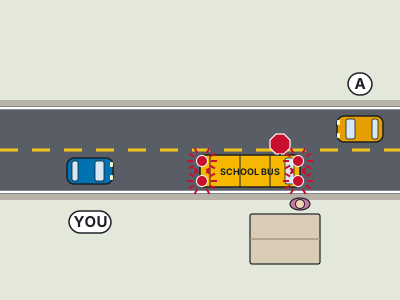
3. A school bus is stopped with red lights flashing. When may a driver pass it?
- Whenever the driver is traveling in the opposing lane
- As soon as no child is visible near the roadway
- After slowing to five miles per hour
- After the bus finishes loading or unloading and begins moving without red lights
Show answer
After the bus finishes loading or unloading and begins moving without red lights. A driver approaching a stopped school bus with red lights flashing must make a complete stop and remain stopped. Passing is prohibited until the bus has finished receiving or discharging passengers and begins moving without its red lights flashing. The absence of a visible child does not show that the loading area is clear, and reducing speed is not a substitute for stopping. The opposing lane is also covered unless a median at least twenty feet wide separates the directions of travel. Watch the lights and bus movement, not just the nearest lane, before resuming.
Study this in the handbook: Stopping for School Buses
4. How far before a turn or lane change should you begin using your turn signal?
- 100 feet
- 25 feet
- 50 feet
- 200 feet
Show answer
100 feet. Arkansas directs drivers to use turn signals 100 feet before a lane change, a right turn, a left turn, a merge, or parking. The distance gives other road users time to understand your plan and adjust. Beginning at 25 or 50 feet reduces that warning, while 200 feet is not the figure stated for these maneuvers. Signal before the action, continue signaling through the movement as appropriate, and check that the path is clear. A simple cue is to activate the signal while you still have a full 100 feet to travel.
Study this in the handbook: Headlights, Horn and Signals
5. When a vehicle begins to hydroplane on a wet roadway, the driver should first:
- Accelerate until the tires regain contact
- Turn sharply toward the shoulder
- Brake hard while holding the wheel tightly
- Slowly remove the foot from the gas pedal
Show answer
Slowly remove the foot from the gas pedal. Hydroplaning occurs when tires ride on water instead of gripping the roadway. Ease your foot off the gas gradually, keep the steering wheel straight, and wait for traction to return before stopping or turning. A hard brake application can worsen the loss of control, while a sharp steering movement may send the vehicle into a skid. Use this cue in heavy rain: release the accelerator smoothly and make no sudden steering correction unless an emergency leaves no alternative.
Study this in the handbook: Slippery Roads and Hydroplaning
6. How close to a fire station driveway on the same side of the street may you park in Arkansas?
- No closer than 20 feet
- No closer than 5 feet
- No closer than 75 feet
- No limit if the station is closed
Show answer
No closer than 20 feet. Arkansas prohibits parking within 20 feet of a fire station driveway on the same side of the street, or on a street where proper signs are posted. Five feet is too close, 75 feet is not the Arkansas figure, and the rule does not depend on whether the station looks closed, because engines may leave at any time. Twenty feet is also the Arkansas distance from a crosswalk at an intersection.
Study this in the handbook: Parking Rules and Accessible Parking
7. Without a qualifying adult in the front seat, how many unrelated minor passengers may an Arkansas intermediate driver carry?
- No unrelated minor passengers under any circumstance
- Two
- Three
- One
Show answer
One. An intermediate driver may carry one unrelated minor passenger under the ordinary restriction. Carrying more than one becomes permissible only when a licensed driver who is at least twenty-one occupies the front seat. The two and three passenger options overlook that threshold, while a total ban is too broad because one unrelated minor is allowed. On a test question, first check whether the supervising adult is present, then count the unrelated minor passengers rather than all occupants.
Study this in the handbook: Instruction Permits and Graduated Licenses
8. What should a driver do after seeing this STOP AHEAD warning?

- Maintain speed because the stop sign applies only to cross traffic
- Slow down and prepare to make a complete stop at the upcoming sign
- Stop where the warning sign stands, even before reaching the intersection
- Pass the upcoming stop sign if no vehicle is visible
Show answer
Slow down and prepare to make a complete stop at the upcoming sign. STOP AHEAD is an advance warning, giving the driver time to slow and prepare for the actual stop sign farther ahead. The complete stop belongs at the upcoming controlled location, not automatically beside the warning itself. The sign applies to your approach, so it is not limited to cross traffic, and an empty intersection does not cancel the stop requirement. Use the warning to manage speed early, then stop at the marked line or proper stopping point and check for traffic and pedestrians.
Study this in the handbook: Stop, Yield and Regulation Signs
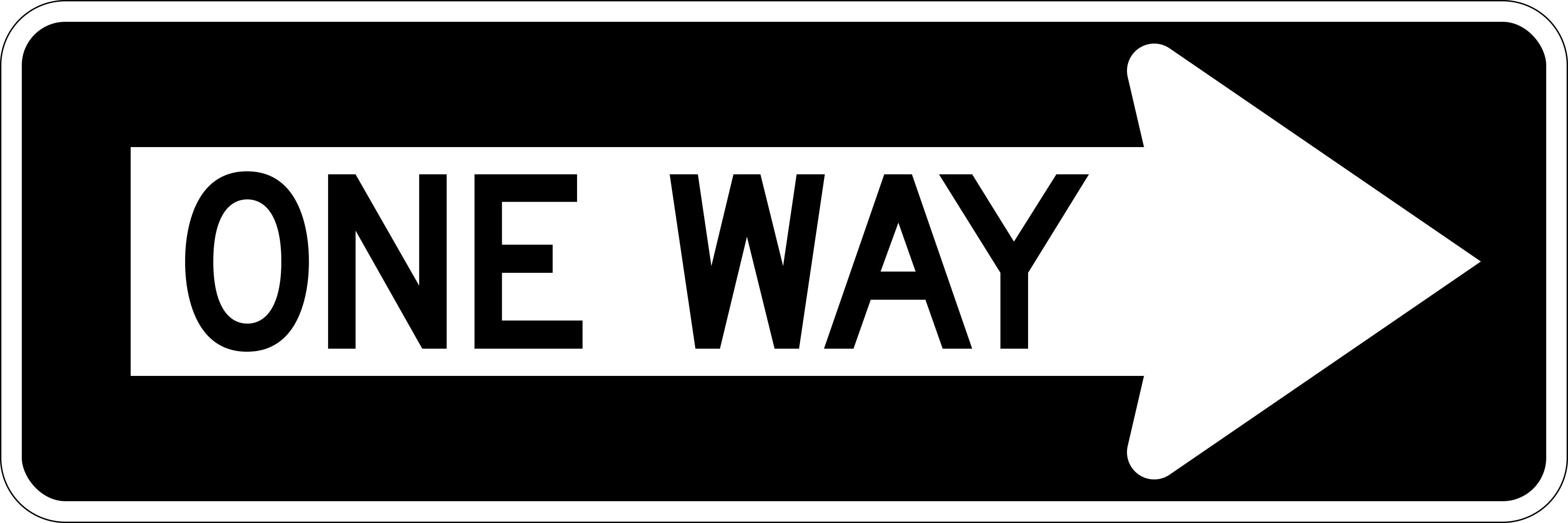
9. What kinds of information can Arkansas traffic signs display?
- Only warnings about impaired drivers
- Only county road speed limits and penalties
- Traffic rules, hazards, locations, travel directions, and services
- Only instructions for railroad employees
Show answer
Traffic rules, hazards, locations, travel directions, and services. Arkansas traffic signs can communicate several kinds of roadway information, including rules, hazards, locations, travel directions, and nearby services. A sign may therefore tell you how traffic must move, alert you to a condition ahead, identify where you are, guide your route, or point toward a service. The narrower choices incorrectly limit signs to one subject, such as speed enforcement or railroad work. Read the sign shape, color, words, and symbol together before acting. That combination identifies whether the message is a rule to obey, a warning requiring preparation, or guidance about the road and surrounding facilities.
Study this in the handbook: Traffic Lights and Arrows
10. How long does sending or reading a text take a driver's eyes off the road, according to the Arkansas guide?
- Less than 1 second
- About 5 seconds, a football field at 55 mph
- About 30 seconds
- It does not affect vision
Show answer
About 5 seconds, a football field at 55 mph. Sending or reading a text takes your eyes off the road for five seconds, and at 55 mph that is like driving the length of an entire football field with your eyes closed. Texting is the most alarming distraction because it takes your eyes, hands and mind at once. Arkansas bans texting for all drivers, and drivers under 18 may use a cell phone only in an emergency.
Study this in the handbook: Phone Laws and Distracted Driving
11. After an Arkansas crash, when must a driver notify the police immediately?
- Only when someone is killed
- Only when the other driver asks
- When anyone is injured or killed, or property damage exceeds $1,000
- Only on interstates
Show answer
When anyone is injured or killed, or property damage exceeds $1,000. If any person is injured or killed, or there is property damage exceeding $1,000, the driver must notify the police immediately, and a driver cannot leave the scene of an injury or death crash until police have collected the information they need. If you hit a parked vehicle, you must try to locate the owner. A separate written report also goes to the Office of Driver Services within 30 days after a crash with injury, death, or significant property damage. Waiting for the other driver to ask, or reporting only deaths or interstate crashes, misses the rule.
Study this in the handbook: Vehicle Emergencies and Crashes
12. If your headlights suddenly go out while driving, what should you try first?
- Accelerate until the headlights come back on
- Turn sharply onto the shoulder without signaling
- Try the headlight switch a few times
- Turn off all exterior lights and continue normally
Show answer
Try the headlight switch a few times. When headlights suddenly go out, the manual says to try the headlight switch a few times first. If that does not restore the lights, use emergency flashers, turn signals, or fog lights if available, then pull off the road as soon as possible. Turning sharply or accelerating does not solve the visibility problem and can put the vehicle into conflict with other traffic. Treat the failure as an immediate safety issue: maintain control, make the vehicle visible with the available lights, and leave the travel lane when you can do so safely.
Study this in the handbook: Vehicle Emergencies and Crashes
13. What is the best way to reduce the risk of hydroplaning?
- Keep your speed down
- Brake hard whenever water covers the lane
- Accelerate across standing water
- Steer sharply from side to side
Show answer
Keep your speed down. Lower speed gives the tires more opportunity to channel water away and maintain contact with the pavement. Hard braking on standing water can worsen instability, and acceleration does not restore traction. Sharp steering can make a loss of grip more difficult to correct. Check tread condition as well, because worn tires raise the risk. When rain builds up, ease off the accelerator before the puddle, keep the wheel steady, and avoid sudden inputs while crossing the wet surface.
Study this in the handbook: Speed Limits and Road Conditions
14. What should a driver do when a steady yellow arrow is displayed?
- Treat it as a protected green arrow
- Begin a left turn immediately without checking traffic
- Stop if it is safe to do so
- Reverse to the previous intersection
Show answer
Stop if it is safe to do so. A steady yellow arrow warns that the signal is preparing to turn red. A driver who has not entered the intersection should stop when stopping can be done safely. It is not a protected green indication, and beginning a new turn on the yellow can leave the vehicle exposed when the phase changes. Reversing is not an appropriate traffic response. Look well ahead, judge the stopping distance, and finish only a maneuver already safely underway.
Study this in the handbook: Traffic Lights and Arrows
15. Which kind of sign warns a driver about a hazard or special situation ahead?
- A yellow warning sign, usually diamond-shaped
- A red octagon stop sign
- A white regulation sign with black symbols
- A white sign with a red circle and slash
Show answer
A yellow warning sign, usually diamond-shaped. Warning signs use yellow with black lettering or symbols, and most have a diamond shape. They alert you to conditions such as an intersection, a slippery surface, a lane ending, or a school area. That information calls for a speed adjustment and readiness to stop. A red octagon stop sign requires a complete stop, and white regulation signs, including those with a red circle and slash, state traffic rules or prohibit a maneuver. Recognize the yellow diamond first, then read the symbol for the particular hazard.
Study this in the handbook: Stop, Yield and Regulation Signs
16. What does a yield sign require a driver to do?
- Stop only after entering the crosswalk
- Accelerate through the intersection before others arrive
- Slow down or yield, stopping when necessary
- Assume cross traffic must yield to you
Show answer
Slow down or yield, stopping when necessary. A yield sign requires the driver to slow down and give the right of way to traffic in the intersection or entering it, stopping when necessary. It does not mean accelerate into the conflict area or assume that cross traffic will wait. Check for vehicles and pedestrians before crossing the line, and stop if the available gap is not safe. The sign is a red and white or yellow and black triangle, so remember both its shape and its yielding duty.
Study this in the handbook: Stop, Yield and Regulation Signs
17. At an intersection without a stop sign or traffic signal, which vehicle must yield?
- The vehicle approaching from the right
- The vehicle approaching from the left
- The vehicle traveling faster
- Neither vehicle under any circumstance
Show answer
The vehicle approaching from the left. When traffic controls are absent, the vehicle approaching from the left yields to the vehicle coming from the right. This rule helps organize arrival at an otherwise uncontrolled intersection, but it does not give either driver permission to ignore a visible hazard or a pedestrian. The vehicle on the right is the one with priority under this rule. Before entering, reduce speed enough to identify the other vehicle and be ready to yield if safety requires it.
Study this in the handbook: Right of Way at Intersections
18. Who may supervise an Arkansas instruction permit holder behind the wheel?
- Any licensed driver 18 or older, sitting anywhere in the car
- A licensed driver 21 or older sitting beside the permit holder
- Any adult passenger, licensed or not
- Only a certified driving instructor
Show answer
A licensed driver 21 or older sitting beside the permit holder. An instruction permit holder may drive only with a licensed driver who is 21 or older and is sitting in the seat beside the driver. An 18 year old does not meet the age rule, and supervision from the back seat is not allowed. An unlicensed adult cannot supervise, and the rule does not require a professional instructor. Every passenger in the vehicle must also wear a seat belt.
Study this in the handbook: Instruction Permits and Graduated Licenses
19. An Arkansas driver with an instruction permit has two passengers in the back seat. What does the law require of them?
- Nothing, belts are only for the front seat
- Only children must buckle up
- They may ride unbelted if the supervising driver agrees
- All of them must wear seat belts
Show answer
All of them must wear seat belts. All passengers riding with an instruction permit holder must wear seat belts, including those in the back seat. The general Arkansas belt law covers the driver and front seat passenger, but the permit rule reaches every passenger, so the front seat only answer is wrong here. It is not limited to children, and the supervising driver cannot waive it. The same all passenger rule applies to Learner's and restricted Intermediate License holders.
Study this in the handbook: Instruction Permits and Graduated Licenses
20. What BAC threshold applies to Arkansas's under-21 DUI rule?
- 0.02%
- 0.00%
- 0.05%
- 0.08%
Show answer
0.02%. The under-21 DUI threshold is 0.02 percent BAC or BrAC. It is lower than the adult 0.08 percent threshold, so the adult number cannot be substituted for a younger driver. The guide does not state zero as the test figure in this rule, and 0.05 percent is also not the listed cutoff. Age must be checked before applying a BAC number to a licensing question.
Study this in the handbook: Drivers Under 21 and Alcohol
QualitySpace is expanding to Arkansas
We are a California-based independent insurance brokerage working on licensing in more states. We cannot help with Arkansas insurance yet. Leave your email and we will let you know when we can.
Every question is written from the official Arkansas Driver License Study Guide. Need paper? Printable AR practice test with answer key.
Last verified 2026-10-05. How we check every question · Study all 200 as flashcards
Frequently asked questions
How many questions are on this Arkansas practice test?
This fixed set has 20 questions. It is test 4 of 10 from the 200 question Arkansas bank.
How does this fixed test relate to the full Arkansas bank?
Each numbered test is a fixed set of questions in a fixed order, so you can retake the same test later and compare. Every test mixes road signs and the other topics in about the same proportion as the full bank. Tests 1 to 10 together cover every question in the Arkansas bank once. The full practice page mixes the whole bank at random.
Last verified 2026-10-05. See the Arkansas DMV facts page for sourced state details.
Return to the full Arkansas practice test · Study road signs