
Test 15 of 25 · 20 questions · Free 2026
AR Permit Practice Test 15
Jump to the test ↓A fixed 20 question set from the Arkansas bank with answers and plain English explanations.
Question 1 of 20 · 0 right so far
All 20 questions in test 15
Every question below comes from the Arkansas question bank on this page. Open a question to see the correct answer and the explanation. Nothing here is hidden behind a signup.
1. Your vehicle has no antilock brakes. The wheels lock and the vehicle starts to skid in a hard stop. What should you do?
- Keep the pedal pressed to the floor
- Pump the pedal as fast as you can
- Let up, then press again once the skid stops
- Release the pedal and steer straight with no braking
Show answer
Let up, then press again once the skid stops. The guide says that without ABS you can cause the vehicle to skid if you brake too hard. Apply the brakes as hard as you can without locking them. If the brakes lock up, you will feel the vehicle start to skid, so quickly let up on the brake pedal. As soon as the vehicle stops skidding, push down on the pedal again, and keep doing this until the vehicle has stopped.
Study this in the handbook: Vehicle Emergencies and Crashes
2. In Arkansas, what should you do for a vehicle entering a roadway that has two or more lanes?
- Speed up to close the gap ahead of the entering vehicle
- Make room for the vehicle entering the roadway
- Force the entering driver to stop on the ramp in all cases
- Change lanes without checking mirrors to block entry
Show answer
Make room for the vehicle entering the roadway. Entering drivers need a usable gap to blend in without harsh braking or a desperate swerve. Shifting over or adjusting speed slightly can open that space at little cost. Closing the gap on purpose turns a routine merge into a contest nobody wins. Forcing a stop at the end of an entry area can leave a car stuck beside fast traffic. Smooth room making keeps traffic flowing for everyone nearby.
3. Where else is parking banned in Arkansas?
- Along a curb inside a marked parking zone
- In a designated parking area beside a park
- In a marked space in front of a store entrance
- On a bridge, overpass, tunnel, or underpass
Show answer
On a bridge, overpass, tunnel, or underpass. Bridges, overpasses, tunnels, and underpasses give drivers very little room to pass a stopped vehicle, and shoulders there are often narrow or missing. A parked vehicle in one of those structures squeezes moving traffic and leaves almost no escape space if another vehicle approaches. Designated areas, marked parking zones, and marked store spaces are built for parking and keep the vehicle clear of travel lanes. Choose a lawful parking area before reaching a narrow structure on the route.
Study this in the handbook: Parking Rules and Accessible Parking
4. In Arkansas, why can a distant oncoming vehicle be hard to judge when a driver considers passing?
- A faraway oncoming vehicle can look stationary while approaching
- Distant oncoming vehicles always travel much slower than they look
- Bright headlights make distant oncoming vehicles disappear completely
- Oncoming vehicles always stop when another driver begins a pass
Show answer
A faraway oncoming vehicle can look stationary while approaching. At long range, an approaching car changes size so slowly that it can look parked in place. That illusion hides closing speed until the gap shrinks alarmingly fast. If the vehicle visibly grows larger, it may already be coming too fast for a safe pass. Giving the scene a moment longer to reveal movement protects against that trick of distance. Doubt about closing speed is a strong signal to stay in line.
Study this in the handbook: Turns, Lane Changes and Passing
5. Traffic speeds up and you match the faster flow on an open road. What happens to the distance you need to stop?
- It stays the same with good tires
- It becomes shorter when traffic flows well
- It changes only on wet or icy roads
- It becomes longer as your speed rises
Show answer
It becomes longer as your speed rises. The guide says that the faster your vehicle is going, the more distance it takes to slow or stop. Stopping takes longer and farther even with good tires, brakes, and dry pavement, so matching a faster flow means you need more room in front of you. The way to cut the time it takes to stop is to adjust your speed to road and traffic conditions.
Study this in the handbook: Slippery Roads and Hydroplaning
6. A police officer pulls you over after dark. What should you do inside your vehicle so the officer can see you clearly?
- Switch your headlights to high beam
- Turn on the interior lights
- Turn off every light so nothing glares
- Open the door and stand beside the car
Show answer
Turn on the interior lights. The Arkansas guide tells drivers who are stopped at night to turn on the interior lights. Light inside the car lets the officer see you, your hands, and any passengers as the officer walks up, which keeps the stop calmer and safer for everyone. The guide also says to remain in the vehicle unless the officer instructs you to exit, so getting out is not a way to be seen. Bright headlights shining ahead do nothing to show the people inside the car.
7. Which vehicles must Arkansas drivers move over for when they come up behind with a siren or air horn and a red or blue flashing light?
- Police, fire, ambulance, and other emergency vehicles
- Only police cars and fire trucks on emergency calls
- Any vehicle that flashes its headlights from behind
- Marked emergency vehicles that are stopped in traffic
Show answer
Police, fire, ambulance, and other emergency vehicles. Arkansas law requires motorists to move over for police cars, fire trucks, ambulances, and other emergency vehicles that are using a siren or air horn and a red or blue flashing light. Drivers should pull to the right edge of the road or as near to the right as possible. The rule is not limited to one kind of emergency vehicle, and it is triggered by the siren or horn and the flashing light, not by headlight flashing.
Study this in the handbook: Emergency Vehicles and the Move Over Law
8. A driver with serious hearing loss wants to stay safe in traffic. Which approach fits the Arkansas guide?
- Avoid driving at all when other cars are nearby
- Drive only on roads where there are no sirens or horns
- Rely on vision and stay alert to what is around you
- Pass more quickly to get away from traffic
Show answer
Rely on vision and stay alert to what is around you. The guide says that hearing can help drivers, since horns, sirens, and screeching tires can warn of danger. It adds that deaf or hearing-impaired drivers can adjust to conditions and be safe drivers by relying on their vision to stay alert, and notes that studies have shown the driving records of hearing-impaired drivers to be as good as those of drivers with good hearing. Staying alert with the eyes replaces the warnings sound would give.
9. A motorcycle rides near you on a gusty day with strong crosswinds. What sudden move should you be ready for?
- A gust could push it across its whole lane
- The rider will stop and wait for you to pass
- The rider will speed up to avoid the wind
- The rider will weave to dodge your car
Show answer
A gust could push it across its whole lane. The guide says that a strong gust of wind can move a motorcycle across an entire lane if the rider is not prepared for it, and that wind gusts from large trucks in the other lane can be a hazard. Allow the motorcyclist room and a full lane, since the rider may need space to correct. A rider who is pushed sideways cannot always recover quickly.
Study this in the handbook: Trucks, Motorcycles and Bicycles
10. You feel angry and worked up right before a drive across town. What should you do before taking the wheel?
- Drive fast to burn off the anger
- Turn the radio up loud and start driving
- Take a short walk until you calm down
- Start driving and calm down on the way
Show answer
Take a short walk until you calm down. The guide says emotions can have a great effect on your driving ability. If you are angry or excited, it advises you to give yourself time to calm down or cool off, and to take a short walk but stay off the road until you have calmed down. Driving while angry can lead to risky moves, so the safest plan is to wait until your mind is back on driving.
11. You see white dashed lines between lanes on an Arkansas road. What do they separate?
- Lanes of traffic going in opposite directions
- A lane that is reserved for passing only
- Lanes of traffic going the same direction
- A lane reserved for left turns only
Show answer
Lanes of traffic going the same direction. The guide says a dashed white line between lanes of traffic indicates that a driver may cross the line to change lanes, when safe, and that these lines separate lanes of traffic moving in the same direction. Lines that separate traffic moving in opposite directions are yellow. A solid double yellow line means passing is prohibited for vehicles traveling in either direction.
Study this in the handbook: Pavement Markings and Lane Use
12. What does the red slash over the bicycle symbol on this Arkansas sign mean?
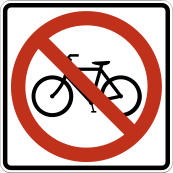
- Bicycles must yield ahead
- A bicycle lane starts here
- Drivers must share the lane
- Bicycles are not allowed here
Show answer
Bicycles are not allowed here. Some Arkansas regulation signs place a red circle with a red slash over a symbol. The slash over the bicycle symbol bars bicycles from that place. It does not ask riders to yield, and it does not mark the start of a bicycle lane, which would welcome riders instead of banning them. Sharing the lane is also the opposite of a ban. Read any symbol under a red slash as a ban on whatever the symbol shows.
Study this in the handbook: Stop, Yield and Regulation Signs
13. In Arkansas, why should you give parked vehicles as much room as possible along the side of the road?
- Parked vehicles always have the right to pull out without looking
- It is only needed when parking meters are present
- It lets you pass other moving traffic more quickly
- A person may get out of a car or walk out from between parked cars
Show answer
A person may get out of a car or walk out from between parked cars. Parked cars hide people until the last moment, especially children and passengers opening doors on the traffic side. A driver who hugs that line has almost no room when someone steps into view. Moving over a bit, when lawful and safe, creates a buffer without a sharp swerve. Scanning mirrors, door handles, and gaps between bumpers can hint that someone is about to emerge. Calm speed near a row of parked cars keeps surprises manageable.
Study this in the handbook: Speed Limits and Road Conditions
14. Before turning right in Arkansas, what must you check for?
- Vehicles behind you, parked cars ahead, and traffic to the right
- Traffic from the left, turning traffic, and people crossing ahead
- Trucks behind you on the right with riders waiting near the corner
- Traffic from the right, drivers behind you, and cars already parked
Show answer
Traffic from the left, turning traffic, and people crossing ahead. A right turn crosses several paths at once, so the check has to cover each one. Traffic from the left reaches the intersection first, oncoming vehicles may turn left across the turn path, and people may be crossing where the vehicle will turn. Looking only behind, only to the right, or only at large vehicles leaves one of those paths unchecked. Complete each part of the scan and begin the turn after the left, oncoming, and crossing paths are clear.
Study this in the handbook: Stopping Distance and Following
15. You look straight ahead as you drive, but a hazard may appear beside you. How should you watch those side areas?
- Stare at the area beside you for a few seconds
- Turn your head toward the side for a long look
- Use your side mirrors and glance to the side
- Ignore the sides until a car moves into view
Show answer
Use your side mirrors and glance to the side. The guide explains that peripheral vision is the field of vision from the corner of your eye, which lets you spot vehicles and other trouble on either side while you look ahead. Because you cannot focus on things to the side, the guide says to use your side mirrors and glance to the side. A long stare or turn of the head takes your eyes off the road ahead.
16. It is evening and the sun went down a half hour ago. When does the Arkansas guide say your headlights should be on?
- Only when it is fully dark outside and you cannot see
- From 30 minutes after sunset until 30 minutes before sunrise
- Only on roads that have no street lights at all
- Only when other cars on the road have theirs on too
Show answer
From 30 minutes after sunset until 30 minutes before sunrise. The guide says to turn on your headlights a half hour, or 30 minutes, after sunset and a half hour before sunrise, or any time you cannot see a person or object clearly within 500 feet. Headlights help you see at night and help others see you. Waiting for full darkness, for a road without lights, or for other cars to turn theirs on leaves you hard to see.
Study this in the handbook: Headlights, Horn and Signals
17. A flagger in an Arkansas work zone holds up a STOP paddle while the nearby signal shows green. What should you do?
- Go on the green light and slow down as you pass
- Go if the cars ahead of you are already moving
- Stop only if the flagger blows a whistle as well
- Stop and obey the flagger
Show answer
Stop and obey the flagger. The guide says to always obey the flagger's signals or signs, such as a STOP/SLOW paddle, and that the flagger's instructions overrule any other traffic signals or devices. A green light does not outrank a flagger in a work zone. Flaggers are legally authorized to direct traffic there and manage its flow through temporary conditions, so a raised STOP paddle means you stop at the designated place and wait for directions.
Study this in the handbook: Work Zones
18. What is the main purpose of Arkansas Move Over laws?
- Give roadside workers extra space to do their jobs safely
- To let traffic pass stopped vehicles at much higher speed today
- To create a parking lane along every state highway now
- To replace work zone speed limits statewide
Show answer
Give roadside workers extra space to do their jobs safely. Move Over laws in Arkansas exist to open a safety buffer around people working beside traffic on the shoulder. Emergency responders, construction crews, utility workers, and tow truck operators all gain room to work without traffic brushing past their vehicles. Passing faster shrinks that buffer instead of growing it for them. The laws create no parking lane and cancel no speed limit on any road. When flashing lights appear ahead, change lanes early when possible or slow down and give the roadside scene every inch you can spare.
Study this in the handbook: Emergency Vehicles and the Move Over Law
19. A lane will close ahead in an Arkansas work zone. When should you merge into the open lane?
- At the last moment, right beside the closure, to keep your place
- As soon as it is safe, ideally a mile or more early
- Only after you pass the first warning sign
- Only when the cars ahead have all moved over
Show answer
As soon as it is safe, ideally a mile or more early. The guide's advice for entering a work zone includes merging early. If you see lane closures ahead, change to the correct lane as soon as it is safe to do so, ideally a mile or more before the closure. Merging early gives you and the cars around you time to find a gap, and avoids sudden moves at the closure itself. Waiting until the last moment forces others to brake hard and leaves little room for error.
Study this in the handbook: Work Zones
20. You are leaving a high-speed two-lane road with traffic close behind you. How should you slow down?
- Tap the brakes and slow safely without slowing too soon
- Slow down well early so the followers have plenty of time to react
- Brake hard just before the turn to save distance
- Stop on the road and wait for the others to pass
Show answer
Tap the brakes and slow safely without slowing too soon. The guide says that on a high-speed two-lane roadway you should try not to slow down too soon if traffic is following you. Tap your brakes and safely reduce your speed, and use your turn signal to show your intentions. Slowing too early or too hard can surprise the driver behind you and lead to a rear-end crash, so the slowdown should be gradual and signaled.
Study this in the handbook: Speed Limits and Road Conditions
Every question is written from the official Arkansas Driver License Study Guide. Need paper? Printable AR practice test with answer key.
Last verified 2026-10-05. How we check every question · Study all 500 as flashcards
Frequently asked questions
How many questions are on this Arkansas practice test?
This fixed set has 20 questions. It is test 15 of 25 from the 500 question Arkansas bank.
How does this fixed test relate to the full Arkansas bank?
Each numbered test is a fixed set of questions in a fixed order, so you can retake the same test later and compare. Every test mixes road signs and the other topics in about the same proportion as the full bank. Tests 1 to 25 together cover every question in the Arkansas bank once. The full practice page mixes the whole bank at random.
Last verified 2026-10-05. See the Arkansas DMV facts page for sourced state details.
Return to the full Arkansas practice test · Study road signs