
Test 3 of 10 · 20 questions · Free 2026
AR Permit Practice Test 3
Jump to the test ↓A fixed 20 question set from the Arkansas bank with answers and plain English explanations.
Question 1 of 20 · 0 right so far
All 20 questions in test 3
Every question below comes from the Arkansas question bank on this page. Open a question to see the correct answer and the explanation. Nothing here is hidden behind a signup.
1. What license penalty can a court order for violating Arkansas's law on moving over for a stopped police vehicle?
- A warning only
- Suspension of the license for up to six months
- A permanent revocation
- A one year mandatory revocation
Show answer
Suspension of the license for up to six months. A driver found guilty of failing to move over for a stopped law enforcement vehicle with its lights on can be fined, jailed, or both, and the court may order community service or suspend the license for up to six months. A warning understates it, and the guide lists no permanent or mandatory one year revocation. On a multilane highway you must move to the farthest lane whenever possible, or slow to a safe speed if you cannot.
Study this in the handbook: Emergency Vehicles and the Move Over Law
2. Who must ride with a 15 year old driving on an Arkansas Learner's License?
- No one, once the license is issued
- A licensed driver at least 21 years old
- Any licensed driver 16 or older
- A parent, even if unlicensed
Show answer
A licensed driver at least 21 years old. A Learner's License holder must be accompanied by a licensed driver who is at least 21, and all passengers must wear seat belts. The license is for drivers 14 to 16 and stays restricted until the 16th birthday and six months of restricted driving are both complete, so driving alone is not allowed. A 16 year old licensee or an unlicensed parent does not meet the rule. Phone use, talking or texting, is banned except in an emergency.
Study this in the handbook: Instruction Permits and Graduated Licenses
3. What restraint is required for an Arkansas child younger than six who weighs less than 60 pounds?
- A properly secured child passenger safety seat
- A lap belt without any child seat
- An adult shoulder belt only
- No restraint when seated in the rear
Show answer
A properly secured child passenger safety seat. Arkansas requires this child to ride in a child passenger safety seat that is properly secured to the vehicle. A lap belt or adult shoulder belt alone does not satisfy the specified child-seat requirement, and rear-seat location does not remove the duty to restrain the passenger. The age and weight conditions work together: under six and under sixty pounds triggers this rule. Also remember that children under fifteen must use appropriate restraints while the vehicle is moving.
Study this in the handbook: Seat Belts, Child Seats and Littering
4. When must a driver stop for a school bus displaying flashing red lights in Arkansas?
- Only when traveling behind the bus in the same lane
- Only when the bus is stopped at a marked school zone
- Only when a crossing guard is visible
- Whenever approaching the bus, unless an opposite lane is separated by a median at least 20 feet wide
Show answer
Whenever approaching the bus, unless an opposite lane is separated by a median at least 20 feet wide. A stopped bus with flashing red lights requires a complete stop regardless of whether the driver is behind it, opposite it, or approaching an intersection. The narrow exception applies when the opposite lane is separated by a median twenty feet or more wide. A marked school zone and a crossing guard are not prerequisites. The same-lane answer misses the broad rule, so identify the median width before deciding whether the opposite direction is exempt.
Study this in the handbook: Stopping for School Buses
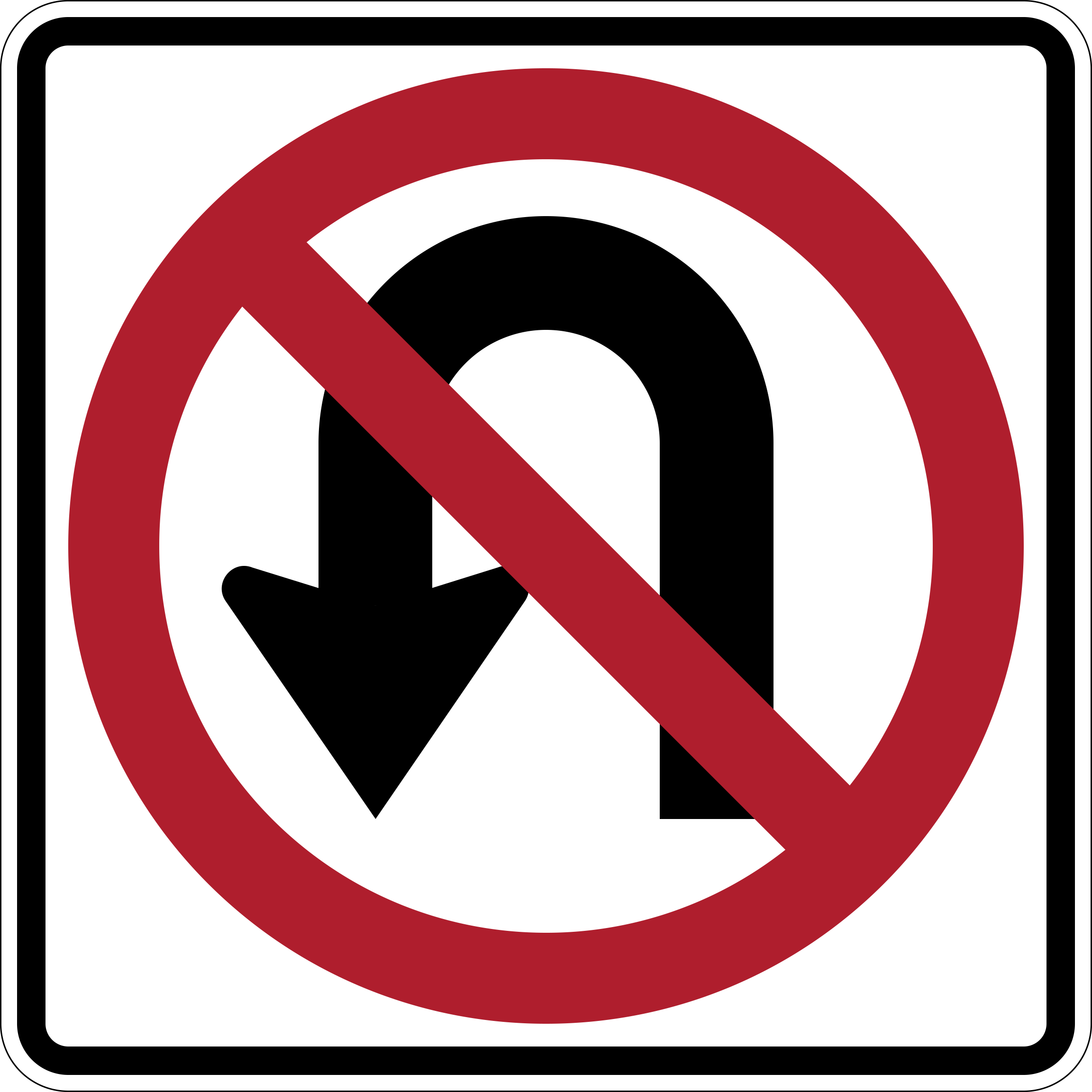
5. What maneuver is prohibited by the red slash over the U-shaped arrow?
- Turning right at the intersection
- Making a U-turn
- Passing a slower vehicle
- Proceeding straight through the roadway
Show answer
Making a U-turn. The U-shaped arrow identifies a reversal of direction, and the red slash marks that maneuver as prohibited. Do not turn across the roadway to head back the way you came at the signed location. The right-turn and straight-through options describe different movements, while passing is a lane-use decision rather than a reversal. When the sign appears, continue in the permitted direction and use a different location where turning around is legal and safe.
Study this in the handbook: Stop, Yield and Regulation Signs
6. When a vehicle starts to skid, where should the driver steer?
- Anywhere while holding the wheel rigidly
- Directly opposite the desired path
- Toward the nearest parked vehicle
- In the direction the driver wants the vehicle to go
Show answer
In the direction the driver wants the vehicle to go. The first steering goal in a skid is to guide the vehicle toward the path the driver wants to follow. As the vehicle begins to straighten, make measured corrections rather than one sharp reversal. The opposite-direction choice can create a second loss of control, and aiming toward a parked vehicle adds a collision risk. Holding the wheel rigidly prevents the small adjustments needed to recover. Look toward the safe path, keep movements smooth, and stay focused on regaining control instead of reacting with a hard, sudden turn.
Study this in the handbook: Vehicle Emergencies and Crashes
7. What is required before an Arkansas applicant receives an instruction permit?
- Six months of supervised driving
- A passed road test only
- A passed knowledge exam and vision test
- A non-restricted Class D license
Show answer
A passed knowledge exam and vision test. The instruction permit follows successful completion of both the knowledge exam and the vision test. A road test is not the only prerequisite described here, and the applicant does not first need six months of driving or a Class D license. The permit exists to support supervised practice, so the exam and vision requirements come before that practice begins. Treat both tests as required parts of the application.
Study this in the handbook: Instruction Permits and Graduated Licenses
8. After an Arkansas Learner's License is issued, which combined condition ends its restriction?
- The holder turns 16 and completes six months of restricted driving
- The holder turns 15 and completes three months of restricted driving
- The holder turns 17 and completes one year of unrestricted driving
- The holder passes a second skills test at age 16
Show answer
The holder turns 16 and completes six months of restricted driving. Arkansas keeps this license restricted until both milestones have been met: the driver reaches the sixteenth birthday and finishes six months of restricted driving. Either event by itself is insufficient, so a birthday does not automatically remove the limitation when the driving period is incomplete. The three-month option shortens the supervised learning period without support, while waiting for seventeen adds a requirement the state does not impose. A useful memory cue is to pair the birthday with the six-month calendar period whenever this license stage appears.
Study this in the handbook: Instruction Permits and Graduated Licenses
9. What must a driver do when passing an authorized vehicle stopped beside the roadway with its lights turned on?
- Stop beside the authorized vehicle until its lights are turned off
- Move to the farthest lane or position away from the authorized vehicle when possible
- Pass in the lane closest to the vehicle to reduce travel distance
- Use the shoulder and maintain the posted speed
Show answer
Move to the farthest lane or position away from the authorized vehicle when possible. Arkansas requires a passing driver to create the greatest available separation from an authorized vehicle stopped on the side of the road. On a multilane road, that normally means moving to the farthest lane. The choice “Stop beside the authorized vehicle until its lights are turned off” turns a passing rule into an unnecessary stop, while the choice “Pass in the lane closest to the vehicle to reduce travel distance” places traffic beside the roadside activity. Using the shoulder is not the prescribed response and may create another hazard. Look for emergency, utility, towing, or highway vehicles with lights on, then change position early if the adjacent lane is clear.
10. What must a driver do before leaving a vehicle unattended on a hill in Arkansas?
- Leave the engine running
- Turn on the hazard lights only
- Leave the wheels straight
- Set the parking brake and turn the wheels to the curb or side of the road
Show answer
Set the parking brake and turn the wheels to the curb or side of the road. Arkansas law says no driver will leave a vehicle unattended on a distinct grade without first setting the parking brake and turning the wheels to the curb or side of the highway. Leaving the engine running or relying on hazard lights does not stop a rolling car, and straight wheels give no protection if the brake fails. Turning the wheels toward the curb or roadside keeps a rolling car away from traffic.
Study this in the handbook: Parking Rules and Accessible Parking
11. At night, about how far ahead do headlights allow a driver to see?
- About 400 feet
- About 100 feet
- About 200 feet
- About 800 feet
Show answer
About 400 feet. The Arkansas guide estimates that headlights let a driver see about 400 feet ahead at night. That distance should shape speed: drive slowly enough to stop within the area illuminated by the headlights. Choosing 100 or 200 feet understates the guide's figure, while 800 feet suggests visibility that ordinary headlights do not provide. Darkness makes objects harder to see, so scan beyond the immediate lane and avoid outrunning the light. Treat the illuminated distance as a stopping boundary, especially when an unexpected object could appear in the roadway.
Study this in the handbook: Speed Limits and Road Conditions
12. How quickly does alcohol in the bloodstream reach the brain, according to the Arkansas guide?
- Only after several drinks
- Instantly
- After about 3 hours
- In 15 to 40 minutes
Show answer
In 15 to 40 minutes. Alcohol is absorbed into the blood and reaches the brain in 15 to 40 minutes. Once there it affects the areas that control judgment and skill, and judgment is the first driving ability to go, and by the time a drinker begins to feel the effects, judgment is already severely affected. The body rids itself of alcohol at about one drink per hour, and coffee, fresh air, exercise or a cold shower will not speed that up.
Study this in the handbook: Drinking and Driving
13. How much time and space does an Arkansas driver need to pass at 55 mph?
- About 3 seconds and 300 feet
- About 30 seconds and one mile
- About 10 seconds, needing a 10 second gap and over 1,600 feet of clear road
- About 1 second and 100 feet
Show answer
About 10 seconds, needing a 10 second gap and over 1,600 feet of clear road. At a speed of 55 mph you need about ten seconds to pass, which means a ten second gap in oncoming traffic and enough sight distance. Because you and the oncoming vehicle each cover about 800 feet in that time, you need over 1,600 feet, about a third of a mile, of clear road. Pass only one vehicle at a time and look ahead for anything that could enter your lane.
Study this in the handbook: Turns, Lane Changes and Passing
14. Which headlight setting is recommended in fog, snow, or heavy rain?
- Emergency flashers instead of headlights
- High beams
- Parking lights only
- Low beams
Show answer
Low beams. Low beams are recommended in fog, snow, or heavy rain because high beams can reflect from the moisture and create glare. That reflection makes the roadway harder to see, even though the higher lamps may seem brighter from the driver's seat. Parking lights do not provide the needed forward lighting, and emergency flashers are not a replacement for headlights while driving. Keep the low beams on, reduce speed when visibility is limited, and leave enough space to stop within the distance you can see. Brightness is not useful if it turns moisture into a visual screen.
Study this in the handbook: Headlights, Horn and Signals
15. What action is required at an Arkansas stop sign?
- Slow only if another vehicle is visible
- Make a complete stop and wait until the way is clear
- Stop after entering the intersection to improve visibility
- Yield only to vehicles approaching from the left
Show answer
Make a complete stop and wait until the way is clear. A stop sign requires the vehicle to come to a complete stop before proceeding. After stopping, the driver waits for crossing vehicles and pedestrians to clear, then moves only when the intersection is safe. Slowing without stopping fails to obey the sign even when no traffic is immediately visible. Stopping inside the intersection puts the vehicle in the path of other users, and the left-only option ignores traffic and pedestrians from other directions. Look for a painted stop line and halt before it when one is present. If the view is blocked, stop first, then ease forward only far enough to see safely.
Study this in the handbook: Traffic Lights and Arrows
16. How close to a hill or curve does the Arkansas guide say drivers should avoid passing?
- Within fifty feet whenever the center line is broken
- Within one tenth of a mile only at night
- Within one third of a mile
- Passing is allowed anywhere if the vehicle ahead signals
Show answer
Within one third of a mile. The guide says drivers should not pass when within one third of a mile of a hill or curve. A blocked view can hide an oncoming vehicle, so the driver should assume opposing traffic may be present and wait for a longer sight distance. A broken center line does not erase the visibility hazard, and a turn signal from the vehicle ahead does not make the pass safe. The distance is a planning cue: if the road rises or bends before that space is available, stay behind the vehicle and pass only after the view opens and markings allow it.
Study this in the handbook: Turns, Lane Changes and Passing
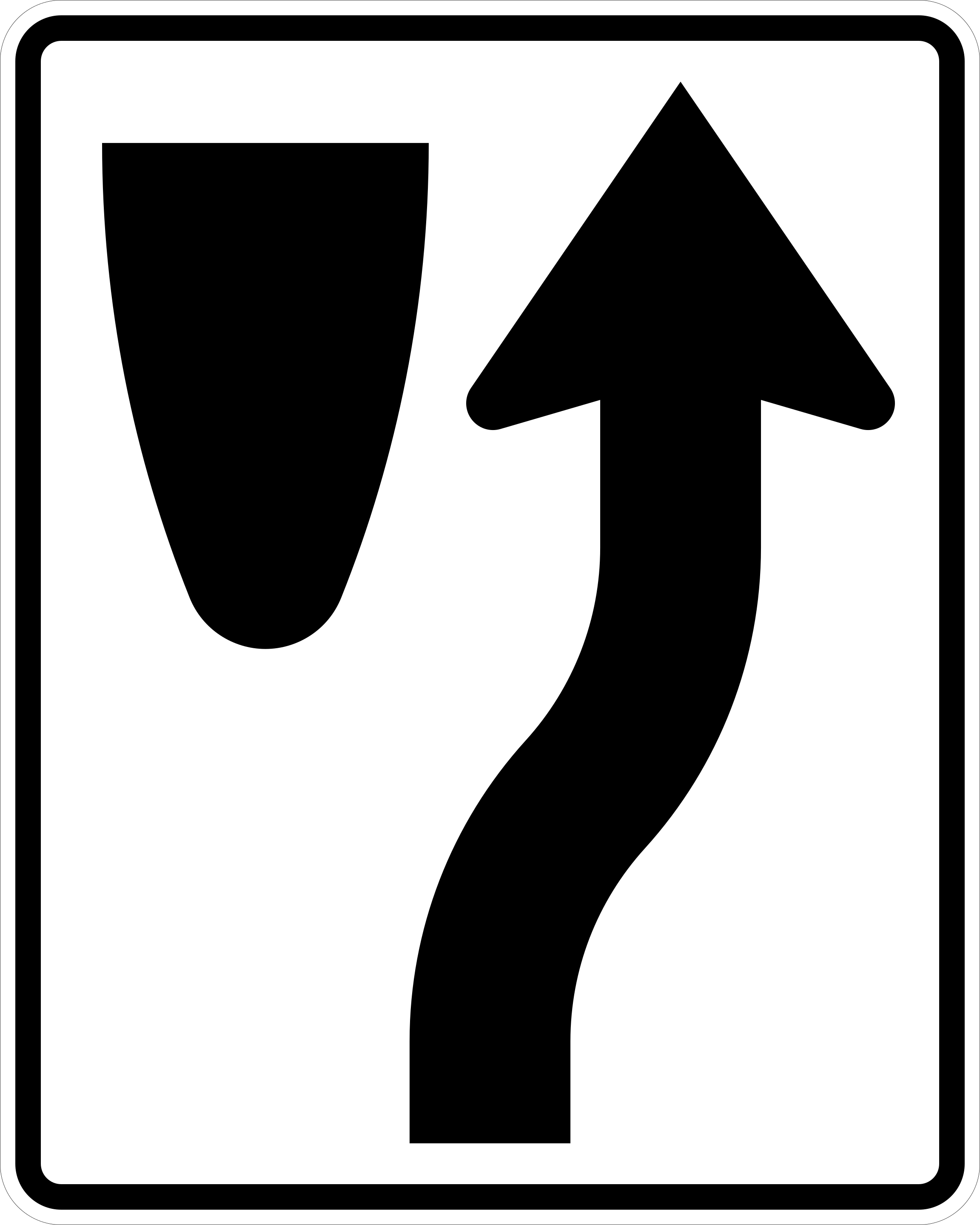
17. What type of roadway sign is the KEEP RIGHT sign?
- A destination guide sign
- A railroad crossing warning sign
- A speed limit sign
- A regulation sign
Show answer
A regulation sign. A KEEP RIGHT sign gives a traffic-direction instruction, so it belongs to the regulation-sign group. Regulation signs use a white square or rectangle with black or red letters or symbols and cover direction, lane use, turns, parking, and other special instructions. The railroad choice concerns a train hazard, while a speed limit sign controls a numerical driving limit. A destination guide sign identifies routes or places. The practical cue is the sign's command about where traffic must travel around an obstruction, not a warning about what hazard lies ahead.
Study this in the handbook: Stop, Yield and Regulation Signs
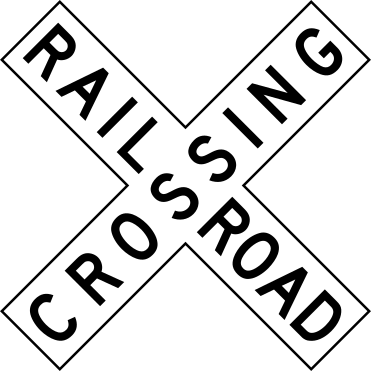
18. At a railroad crossing, what does the white X-shaped crossbuck require?
- Speed up so the vehicle clears the rails first
- Stop only when the crossing gate is fully raised
- Yield the right of way to the train
- Treat the tracks as a passing zone
Show answer
Yield the right of way to the train. A crossbuck marks the grade crossing and requires yielding the right of way to the train. Look and listen, obey any lights or gates, and never assume a vehicle can outrun an approaching train. Waiting only for a raised gate misses the crossbuck’s independent yield instruction. Speeding up creates a dangerous conflict, and railroad tracks are not a passing permission. The white X is the visual cue to give the train priority before entering the crossing.
Study this in the handbook: Warning and Railroad Crossing Signs
19. When may a driver cross a solid yellow line to turn into a driveway?
- Whenever the driver is traveling below the speed limit
- Whenever the driver wants to pass a slower vehicle
- When no opposing traffic is approaching the planned turn site
- When entering a lane used for parked vehicles
Show answer
When no opposing traffic is approaching the planned turn site. Arkansas allows a driver to cross a solid yellow line for a driveway turn only when no opposing traffic is approaching the planned turn site. The rule is a narrow exception to the double yellow passing prohibition, not a general license to pass. Traveling below the speed limit does not make passing lawful, and a parked-vehicle lane is not the stated purpose. Before turning, check the opposing lane and the driveway entrance, signal clearly, and cross only when that approach is clear.
Study this in the handbook: Pavement Markings and Lane Use
20. When turning left, what traffic must an Arkansas driver yield to?
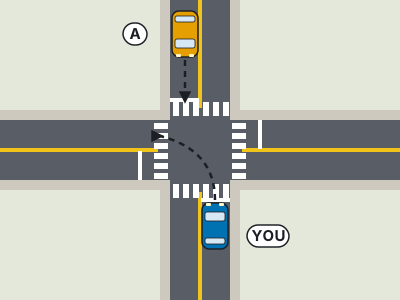
- Oncoming cars traveling straight ahead
- Only vehicles behind the turner
- No traffic because the turn signal gives priority
- Only bicycles traveling in the same direction
Show answer
Oncoming cars traveling straight ahead. A left turn crosses the path of vehicles coming toward the intersection, so the turning driver yields to oncoming cars traveling straight ahead. A signal communicates intention but does not transfer priority. Traffic behind the turner is not the central conflict described by this rule, and the bicycle-only option is too limited. Wait until the opposing lane is clear, then complete the turn without cutting the corner.
Study this in the handbook: Right of Way at Intersections
QualitySpace is expanding to Arkansas
We are a California-based independent insurance brokerage working on licensing in more states. We cannot help with Arkansas insurance yet. Leave your email and we will let you know when we can.
Every question is written from the official Arkansas Driver License Study Guide. Need paper? Printable AR practice test with answer key.
Last verified 2026-10-05. How we check every question · Study all 200 as flashcards
Frequently asked questions
How many questions are on this Arkansas practice test?
This fixed set has 20 questions. It is test 3 of 10 from the 200 question Arkansas bank.
How does this fixed test relate to the full Arkansas bank?
Each numbered test is a fixed set of questions in a fixed order, so you can retake the same test later and compare. Every test mixes road signs and the other topics in about the same proportion as the full bank. Tests 1 to 10 together cover every question in the Arkansas bank once. The full practice page mixes the whole bank at random.
Last verified 2026-10-05. See the Arkansas DMV facts page for sourced state details.
Return to the full Arkansas practice test · Study road signs