Every question below comes from the South Dakota question bank on this page. Open a question to see the correct answer and the explanation. Nothing here is hidden behind a signup.
1. After a crash involving an unattended parked vehicle, what must you do if you cannot find the owner?
- Drive away if the damage appears minor
- Leave identifying and crash information where the owner can find it
- Wait 24 hours before notifying anyone
- Move the parked vehicle before leaving a note
Show answer
Leave identifying and crash information where the owner can find it. If you damage unattended property and cannot locate the owner, South Dakota says to contact law enforcement and leave information where the Full explanation in Test 1
2. In which months does the South Dakota manual say to be especially alert for deer?
- October and November
- June and July
- January and February
- March and April
Show answer
October and November. The manual singles out October and November as the months to be especially alert for deer, because those are the months with the highest num Full explanation in Test 2
3. A South Dakota Instruction Permit holder under 16 is convicted of a first traffic violation. How long is the suspension?
- Seven days
- Until age 18
- A full year
- Thirty days
Show answer
Thirty days. For a minor under 16, a conviction for a traffic violation or a violation of the permit or license restrictions suspends driving privileges Full explanation in Test 3
4. How long does a new South Dakota resident have to register a vehicle brought in from another state?
- Within 30 days
- Within 60 days
- Within one year
- Within 90 days
Show answer
Within 90 days. All motor vehicles, motorcycles, and trailers owned by South Dakota residents and used on public highways must be registered with the County Full explanation in Test 4
5. You want to pass a slow-moving vehicle but are not sure there is enough space to complete the pass. What does the South Dakota manual advise?
- Pass on the right before it reaches the next driveway
- Honk steadily so the driver holds a straight path
- Wait until you are sure there is enough space
- Move beside it and check for a hand signal
Show answer
Wait until you are sure there is enough space. South Dakota tells drivers to wait when they are unsure there is enough room to pass. Full explanation in Test 5
6. Your vehicle has trouble and you must stop on a South Dakota highway. What should you try to do first?
- Get your vehicle off the road and away from traffic if possible
- Stop in the travel lane and wait for help
- Turn off all lights so other drivers are not distracted
- Stand near the center line to warn traffic
Show answer
Get your vehicle off the road and away from traffic if possible. South Dakota's breakdown guidance starts with getting the vehicle off the road and away from traffic when that is possible. Full explanation in Test 6
7. What color and shape are most South Dakota warning signs?
- White with black, red, or green letters and square shaped
- Blue with white lettering and square shaped
- Green or brown with white lettering and rectangular shaped
- Yellow with black lettering or symbols and diamond shaped
Show answer
Yellow with black lettering or symbols and diamond shaped. Most warning signs in South Dakota are yellow with black symbols or lettering and have a diamond shape. Full explanation in Test 7
8. A South Dakota Instruction Permit holder was convicted of a traffic violation four months ago. What does that block?
- Getting a Restricted Minor's Permit until six months pass without a conviction
- Only night driving
- Retaking the knowledge test
- Nothing, as long as the fine is paid
Show answer
Getting a Restricted Minor's Permit until six months pass without a conviction. To obtain a Restricted Minor's Permit, the applicant must be at least 14, complete the Instruction Permit requirements, pass the driving tes Full explanation in Test 8
9. A 19-year-old South Dakotan renews a license. When will a license issued to someone under 21 with five years or less until age 21 expire?
- On the 21st birthday
- 30 days after the 21st birthday
- Five years from issue no matter what
- On the 25th birthday
Show answer
30 days after the 21st birthday. Any South Dakota driver license or ID issued to someone under 21 with five years or less remaining until the 21st birthday expires 30 days a Full explanation in Test 9
10. If your wheels leave the paved road surface, how should you return?
- Steer sharply back onto the pavement at once
- Slow gradually when safe, then turn back onto the pavement
- Brake hard and stop in the travel lane
- Accelerate until all wheels are on the shoulder
Show answer
Slow gradually when safe, then turn back onto the pavement. For a pavement drop off, avoid panic steering. Slow down gradually when it is safe, regain control, and then turn back onto the pavement. Full explanation in Test 10
11. How should a driver respond to deer eyes reflecting beside the road?
- Speed up before more deer reach the pavement
- Swerve toward the shoulder to scare the deer away
- Slow down, blow the horn, and be ready to stop
- Dim all lights and coast past silently
Show answer
Slow down, blow the horn, and be ready to stop. If headlights reflect in deer eyes beside the road, slow down, blow the horn, and prepare to stop. Full explanation in Test 1
12. What does a red arrow signal mean?
- You may turn after yielding to pedestrians
- The arrow direction has priority over other lanes
- You may proceed if there is no oncoming traffic
- You must stop and may not go in the arrow's direction
Show answer
You must stop and may not go in the arrow's direction. A red arrow means stop, and you cannot move in the direction shown by the arrow until the signal changes. Full explanation in Test 2
13. For a second DWI in South Dakota, what minimum license loss does the manual list?
- At least 60 days
- At least 30 days
- At least one year
- Until the driver turns 21
Show answer
At least one year. A second DWI has a much tougher license consequence than a first DWI. Full explanation in Test 3
14. What maximum prison term does South Dakota list for a third DWI offense?
- Six months
- Life
- Up to ten years
- Up to two years
Show answer
Up to two years. A third DWI is a Class 6 felony punishable by a fine, imprisonment up to two years, and loss of the license for no less than one year after Full explanation in Test 4
15. A dashed yellow line is on your side of a two-direction roadway. What does it mean?
- Traffic in your direction may not cross it
- Passing is prohibited for both directions
- The lane is reserved for emergency vehicles
- Passing is permitted on your side when safe
Show answer
Passing is permitted on your side when safe. A dashed yellow line on your side marks a passing area, but only when the maneuver can be completed safely. Full explanation in Test 5
16. In a South Dakota funeral procession, which vehicle must obey traffic signs and signals?
- Only the hearse
- Only the first vehicle
- Every third vehicle
- Only vehicles without headlights on
Show answer
Only the first vehicle. South Dakota assigns the traffic-control duty to the first vehicle in a funeral procession. Full explanation in Test 6
17. Where should both hands usually be placed on the steering wheel for best control?
- At the 2 and 10 o'clock positions
- At the 3 and 9 o'clock positions
- Together at the bottom of the wheel
- One hand inside the rim and one on top
Show answer
At the 3 and 9 o'clock positions. South Dakota recommends both hands on opposite sides of the wheel at 3 and 9 o'clock. Full explanation in Test 7
18. What does a red circle with a red slash over a symbol tell you?
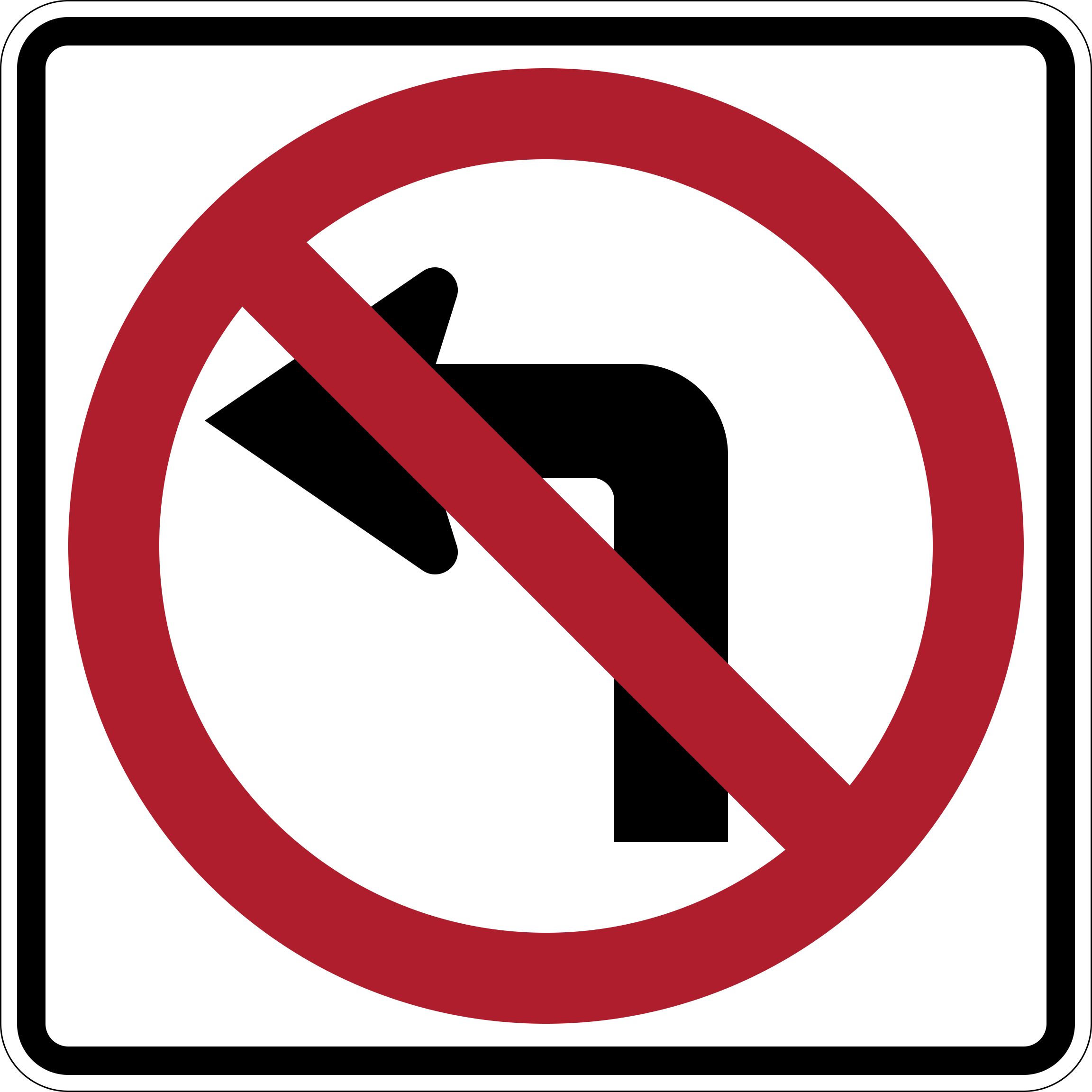
- The pictured action is recommended in heavy traffic
- The pictured action is prohibited by that sign
- The pictured action is allowed after a full stop
- The sign gives route information for services
Show answer
The pictured action is prohibited by that sign. South Dakota uses the red circle and slash on regulatory signs to show a banned movement, such as a no turn or no parking symbol. Full explanation in Test 8
19. What penalties can follow a South Dakota conviction for failing to maintain proof of financial responsibility (insurance)?
- A Class 2 misdemeanor plus a driver license suspension
- A $25 fine only
- A warning on the first offense
- Loss of license until age 21
Show answer
A Class 2 misdemeanor plus a driver license suspension. Failure to maintain proof of financial responsibility is a Class 2 misdemeanor in South Dakota, which can bring time in county jail, a fine, Full explanation in Test 9
20. A new South Dakota resident holds a valid out-of-state regular (non-commercial) license. How long does the driver have to apply for a South Dakota license?
- Within 30 days
- Within 60 days
- Within one year
- Within 90 days
Show answer
Within 90 days. Holders of a valid out-of-state non-commercial license must apply for a South Dakota license within 90 days of establishing residency. Full explanation in Test 10
21. At a flashing red traffic light, what action is required?
- Treat it like a yield sign and roll through if clear
- Stop only when pedestrians are in a marked crosswalk
- Proceed without stopping because cross traffic has yellow
- Come to a complete stop, then go when safe
Show answer
Come to a complete stop, then go when safe. A flashing red light has the same meaning as a stop sign. You must come to a complete stop and may proceed only when the way is safe. Full explanation in Test 1
22. When passing horseback riders or animal-drawn vehicles, what should you avoid?
- Avoid leaving extra space
- Avoid slowing before you pass
- Avoid using the horn or revving the engine
- Avoid looking for driveway turns
Show answer
Avoid using the horn or revving the engine. Horses can be frightened by sudden noise, so South Dakota tells drivers not to honk or rev the engine near animal-drawn vehicles or riders. Full explanation in Test 2
23. Under South Dakota implied consent, what have you agreed to when you get a driver license?
- Automatic guilt for any crash after drinking
- A search of your vehicle at every traffic stop
- A lawfully requested alcohol or drug content test when suspected of impaired driving
- A yearly medical exam by law enforcement
Show answer
A lawfully requested alcohol or drug content test when suspected of impaired driving. South Dakota describes implied consent as an agreement connected to licensing and driving: if an officer lawfully requests a test because im Full explanation in Test 3
24. What color are service signs that point to facilities such as rest areas, gas stations, or hospitals?
- Blue with white letters or symbols
- Orange with black construction symbols
- Yellow with black hazard symbols
- Brown with white route numbers
Show answer
Blue with white letters or symbols. Service signs are blue with white letters or symbols, and they guide drivers to facilities such as rest areas, gas, campgrounds, and hospita Full explanation in Test 4
25. What should you do when rain, snow, ice, or fog makes the posted maximum speed unsafe?
- Use the minimum speed sign as your target
- Drive exactly the posted maximum to avoid surprising others
- Reduce speed below the posted maximum
- Speed up until visibility improves
Show answer
Reduce speed below the posted maximum. A posted maximum assumes ideal driving conditions. Full explanation in Test 5
26. Which debt can cost a South Dakota driver the license?
- Any unpaid parking meter
- A credit card balance over $500
- Owing $1,000 or more to a South Dakota government agency
- A $100 library fine
Show answer
Owing $1,000 or more to a South Dakota government agency. The manual lists owing debt to a South Dakota government agency totaling $1,000 or more as a reason to lose the license, along with failing Full explanation in Test 6
27. A South Dakota driver under 21 is convicted of a second Zero Tolerance offense (BAC 0.02% or more). What license loss applies?
- A 180 day loss
- A 30 day loss
- A one year loss
- Loss until age 21
Show answer
A 180 day loss. Under Zero Tolerance, a first offense is a Class 2 misdemeanor with a fine and a 30-day loss of license. Full explanation in Test 7
28. What should a driver do during an enforcement stop to acknowledge the officer?
- Open the driver door while moving
- Flash high beams repeatedly
- Turn on the right turn signal
- Wave both hands out the window
Show answer
Turn on the right turn signal. During an enforcement stop, turn on your right turn signal to show the officer you recognize their presence and intend to yield. Full explanation in Test 8
29. What are shared center lanes reserved for?
- Passing slow traffic in either direction
- Driving straight during rush hour only
- Stopping for loading and unloading passengers
- Making left turns or permitted U-turns from either direction
Show answer
Making left turns or permitted U-turns from either direction. Shared center lanes are for left turns, and for U-turns only where U-turns are allowed, by traffic traveling in either direction. Full explanation in Test 9
30. How should you drive through a South Dakota work zone?
- Ignore work signs after you pass the first barrel
- Keep the normal limit because work areas are short
- Follow closely so no vehicle enters your lane
- Reduce speed, increase following distance, and watch for workers
Show answer
Reduce speed, increase following distance, and watch for workers. Work zones call for lower speed and more space because lanes can narrow, pavement may be rough, and workers or equipment may be near traffic Full explanation in Test 10
31. A South Dakota driver under 21 has a BAC of 0.03%. Which statement matches the manual?
- The driver is legal because BAC is below 0.08%
- The driver may be arrested for alcohol impairment under the underage rule
- The driver can only be cited for possession, not driving
- The driver is legal if no crash occurred
Show answer
The driver may be arrested for alcohol impairment under the underage rule. For drivers under 21, South Dakota allows arrest for alcohol impairment at 0.02%, so 0.03% is already over that underage threshold. Full explanation in Test 1
32. At a crash scene with wrecked vehicles, what should be done about ignition and smoking?
- Turn off ignitions and do not smoke around wrecked vehicles
- Keep engines running so emergency lights stay bright
- Smoke only if no flame is visible
- Restart damaged vehicles to move debris faster
Show answer
Turn off ignitions and do not smoke around wrecked vehicles. South Dakota warns that spilled fuel can make fire a real danger after a crash. Turning off ignitions and avoiding smoking lowers that risk. Full explanation in Test 2
33. If a posted minimum speed is too fast for your vehicle or conditions, what does the South Dakota manual advise?
- Ignore the minimum speed sign
- Stay in the left lane with hazard flashers
- Stop on the shoulder until traffic clears
- Use another road
Show answer
Use another road. Minimum speed signs are used so slow vehicles do not become hazards on high-speed roads. Full explanation in Test 3
34. Who may supervise a South Dakota Instruction Permit holder under 18?
- Only a licensed adult 25 or older
- Only a certified driving instructor
- Any licensed driver of any age
- A parent, legal guardian, or other adult with a valid license and at least one year of driving experience
Show answer
A parent, legal guardian, or other adult with a valid license and at least one year of driving experience. The supervising adult must be a parent or legal guardian, or another adult with a valid driver's license and at least one year of driving ex Full explanation in Test 4
35. What does the South Dakota manual say about assuming you have the right-of-way at an intersection?
- It always belongs to the vehicle that is moving faster
- The driver on the larger road always has it
- No one should assume they automatically have it; consider the situation and circumstances
- A driver who signals first has it
Show answer
No one should assume they automatically have it; consider the situation and circumstances. The yielding rules are a guide to who should give way, but the manual adds that no one should assume he or she automatically has the right-o Full explanation in Test 5
36. How does South Dakota classify a third DWI offense in the manual?
- Class 6 felony
- Class 2 misdemeanor
- Petty offense
- Civil insurance violation
Show answer
Class 6 felony. The third DWI listed in the manual is no longer treated as the same misdemeanor level as earlier offenses. Full explanation in Test 6
37. To cut South Dakota's required Instruction Permit holding time from 275 to 180 days, what driver education result is needed?
- Attendance at any one-day safety class
- Completing a course with a score of 80% or better on both written and driving portions
- Passing the DMV knowledge test twice
- 50 logged hours with a parent
Show answer
Completing a course with a score of 80% or better on both written and driving portions. Minors must hold the Instruction Permit continuously for 275 days, or 180 days with successful completion of an approved Department of Educa Full explanation in Test 7
38. Two vehicles approach an unsigned intersection at different times. Who should yield under South Dakota right-of-way guidance?
- The driver who arrives first
- The driver who arrives later
- The driver on the wider road every time
- The driver turning right from the cross street
Show answer
The driver who arrives later. At an intersection without a controlling signal or sign, arrival order matters. Full explanation in Test 8
39. When using ABS in an emergency stop, how should you press the brake pedal?
- Press as hard as you can and keep pressure applied
- Pump the brake pedal rapidly until the vibration stops
- Brake lightly and steer only after the vehicle stops
- Use the parking brake before touching the pedal
Show answer
Press as hard as you can and keep pressure applied. With ABS, press the brake pedal as hard as you can and keep steady pressure on it. Full explanation in Test 9
40. Why does the South Dakota manual say never to secure a child in the front passenger seat?
- Children cannot see out of the front windshield
- If the air bag deploys in a crash, the child could be severely injured
- Front seat belts do not fit children
- It is illegal for anyone under 21 to ride in front
Show answer
If the air bag deploys in a crash, the child could be severely injured. Small children should be secured in the rear seat, and the manual says never to secure a child in the front passenger seat, especially if th Full explanation in Test 10
