
Test 4 of 10 · 20 questions · Free 2026
SD Permit Practice Test 4
Jump to the test ↓A fixed 20 question set from the South Dakota bank with answers and plain English explanations.
Question 1 of 20 · 0 right so far
All 20 questions in test 4
Every question below comes from the South Dakota question bank on this page. Open a question to see the correct answer and the explanation. Nothing here is hidden behind a signup.
1. How long does a new South Dakota resident have to register a vehicle brought in from another state?
- Within 30 days
- Within 60 days
- Within one year
- Within 90 days
Show answer
Within 90 days. All motor vehicles, motorcycles, and trailers owned by South Dakota residents and used on public highways must be registered with the County Treasurer of the owner's county of residence, and a vehicle brought in from another state must be registered within 90 days. Thirty and sixty days are shorter than the rule, and one year is far longer. The 90 day figure matches the deadline for converting a non-commercial out-of-state license.
Study this in the handbook: Instruction and Restricted Minor's Permits
2. What maximum prison term does South Dakota list for a third DWI offense?
- Six months
- Life
- Up to ten years
- Up to two years
Show answer
Up to two years. A third DWI is a Class 6 felony punishable by a fine, imprisonment up to two years, and loss of the license for no less than one year after release. Driving without a license during that period brings at least ten days in county jail that may not be suspended. Six months is too short for the felony level, and ten years or life are far beyond the listed penalty.
Study this in the handbook: DWI and zero tolerance penalties
3. What color are service signs that point to facilities such as rest areas, gas stations, or hospitals?
- Blue with white letters or symbols
- Orange with black construction symbols
- Yellow with black hazard symbols
- Brown with white route numbers
Show answer
Blue with white letters or symbols. Service signs are blue with white letters or symbols, and they guide drivers to facilities such as rest areas, gas, campgrounds, and hospitals. Orange signs warn of work zones, so that choice confuses services with construction hazards. When you need fuel, medical services, or a rest stop, look for the blue rectangle or square rather than a warning color. The facility symbol then tells you which service is available.
Study this in the handbook: Warning, railroad and work zone signs
4. Who may supervise a South Dakota Instruction Permit holder under 18?
- Only a licensed adult 25 or older
- Only a certified driving instructor
- Any licensed driver of any age
- A parent, legal guardian, or other adult with a valid license and at least one year of driving experience
Show answer
A parent, legal guardian, or other adult with a valid license and at least one year of driving experience. The supervising adult must be a parent or legal guardian, or another adult with a valid driver's license and at least one year of driving experience, seated beside the permit holder. South Dakota does not set a 25 year minimum, and a driving instructor is not required. The one year of experience rule is why any licensed driver of any age is wrong. The supervised hours must total 50, including 10 in inclement weather and 10 after dark.
Study this in the handbook: Instruction and Restricted Minor's Permits
5. What two problems does the South Dakota manual link to worn tires?
- Engine overheating and poor fuel economy
- Brake fade and battery drain
- Hydroplaning and a greater chance of a flat tire
- Headlight misalignment and noise
Show answer
Hydroplaning and a greater chance of a flat tire. The vehicle check section warns that worn tires can cause hydroplaning and increase the chance of having a flat tire. Worn or bald tires also increase stopping distance and make turning more difficult when the road is wet, and unbalanced tires or a vehicle that pulls to one side should be checked by a mechanic. Engine, brake and lighting faults are separate maintenance items, not the tire warning the manual gives.
6. On a two-direction roadway, what does a double yellow center line mean?
- Drivers may pass when no crosswalk is marked
- Passing is permitted from either direction
- Only the left lane may pass
- Passing is prohibited in both directions
Show answer
Passing is prohibited in both directions. South Dakota's pavement marking chart says a double yellow line on a two-direction roadway means passing is prohibited in both directions. The either-direction choice reverses the rule and would invite drivers across the center line illegally. Use the pair of solid yellow lines as the cue to stay right of center and wait for a dashed line on your side before considering a pass.
Study this in the handbook: Pavement markings and signaling
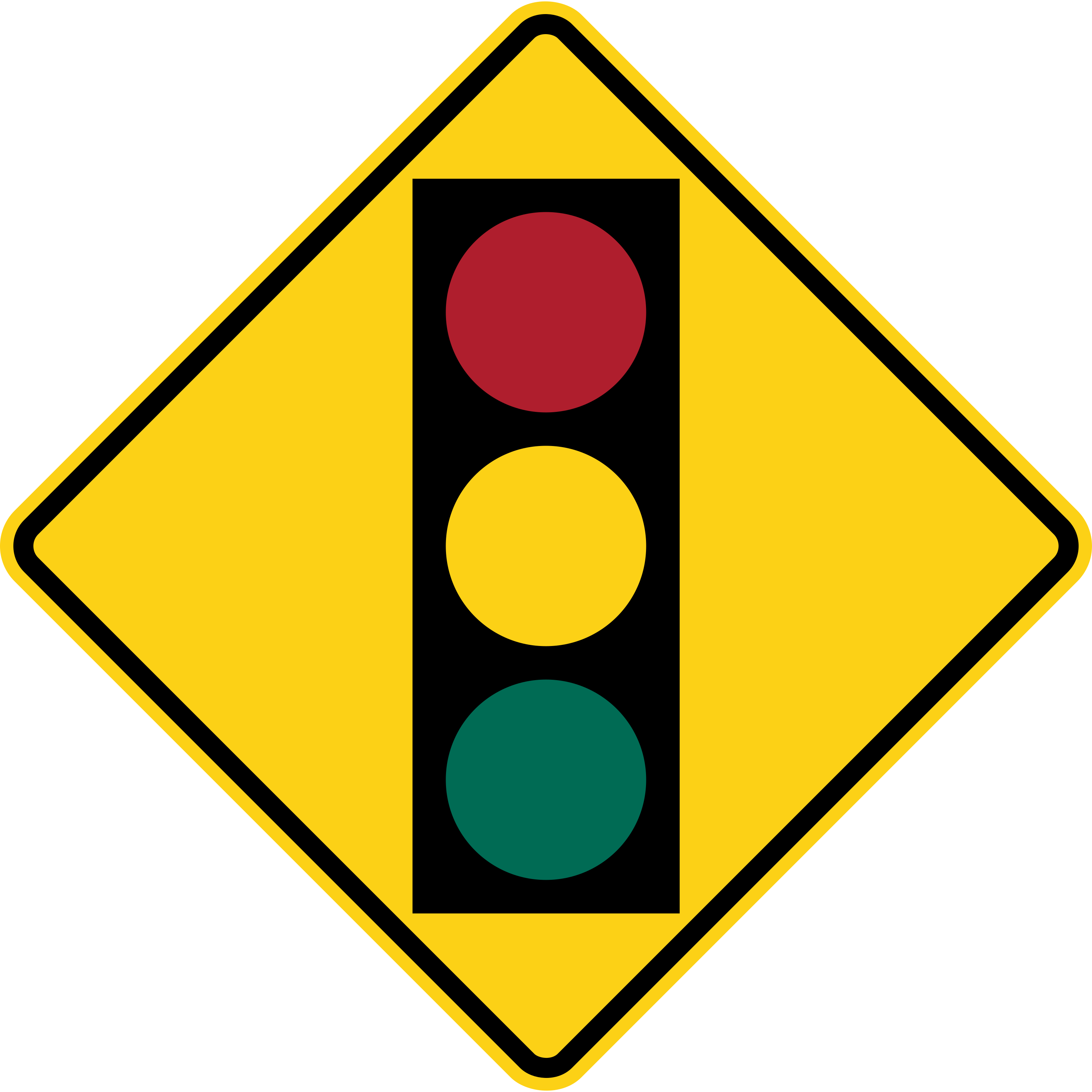
7. What does this signal-ahead warning sign tell you?
- All turns are prohibited
- The next intersection has no traffic controls
- A traffic signal is ahead
- The road becomes a divided highway
Show answer
A traffic signal is ahead. South Dakota's common warning signs include a Traffic Signal sign, so this symbol warns of a signal ahead. It is not saying the intersection has no controls; it is doing the opposite by preparing you for a light. Use the signal-head symbol as the cue to check your speed, watch for stopped traffic, and prepare for red, yellow, or green indications.
Study this in the handbook: Warning, railroad and work zone signs
8. What does this lane-ends warning sign mean?

- Passing is required on both shoulders
- One lane ahead ends or narrows
- The road becomes a one-way street
- A school bus stop is ahead
Show answer
One lane ahead ends or narrows. South Dakota includes Lane Ends in its common warning sign table. The one-way choice describes a regulatory direction sign, while this yellow warning gives advance notice that lane space will change. Use the taper or narrowing symbol as the cue to check mirrors, signal when needed, and merge early instead of waiting until pavement disappears. Like other warning signs, it alerts you to a special situation on the roadway ahead so you have time to prepare.
Study this in the handbook: Warning, railroad and work zone signs
9. What does this five-sided fluorescent yellow-green sign identify?

- A truck-only entrance ramp
- A hospital service route
- A school crossing area
- A no-passing zone
Show answer
A school crossing area. South Dakota notes that some warning signs may be fluorescent yellow, including school crossing signs, and its common warning list names School Crossing. The truck-only option is unrelated to the pentagon with walking figures. Use the shape and bright yellow-green color as the cue to slow, scan for children and crossing guards, and be prepared to stop before the crossing.
Study this in the handbook: Warning, railroad and work zone signs
10. A 15-year-old in South Dakota with no permit or license gets a traffic violation. What happens?
- Nothing, because the teen holds no license
- A like suspension to what a permit holder would receive
- A $25 fine only
- The teen's parents lose their licenses
Show answer
A like suspension to what a permit holder would receive. Anyone under 18 who receives a violation and does not have an Instruction Permit, Restricted Minor's Permit, or Operator License receives a like suspension to a permit holder. For a first violation under 16 that is thirty days, and a second offense means 180 days or until the 16th birthday, whichever is longer. Not holding a license does not protect the teen, and the rule does not reach the parents' licenses.
Study this in the handbook: Instruction and Restricted Minor's Permits
11. What is the penalty class for simply failing to move over or slow down for a stopped vehicle using amber, yellow, or blue warning lights in South Dakota (no crash)?
- A Class 2 misdemeanor, punishable by a fine and/or county jail
- A petty offense
- A Class 6 felony
- No penalty unless an officer is hurt
Show answer
A Class 2 misdemeanor, punishable by a fine and/or county jail. Violating South Dakota's stopped-vehicle law is a Class 2 misdemeanor punishable by a fine and/or time in county jail. If the violator causes a crash with the stopped vehicle, the charge rises to a Class 1 misdemeanor. It is not a petty offense or a felony, and no injury is required. The rule is to move to the far lane at least 300 feet before the vehicle on multilane roads, or slow to 20 mph under the limit on two lane roads.
12. How do worn or bald tires affect a vehicle on a wet South Dakota road, according to the manual?
- They improve grip because the tread is flatter
- They increase stopping distance and make turning more difficult
- They only affect fuel economy
- They have no effect until the road freezes
Show answer
They increase stopping distance and make turning more difficult. The manual's vehicle check warns that worn or bald tires can increase the stopping distance and make turning more difficult when the road is wet. Worn tires can also cause hydroplaning and increase the chance of having a flat tire. Unbalanced tires and low pressure cause faster tire wear and make the vehicle harder to steer or stop. Check the tread with a penny, and replace the tire if the tread does not come at least to Abe's head.
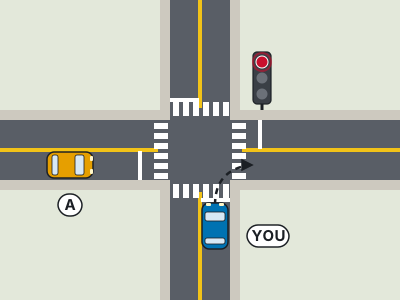
13. When may a driver turn right on a red light?
- Only when a green arrow appears
- Without stopping if the right lane is clear
- After stopping, when safe, unless a sign prohibits it
- Only from a one way street onto another one way street
Show answer
After stopping, when safe, unless a sign prohibits it. South Dakota allows a right turn on red after a complete stop when it is safe and no sign prohibits the turn. The driver must yield to traffic, pedestrians, bicyclists, and cars before proceeding. The without stopping choice misses the required full stop and yield. A practical cue is the red signal at a right turn: stop first, scan the crosswalk and lanes, check for No Turn on Red, then turn only if the path is open.
Study this in the handbook: Traffic signals and arrows
14. What should you do when an emergency vehicle approaches with flashing lights and sirens on?
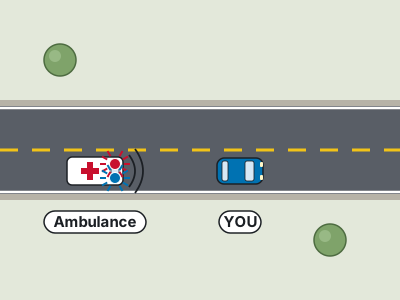
- Pull over to the edge of the road and avoid blocking intersections
- Stop immediately wherever your vehicle is located
- Follow the vehicle closely through traffic
- Move left and continue at the posted speed
Show answer
Pull over to the edge of the road and avoid blocking intersections. When an emergency vehicle uses flashing lights and sirens, yield by pulling over to the edge of the road so it can pass. Avoid blocking intersections because emergency drivers may need that space to maneuver. Stopping immediately wherever you are can block the route or trap the vehicle behind you. The cue is the combination of siren and flashing lights: signal your intent, move toward the edge, and leave intersections open.
Study this in the handbook: Crashes, emergency vehicles and traffic stops
15. South Dakota says a driver making a left turn must yield to which traffic?
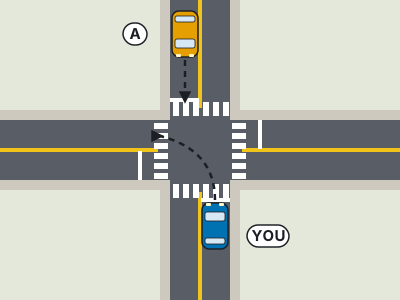
- Oncoming traffic
- Only parked vehicles on the right
- Traffic behind you in your lane
- Only vehicles with hazard flashers
Show answer
Oncoming traffic. South Dakota gives a simple left-turn rule: yield to oncoming traffic before turning across its path. Traffic behind you is important for signaling and braking, but it is not the traffic you cross during the turn. The cue is any approaching vehicle in the opposite lane that could reach the intersection while you turn. A safe left turn depends on the gap, not just on arriving first or having your signal activated.
Study this in the handbook: Turns, U turns and roundabouts
16. After a conviction for failing to maintain proof of financial responsibility, how long must SR22 proof be filed from the eligibility date?
- Until the next registration renewal only
- 30 days
- 6 months
- 3 years
Show answer
3 years. A no-proof conviction can bring a Class 2 misdemeanor, a license suspension, and an SR22 filing obligation. The filing lasts 3 years from the eligibility date, not just the 30-day minimum suspension period. The 30-day choice is attractive because the same penalty paragraph mentions a suspension of not less than 30 days, but that is separate from the insurance filing period. Keep the cue simple: suspension length can vary, while SR22 after this conviction is a 3-year filing requirement.
Study this in the handbook: License rules, insurance and the point system
17. You are leaving a private road and entering a South Dakota public highway. Who has priority?
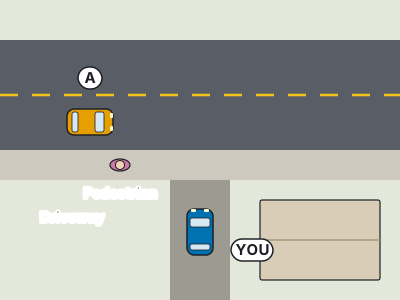
- Drivers already on the public highway
- The driver leaving the private road
- Only traffic approaching from the left
- Whichever vehicle is moving more slowly
Show answer
Drivers already on the public highway. Traffic already on the public highway has priority over a driver entering from a private road or driveway. The private-road driver is joining an established traffic stream and must wait for a safe opening. The left-side-only choice is too limited because the rule applies to drivers on the highway, not just one direction. Watch for the cue that your vehicle is coming from private property or a driveway; that is when you yield before entering.
Study this in the handbook: Right of way, funerals and intersections
18. According to the South Dakota manual, which driving sense is affected at 0.02% BAC?
- Vision
- Hearing
- Smell
- Balance only while walking
Show answer
Vision. The manual identifies vision as the key sense that can already be harmed at 0.02% BAC. That matters for judging distance, vehicle movement, and roadway hazards before a driver may feel obviously drunk. Hearing is a plausible distractor because horns and sirens are important, but the cited alcohol effect is visual, not auditory. On the road, use the cue that alcohol first steals the information you need to see lanes, gaps, pedestrians, and changing traffic clearly.
Study this in the handbook: Alcohol, zero tolerance and implied consent
19. At an intersection, how should a South Dakota driver treat right-of-way rules?
- Assume the listed driver may go first every time
- Use the rules as a guide, but judge the actual situation
- Enter first whenever no stop sign faces your lane
- Rely on other drivers to give extra space
Show answer
Use the rules as a guide, but judge the actual situation. Right-of-way rules tell drivers who should yield, but South Dakota warns against treating them as automatic permission to move. The option that says to assume a listed driver may go first ignores the manual's caution that conditions at the intersection still control. A practical cue is hesitation or movement from another road user; slow enough to yield or stop if that person enters your path.
Study this in the handbook: Right of way, funerals and intersections
20. In a South Dakota school zone with flashing lights or children present, what speed rule applies?
- Stop at every driveway
- Drive the regular limit unless a crossing guard is present
- Obey the slower speed limit
- Use the same speed as nearby traffic
Show answer
Obey the slower speed limit. The manual gives a direct school-zone instruction: when lights are flashing or children are present, obey the slower limit. Matching surrounding traffic is not enough if those drivers are failing to slow. The crossing-guard choice is incomplete because a guard can require stopping, but the speed duty exists when the lights flash or children are there. Use the cue of school-zone activity: flashing lights, children near the road, or a patrol signal mean your speed must drop.
Study this in the handbook: Controlling speed
QualitySpace is expanding to South Dakota
We are a California-based independent insurance brokerage working on licensing in more states. We cannot help with South Dakota insurance yet. Leave your email and we will let you know when we can.
Every question is written from the official South Dakota Driver License Manual. Need paper? Printable SD practice test with answer key.
Last verified 2026-10-05. How we check every question · Study all 202 as flashcards
Frequently asked questions
How many questions are on this South Dakota practice test?
This fixed set has 20 questions. It is test 4 of 10 from the 202 question South Dakota bank.
How does this fixed test relate to the full South Dakota bank?
Each numbered test is a fixed set of questions in a fixed order, so you can retake the same test later and compare. Every test mixes road signs and the other topics in about the same proportion as the full bank. Tests 1 to 10 together cover 200 of the 202 questions in the South Dakota bank, each once. The full practice page mixes the whole bank at random.
Last verified 2026-10-05. See the South Dakota DMV facts page for sourced state details.
Return to the full South Dakota practice test · Study road signs