
Test 11 of 25 · 20 questions · Free 2026
SD Permit Practice Test 11
Jump to the test ↓A fixed 20 question set from the South Dakota bank with answers and plain English explanations.
Question 1 of 20 · 0 right so far
All 20 questions in test 11
Every question below comes from the South Dakota question bank on this page. Open a question to see the correct answer and the explanation. Nothing here is hidden behind a signup.
1. You feel unwell but need to travel somewhere. What does the handbook advise?
- Drive yourself slowly with windows open
- Coffee or fresh air makes driving safe
- Delay medication until after the drive
- Let someone else drive when you are not feeling well
Show answer
Let someone else drive when you are not feeling well. Illness degrades the driver before it shows, so when you are not feeling well and must go, hand the trip to someone else. Slow self-driving still places a fevered, aching, distracted operator in traffic. Medication timing is a medical question, not a driving clearance. Caffeine cannot neutralize a virus, infection, or a bad cold. Even little problems like a stiff neck or a sore leg distort checking and control; respecting that early keeps a minor illness from authoring a major event.
Study this in the handbook: Vision, fatigue, distraction and aggressive driving
2. While backing into a parallel space, you have cleared the vehicle in the space ahead. What should you do next?
- Straighten the wheels and keep backing straight until you reach the curb line
- Turn the wheels sharply to the right, driving the rear toward the curb
- Stop, pull forward into the lane, and restart the whole maneuver
- Turn sharply left and back slowly toward the vehicle in the space behind
Show answer
Turn sharply left and back slowly toward the vehicle in the space behind. Clearing the front vehicle opens the swing. Turn the wheels sharply left and back slowly toward the vehicle now behind you, watching the sidewalk side and that rear vehicle as the nose sweeps in. Straight backing after this point leaves you angled out in the lane. A sharp right turn drives the rear toward the curb far too early and can strike it. Stopping to restart wastes a position you have already earned. Finish by turning right again to center the vehicle once the rear has tucked in.
3. What is the first move when beginning a three-point turnabout?
- Activate the left turn signal and turn across the road right away
- Back across both lanes immediately
- Check mirrors, activate the right turn signal, and pull off to the right side of the road
- Stop in the center of the roadway
Show answer
Check mirrors, activate the right turn signal, and pull off to the right side of the road. The sequence opens by clearing traffic from the equation: check mirrors, signal right, and stop on the right side of the road before any crossing movement begins. Signaling left and turning at once launches into oncoming lanes without that staging. Backing across lanes belongs to a later phase performed after checks in each direction. The road's center is the worst staging area available. Every stage of this turnabout alternates motion with a fresh traffic check, because the maneuver spends long seconds broadside to traffic that expects a clear road.
Study this in the handbook: Turns, U turns and roundabouts
4. With no immediate danger present, how should the horn generally be used to alert others?
- A long loud blast lasting several seconds each time
- The horn must never be used when no danger exists
- Repeated rapid honking until other drivers notice you
- A light tap on the horn should be all that is needed
Show answer
A light tap on the horn should be all that is needed. A light tap communicates presence without startling anyone when no emergency is unfolding, reserving the horn's shock value for real danger. Long blasts turn information into aggression at close range. Rapid repeated honking panics the very people you want thinking clearly. The horn does have lawful alerting uses short of danger, which is why the tap exists. Think of horn volume as vocabulary: a tap says I am here, a blast says stop now, and using the second sentence for the first message trains everyone to ignore both.
Study this in the handbook: Night, winter, deer and work zones
5. Which combination can cause a skid to begin?
- Driving slowly and carefully on smooth, dry pavement during light traffic hours
- Traveling too fast for conditions, stopping too suddenly, or tires losing grip
- Checking mirrors before braking firmly
- Using the parking brake while parked
Show answer
Traveling too fast for conditions, stopping too suddenly, or tires losing grip. Skids start when speed outruns conditions, when a stop is demanded too suddenly, or when tires simply can no longer grip the surface, and often two causes stack together. Slow travel on dry pavement is the safest state a vehicle can occupy. Mirror checks before firm braking are protective habits, not causes. A parking brake on a parked vehicle moves nothing at all. Read the trio as a warning system: pace, smoothness, and surface, and manage whichever one starts slipping before the tires announce it for you.
Study this in the handbook: Skids, brake failure and other vehicle emergencies
6. How much farther do high beams let you see compared with low beams?
- About the same distance
- Twice as far as low beams
- Four times as far as low beams
- Only ten feet farther ahead
Show answer
Twice as far as low beams. High beams reach about twice as far as low beams, doubling the preview you get on empty, unfamiliar, or people-lined roads at night. Equal distance would make the second setting pointless. Four times overstates the equipment and tempts overdriving the light you actually have. Ten feet is a parking lot margin, not a beam pattern. Use that doubled view wherever no oncoming traffic suffers for it, and remember the limit still exists: drive so a stop fits inside the lit distance, not beyond it.
Study this in the handbook: Night, winter, deer and work zones
7. How far can the blind spot directly behind a large truck extend?
- About 20 feet behind the trailer
- About 75 feet behind the trailer
- For 200 feet behind the truck
- It ends at the rear bumper
Show answer
For 200 feet behind the truck. The rear blind spot of a large truck can stretch two hundred feet, an entire zone where the driver may not be able to see a following car. Twenty or seventy five feet both shrink a hazard measured in dozens of car lengths. The bumper is where the blind area begins, not where it ends. If you cannot see the truck mirrors, assume you are invisible and either fall back until the road ahead opens or complete a pass decisively. Lingering in that long shadow means a sudden truck stop arrives with zero warning.
Study this in the handbook: Following distance, passing and large vehicles
8. At night, how should you search the road beyond your headlight beams?
- Stare fixedly at the bright center of the headlight beams on the pavement
- Search well ahead of the beams, looking for dark shapes on the roadway
- Watch only the lit pavement immediately ahead
- Keep your eyes on the dashboard glow
Show answer
Search well ahead of the beams, looking for dark shapes on the roadway. Night searching pushes past the bright pool, hunting dark shapes that announce pedestrians, animals, or debris before the beams fully reveal them. A fixed stare at beam center blinds your peripheral detection and still finds hazards late. Lit pavement alone ends where your stopping distance does not. Dashboard glow pulls attention inside the cabin and ruins dark adaptation. Graze the edges of the light, glance for the pavement boundaries, and slow until your speed matches the distance you can actually verify as clear.
Study this in the handbook: Following distance, passing and large vehicles
9. On a very cold night, why might a driver leave the parking brake off after parking?
- The brake could freeze in the on position
- Cold makes the parking brake stronger than needed
- Cold weather cancels the need to use park or gear
- The brake light would drain the battery overnight
Show answer
The brake could freeze in the on position. Cold weather creates a narrow exception because moisture can freeze the parking brake in the on position, leaving the vehicle stuck when you return. At such times you may leave the brake off, yet the vehicle still stays in the lowest gear or in park, so the exception never cancels the gear requirement. Cold does not make a brake stronger, and a brake light is not lit while parked. Picture frost on the cable: skip the brake for that night, but keep the transmission safeguard fully engaged.
Study this in the handbook: Pedestrians, bicyclists, motorcyclists and school buses
10. How much time does speeding typically save on an hour of driving?
- About fifteen minutes
- Only a few minutes
- Nearly half the trip
- No less than ten minutes
Show answer
Only a few minutes. The handbook makes a practical point about hurry: pushing above the limit does not buy much. It saves only a few minutes across an hour of travel, while the added risk of a crash or a ticket stays with you. Fifteen minutes, half the trip, or at least ten minutes all overstate the gain and make the speed seem more worthwhile than it is. If you are running late, leave earlier or accept the small difference. Watch the clock on a familiar route to see how little a faster pace changes your arrival time.
Study this in the handbook: Controlling speed
11. What does the BAC percentage actually measure in your body?
- The percentage of alcohol in relation to the amount of blood
- The number of drinks consumed per hour
- The percentage of liver capacity already used up by recent drinking
- The alcohol proof of the last drink taken
Show answer
The percentage of alcohol in relation to the amount of blood. BAC expresses alcohol as a percentage measured against the amount of blood in your body, so the same drinks produce different readings in different sized people. Counting drinks per hour ignores body mass, food, and time, which is why two drinkers at one table can test far apart. Liver capacity percentages play no role in the measurement. The proof of a final drink says what was in the glass, not what reached the bloodstream. Officers test the blood ratio, never your memory of the evening.
Study this in the handbook: Alcohol, zero tolerance and implied consent
12. An approaching driver has a turn signal flashing. Why should you not turn into that lane on the signal alone?
- Signals always mean the driver will turn immediately at your street
- The driver may pass you first or may have forgotten to cancel it
- Oncoming signals are only advisory for trucks
- A flashing signal legally transfers right-of-way to you
Show answer
The driver may pass you first or may have forgotten to cancel it. A blinking signal is a claim, not a guarantee: that driver may intend to turn beyond your position or may have left the signal running from an earlier turn. Treating it as proof of an immediate turn puts you in front of a vehicle still traveling straight. Signals apply to every vehicle class the same way, and no signal hands you legal priority. Wait for the wheels to actually commit to the turn, with speed dropping and the nose angling, before you claim the lane.
Study this in the handbook: Right of way, funerals and intersections
13. Why avoid high beams during a nighttime snowstorm?
- To prevent glare reflecting back during the storm
- High beams melt snow onto the windshield
- Snowstorms make high beam use illegal statewide
- Low beams drain less battery in cold
Show answer
To prevent glare reflecting back during the storm. Falling snow acts like a wall of mirrors, and high beams bounce their light straight back into your eyes as glare, so low beams serve better inside a night storm. Beams melt nothing; the problem is optical, not thermal. No statewide storm ban on high beams exists to cite. Battery economy does not drive headlight selection in weather. The same rule serves fog and hard rain: light aimed lower and shorter keeps the reflection below your sight line and the road readable.
Study this in the handbook: Night, winter, deer and work zones
14. What two driving abilities does fatigue degrade directly?
- Fatigue can affect vision and increase the time needed to make decisions.
- Fatigue can improve vision and shorten the time needed to make decisions.
- Fatigue can sharpen hearing and make steering more precise.
- Fatigue can increase alertness and shorten the time needed to make decisions.
Show answer
Fatigue can affect vision and increase the time needed to make decisions.. Fatigue affects vision and increases the time needed to make decisions. A tired driver may spot a hazard later and need longer to choose a response. Claims of better vision and faster decisions reverse both effects. Claims of sharper hearing and more precise steering substitute different abilities, while increased alertness and faster decisions also contradict the cited sentence. The practical warning is that tiredness can reduce what the driver sees and delay the decision that follows.
Study this in the handbook: Vision, fatigue, distraction and aggressive driving
15. You live in another state and visit South Dakota. At what youngest age may you drive here on your home state operator license?
- At age 14 with a valid home state license
- At age 15 with a valid home state license
- At age 16 with a valid home state license
- At age 18 with a valid home state license
Show answer
At age 16 with a valid home state license. Visitors may drive on a home state operator license once they reach 16, provided that license stays valid. Fourteen tempts younger visitors because South Dakota starts its own instruction permits at that age, yet a permit stage at home does not equal an operator license for visiting drivers. Fifteen still falls short of the stated floor, and eighteen waits two years longer than required. Check the home license before the trip and carry it on every drive.
Study this in the handbook: License rules, insurance and the point system
16. A steady yellow arrow appears for your lane. What is it telling you?
- The turn is now prohibited completely
- You may finish the turn at any speed
- Oncoming traffic must stop for you
- The green arrow protection is ending
Show answer
The green arrow protection is ending. A yellow arrow follows a green arrow to warn that protected turning time is running out. If you intend to turn that way, prepare to stop and give way to oncoming traffic before completing the movement. The idea that the turn is now prohibited goes too far, since the arrow still points in your direction and you may turn when it is safe. The claim that oncoming traffic must stop for you reverses the warning, because the protection is ending and those drivers will have a green light. Treat the color change as a deadline rather than a guarantee.
Study this in the handbook: Traffic signals and arrows
17. How does steering difficulty change while you are backing up?
- The vehicle becomes much harder to steer
- Steering becomes lighter than at highway speed
- Steering responds exactly as in forward driving
- Only large vehicles become harder to steer
Show answer
The vehicle becomes much harder to steer. A vehicle is much harder to steer in reverse, because the steering geometry now leads from behind and small wheel movements swing the rear quickly. The effort does not become lighter than highway travel; control simply behaves less intuitively. Handling does change from forward driving, growing less predictable rather than staying identical. Vehicle size does not confine that difficulty to large models alone. Back slowly, steer slightly toward where the rear should go, and keep looking behind until the stop, since the vehicle answers steering in a way that surprises drivers used to forward motion.
18. Which action with a driver license can cost you your South Dakota license?
- Laminating a worn license to keep it readable
- Carrying your license in a phone case wallet
- Altering your license or using someone else's license
- Replacing a license after a legal name change
Show answer
Altering your license or using someone else's license. Changing what a license says, or presenting a credential issued to another person, attacks the trust the whole licensing system rests on. Protective covers and phone wallets only change how the card is carried. A name change handled through replacement keeps the record honest. Keep the card exactly as issued, carry your own card only, and let the exam station print any correction you need.
Study this in the handbook: License rules, insurance and the point system
19. What does a crosswalk marking define on the roadway?
- A loading zone for delivery vehicles
- A bicycle storage area at the intersection
- The area where pedestrians may cross the roadway
- The place where city buses must discharge all of their passengers
Show answer
The area where pedestrians may cross the roadway. Crosswalk markings stake out the exact band where pedestrians may cross, which tells drivers where foot traffic should be expected and protected. Delivery loading happens at curbs and signed zones, not inside crossing bands. Bicycle storage boxes, where they exist, sit at signal waiting areas with their own markings. Buses discharge at stops along the curb, clear of the crossing path where possible. When your stop is required, halt before that band, since a vehicle nose inside it forces walkers into the traffic stream around you.
Study this in the handbook: Pavement markings and signaling
20. A black and white SPEED LIMIT sign tells you what?
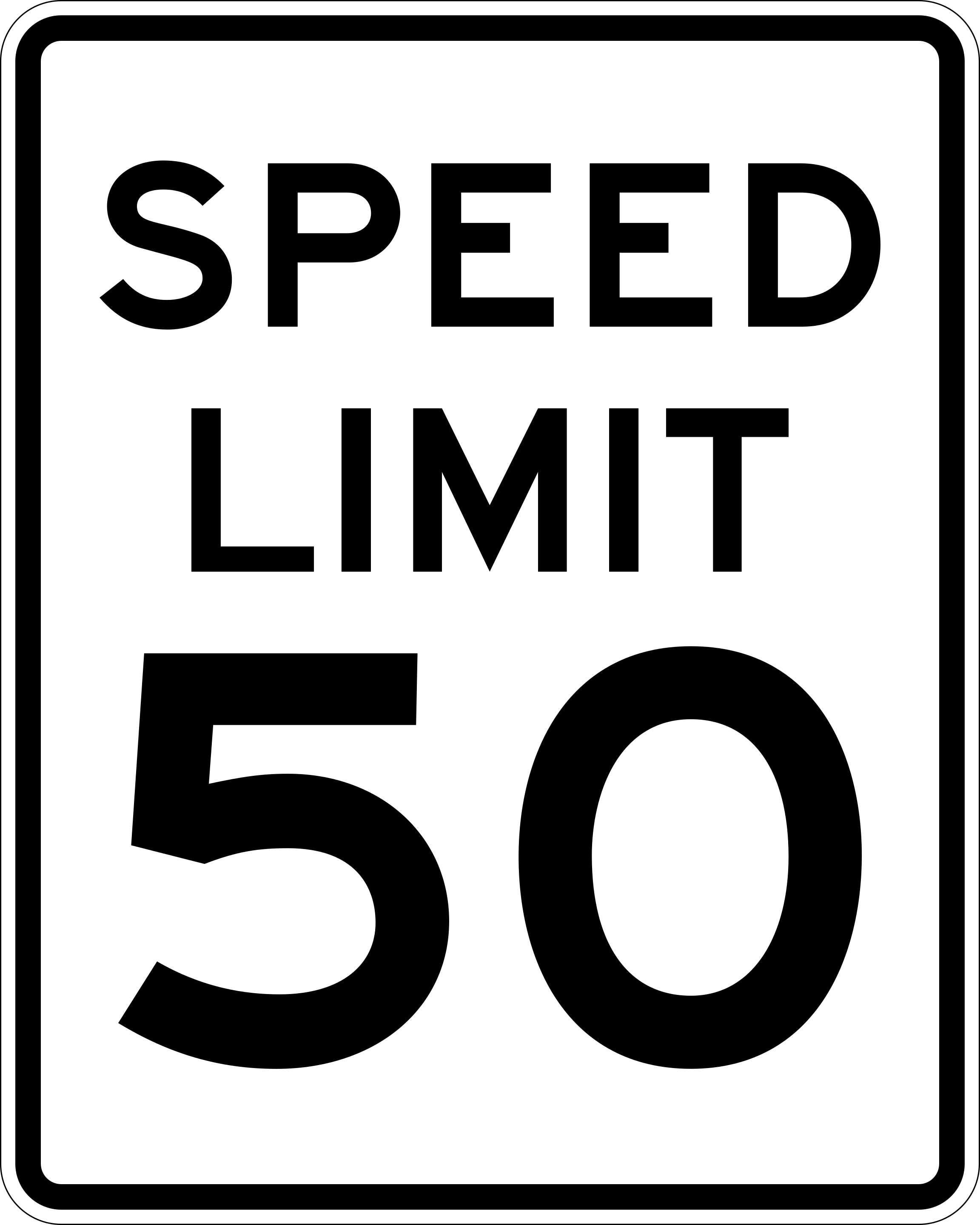
- The maximum safe speed allowed or minimum speed required
- The suggested speed for bad weather
- The speed only commercial traffic must use
- The advisory speed for the next curve
Show answer
The maximum safe speed allowed or minimum speed required. South Dakota says speed limit signs are black and white and show either a maximum safe speed or a required minimum speed. The advisory curve choice is different because advisory plates are warning information, not the posted speed limit rule. Your cue is the black text on a white regulatory sign; obey that number and reduce speed further when weather or road surface requires it.
Study this in the handbook: Regulatory, stop, yield and guide signs
Every question is written from the official South Dakota Driver License Manual. Need paper? Printable SD practice test with answer key.
Last verified 2026-10-05. How we check every question · Study all 500 as flashcards
Frequently asked questions
How many questions are on this South Dakota practice test?
This fixed set has 20 questions. It is test 11 of 25 from the 500 question South Dakota bank.
How does this fixed test relate to the full South Dakota bank?
Each numbered test is a fixed set of questions in a fixed order, so you can retake the same test later and compare. Every test mixes road signs and the other topics in about the same proportion as the full bank. Tests 1 to 25 together cover every question in the South Dakota bank once. The full practice page mixes the whole bank at random.
Last verified 2026-10-05. See the South Dakota DMV facts page for sourced state details.
Return to the full South Dakota practice test · Study road signs